Tag: MacBook Pro

  • Apple’s Product Launches: SoC Refreshes, No Major Design Changes

    Apple’s Product Launches: SoC Refreshes, No Major Design Changes

    Key Takeaways

    1. Apple’s upcoming “Experience” event will focus on MacBooks, with Tim Cook hinting at new releases.
    2. Three new MacBooks are expected: updated 14″ and 16″ MacBook Pro models, a refreshed MacBook Air, and a budget-friendly MacBook.
    3. Upcoming MacBooks and iPads will primarily receive new SoCs, with no significant upgrades beyond that.
    4. The high-end MacBook Pro series will transition to the M5 lineup, with potential for new configurations and larger GPUs.
    5. Current MacBook Pro pricing remains unchanged, suggesting users may want to wait for the next-generation models expected in eight months.


    Apple’s upcoming “Experience” event is set for next week, and numerous leaks and rumors have already given us a good sense of what may be revealed. Among the anticipated products is the iPhone 17e, but the low-cost MacBook seems to be the most intriguing offering for various reasons, both exciting and disappointing.

    Tim Cook’s Tease

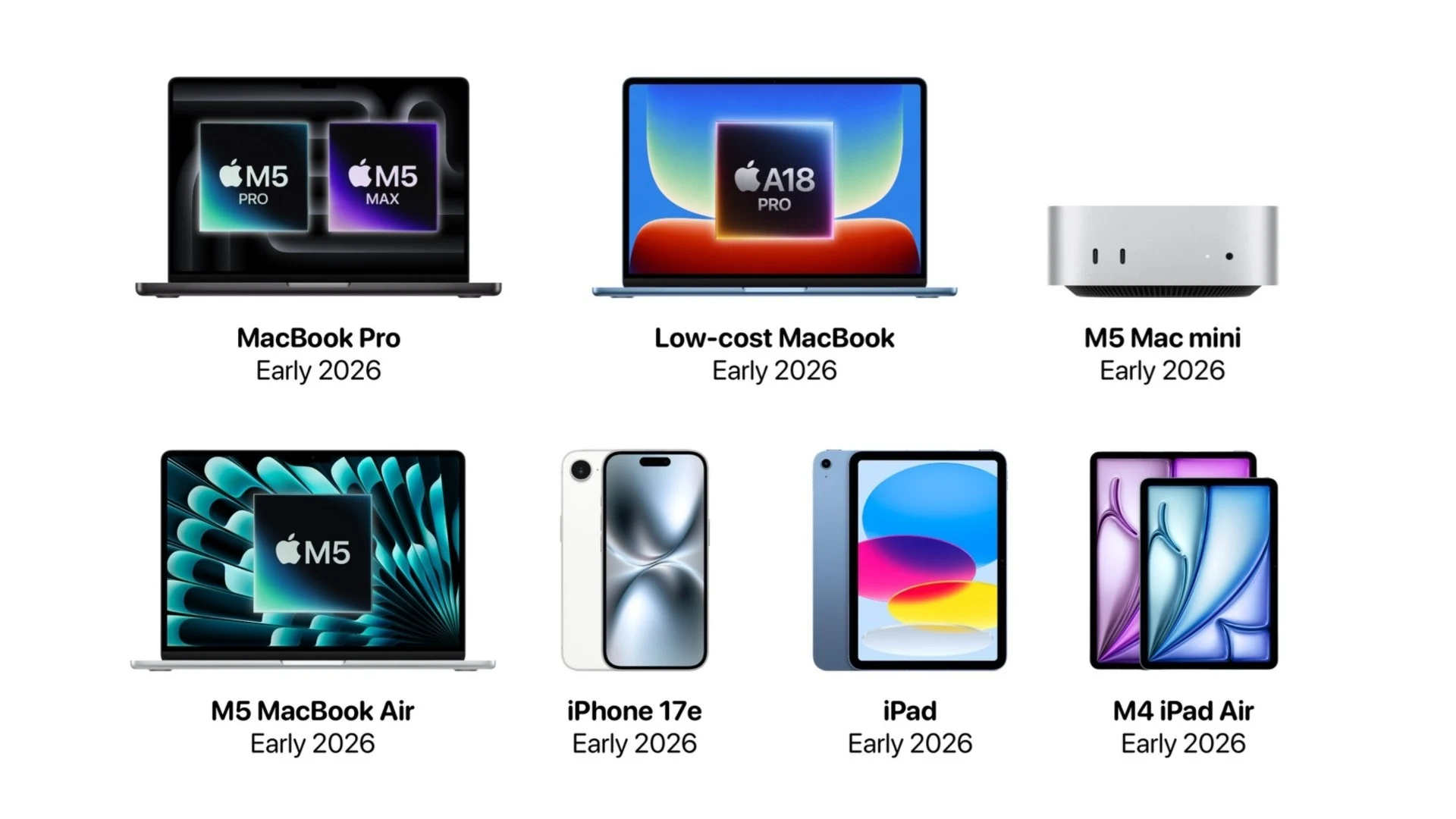
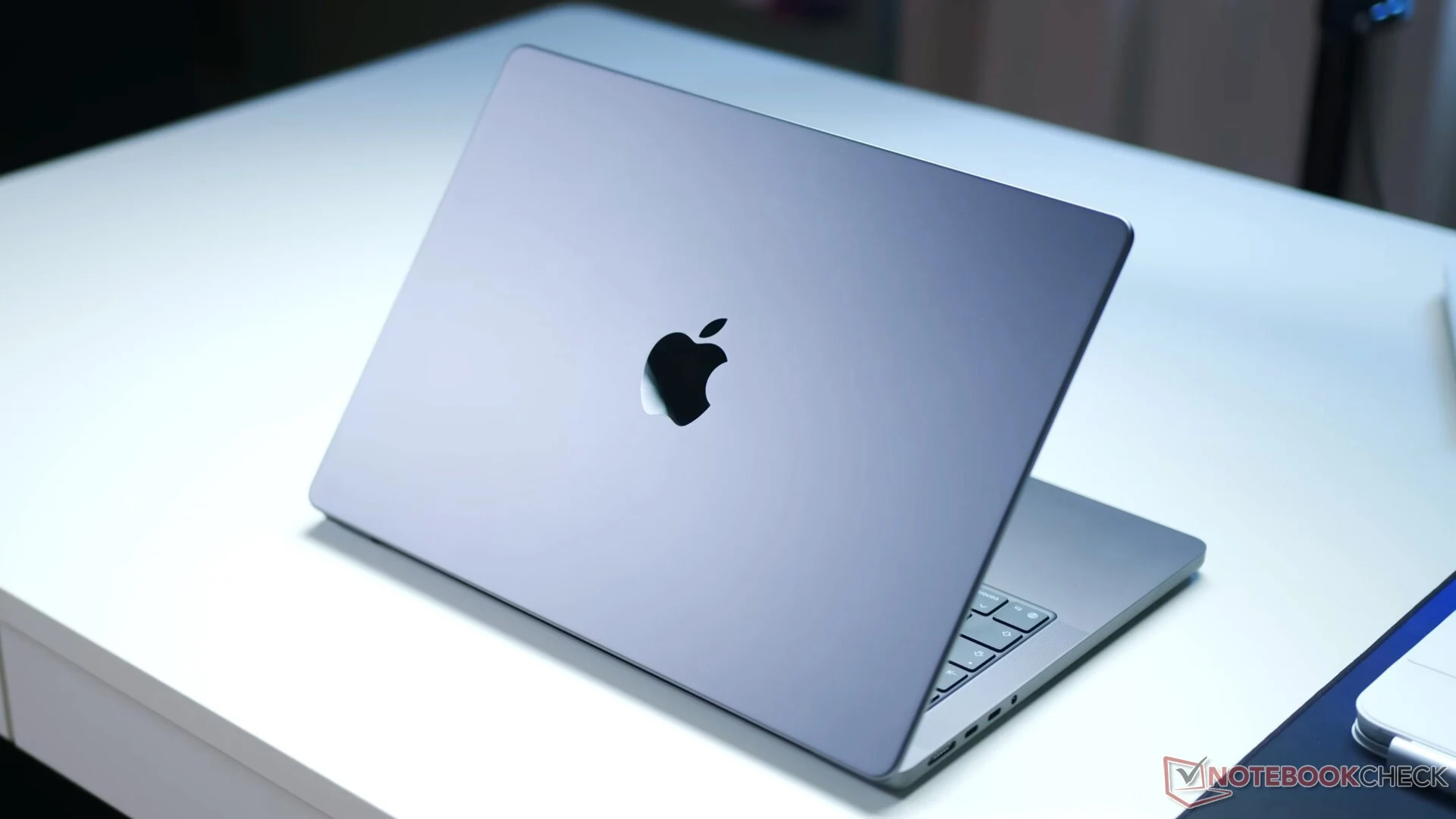
    Recently, Apple CEO Tim Cook took to X to share a tweet that hinted strongly at the event’s emphasis on MacBooks. The accompanying video shows Apple’s logo being “stamped” onto a MacBook’s shell, which features a slightly bluish-silver color. We can expect three new MacBooks to be announced next week: the updated 14″ and 16″ MacBook Pro models, a refreshed MacBook Air, and the new budget-friendly MacBook.

    Expectations vs. Reality

    For those eagerly waiting for these devices, there’s some potential letdown on the horizon. Reports suggest that none of the upcoming MacBooks and iPads will see upgrades beyond the new SoCs. This has been hinted at before, which is pretty typical for Apple’s product cycles.

    A recent claim from Fixed Focus Digital supports this, indicating that the focus of next week’s updates will mainly be on Apple’s latest series of SoCs.

    Performance Upgrades

    The high-end MacBook Pro series is set to transition to the M5 lineup, featuring the M5 Pro and M5 Max SoCs. Details on these chips remain scarce, and no benchmark leaks have surfaced yet. However, based on TSMC’s N3P process, rumors suggest that Apple might decouple the CPU and GPU components, which could allow for new configurations and larger GPUs than before.

    The entry-level iPad and the iPad Air will also receive SoC updates, although not much beyond that. On the other hand, the iPhone 17e is expected to incorporate the Dynamic Island feature, aligning it with the other iPhone models. Moreover, the MacBook Air will finally be equipped with the standard M5 SoC.

    Pricing and Future Prospects

    It’s worth noting that the M5 MacBook Pro (currently listed at $1,449 on Amazon) will remain unchanged. Therefore, those who aren’t in urgent need of a new MacBook Pro might find it wiser to wait another eight months. That’s when we anticipate Apple will introduce the next-generation MacBook Pros, which are rumored to include a redesigned chassis, touchscreen OLED displays, and M6-series SoCs.

    Fixed Focus Digital.

    Source:
    Link


  • OLED MacBook Pro to Feature Touchscreen Displays and New UI

    OLED MacBook Pro to Feature Touchscreen Displays and New UI

    Key Takeaways

    1. Significant design update and new M6-era SoCs expected for the upcoming MacBook Pro series.
    2. Introduction of an OLED display and Apple’s first touchscreen laptop, featuring specialized user interfaces.
    3. Standard touch actions will be available, but traditional keyboard and trackpad interactions will remain central.
    4. Integration of the Dynamic Island feature from iPhone, but without Face ID and with a single-camera module.
    5. No specific design leaks available yet, but efficient Apple Silicon may enable a sleek design without thermal issues.


    It’s widely known that Apple is getting ready to launch a new MacBook Pro series later this year, probably in October, if they keep to their usual schedule. Thanks to various leakers and insiders, we have a solid idea of what to expect from the upcoming MacBook Pro lineup.

    Major Upgrades Ahead

    Firstly, it’s clear that the MacBook Pro series will receive a significant design update, along with new M6-era SoCs and an OLED display. Additionally, a recent report from Mark Gurman at Bloomberg suggests that this will be Apple’s first attempt at a touchscreen laptop.

    Apple’s approach is likely to be quite distinctive, which is typical for a company that emphasizes software design, for better or worse. Mark notes that these touch-enabled MacBooks will feature specialized user interfaces, enabling unique menu options to appear when a user interacts with specific buttons or elements on screen. The macOS will also adapt to user habits and suggest menu items based on behavior.

    Touch Features and Familiarity

    Naturally, standard touch actions like scrolling and zooming will still be available, but the Mac will remain optimized for traditional point-and-click interactions. In simpler terms, the classic keyboard and trackpad setup isn’t going anywhere anytime soon. Unlike the iPad Pro, priced at $1,100 on Amazon, the MacBook Pros won’t be promoted as touch-first devices.

    As previously reported, the Dynamic Island feature will also be integrated into the Mac, arriving four years after its debut on the iPhone, much like the notch made its way to the Mac after a similar time frame. However, Face ID won’t be included, and only a single-camera module will be placed within the “Dynamic Island”.

    Uncertain Design Details

    Currently, we don’t have any specific leaks that show how the redesigned MacBook Pro series will appear or how slim Apple plans to make them.

    Given the efficiency improvements brought by Apple Silicon in recent years, it seems very probable that the company will successfully create a sleek MacBook Pro without facing significant thermal and performance challenges.

    Mark Gurman via Bloomberg

    Source:
    Link


  • iPhone 17e Features and Price Revealed; New iPads and Macs Coming

    iPhone 17e Features and Price Revealed; New iPads and Macs Coming

    Key Takeaways

    1. Google’s Pixel 10a will launch in 2026 with no major enhancements, only new color options.
    2. Apple’s iPhone 17e will feature the new A19 chipset, support MagSafe, and maintain a base price of $599.
    3. Two new iPads are in development: a successor to the iPad 11 with the A18 SoC and an iPad Air 8 with the M4 chip, both with minor upgrades.
    4. Upcoming Macs include upgraded 14-inch and 16-inch MacBook Pros and MacBook Airs with the M5 chipset, plus a new Mac Studio desktop.
    5. The iPad Mini 8 may feature an OLED display by the end of this year, and a new Studio Display will resemble the current model.


    Google has set a launch date for its 2026 entry-level phone, the Pixel 10a, but it appears there won’t be many significant enhancements apart from the introduction of four new color options. On the other hand, Apple is gearing up to provide several upgrades for the successor to the iPhone 16e. This information comes from the well-known Bloomberg analyst Mark Gurman in his recent Power On newsletter. The iPhone 17e is expected to feature the new Apple A19 chipset and will also support MagSafe, allowing for magnetic wireless charging.

    Features and Pricing

    In addition to the upgraded chipset, the iPhone 17e will include the Apple C1X modem and an Apple N1 chip for Bluetooth, WiFi, and Thread connectivity. Despite rising memory prices, Gurman asserts that the base price for the device will stay at $599 in the US. Furthermore, two new iPads are in development: a successor to the iPad 11, which will feature the Apple A18 SoC, and the upcoming iPad Air 8, supposedly equipped with the Apple M4. Both tablets are likely to see only minor improvements in specifications, with no new designs expected. However, the iPad Mini 8 may receive an OLED display by the end of this year.

    Upcoming Apple Products

    While the analyst hasn’t pinpointed an exact release date for these new Apple products, he has hinted at several Macs that should be launching “soon.” These include the upgraded 14-inch and 16-inch MacBook Pro (starting at $1,449 on Amazon) and the MacBook Air, both likely to feature the Apple M5 chipset. Additionally, a new Mac Studio desktop is in the works, but it won’t be introduced during the spring launch event. Lastly, Gurman notes a new Studio Display that will reportedly resemble the current model. The new Mac Mini and a 13-inch MacBook powered by an iPhone processor are also expected to arrive later this year.

    Source:
    Link


  • iOS Beta Uncovers M5 Max and M5 Ultra SoCs; M5 Pro Missing

    iOS Beta Uncovers M5 Max and M5 Ultra SoCs; M5 Pro Missing

    Key Takeaways

    1. Apple is expected to release the M5 Pro and M5 Max MacBook Pros soon, alongside the existing M5 model priced at $1,875.
    2. New unreleased Apple M-series SoCs, T6051 and T6052, were found in the latest iOS 26.3 beta.
    3. The “C” and “D” designations in the SoCs likely indicate the M5 Max and M5 Ultra models, with no current mention of an M5 Pro variant.
    4. The absence of an M5 Pro could suggest a possible upcoming introduction or that an updated Mac Studio may launch sooner.
    5. There are concerns about power management with high-end SoCs, as MacBooks typically struggle with the demands of an Ultra SoC without sacrificing battery life.


    Apple is likely to release the M5 Pro and M5 Max MacBook Pros very soon, adding to the existing M5 MacBook Pro, which is currently priced at $1,875 on Amazon. Numerous rumors and insider information suggest that the launch of these new premium MacBooks is around the corner, with a recent leak indicating some intriguing details about the System on Chips (SoCs).

    New SoCs Spotted

    It’s not unusual for unreleased SoCs to appear in operating system beta versions, and this appears to have happened once again. Developer Nicolás Alvarez found mentions of two unreleased Apple M-series SoCs, known as T6051 and T6052, in the latest iOS 26.3 beta. The platform names associated with these chips are H17C and H17D.

    Naming Conventions

    As noted by MacRumors, the “C” and “D” designations likely correspond to the M5 Max and M5 Ultra models, based on Apple’s past naming patterns. This is curious because there seems to be no reference to a Pro version at all.

    With the high-end MacBook Pros seemingly only days away from launch, it’s puzzling that there has been no mention of an M5 Pro variant. It’s certainly possible that Apple might introduce the M5 Pro identifier soon, but there is also a chance that the updated Mac Studio could launch sooner than anticipated.

    Power Management Concerns

    MacRumors also mentions that Apple might include the M5 Max and M5 Ultra SoCs in the high-end MacBook Pros. However, this seems unlikely because MacBooks generally struggle to handle the power and thermal demands of an Ultra SoC without compromising on battery life and overall efficiency.

    Source:
    Link


  • MacBook Pro with OLED Display Expected to Launch in Late 2026

    MacBook Pro with OLED Display Expected to Launch in Late 2026

    Key Takeaways

    1. Apple is expected to announce refreshed MacBook Pros with M4 Pro and M4 Max chips soon, primarily featuring an upgraded System on Chip (SoC).
    2. A new MacBook Pro variant with an OLED display is planned for release in late 2026 to early 2027, with Samsung starting production of OLED panels in May 2026.
    3. The new OLED MacBook Pro may introduce touch capabilities, marking a first for Apple laptops.
    4. Additional features may include FaceID and a Dynamic Island display, while the base model may not have these enhancements.
    5. Apple may unveil three versions of the MacBook Pro alongside three new laptop SoCs, including the M6 Pro and M6 Max.


    Apple is likely to announce refreshed MacBook Pros powered by the new M4 Pro and M4 Max chips in the near future. These upgraded laptops are not expected to feature much more than an upgraded System on Chip (SoC). Recently, a report from The Elec has indicated that Apple intends to introduce another variant of the MacBook Pro in 2026, which will include a highly desired feature: an OLED display.

    Samsung’s Production Plans

    It seems Samsung Display will begin mass production of 14-inch and 16-inch OLED panels for this MacBook Pro variant around May 2026, with an official launch anticipated in the fourth quarter of 2026. This timeline matches with previous reports suggesting a release window from late 2026 to early 2027. The Elec mentions that not all the components are ready yet, likely because Apple is adjusting design details to manage price hikes. The new OLED screen is also likely to introduce touch capabilities to the MacBook Pro, which would be a first for Apple’s laptops.

    Possible Features and Upgrades

    In addition to the OLED screen, there might be other significant enhancements including a FaceID feature and a revamped display with a Dynamic Island instead of the traditional notch. Naturally, the laptops will be equipped with the all-new Apple M6 series chip. However, Mark Gurman previously noted that the base model of the MacBook Pro with the standard M6 chip will not have the OLED display or the new chassis design. Instead, these updates could be reserved for the more advanced M6 Pro and M6 Max versions. If this is accurate, there is a possibility that Apple could unveil all three versions of the MacBook Pro along with three new laptop SoCs simultaneously.

    The Elec’s report points to an exciting future for Apple users, who are eagerly awaiting these enhancements.

    Source:
    Link


  • Apple M6 Launch Could Be Sooner Than Expected: 2026 for Mac

    Apple M6 Launch Could Be Sooner Than Expected: 2026 for Mac

    Key Takeaways

    1. New MacBook Pro and MacBook Air models are expected to be announced at Apple’s upcoming launch event, along with an updated Mac Studio and Apple Studio Display.
    2. The second half of the year may see the launch of a redesigned MacBook Pro featuring an OLED touchscreen, as production of OLED panels has begun.
    3. Other devices, including the iPad Mini, iPad Air, iMac, and MacBook Air, are rumored to transition from LCD to OLED displays soon.
    4. Mark Gurman predicts that the new Apple M-series chipset could launch sooner than expected, with the first Macs powered by the Apple M6 potentially revealed at WWDC in 2026.
    5. Recent supply chain leaks suggest a strong focus on OLED technology for multiple Apple products in the near future.


    Apple’s upcoming launch event is just around the corner, usually happening towards the end of the first quarter. This year, there’s a lot of anticipation for new gadgets, particularly for those who love MacBooks and Apple’s desktop products, as pointed out by Mark Gurman in his latest Power On newsletter. Gurman mentions that we can expect new models of the MacBook Pro and MacBook Air, along with a refreshed Mac Studio and the much-anticipated upgrade for the Apple Studio Display to be revealed in the first half of the year.

    Excitement for the Second Half

    The latter part of the year promises to be thrilling too. Alongside a new Mac Mini and a basic MacBook powered by an iPhone chipset, there’s talk of a redesigned MacBook Pro that has been rumored several times. This new model is expected to feature an OLED touchscreen and is likely to be launched towards the year’s end. This information is consistent with recent leaks from the supply chain, which reveal that Samsung has started production in a new factory dedicated to these OLED panels. The redesign of the MacBook Pro might not be the only Apple device making the switch from LCD to OLED displays in the near future. The iPad Mini, iPad Air, and eventually even the iMac and MacBook Air are rumored to benefit from vibrant OLED screens with impressive contrast ratios.

    Mark Gurman’s Insights

    Turning back to Mark Gurman and his forecasts, the year 2026 is also set to showcase the new Apple M-series chipset, which might launch sooner than we thought. The time gap between the Apple M3’s launch in October 2023 and the Apple M4’s announcement in May 2024 was just about six months, and Gurman hints that a similar timeline might occur again in 2026. Thus, it’s feasible that the first Macs powered by the Apple M6 could be revealed at WWDC in early summer.

    Source:
    Link


  • Apple Shifts Five Products to OLED Displays, MacBook Pro Panels Start Production

    Apple Shifts Five Products to OLED Displays, MacBook Pro Panels Start Production

    Key Takeaways

    1. Samsung Display has started production of OLED displays for the upcoming MacBook Pro models.
    2. The MacBook Pro with OLED is expected to launch around late 2026 or early 2027, featuring a touchscreen and a slimmer design.
    3. Apple plans to transition four more product lines to OLED displays in the next three years, including the iPad mini, iPad Air, iMac, and MacBook Air.
    4. OLED technology offers improved HDR brightness, deeper blacks, and quicker response times compared to LCDs.
    5. Apple is expanding its use of OLED screens across major products, building anticipation for future releases.


    Rumors about the Apple MacBook Pro getting an OLED display have been around for quite a while. Recently, insider leaker yeux1122 shared news that Samsung Display has started up the factory meant to make these displays for Apple’s upcoming top-tier laptops.

    Timeline of Release

    This development suggests that the display is now ahead of what Apple had planned. But, this doesn’t mean the MacBook Pro featuring the Apple M6 Pro and M6 Max will hit the market sooner than we thought. Speculations suggest that it might launch around late 2026 or early 2027. Along with this upgrade, it looks like the MacBook Pro will finally come with a touchscreen. Furthermore, Apple is said to be making significant changes to the flagship laptop, aiming for a slimmer and lighter design, as well as a screen that has thinner bezels and a punch-hole camera instead of the usual notch.

    Future Product Plans

    In addition, DigiTimes reports that the MacBook Pro is just the first step. Over the next three years, Apple plans to transition four more product lines from LCDs to OLED displays. This includes the iPad mini, which is expected to get an OLED display later this year, the iPad Air, and iMac set for 2027, and the MacBook Air, which should also get an OLED upgrade in 2028. Apple already incorporates OLED screens in the iPhone, iPad Pro, Apple Watch, and Vision Pro VR headset. OLED technology usually provides improved HDR peak brightness, deeper blacks, and quicker response times.

    Conclusion

    With these advancements, it is clear that Apple is moving towards a future with OLED screens across its major products. The anticipation for these new features and designs has been building, and it looks like consumers will have much to look forward to in the coming years.

    Source:
    Link


  • Satechi CubeDock: Thunderbolt 5 Dock for Mac Mini with M.2 SSD

    Satechi CubeDock: Thunderbolt 5 Dock for Mac Mini with M.2 SSD

    Key Takeaways

    1. The Satechi CubeDock is designed for MacBook Pro and Mac mini users, complementing the Mac mini’s aluminum aesthetic.
    2. It connects via Thunderbolt 5, offering 120Gbps bandwidth and charging capabilities of up to 140 watts, also compatible with Thunderbolt 4.
    3. The dock features multiple ports, including a front USB-C port (30 watts), USB-A, 3.5mm headphone jack, and SD/microSD card readers.
    4. The back includes four Thunderbolt 5 ports, 2.5Gbps Ethernet, additional USB-C and USB-A ports, and supports up to three 8K monitors.
    5. The CubeDock is priced at $399 in the US, with availability in Europe and other regions following its US launch.


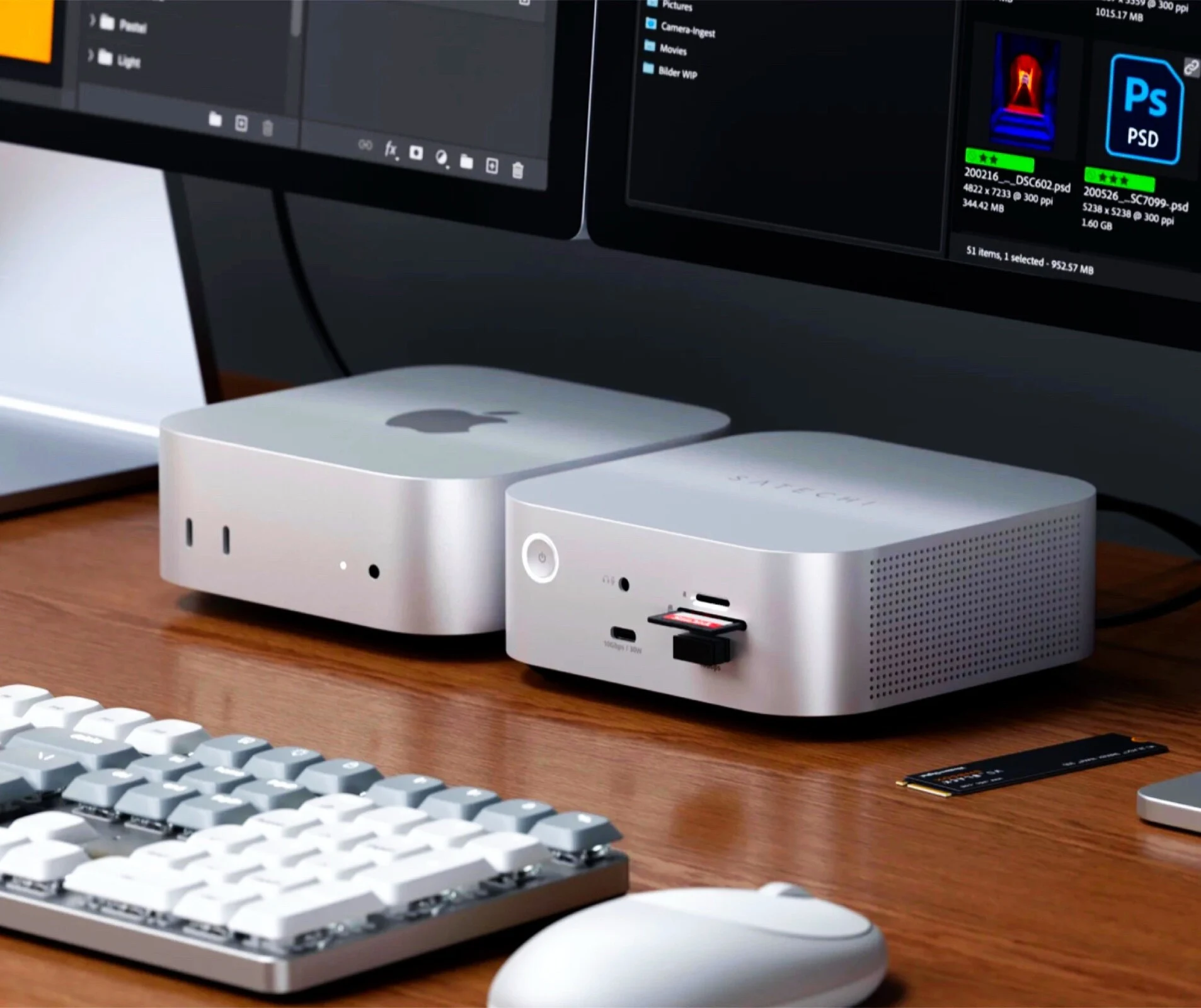
    The Satechi CubeDock is mainly meant for users of MacBook Pro and Mac mini. Currently, the Mac mini starts at $539 on Amazon. The aluminum design closely resembles the size, shape, and color of Apple’s mini PC, allowing it to integrate nicely into your setup.

    Connection and Charging Capabilities

    This docking station connects using Thunderbolt 5, offering a remarkable bandwidth of 120Gbps and the ability to charge laptops through the same cable with up to 140 watts. It’s also compatible with Macs that only have Thunderbolt 4, although it will work at a lower performance level. On the front, you’ll find a USB-C port capable of charging devices with up to 30 watts, alongside data transfer speeds of 10Gbps. Additionally, it features a 3.5mm headphone jack, one USB-A port, and both SD and microSD card readers.

    Ports and Additional Features

    At the back, there are four Thunderbolt 5 ports, with one dedicated for connecting to your computer. This section also includes 2.5Gbps Ethernet, one USB-C port, and one USB-A port, all with 10Gbps bandwidth. There’s also a barrel connector for the provided 180 watt power supply. The dock can support up to three 8K monitors. On the bottom, it has an M.2-2280 slot suitable for a PCIe 4.0 x4 SSD, allowing for a maximum capacity of 8TB and speeds reaching up to 6000 MB/s.

    The Satechi CubeDock is priced at $399 in the United States. Typically, Satechi products are available in Europe and other regions a few weeks after their US launch.

    Source:
    Link


  • Apple MacBook Pro and Air Gain Touchscreen with Magic Screen

    Apple MacBook Pro and Air Gain Touchscreen with Magic Screen

    Key Takeaways

    1. Apple has not included touchscreen features in its laptops until now, but the upcoming MacBook Pro will change that.
    2. The Intricuit Magic Screen is a new accessory that adds a touchscreen capability to MacBooks by attaching magnetically.
    3. Basic touch functions will work without additional software, but advanced features require a specific app from the manufacturer.
    4. The Magic Screen includes a stylus for enhanced drawing experiences and can also function as a separate drawing tablet.
    5. The Magic Screen will be available for various MacBook models, priced at $139, with funding starting soon on Kickstarter and delivery expected by the end of March.


    While many laptops available today include touchscreen features as an option, Apple has been steadfast in not providing touch-sensitive screens for its laptops. However, this is about to change with the upcoming MacBook Pro. Additionally, the Intricuit Magic Screen, an accessory that enables users to add a touchscreen feature to their MacBooks, will soon be released.

    Touchscreen Capability

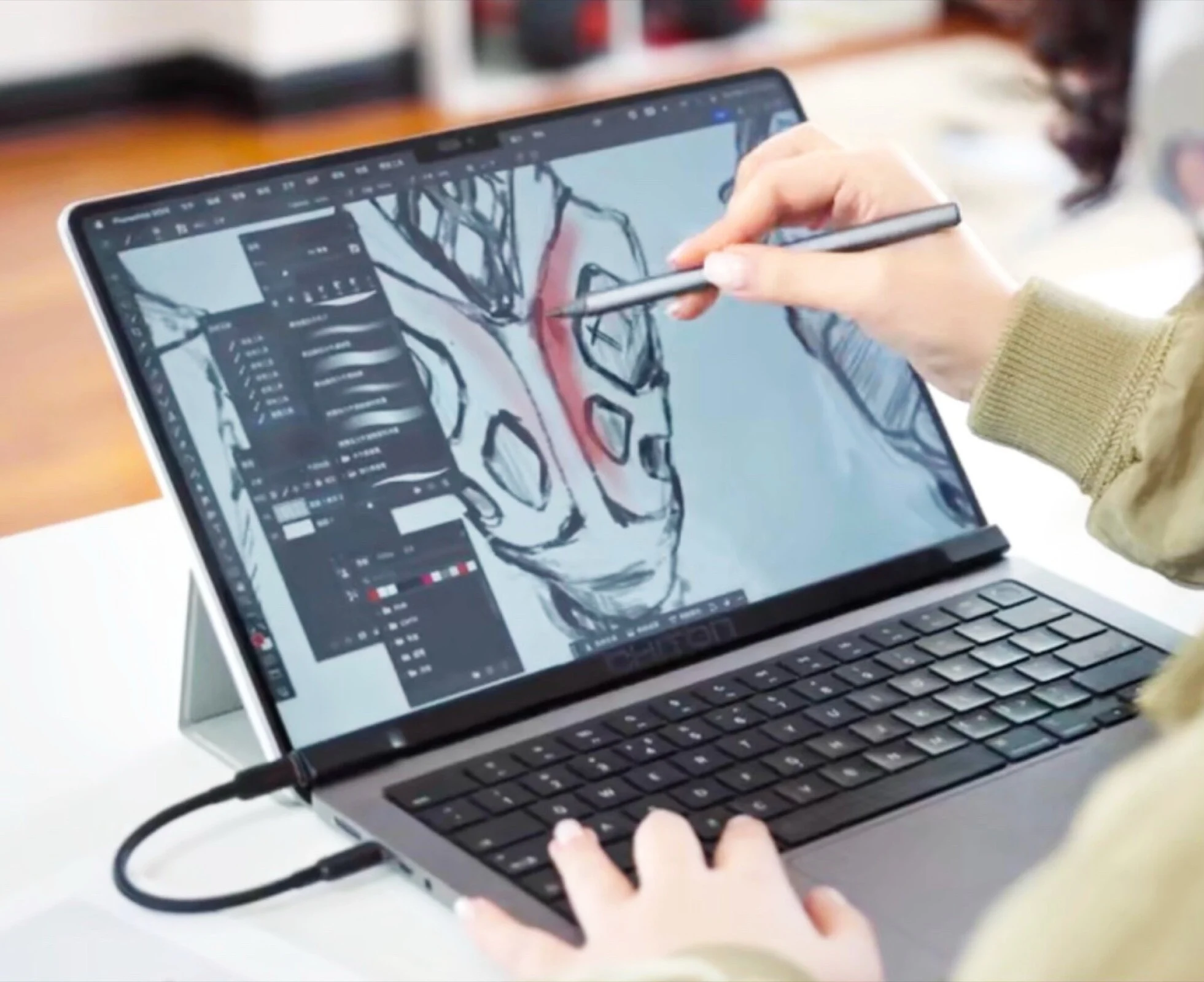
    The Magic Screen is a clear plexiglass panel that magnetically attaches to the display of either a MacBook Pro or MacBook Air. Users will need to connect the gadget to the laptop using a USB-C cable, allowing macOS to be controlled with a finger. Basic touch functions are expected to work without needing any drivers or extra software, but to access more advanced features, the manufacturer’s app will be necessary.

    Enhanced Drawing Experience

    Included with the Intricuit Magic Screen is a stylus, which aims to enhance the experience of drawing, using Photoshop brushes, or even making 3D models on a MacBook. Users can also utilize the Magic Screen as a drawing tablet separate from the MacBook’s display. A case that magnetically attaches to the back of the MacBook’s screen provides support for the device, ensuring stability during drawing tasks. It’s important to note that the Magic Screen needs to be detached before the laptop can be closed.

    Availability and Pricing

    The Intricuit Magic Screen will be compatible with the 14-inch and 16-inch MacBook Pro models, as well as the 13-inch and 15-inch MacBook Air. Funding for this touchscreen accessory is expected to start “soon” on Kickstarter, where it will be priced at $139. Delivery is anticipated to commence before the end of March.

    Source:
    Link


  • iFixit Teardown: MacBook Pro M5 Shows Repair Challenges and Upgrades

    iFixit Teardown: MacBook Pro M5 Shows Repair Challenges and Upgrades

    Key Takeaways

    1. The 14-inch MacBook Pro features updates like the new Apple M5 ARM chip and a quicker SSD, but its design remains unchanged.
    2. Loud fan noise during heavy use and the lack of Wi-Fi 7 are notable criticisms of the device.
    3. Battery replacement is difficult, requiring removal of twelve adhesive strips and is sold only with a new upper case.
    4. Most repairs necessitate removing the motherboard, making the process complicated despite some minor improvements.
    5. The MacBook Pro received a low repairability score of four out of ten from iFixit, indicating significant challenges for users needing repairs.


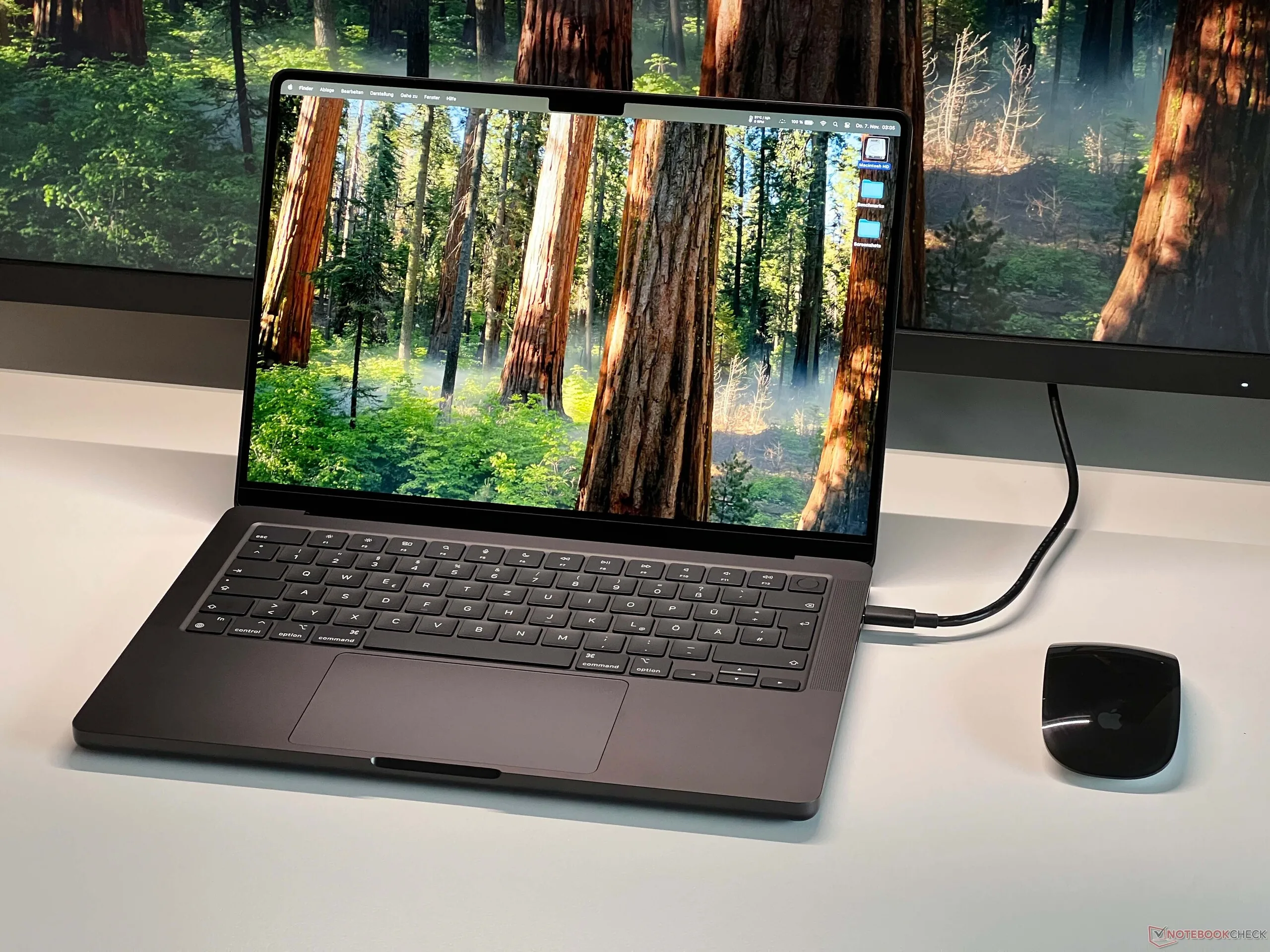
    The 14-inch MacBook Pro has had some updates, especially with the new Apple M5 ARM chip and a quicker SSD, but the overall design hasn’t changed. In our thorough review, we noted some criticisms like the excessively loud fans during heavy use, the absence of Wi-Fi 7, and the limited maintenance options similar to the last version.

    Teardown Insights

    The teardown specialists at iFixit took the new MacBook Pro apart to check for any internal changes beyond the exterior design. One major issue is that changing the battery is still a hassle. After unscrewing the bottom and disconnecting the trackpad cable, users must remove twelve adhesive strips to free the six battery cells. It seems Apple doesn’t trust users to handle this, as they only sell the battery together with a new upper case that includes the keyboard. To do the repair as Apple suggests, almost the entire MacBook Pro needs to be disassembled.

    Repair Process

    While both speakers can be replaced quite easily, nearly all other repairs require the motherboard to be taken out, which involves dealing with many screws and unplugging various cables. Once that’s done, replacing connections, the trackpad, and the fan can be accomplished. Some minor improvements have been made compared to the last model. For instance, you can now swap the battery without needing to take out the trackpad, and Apple provides a repair manual on launch day. However, the repair process can still be quite complex, leading to a score of only four out of ten on the iFixit repair scale.

    Conclusion

    Overall, while there are some upgrades, the 14-inch MacBook Pro still faces significant challenges in terms of repairability, keeping it from being user-friendly for those who might need to fix it themselves.

    Source:
    Link