Tag: HBM3E

  • Navee CEO Tests First $200K Water & Air Vehicle

    Navee CEO Tests First $200K Water & Air Vehicle

    Key Takeaway

    – WaveFly 5X is a luxury hybrid water-and-air vehicle, blending speedboat and aircraft features.
    – No pilot’s license required; vehicle lifts just above water for a smoother, flying-like ride.
    – Top speed of 53 MPH, 80-minute runtime, and 50-mile range; all-electric.
    – Priced at $199,999 USD, targeted at luxury resorts and high-net-worth individuals.
    – First unit already ordered; CEO performed the inaugural ride across Taihu Lake.


    Navee Just Dropped Their WaveFly 5X, It’s a Luxury Thing That Blurs the Line Between a Speedboat and a Personal Aircraft

    It has a dual-passenger capacity and a top speed of 53 MPH, the WaveFly 5X is designed to provide a novel riding experience while it also addressing the transportation shortcomings of traditional boats for short distances. This vehicle is suppossed to be a new way to get around on the water, making short trips more exciting and less rough. Many people might find it interesting for quick coastal travel.

    CEO Lu Juian Took the First Ride Across Taihu Lake for Its Launch

    To celebrate the release of the all-new WaveFly 5X, the CEO, Lu Juian, took the new water-and-air vehicle on its first ride across Taihu Lake, near their headquarters. While it was a short ride, it represented the launch of the company’s most ambitious transportation solution yet, showing off what they can do. This event was meant to demonstrate the vehicles capabilities and generate buzz.

    Pricing, Range, and Specs Starting at $199,999 USD per Unit

    The WaveFly 5X is a hybrid water-and-air vehicle that lifts users just above the water’s surface to create the sensation of flying without needing a pesky pilot’s license. Being slightly airborne also provides the added benefit of creating a cushion of air between passengers and the waves, effectively reducing the bumpy ride one would experience on a traditional speedboat. Other features of the all-electric WaveFly 5X are an 80-minute runtime, a top speed of 53 miles per hour, and an estimated range of 50 miles. So you get a smoother ride and that flying feeling.

    For Most People It Is Cost-Prohibitive But Luxury Resorts Might Want It

    For most, the Navvee WaveFly 5X is cost-prohibitive, but for luxury resorts, this is exactly the type of vehicle that could entice prospective guests looking for a unique experience. However, that’s not to say that there aren’t interested buyers, as Navee shared with us that there is already an order for someone’s very own Navee WaveFly 5X. So some individuals are already putting down money for this expensive toy.

    • Dual-passenger capacity.
    • Top speed of 53 miles per hour.
    • 80-minute runtime.
    • Estimated range of 50 miles.
    • Starting at $199,999 USD.
    • All-electric hybrid water-and-air design.
    Sources
    • SK Hynix Supplies DRAM, NAND, HBM Chips to Nvidia Amid Rising AI Demand

      SK Hynix Supplies DRAM, NAND, HBM Chips to Nvidia Amid Rising AI Demand

      Key Takeaways

      1. SK hynix’s production capabilities for DRAM, NAND, and HBM are fully booked through 2026, driven by a significant order from Nvidia.
      2. The company reported a Q3 2025 profit of $8 billion, a 62% increase from the previous year, largely due to HBM3E chip sales to Nvidia.
      3. SK hynix now holds over 50% of the global HBM market, significantly outpacing competitors Samsung and Micron.
      4. The company plans to ramp up production of HBM4 memory by late 2025, which promises enhanced bandwidth and energy efficiency for future AI processors.
      5. The demand for HBM is rapidly increasing, with predictions estimating the global HBM market to reach $43 billion by 2027, highlighting the critical role of memory manufacturers in the AI infrastructure.


      SK hynix has recently revealed that its production capabilities for DRAM, NAND, and high-bandwidth memory (HBM) are completely booked through 2026. This accomplishment is largely attributed to a significant order from Nvidia. The world’s largest company by market cap relies on SK hynix’s HBM semiconductors, such as the H100 and B200 models, to power its AI processors.

      Financial Success

      SK hynix experienced a remarkable Q3 2025, reporting a profit of $8 billion (₩11.4 trillion), which is a 62% increase from the previous year. Revenue rose by 39% to ₩22.4 trillion, primarily driven by sales of HBM3E chips that Nvidia purchased for their data center GPUs. Consequently, SK hynix’s market value now surpasses that of its rivals.

      Market Dominance

      According to TrendForce, SK hynix now dominates over 50% of the global HBM market, while competitors Samsung and Micron hold about a quarter each. The company’s recent financial performance illustrates how closely linked the AI hardware ecosystem is becoming, with Nvidia’s leading position in GPUs significantly boosting SK hynix’s exceptional performance.

      “We have completely sold out our DRAM, NAND, and HBM capacity for the upcoming year,” remarked Kim Kyu-hyun, the head of DRAM marketing at SK hynix. He also mentioned that clients have already booked manufacturing slots up to 2026. This means SK hynix will be mostly unable to accept new orders next year.

      Future Production Plans

      The company is gearing up to ramp up production of its HBM4 memory by late 2025. If successfully implemented, it promises a significant enhancement in both bandwidth and energy efficiency. The next-gen chips are anticipated to be crucial for Nvidia’s forthcoming AI processors and supercomputing platforms.

      SK hynix has also entered into supply agreements with OpenAI for its planned Stargate supercomputer project. This initiative is projected to more than double the industry’s total HBM needs.

      Changing Landscape

      The strong performance of SK hynix indicates a broader shift in the tech landscape. Memory manufacturers are now vital players in AI infrastructure. “Demand for HBM is growing at a rapid pace, making it challenging for supply to keep up in the near future,” stated Kim Ki-tae, head of HBM sales and marketing.

      Citi Research predicts that the global HBM market will reach US$43 billion by 2027. The partnership between SK hynix and Nvidia positions both companies at the forefront of the AI semiconductor surge, while Samsung and Micron are left scrambling to catch up.

      Source:
      Link


    • Samsung HBM3E Demand Surges, Pressuring Prices and Margins

      Samsung HBM3E Demand Surges, Pressuring Prices and Margins

      Key Takeaways

      1. Samsung is increasing HBM3E production faster than market demand, which may lower prices temporarily.
      2. Rising contract prices for standard DRAM will narrow profit margins between HBM3E and regular memory.
      3. Competitors like SK Hynix and Micron are producing 12-stack HBM3E, risking inventory buildup before demand rises.
      4. Samsung’s semiconductor division profits have dropped 94% year-on-year, prompting cost cuts to regain Nvidia’s business.
      5. Samsung is considering price cuts to compete, with future market dominance depending on cost and yield rather than just bandwidth.


      Samsung informed investors that the production of the fifth-generation HBM3E is increasing quicker than the demand in the market, which the company believes “will affect market prices for the time being.”

      Profitability Concerns

      Management pointed out that the rising contract prices for regular DRAM are going to narrow the previously large profit margin between HBM3E and standard memory in the second half of the year. This will limit the potential for increased margins, even with a rise in volumes.

      Customer Shift and Competitive Landscape

      This alert comes at a time when clients like Nvidia and AMD are moving towards the 12-stack HBM3E for their next-gen AI accelerators. Other competitors, including SK Hynix and Micron, are already producing this denser version in large amounts, which increases the risk of inventory accumulation before the anticipated demand surge happens.

      Internally, Samsung’s semiconductor division is facing challenges: its quarterly operating profit has plummeted by 94 percent year-on-year to 400 billion Korean won ($287 million) due to export controls and inventory adjustments affecting the results. To stop this decline, the company is cutting HBM3E production costs in hopes of regaining Nvidia’s business that has mostly shifted to SK Hynix.

      Growth in Memory Revenue

      Memory revenue has seen an 11 percent increase compared to Q1 as HBM3E shipments have risen. Samsung intends to boost production of 128 GB DDR5, 24 GB GDDR7, and 8-gen V-NAND by the end of the year. A deal worth $16.5 billion to manufacture Tesla’s next-gen AI6 chips in Texas should also help stabilize foundry usage, although new 15 percent US tariffs on Korean products cast a shadow over the demand forecast.

      Price Concessions and Market Dynamics

      Sources within the industry mention that Samsung has proposed price cuts. Meanwhile, Nvidia is confirming its 12-layer stacks, indicating that market dominance in the next cycle may depend more on cost and yield rather than just bandwidth. If Samsung can achieve high-yield and lower-cost production ahead of its competitors, the company might regain some market share in the profitable AI-memory sector—however, any error could deepen the oversupply issue that is currently pressuring HBM3E prices.

      Source:
      Link

    • Shinebolt: Samsung’s Pioneering HBM3E Memory Aims to Redefine High-Performance Computing

      Shinebolt: Samsung’s Pioneering HBM3E Memory Aims to Redefine High-Performance Computing

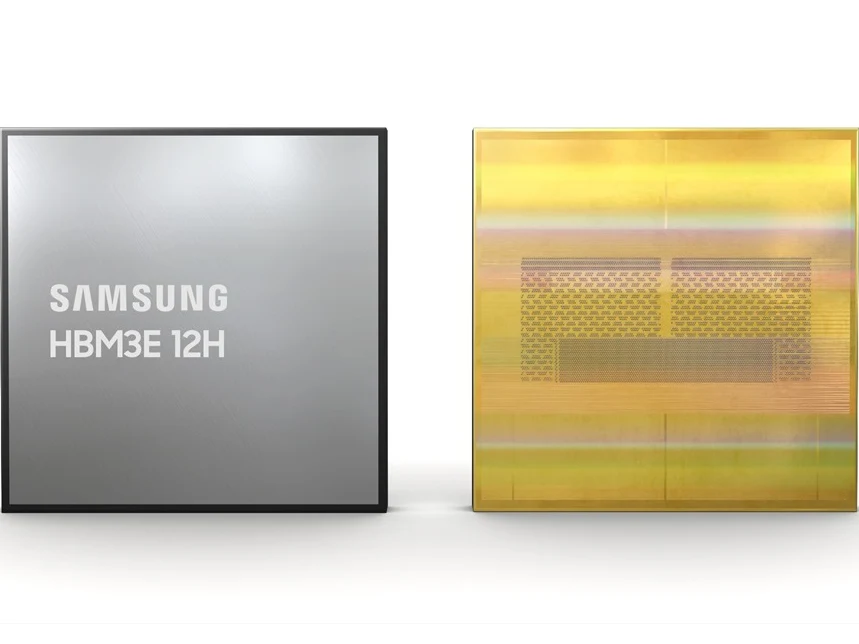
      Samsung Electronics is making substantial strides in the realm of high-bandwidth memory (HBM) with the unveiling of its 5th generation HBM3E product, dubbed “Shinebolt.” This innovation is part of Samsung’s broader initiative to accelerate the advancement and commercialization of HBM3E technology, with the aim of closely tailing the market leader, SK hynix​1​.

      The Technical Leap

      The Shinebolt prototype encompasses 24 gigabit (Gb) chips stacked in 8 layers. Industry insiders revealed that the development of a 36 gigabyte (GB) variant with 12 layers is nearing completion. This new HBM3E memory boasts a maximum data transfer speed that is approximately 50% faster than its predecessor, HBM3, clocking in at an impressive 1.228 terabytes (TB) of bandwidth. This substantial leap in performance is crucial as HBM technology is widely recognized as the next-gen DRAM especially in the burgeoning Artificial Intelligence (AI) era​1​.

      Competition and Future Strategies

      The journey towards the apex of HBM technology is marked by intense competition, particularly in the bonding process which is a pivotal manufacturing step. Samsung has consistently employed the thermal compression-non-conductive film (TC-NCF) method since the early stages of HBM production. There’s anticipation in the industry to see if Samsung can outperform the advanced mass reflow-molded underfill (MR-MUF) process that SK hynix adopted beginning from HBM3​1​.

      Moreover, Samsung is exploring strategies to expedite the development of a potentially revolutionary “hybrid bonding” process for HBM. This enthusiasm is echoed by Lee Jung-bae, president of Samsung Electronics’ memory business, who affirmed the smooth progress in HBM3 production and the development of the next-gen HBM3E. He also mentioned the plans to expand and offer custom-made HBM solutions for clients​1​.

      Benchmarking Against Peers

      The HBM3E technology is not confined to Samsung; other industry giants like SK hynix are also on the vanguard of HBM3E memory development. For instance, SK hynix has announced HBM3E memory capable of processing data up to 1.15 TB/s, which equivocates to handling more than 230 Full-HD movies of 5GB-size each in a second​2​. In a similar vein, Samsung’s HBM3E memory stacks are projected to offer a 9.8 GT/s data transfer rate, thereby advancing the high-performance computing (HPC) and AI applications​3​.

      In conclusion, the advent of Shinebolt is a testament to Samsung’s relentless endeavor to regain its footing in the advanced memory production landscape. As the HBM technology continues to evolve, the industry is keenly watching the competitive dynamics and the potential game-changing innovations that may redefine the high-performance computing domain.


      Sources: