Tag: Apple

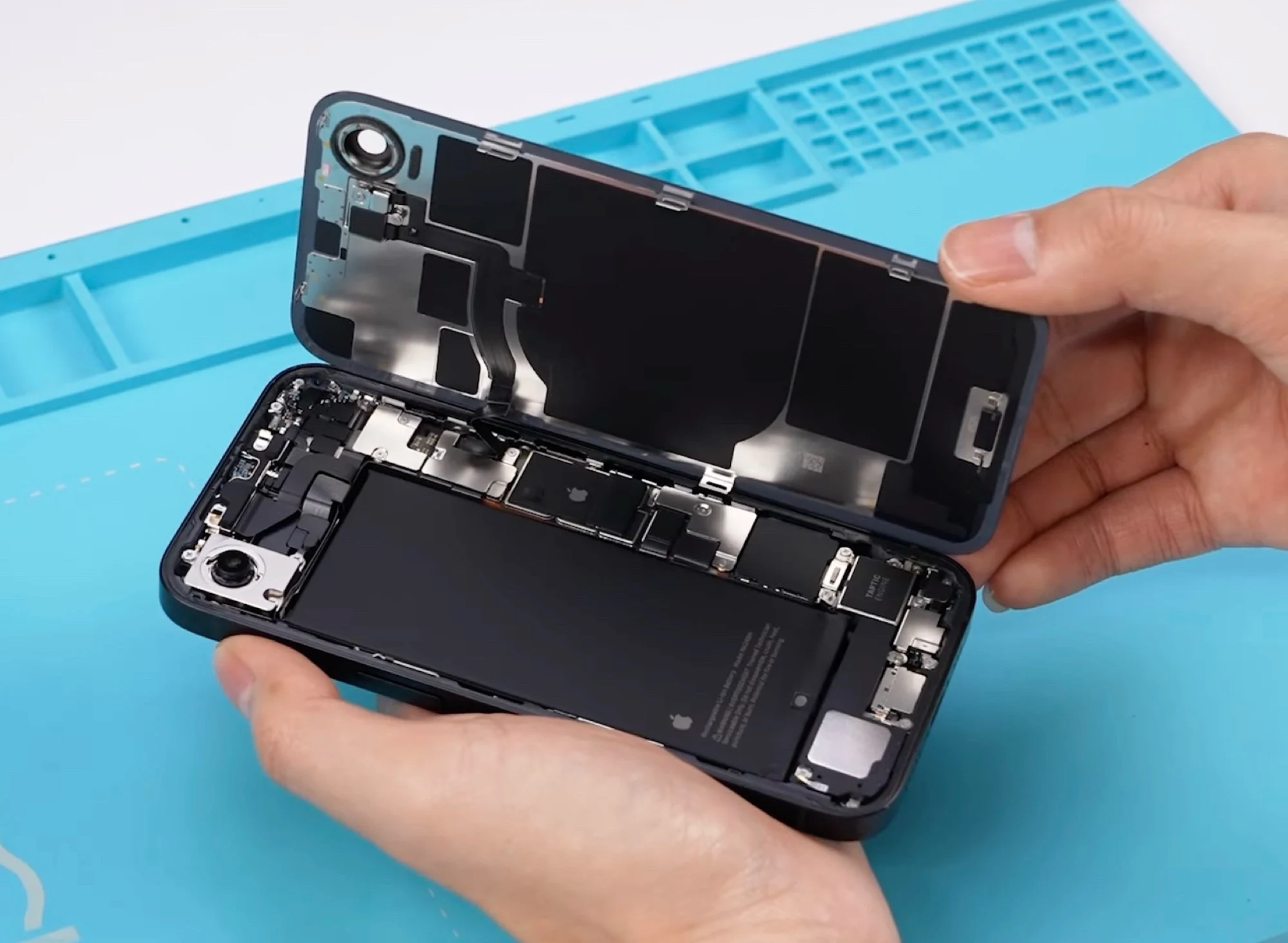
  • iPhone 16e Supports Magnetic Wireless Charging Upgrade, Teardown Reveals

    iPhone 16e Supports Magnetic Wireless Charging Upgrade, Teardown Reveals

    Key Takeaways

    1. The iPhone 16e features a single rear camera setup, a first since the last SE model, with a starting price of $599.99.
    2. It includes a new battery removal system using electrically-debondable adhesive, shared with the flagship iPhone 16.
    3. The screen of the iPhone 16e can be swapped with the older iPhone 14, enhancing repairability and cost-effectiveness.
    4. Several parts from older iPhone models, such as MagSafe charging coils from iPhone 15 and 14, are compatible with the 16e.
    5. The charging magnets fit well within the rear panel of the 16e, maintaining compatibility with puck-style chargers, though charging speed remains at 7.5 watts.


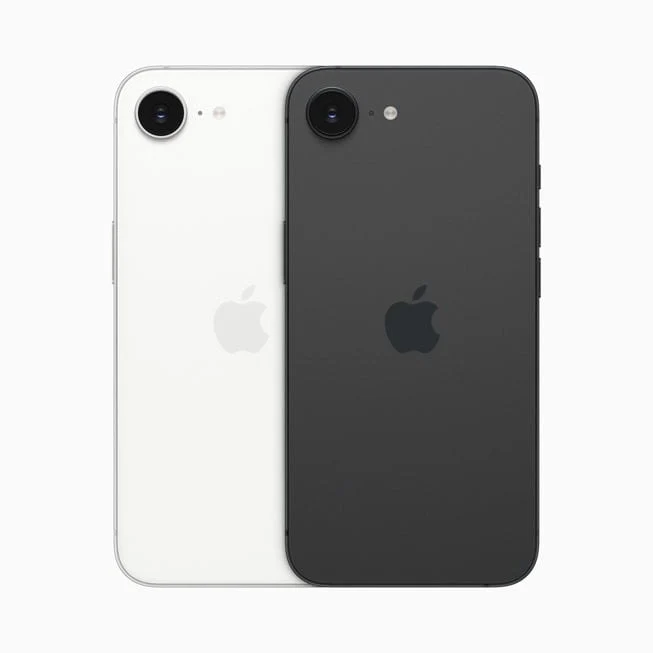
    The iPhone 16e marks Apple’s return to a single rear camera setup, a first since the last SE model. However, besides this feature, the two devices don’t share much in common, especially not the new starting price of $599.99.

    Innovative Design Features

    This latest model includes Apple’s new system for battery removal, which uses electrically-debondable adhesive. This feature is also found in the regular flagship iPhone 16, as confirmed by both REWA Technology and PBKReviews.

    Enhancing Repairability

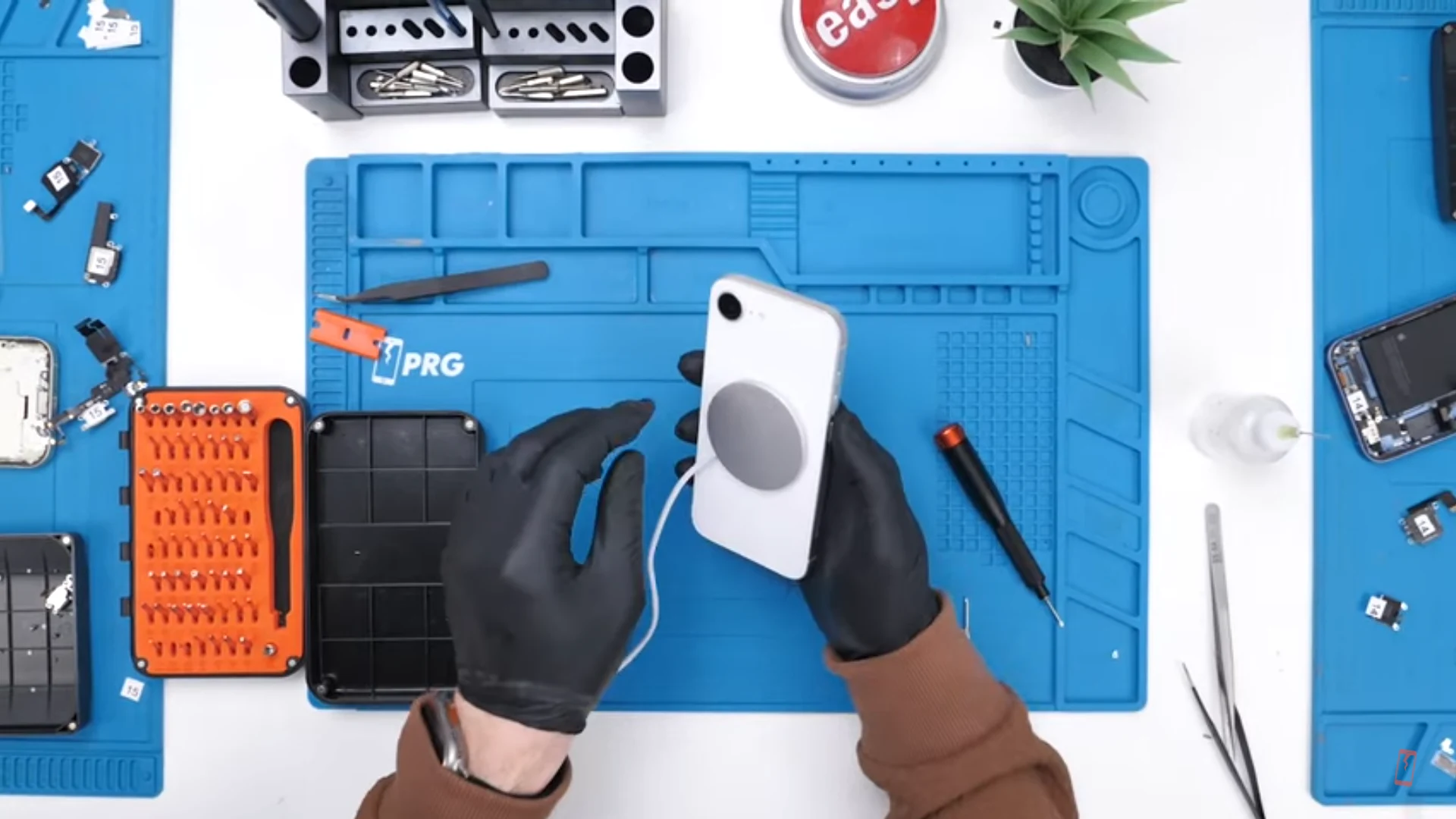
    Recently, PhoneRepairGuru, a Canadian repair service, has shared insights from a teardown of the 16e. They discovered that the screen can be swapped with the older iPhone 14, making repairs easier and possibly more cost-effective.

    PhoneRepairGuru also noted that several parts from older iPhone models can be used in the 16e. This includes MagSafe charging coils from both the iPhone 15 and 14. It’s curious, considering Apple has decided that MagSafe isn’t a priority for 16e users.

    Charging Capabilities

    Interestingly, the teardown revealed that a replacement set of charging magnets fits perfectly within the rear panel of the 16e, even after sealing it back up. While these magnets did not enhance the charging speed, which remains at a standard 7.5 watts, they did restore compatibility with puck-style chargers for this ‘budget’ iPhone.

    Alternatively, users can achieve similar results by purchasing a new case for the iPhone 16e.

    Source:
    Link
  • iPhone 16e Teardown Shows Bigger Battery and Easier Repairs

    iPhone 16e Teardown Shows Bigger Battery and Easier Repairs

    Key Takeaways

    1. The iPhone 16e has a similar design to the iPhone 16, with a mainboard fixed to the frame for easier access.
    2. A new adhesive allows for simpler battery replacements by losing stickiness when electrical voltage is applied.
    3. The iPhone 16e features a larger battery capacity of 4,005 mAh, which is 12.4% more than the iPhone 16.
    4. Key components like the camera, speakers, and USB-C port are easily replaceable, enhancing repairability.
    5. The iPhone 16e’s display is compatible with the iPhone 14, indicating shared parts between models, and it received a repairability rating of 7.5 out of 10.


    The Apple iPhone 16e has just begun shipping, and both PBKreviews and REWA Technology have managed to take apart the most affordable iPhone model into its separate components. There’s some good news, as the design of the iPhone 16e is quite similar to that of the pricier iPhone 16.

    Design and Repairability

    In contrast to many previous iPhone models, the mainboard is now fixed to the frame rather than the back. This allows the iPhone 16e to be opened from either the front or the back, depending on whether the display or other parts (like the battery) need replacing. This change makes certain repairs much easier. Additionally, Apple has introduced a new type of adhesive for the iPhone 16e that loses its stickiness when electrical voltage is applied at the designated area.

    Improved Battery Replacement

    Thanks to this new adhesive, changing the battery is simpler, as technicians no longer have to struggle with adhesive strips that might break during the process. While the internal layout is quite alike in both the iPhone 16e and the iPhone 16, Apple has made use of the space saved by eliminating the ultra-wide-angle camera to fit in a larger battery, boasting a capacity of 4,005 mAh. This is 12.4% more capacity than the iPhone 16. When compared to the third-generation iPhone SE, the capacity nearly doubles.

    Component Accessibility

    The components located on the back, such as the Qi charging coil, 48 MP main camera, selfie camera, speakers, USB-C port, and the Taptic Engine, can also be replaced without much hassle. Interestingly, the display of the iPhone 16e is compatible with the iPhone 14, implying that Apple has used the exact same panel for both devices. PBKreviews rates the iPhone 16e’s repairability at 7.5 out of a total of 10 points.

    Source:
    Link

  • Apple sued by consumers over carbon neutrality claims

    Apple sued by consumers over carbon neutrality claims

    Key Takeaways

    1. Consumers have filed a lawsuit against Apple, claiming the Apple Watch models are falsely marketed as “carbon neutral.”
    2. The lawsuit argues that two carbon offset projects funded by Apple have not effectively reduced carbon emissions.
    3. Allegations suggest that the claimed carbon reductions would have occurred regardless of Apple’s involvement in the projects.
    4. The misleading marketing is said to hinder consumer choice and deny informed buying decisions in the smartwatch market.
    5. The legal case is currently ongoing in the United States District Court of Northern California.


    Apple might not be as green as they say.

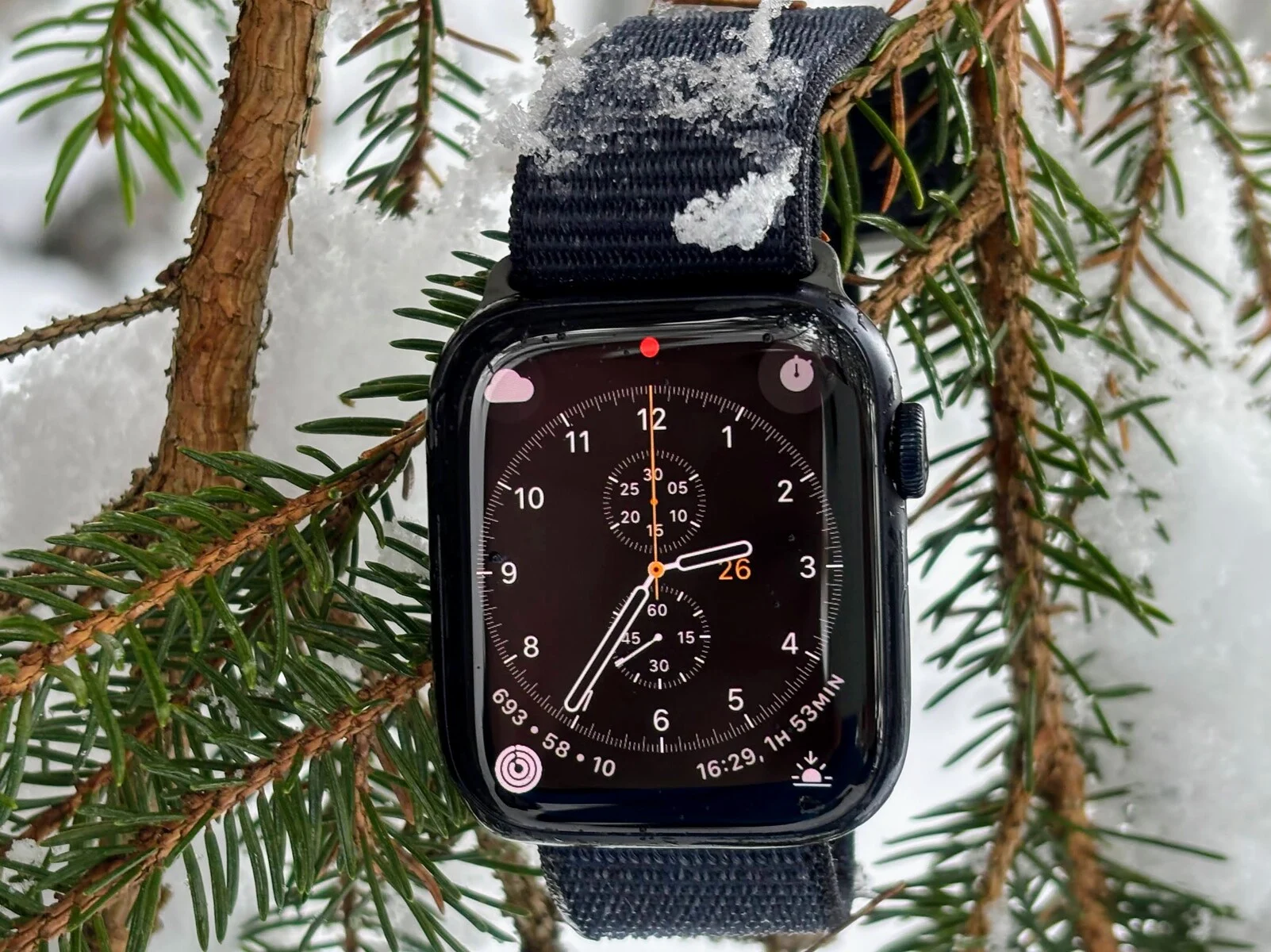
    A recent lawsuit from consumers suggests that the tech giant misrepresented the Apple Watch Series 9, Apple Watch Ultra 2, and Apple Watch SE. These watches were marketed as “carbon neutral,” but seven buyers argue that this claim is misleading.

    Claims About Carbon Neutrality

    According to Apple, the watches achieved carbon neutrality through a mix of lowered emissions and funding carbon credits by investing in carbon reduction initiatives. The lawsuit, which involves customers from Florida, California, and Washington, D.C., asserts that two carbon offset projects funded by Apple have failed to effectively lower carbon emissions.

    One of these projects is located in China, while the other is in a national forest in Kenya. Both initiatives focus on forestry, but the lawsuit claims they have done very little to actually reduce atmospheric carbon. The Kenyan project has been protected from deforestation since 1983, and the Chinese initiative is situated in a tree-rich area.

    Allegations of Misleading Information

    The lawsuit contends that “in both instances, the carbon reductions would have happened regardless of Apple’s participation or the projects’ existence. Since Apple’s claims of carbon neutrality rely on the effectiveness and credibility of these projects, its assertions are false and deceptive.” Apple stated that these initiatives have “retired 485,000 metric tons of carbon dioxide equivalents,” according to the lawsuit, which also claims these statements are misleading and incorrect.

    The individuals involved in the lawsuit expressed that “Apple’s misleading marketing tactics… hinder consumer choice” and “[deny consumers] the chance to make informed buying decisions in the smartwatch sector.” The main argument in the lawsuit is that “each Plaintiff might not have bought the Products or would not have paid as much had they known that Apple’s ‘carbon neutral’ assertions were untrue,” indicating that Apple’s advertising led to financial harm by manipulating consumer choices.

    Current Legal Proceedings

    The case, titled Dib et al v. Apple Inc., has been filed in the United States District Court of Northern California under Case number 5:25-cv-02043 and is presently ongoing.

    Source:
    Link

  • Apple Explains iPhone 16e Lacks MagSafe: Cables Are Common

    Apple Explains iPhone 16e Lacks MagSafe: Cables Are Common

    Key Takeaways

    1. The iPhone 16e features a significant redesign with flat edges, thinner bezels, a notch, and an Action Button.
    2. It supports magnetic wireless charging at 7.5W but does not include the MagSafe ring for secure accessory attachment.
    3. Apple claims the lack of MagSafe is not a major issue for the target audience, as they primarily use charging cables.
    4. The absence of MagSafe is seen as a missed opportunity, given its importance in Apple’s accessory ecosystem.
    5. The iPhone 16e is priced at $599 for the 128GB model in the US, with higher options available, and starts at ₹59,999 in India.


    Apple has begun the shipping of the iPhone 16e, which is the new version of the iPhone SE (3rd Gen) starting today. This release features a significant redesign.

    New Design Features

    The updated budget iPhone moves away from the old style of its predecessor, embracing flat edges, thinner bezels, a notch, and even includes an Action Button. However, despite the iPhone 16e finally matching the modern iPhone aesthetic, it’s surprisingly lacking a feature that seems illogical: MagSafe.

    Charging Limitations

    The iPhone 16e supports magnetic wireless charging, but only at 7.5W. Importantly, it doesn’t have the MagSafe ring that allows accessories and chargers to attach securely. Apple claims that this missing feature isn’t a big deal for the intended users of the 16e. An unnamed Apple spokesperson told Daring Fireball’s John Gruber that “most people in the 16e’s target audience only charge their phones by plugging them into a charging cable.”

    A Missed Opportunity

    While that may have been a valid point a few years back, today, MagSafe is everywhere—not just for charging, but also as an essential part of Apple’s accessory ecosystem. Omitting it from a 2025 iPhone feels like a strange choice. For a device that aims to make the iPhone experience accessible to a broader audience, Apple sure chose an odd feature to eliminate.

    Alternative Solutions

    There is a workaround, however, for those who still want the MagSafe functionality. You can purchase a MagSafe-compatible case, which won’t increase charging speed but will allow you to use MagSafe accessories without any hassle.

    The iPhone 16e is priced at $599 in the US for the 128GB version, and it goes up to $899 for the 512GB model. In India, it starts at ₹59,999 and reaches ₹89,900 at the top end.

    Source:
    Link

  • Apple iPhone Foldable Aims to Eliminate Display Crease Visibility

    Apple iPhone Foldable Aims to Eliminate Display Crease Visibility

    Key Takeaways

    1. Apple is reportedly working on a foldable device, possibly a clamshell model similar to the Galaxy Z Flip6 or Razr 50 Ultra.
    2. There is a preference for a larger foldable model, resembling the Find N2, rather than a smaller design.
    3. Component sourcing for the device is on track to finish by April, with suppliers like Amphenol and Corning involved.
    4. Apple has an exclusive agreement with Samsung Display for OLED panels, focusing on creating a flexible panel that eliminates screen creases.
    5. The expected launch date for Apple’s first foldable device is set for 2026, likely in the latter half of the year.


    There have been a growing number of whispers regarding Apple’s debut foldable device recently. Just to summarize, some reports have indicated that a clamshell model is in the works, comparable in size to the Galaxy Z Flip6 or Razr 50 Ultra (currently priced at $689.99 on Amazon).

    Larger Options Considered

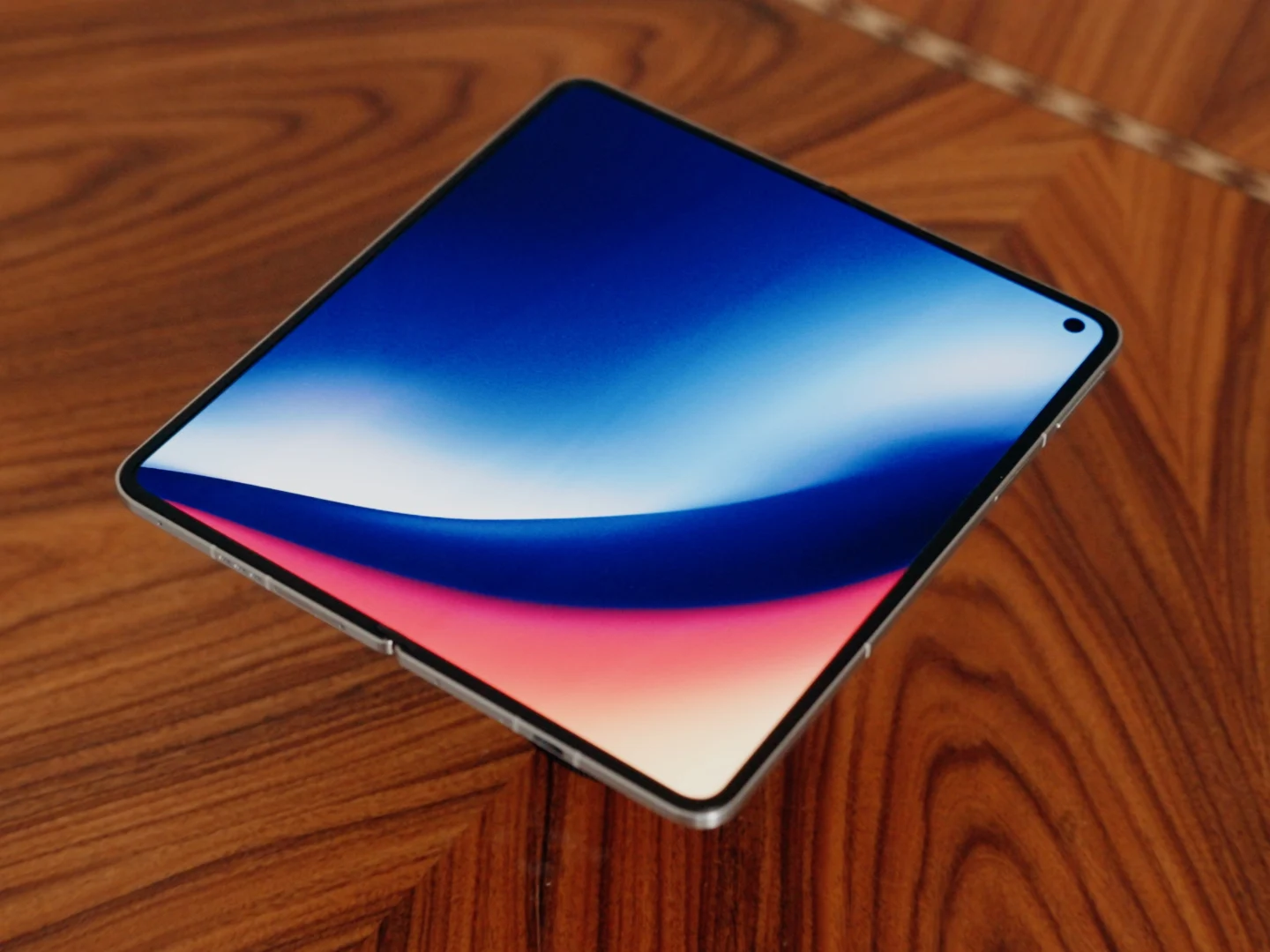
    More new info suggests that Apple might actually prefer a bigger model, one that resembles the Find N2 more than the Galaxy Z Fold6. Recently, ETNews has provided fresh insights into the development status of Apple’s first foldable device.

    Component Sourcing Progress

    It appears that the sourcing of component suppliers is on schedule to wrap up in April. For instance, Amphenol is reportedly in the running to provide hinge mechanisms, having previously supplied them for different generations of the MacBook Pro. Additionally, Apple is anticipated to work with Corning for ultra-thin glass (UTG) for the internal display of the so-called iPhone Fold.

    On another note, the site mentions that Apple has secured an exclusive agreement with Samsung Display for the supply of OLED panels for this device. ETNews further points out that a brand new flexible OLED panel has been under development since last year for the iPhone Fold, aimed specifically at ‘eliminating the crease at all costs.’

    Focus on Innovation

    This focus on removing the crease is said to be considered ‘regardless of price,’ as Apple hopes to set its first foldable apart from competitors. As it stands now, the expectation is that Apple’s first foldable will launch in 2026, likely in the latter half of the year.

    Source:
    Link

  • Analyst Insights on iPhone 17 Pro and Pro Max RAM Upgrades

    Analyst Insights on iPhone 17 Pro and Pro Max RAM Upgrades

    Key Takeaways

    1. Apple has launched the iPhone 16E globally, shifting focus to the upcoming iPhone 17 series.
    2. The iPhone 17 Air (also known as iPhone 17 Slim) will replace the iPhone 16 Plus in Apple’s lineup.
    3. The iPhone 17 Pro and Pro Max are expected to feature 12 GB of LPDDR5 RAM, enhancing performance.
    4. A 50% RAM increase is anticipated to improve Apple Intelligence and multitasking capabilities.
    5. Additional upgrades for the iPhone 17 Pro models may include a new camera design, a lighter frame, and a Wi-Fi 7 chip.


    Apple has recently launched the iPhone 16E worldwide. Now that all the info about this new mid-range smartphone is out, many sources are shifting their focus to the upcoming iPhone 17 series and how it might stand out from Apple’s current flagship models.

    New Features on the Horizon

    To summarize, Apple is set to revamp this fall’s iPhone lineup with the iPhone 17 Air, which has also been called the iPhone 17 Slim at times. It’s said that the iPhone 17 Air will take the place of the iPhone 16 Plus in Apple’s offerings, while there will also be direct successors for the iPhone 16, iPhone 16 Pro, and iPhone 16 Pro Max.

    Expected RAM Upgrades

    As per analyst Jeff Pu, Apple aims to introduce a second RAM upgrade within two years, having already bumped up non-Pro iPhones to 8 GB of RAM with the iPhone 16 and iPhone 16 Plus (currently priced at $774.97 – renewed on Amazon). This time, Pu claims that the iPhone 17 Pro and iPhone 17 Pro Max will come with 12 GB of LPDDR5 RAM, after previously hinting that only the latter device would receive this enhancement.

    Performance Boosts Ahead

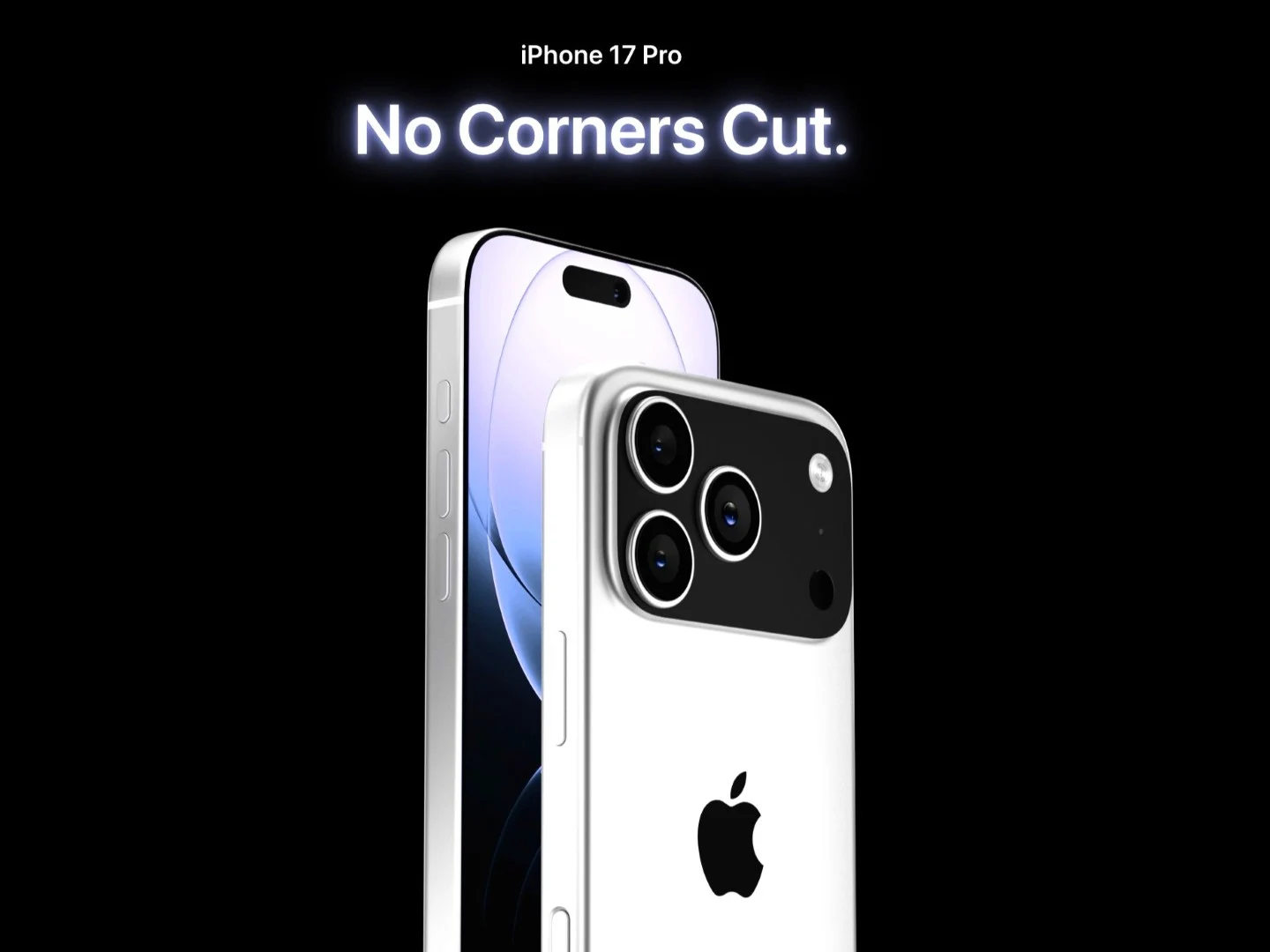
    Predictably, Pu anticipates that the 50% increase in RAM will enhance Apple Intelligence and multitasking capabilities. If the other rumors are to be believed, then the 12 GB of RAM will just be one of several upgrades Apple intends to roll out with the iPhone 17 Pro and iPhone 17 Pro Max. Supposedly, this year’s Pro models might also feature a revamped camera design, a lighter aluminum frame, and a proprietary Wi-Fi 7 chip, among other modifications.

    Source:
    Link

  • Apple iPhone 17e Launching Next Year: Affordable Models Annually

    Apple iPhone 17e Launching Next Year: Affordable Models Annually

    Key Takeaways

    1. The iPhone 16e is the new budget-friendly model in the iPhone 16 lineup, succeeding the iPhone SE series.
    2. Apple plans to release “budget-friendly iPhones” more frequently, with the iPhone 17e expected about six months after the iPhone 17 series.
    3. The iPhone 16e aims to replicate the success of the iPhone 5c by offering a contemporary design and features from pricier models while cutting some components.
    4. The iPhone SE’s low popularity, making up only 5% of iPhone sales in 2024, prompted Apple’s shift in strategy.
    5. Analysts believe the iPhone 16e’s pricing and design could attract more consumers to the iPhone ecosystem compared to the iPhone SE.


    The Apple iPhone 16e is the new model that follows the third-generation iPhone SE and is the least expensive option in the iPhone 16 lineup. After the initial three generations of the iPhone SE, released in 2016, 2020, and 2022, Apple plans to introduce new “budget-friendly iPhones” more frequently in the future.

    Future Launches

    Analysts from CIRP believe that the iPhone 17e will be introduced in about a year, which is approximately six months after the iPhone 17 series is released. This strategy appears to mirror that of Google, where the lower-cost Pixel A models typically come out shortly after the pricier versions in each series. This change in approach is reportedly due to the iPhone SE’s underwhelming popularity, which made up only about 5% of iPhone sales in 2024.

    Design and Features

    With the iPhone 16e, Apple might aim to achieve the same success as the iPhone 5c from 2013. The iPhone 16e features a contemporary design and incorporates many attributes of its more expensive counterparts. However, it does cut back on certain components like MagSafe and the ultra-wide-angle camera, which helps validate the higher price of the iPhone 16. According to the CIRP analysts, the iPhone 16e presents a more appealing entry point into the iPhone ecosystem compared to the iPhone SE, which could result in better sales.

    Conclusion

    CIRP’s insights suggest a promising future for the iPhone 16e, indicating that Apple’s new pricing strategy and design choices may resonate well with consumers looking for a more affordable yet modern smartphone option.

    Source:
    Link

  • Apple Dominates 2024 with Over Half of AI-Capable PCs Shipped

    Apple Dominates 2024 with Over Half of AI-Capable PCs Shipped

    Key Takeaways

    1. Apple leads the market with over 54% of all AI-capable PCs shipped in 2024.
    2. The rise of AI in households is linked to the increasing availability of AI-supporting personal devices.
    3. Apple’s success is attributed to its new M4 processor and the integration of Apple Intelligence in recent laptops.
    4. Windows laptops are struggling to compete, particularly with Microsoft’s Copilot PCs underperforming in sales.
    5. The AI PC market is growing, with an 18% increase from 2023 to 2024, indicating a promising future for AI technology in everyday devices.


    With the rise of AI, this technology is slowly making its way into everyday households. A significant part of this increase is linked to the growing number of personal devices that support AI, like smartphones and computers. Apple seems to be at the forefront of this trend, and by a large margin.

    Apple Dominates the Market

    A recent study from Canalys, a market research firm, reveals that Apple accounted for over half of all “AI-capable PCs.” These PCs are defined as those with hardware specifically designed for AI tasks, including a neural processing unit (NPU). In 2024, 17% of shipped PCs fit this category, with Apple responsible for 54% of those shipments.

    The tech giant from Cupertino stands out as the clear leader in this sector. Lenovo and HP hold the second and third positions, each contributing 12% of all AI-capable PCs in 2024.

    Key Factors in Apple’s Success

    The primary reason behind Apple’s impressive performance is likely its recently introduced M4 processor and the incorporation of Apple Intelligence into most of its latest laptops (for instance, the M4 Mac Mini, priced at $549 on Amazon). Apple has technically enabled AI capabilities with on-chip neural processors since the A11 Bionic SoC, which was used in the iPhone 8, iPhone 8 Plus, and iPhone X back in 2017. Every processor from Apple since then has included some form of neural engine, but the company’s recent AI initiatives have brought this technology to the forefront for everyday consumers.

    Challenges for Windows Laptops

    Windows laptops, however, have not kept pace in this arena. Microsoft’s Copilot PCs have not sold as well as anticipated, mainly due to issues surrounding Copilot (including its Recall feature, which would automatically take snapshots of a PC’s state for easy access).

    Overall, the market for AI PCs is consistently expanding. This category experienced an 18% growth from 2023 to 2024. As AI becomes increasingly integrated into our personal devices and the necessary hardware becomes more affordable, we can expect ongoing growth in the AI PC sector.

    Source:
    Link

  • Apple announces $500 billion US investment plan amid tariff concerns

    Apple announces $500 billion US investment plan amid tariff concerns

    Key Takeaways

    1. Apple plans to invest over $500 billion in the US over the next four years, including a new server manufacturing facility in Houston.
    2. The company is doubling its US Advanced Manufacturing Fund to $10 billion and launching a skills academy in Michigan to boost manufacturing skills.
    3. Apple will collaborate with thousands of suppliers nationwide, creating direct jobs and infrastructure for its Apple Intelligence systems and data centers.
    4. The new Houston server plant will be crucial for Apple Intelligence and is expected to create thousands of local jobs by 2026.
    5. Apple aims to add around 20,000 new positions focused on research, development, and advanced technologies over the next four years.


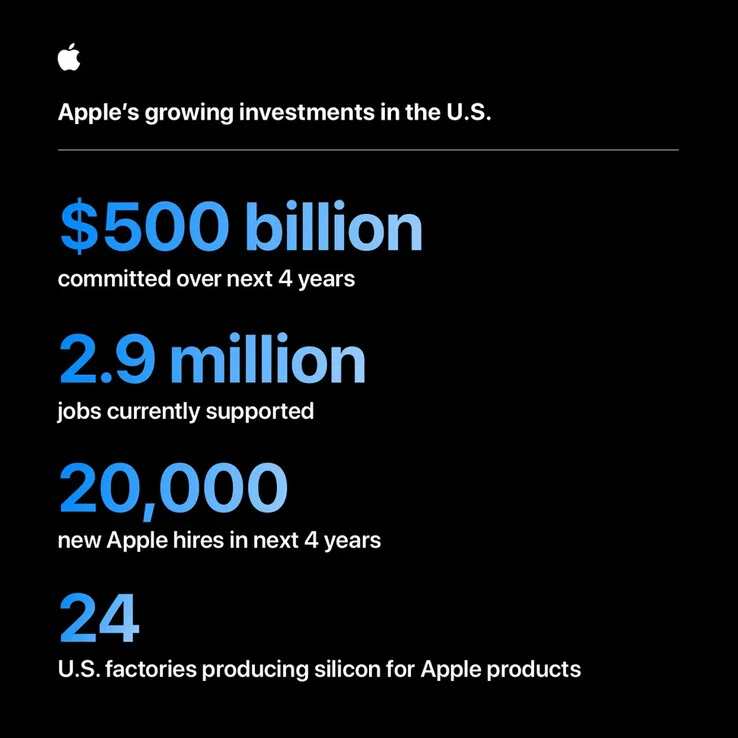
    Apple has just revealed an unprecedented investment strategy, planning to pour over $500 billion into the US within the next four years. This initiative encompasses the establishment of a server manufacturing facility in Houston, aimed at powering its Apple Intelligence systems. Additionally, Apple is doubling its US Advanced Manufacturing Fund to $10 billion and will be initiating a skills academy in Michigan to enhance manufacturing skills.

    Collaborations and Job Creation

    In this ambitious plan, Apple intends to collaborate with thousands of suppliers across all 50 states. This effort will create direct employment opportunities, strengthen the infrastructure for Apple Intelligence, and develop data centers. Furthermore, it includes building corporate hubs and supporting Apple TV+ productions in 20 different states. Currently, Apple supports more than 2.9 million jobs in the US through direct employment, partnerships with American suppliers and manufacturers, and roles for iOS app developers.

    New Server Plant in Houston

    The new server facility in Houston, which will cover 250,000 square feet and is set to begin operations in 2026, is anticipated to generate thousands of jobs in the area. These servers, previously manufactured overseas, will now be essential for Apple Intelligence and will lay the groundwork for what’s being referred to as Private Cloud Compute, a system that integrates AI processing with high-level security for cloud services.

    Investment in Advanced Manufacturing

    As part of its enhancement to the US Advanced Manufacturing Fund, Apple is making a significant multibillion-dollar investment in advanced silicon production at TSMC’s Fab 21 in Arizona, where it stands as the largest client. Notably, mass production of Apple chips commenced just last month at this state-of-the-art facility, which already has over 2,000 workers on its payroll.

    Future Hiring Plans

    Looking forward, Apple aims to add approximately 20,000 new positions over the next four years, primarily in research and development, silicon engineering, software development, as well as AI and machine learning. The company has nearly doubled its investment in advanced R&D in the US over the past five years and is keen to maintain this growth.

    All of this is happening amid potential tariff challenges, as the upcoming Trump administration signals a crackdown on Chinese imports. Recently, Apple CEO Tim Cook had a meeting with President-elect Trump, who suggested that Apple might withdraw from Mexico and increase its investments in the US. Meanwhile, the administration is considering a potential 25 percent tariff on chips and has already introduced a 10 percent tariff on goods from China.

    Source:
    Link


  • Apple Intelligence May Compete with Galaxy AI Through Gemini Integration

    Apple Intelligence May Compete with Galaxy AI Through Gemini Integration

    Key Takeaways

    1. Apple’s AI features currently lag behind those of Samsung and other Android models.
    2. Users may soon choose between Google’s Gemini AI and OpenAI’s ChatGPT in upcoming updates.
    3. The integration of Google’s Gemini AI is expected in the iOS 18.4 update.
    4. The update may introduce new features like prioritized notifications and an Image Playground mode.
    5. Despite potential improvements, Apple’s cautious approach raises questions about significant advancements in AI capabilities.


    While Apple has brought AI into its devices, it still falls behind the offerings found in Samsung and other Android top models. We’ve all witnessed the comparison between the AI-driven object removal feature on an iPhone and that of a Galaxy flagship. Several reports also point out major problems with the notification summarization feature. A recent leak, however, hints that improvements to Apple’s AI features may be on the horizon.

    New AI Options for Users

    Reports indicate that users will soon be able to choose between Google’s Gemini AI and OpenAI’s ChatGPT for Apple Intelligence features. Apple is said to be working on integrating Google’s Gemini AI into its upcoming iOS 18.4 update. This information was uncovered by developer Aaron Perris (@aaronp613) on X, and it points to Apple enhancing its AI capabilities with the addition of Gemini. For those who don’t know, Gemini is the backbone of many AI features seen in Android flagships like the Galaxy S25 series.

    Increased Flexibility and Performance

    The code snippet suggests that users will soon have the ability to pick either “Google” or “OpenAI” as their preferred AI model, which could lead to more flexibility and might enhance the overall performance of Apple Intelligence. The anticipated iOS 18.4 update is likely to bring various AI-driven upgrades, such as prioritized notifications and a new Image Playground mode. However, just because Apple is integrating Google Gemini doesn’t mean a big leap in AI features is guaranteed. Apple has been cautious from the start, and it seems their approach hasn’t shifted much yet. We remain hopeful that Apple Intelligence will become smarter, but we’ll need to wait for the official rollout to make further judgments.

    Source:
    Link