Tag: AI Robotics

  • Asus Chairman Halts Smartphone Launches to Focus on AI Tech

    Asus Chairman Halts Smartphone Launches to Focus on AI Tech

    Key Takeaways

    1. Asus will stop launching new smartphone models and focus on the AI market.
    2. The company plans to invest in AI robotics and AI glasses for future developments.
    3. Asus experienced a 26.1% revenue growth, mainly from increased AI server installations.
    4. Future laptops may use Snapdragon X processors instead of Qualcomm chips.
    5. Asus acknowledges rising RAM costs and plans to manage price increases through design and supply chain strategies.


    As the AI boom is happening, businesses are quickly changing their focus. Jonney Shih, the chairman of Asus, has confirmed that the company will no longer be launching new smartphones. Instead, the focus will shift to making profits in the highly profitable AI market, particularly in robotics and smart glasses.

    Confirmation of Shift in Strategy

    VideoCardz shared recent statements made by Shih, which were captured by Taiwanese Money UDN. During a gala on January 16th, he stated, “Asus will no longer add new mobile phone models in the future.” Because of this, customers might not see a new Zenfone or ROG Phone for a while. Nonetheless, Shih promised to support the current models throughout this transition.

    Focus on AI Innovations

    The chairman mentioned that the company plans to explore “AI robot & robotics” and “AI glasses.” Looking at its 2025 financial report, the rationale behind this shift is clear. Revenue rose by 26.1% from the previous year, with a significant portion of the growth coming from increased AI server installations.

    Asus has never really taken the lead in the smartphone market with its high-end Zenfone or gaming models. Similarly, smart glasses from tech giants like Google and Apple have also had a hard time achieving widespread acceptance. Regardless, Shih might think that progress in AI technology could turn these gadgets into more mainstream products.

    Future Product Developments

    Inside TW expects that Asus will move away from using Qualcomm chips in its smartphones. Consumers might notice that more of its laptops will be powered by Snapdragon X processors. Qualcomm’s Dragonwing platform will play a vital role in creating more autonomous robots.

    Shih also talked about the memory shortage, acknowledging that current laptops and other items may see price increases. The company plans to rely on “design thinking and supply chain collaboration” to lessen the effect of rising RAM costs. Asus has already increased some MSRPs for laptops and desktops. However, it maintains that it has enough parts on hand to postpone other price hikes.

    Source:
    Link


  • Nvidia Jetson Thor: 2,070 TFLOPS for Robots with On-Device AI

    Nvidia Jetson Thor: 2,070 TFLOPS for Robots with On-Device AI

    Key Takeaways

    1. High Performance: The Jetson Thor series offers up to 2,070 FP4 tera-operations per second and 128 GB of memory, significantly outperforming AGX Orin with 7.5 times the AI computing power and 3.5 times better energy efficiency.

    2. Powerful Specifications: Equipped with a Blackwell GPU and a 14-core Arm CPU, Jetson Thor allows for seamless execution of multiple AI tasks related to language, vision, and control without slowdowns.

    3. Compact and Efficient Design: Despite its powerful capabilities, Thor maintains a compact design, doubling the power range of earlier models to support real-time multi-AI workflows and safe human-machine interaction.

    4. Versatile Applications: The module supports edge-class generative models and is suited for low-latency applications like humanoid robots, agricultural automation, and surgical assistance, facilitating a smooth transition from development to production.

    5. Ethical Considerations: The enhanced capabilities of Thor raise concerns about potential misuse in autonomous systems and the impact on employment, highlighting the need for strong safeguards, oversight, and accountability.


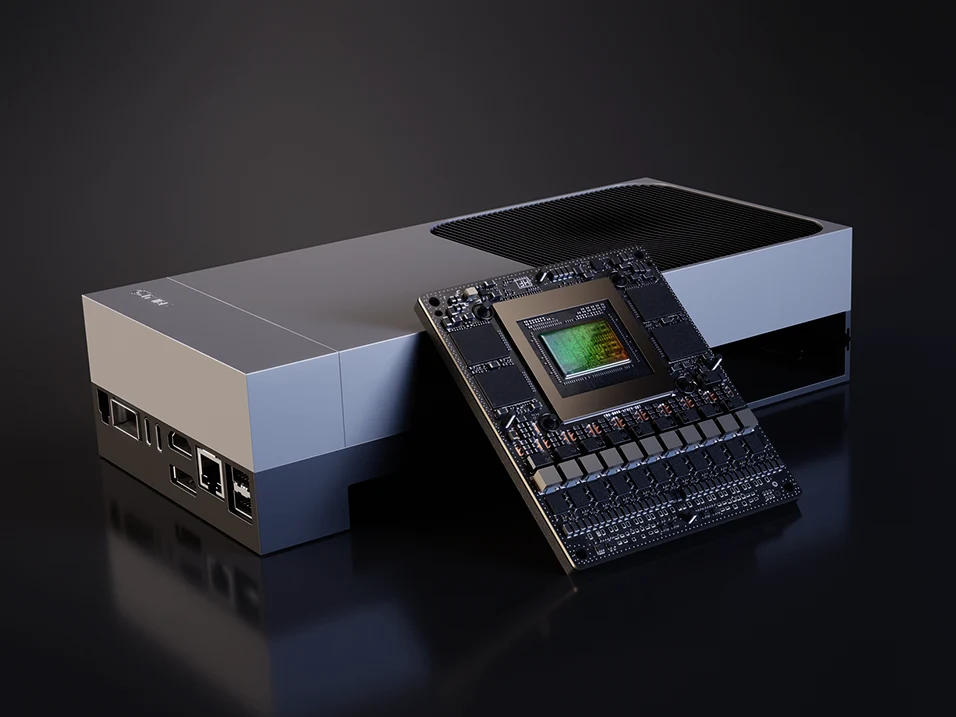
    Nvidia has introduced the Jetson Thor series, which focuses on “physical AI” through compact modules comparable to laptops. These modules can handle up to 2,070 FP4 tera-operations per second and come with 128 gigabytes of memory, all while operating within a power range of 40 to 130 watts. Nvidia presents Thor as a major improvement over AGX Orin, boasting about 7.5 times the AI computing power and 3.5 times better energy efficiency. This allows robots to execute complex models locally without depending on cloud services.

    Powerful Specifications

    The Jetson AGX Thor includes a Blackwell GPU paired with a 14-core Arm CPU, which provides excellent memory bandwidth and clock speeds. These features make it possible for robots to run various AI tasks related to language, vision, and control at the same time without experiencing any slowdowns.

    Compact and Efficient Design

    Maintaining the small size of earlier Jetson models, Thor doubles the power range of Orin to achieve its performance goals. Nvidia aims to support real-time multi-AI workflows, enhancing the ability of machines to interact safely with humans.

    Nvidia has announced that production modules and development kits for the new Jetson platform are already available. Notable early users include Amazon, Meta, John Deere, OpenAI, and Boston Dynamics. Agility Robotics is planning to use Thor in its sixth-generation Digit humanoid aimed at warehouse tasks, while Boston Dynamics is developing a new version of Atlas to work with Thor. The pricing is set at $2,999 for each Jetson Thor T5000 module when ordered in 1,000-unit batches, and $3,499 for AGX Thor development kits.

    Versatile Applications

    Nvidia refers to this chip as a “robot brain,” and the description fits perfectly: it enables edge-class generative models, large language models, and high-throughput vision to work together on a single module. This capability opens up applications that need low latency, such as humanoid robots, agricultural automation, and surgical assistance, where timing is crucial and missing a frame could lead to errors.

    The main advantage is evident: teams can swiftly move from the development phase to production, using the same software for both perception and planning. Nevertheless, there are considerable risks. The increased power of Thor could potentially enhance autonomous systems for both beneficial and harmful purposes, as demonstrated by Jetson Orin in conflict regions. The effect on employment is unclear; while some jobs may remain, tasks might become more monotonous. Strong safeguards, vigilant oversight, and clear accountability are vital as these technologies continue to evolve.

    Source:
    Link


  • MIT Discovers Brain’s Separate Systems for Solids and Fluids

    MIT Discovers Brain’s Separate Systems for Solids and Fluids

    Key Takeaways

    1. The human brain has specialized areas for processing solid objects and non-solid materials, identified in a study published in Current Biology.
    2. The research reveals subregions in the brain’s visual cortex that respond differently to “things” (solids) and “stuff” (liquids).
    3. Researchers used video clips of objects interacting with environments while monitoring participants’ brain activity with fMRI.
    4. Both shape recognition and physical property analysis areas in the brain show distinct reactions to solids and liquids.
    5. These findings could inform the development of advanced AI systems with separate processing models for solids and liquids, enhancing their interaction with the environment.


    In research, neuroscientists found out that the human brain has different specialized areas for processing solid objects compared to non-solid materials. This study, published on July 31 in the Current Biology journal, is the first to identify specific regions in the visual cortex that correspond to this distinction.

    New Insights on Recognition

    Previously, it was known that the brain features specialized areas for recognizing 3D objects. This new research goes further, showing that within the brain’s shape-recognition pathway and the one that analyzes physics, there are subregions that react differently to solid items and flowing materials. The researchers referred to these categories as “things” and “stuff.”

    Research Methodology

    To conduct their study, the team utilized software typically used by visual effects artists to create more than 100 video clips showcasing things and stuff interacting with various environments. Participants watched these videos while their visual cortex was scanned using fMRI (functional magnetic resonance imaging). The results indicated that both the area associated with shape recognition and the one linked to analyzing physical properties reacted to both stuff and things, highlighting specialized subregions for each type of object.

    Implications for AI Development

    This discovery could lay the groundwork for creating more advanced AI robots. Similar to the human brain, AI systems and robotic vision could be designed with distinct computational models for solids and liquids, enabling them to better perceive and engage with their physical environment.


  • Trainable AI-Powered Humanoid Robot for Tasks and Communication in 2025

    Trainable AI-Powered Humanoid Robot for Tasks and Communication in 2025

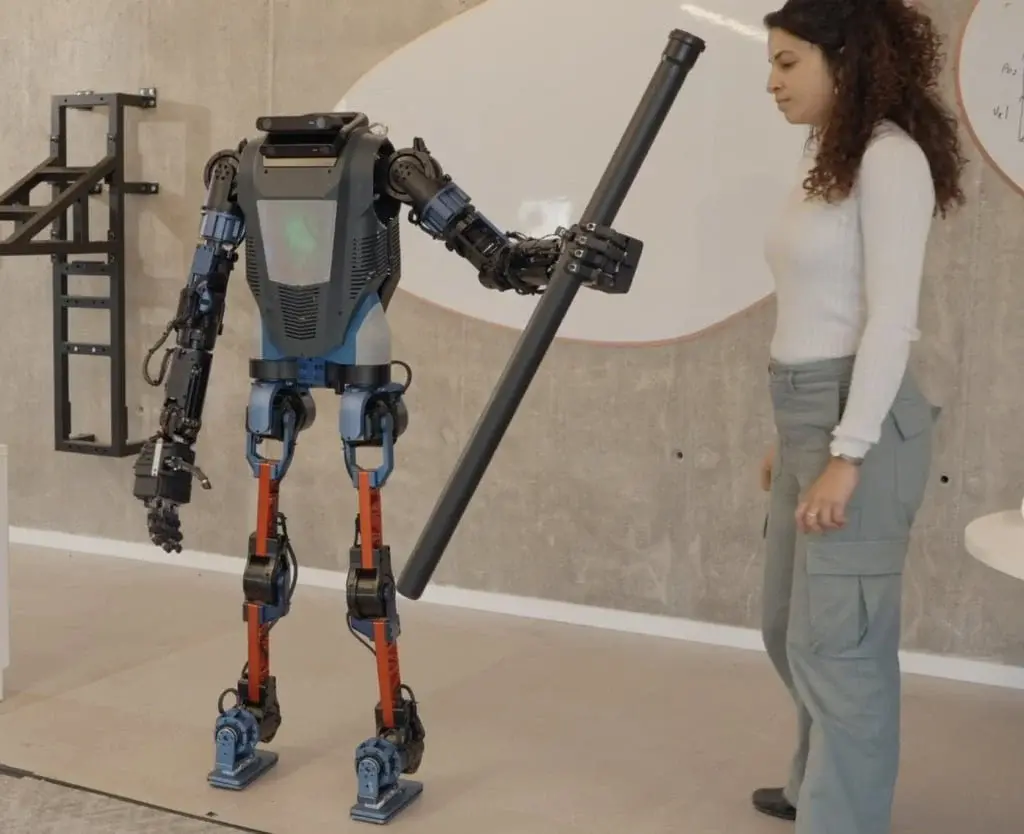
    Mentee Robotics’ groundbreaking product Menteebot is pushing the limits of AI technology with an intelligent human-sized robot suitable for home and commercial settings, capable of walking, running, sidestepping and sideways moving similar to human beings – as well as performing complex lifting tasks with its substantial size. Furthermore, its design differs significantly from typical humanoid robots by forgoing its typical headless design, creating an less intimidating presence overall.

    Advanced Conversational Abilities

    Menteebot stands out among humanoid robots with its advanced AI functionalities, excelling at engaging in conversations and carrying out commands articulated in natural language. Furthermore, users have the option to train Menteebot for new tasks using an interesting method – imagine having your virtual Menteebot repeatedly practice its task digitally until mastery has been reached – once training phase concludes, the Menteebot should be ready to carry out physical actions, such as pouring milk.

    Impressive Agility And Precision

    Menteebot displays remarkable agility through numerous videos that display its remarkable agility by running and performing various movements with great agility and precision. For instance, its arms and hands offer full mobility and precision that enable Menteebot to execute even intricate tasks, like gently handing a piece of dishware over to someone.

    Menteebot stands as an impressive engineering achievement despite its expected release in 2025 and likely over-optimistic initial promotional materials. While pricing details remain undisclosed, Menteebot will come in two variants; one offering household chore services and another designed specifically to handle manual labor applications.