
Key Takeaways
1. High Performance: The Jetson Thor series offers up to 2,070 FP4 tera-operations per second and 128 GB of memory, significantly outperforming AGX Orin with 7.5 times the AI computing power and 3.5 times better energy efficiency.
2. Powerful Specifications: Equipped with a Blackwell GPU and a 14-core Arm CPU, Jetson Thor allows for seamless execution of multiple AI tasks related to language, vision, and control without slowdowns.
3. Compact and Efficient Design: Despite its powerful capabilities, Thor maintains a compact design, doubling the power range of earlier models to support real-time multi-AI workflows and safe human-machine interaction.
4. Versatile Applications: The module supports edge-class generative models and is suited for low-latency applications like humanoid robots, agricultural automation, and surgical assistance, facilitating a smooth transition from development to production.
5. Ethical Considerations: The enhanced capabilities of Thor raise concerns about potential misuse in autonomous systems and the impact on employment, highlighting the need for strong safeguards, oversight, and accountability.
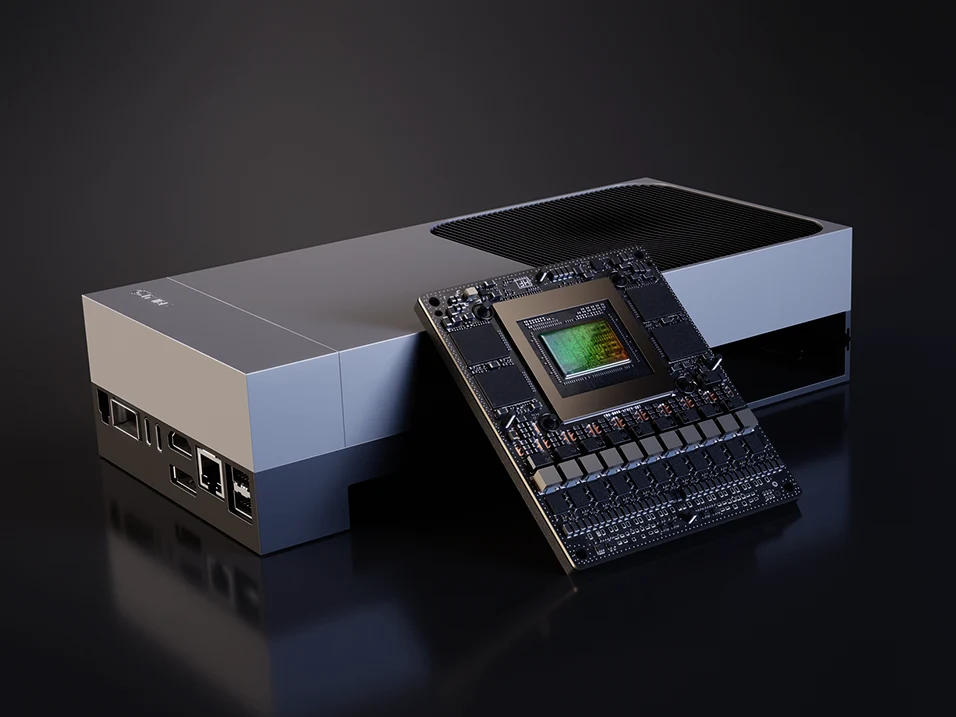
Nvidia has introduced the Jetson Thor series, which focuses on “physical AI” through compact modules comparable to laptops. These modules can handle up to 2,070 FP4 tera-operations per second and come with 128 gigabytes of memory, all while operating within a power range of 40 to 130 watts. Nvidia presents Thor as a major improvement over AGX Orin, boasting about 7.5 times the AI computing power and 3.5 times better energy efficiency. This allows robots to execute complex models locally without depending on cloud services.
Powerful Specifications
The Jetson AGX Thor includes a Blackwell GPU paired with a 14-core Arm CPU, which provides excellent memory bandwidth and clock speeds. These features make it possible for robots to run various AI tasks related to language, vision, and control at the same time without experiencing any slowdowns.
Compact and Efficient Design
Maintaining the small size of earlier Jetson models, Thor doubles the power range of Orin to achieve its performance goals. Nvidia aims to support real-time multi-AI workflows, enhancing the ability of machines to interact safely with humans.
Nvidia has announced that production modules and development kits for the new Jetson platform are already available. Notable early users include Amazon, Meta, John Deere, OpenAI, and Boston Dynamics. Agility Robotics is planning to use Thor in its sixth-generation Digit humanoid aimed at warehouse tasks, while Boston Dynamics is developing a new version of Atlas to work with Thor. The pricing is set at $2,999 for each Jetson Thor T5000 module when ordered in 1,000-unit batches, and $3,499 for AGX Thor development kits.
Versatile Applications
Nvidia refers to this chip as a “robot brain,” and the description fits perfectly: it enables edge-class generative models, large language models, and high-throughput vision to work together on a single module. This capability opens up applications that need low latency, such as humanoid robots, agricultural automation, and surgical assistance, where timing is crucial and missing a frame could lead to errors.
The main advantage is evident: teams can swiftly move from the development phase to production, using the same software for both perception and planning. Nevertheless, there are considerable risks. The increased power of Thor could potentially enhance autonomous systems for both beneficial and harmful purposes, as demonstrated by Jetson Orin in conflict regions. The effect on employment is unclear; while some jobs may remain, tasks might become more monotonous. Strong safeguards, vigilant oversight, and clear accountability are vital as these technologies continue to evolve.
Source:
Link
Leave a Reply