
Key Takeaways
1. Neutron star mergers create powerful gamma-ray bursts, among the most intense explosions in the universe.
2. The magnetic fields generated by these stars are extremely strong, up to 10 trillion times more potent than typical refrigerator magnets.
3. NASA’s Pleiades supercomputer was used for over 100 simulations to study the effects of magnetic fields during neutron star mergers.
4. Significant interactions among magnetic field lines occur in the last 7.7 milliseconds before a merger, converting particles into radiation and vice versa.
5. While high-energy gamma-rays cannot escape due to strong magnetic fields, lower-energy gamma-rays can escape and may lead to X-ray emissions, providing insights into neutron star mergers.
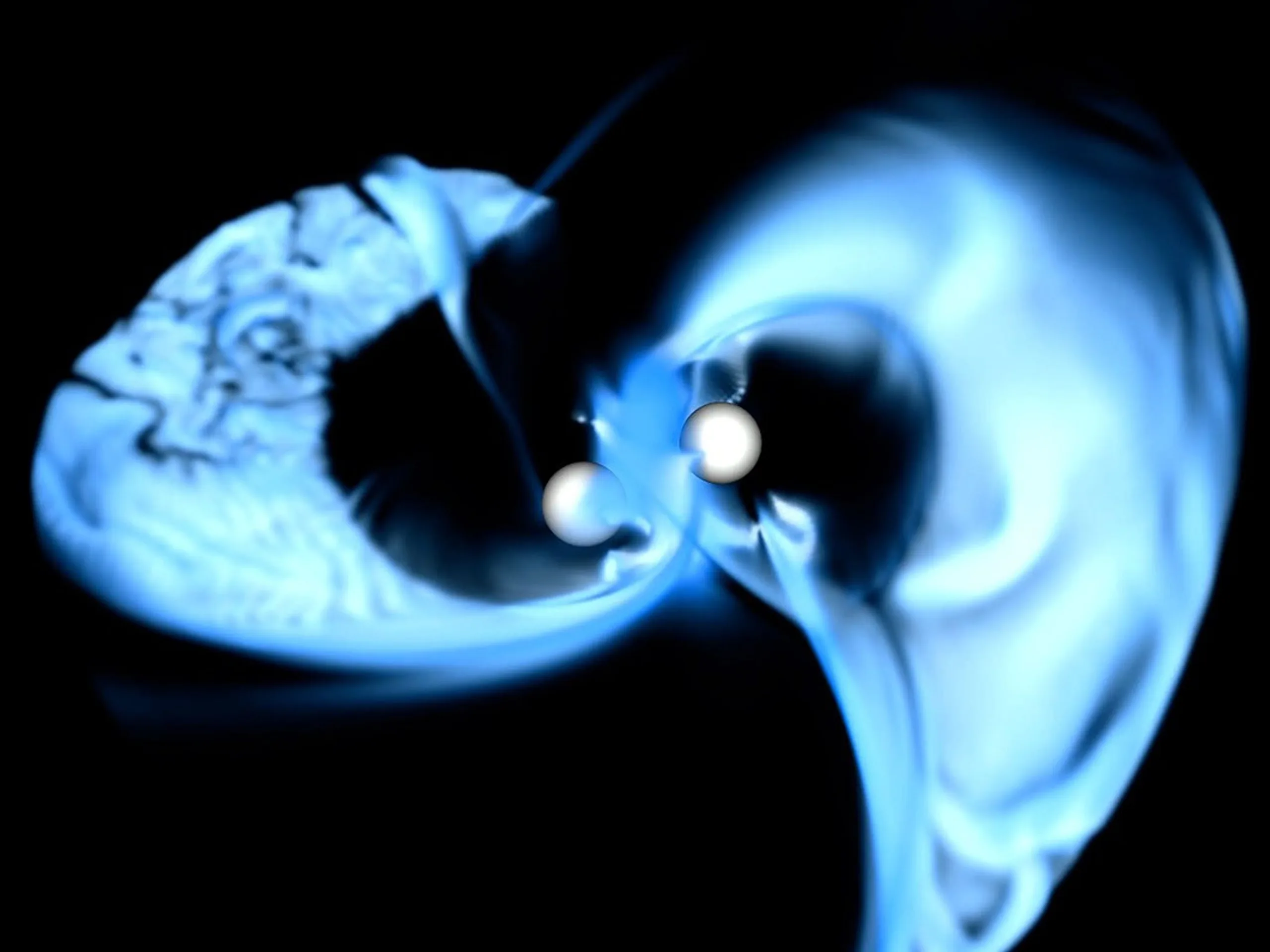
When a neutron star merger takes place, it creates one of the most intense explosions in the universe — gamma-ray bursts. Prior to these mergers, the stars revolve dozens of times, generating a magnetic field. This magnetic field is among the most powerful known, being up to 10 trillion times more potent than a typical refrigerator magnet. The strength of these magnetic fields allows them to convert gamma-rays directly into electrons and positrons, accelerating them to extremely high energies.
Complex Simulations
Scientists utilized NASA’s Pleiades supercomputer to conduct over 100 simulations to examine how various magnetic field setups influenced the emission of electromagnetic waves from a pair of orbiting neutron stars, each with a mass of 1.4 solar masses. Most simulations concentrated on the last 7.7 milliseconds leading up to the merger. The results indicated a significant interaction among the magnetic field lines during this brief period, where the lines connect, break apart, and reconnect. As these fields interact, particles are turned into radiation and the other way around.
Insights on Gamma-Rays
The simulations also identified areas where the highest-energy gamma-rays are generated. These gamma-rays cannot escape the merging system due to their rapid conversion into particles in the presence of strong magnetic fields. However, lower-energy gamma-rays can escape and may produce X-rays later. Future observatories could focus on detecting these lower-energy emissions, offering scientists a glimpse of a neutron star merger just before it occurs.
Source:
Link
Leave a Reply