
Key Takeaways
1. New Panther Lake CPUs Unveiled: Intel officially launched the Panther Lake CPUs for laptops, succeeding the Lunar Lake CPUs, but without desktop variants.
2. Advanced Specifications: The Panther Lake chips are built on the Intel 18A process and feature new P-cores, E-cores, and an integrated Xe3 GPU, claiming over 50% better CPU and GPU performance compared to Lunar Lake.
3. Diverse CPU Models: Intel offers three main CPU models, including a top-tier 16-core model with extensive PCIe and memory support, a mid-range option with fewer GPU cores, and an entry-level 8-core chip.
4. Memory System Changes: The Panther Lake CPUs transition back to conventional DDR5 and LPDDR5, allowing for higher memory capacity and speed compared to the previous on-die memory system.
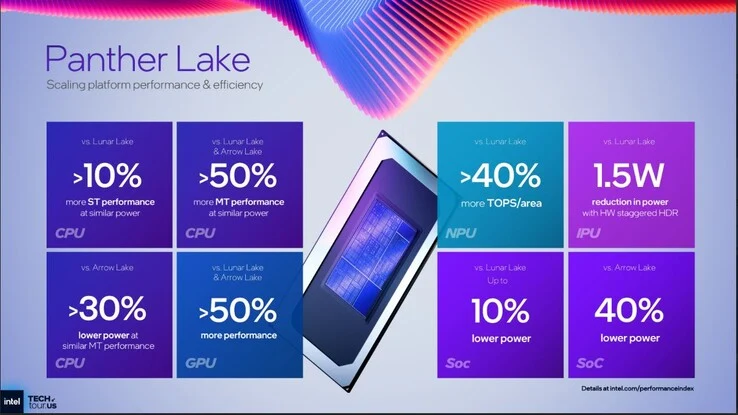
5. Efficiency Improvements: Intel claims Panther Lake CPUs provide over 10% faster single-core performance and more than 50% better multi-core performance than earlier models, while consuming up to 30% less power than Arrow Lake.
After a long period of speculation and leaks, the new Intel Panther Lake CPUs for laptops have been officially unveiled. These chips are the next version following the Intel Lunar Lake CPUs, but they do not have any desktop variants. This may disappoint fans who were looking forward to new Intel desktop processors.
Impressive Specifications
The Intel Panther Lake products look quite promising on paper. They are built on the advanced Intel 18A process node and utilize technologies like RibbonFET and PowerVia. Intel asserts that these chips merge the efficiency of the Core Ultra 200V Lunar Lake with the multi-core prowess of the Core Ultra 200H Arrow Lake mobile CPUs.
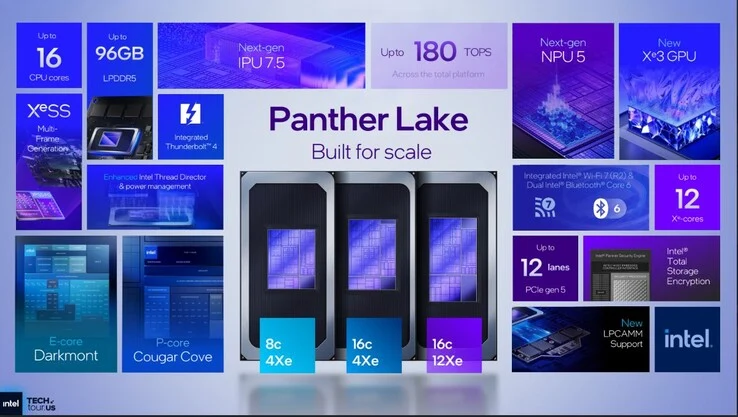
At the core of the Panther Lake CPUs are the new “Cougar Cove” P-cores, “Darkmont” E-cores, along with an Intel Arc Celestial-based Xe3 integrated GPU (iGPU). Intel claims that these innovations provide Panther Lake with over 50% better CPU and GPU performance compared to Lunar Lake. But before diving into performance claims, let’s examine the core specifications and the available Panther Lake models.
Diverse Offerings
Intel is categorizing the PTL CPUs into three main groups:
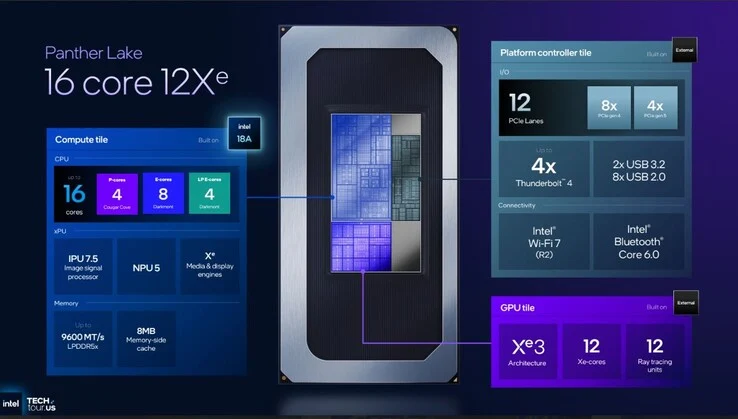
The top-tier 16-core model includes:
In addition, this CPU supports 12 PCIe lanes (8 Gen 4 + 4 Gen 5), up to 4 Thunderbolt 4 ports, and Intel Wi-Fi 7 Rev 2/BT 6.0.
Intel is also revamping the memory system with Panther Lake. The on-die memory of Lunar Lake is being replaced, as Intel returns to conventional DDR5 and LPDDR5 modules. This change is favorable since the on-die memory on previous chips constrained OEMs in terms of configurations and pricing. According to Intel, the highest-end PTL model can accommodate up to 96 GB of LPDDR5x memory at 9,600 MT/s.
Mid-Range Options
Beneath the top PTL processor, Intel is providing OEMs with a 16-core chip that has fewer Xe3 cores. This could be a solid choice for budget gaming laptops, allowing OEMs to pair the 16-core PTL CPU with mid-range discrete GPUs like the RTX 5060 (desktop version is available on Amazon).
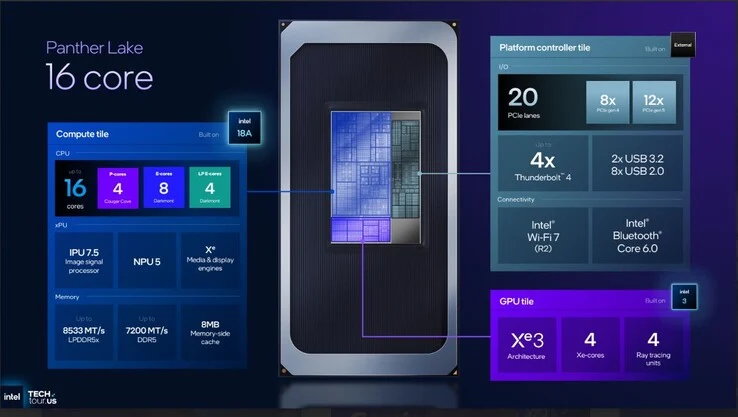
The main specifications for this version consist of:
This chip has only 4 Xe3 iGPU cores, 20 PCIe lanes instead of 12, and slower maximum memory speeds. Intel has capped the mid-range PTL SKU at 7,200 MT/s for DDR5 and 8,533 MT/s for LPDDR5x. Other connectivity options, such as 4 Thunderbolt 4 support, are unchanged.
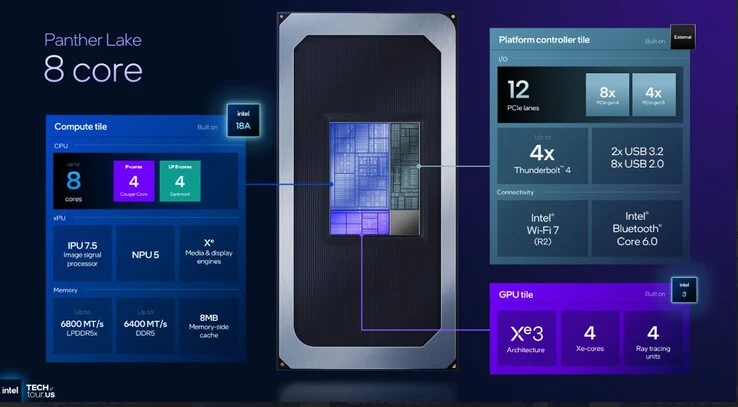
For budget-friendly thin and light laptops, Intel has an 8-core Panther Lake chip with:
This SKU lacks regular E-cores. Furthermore, this entry-level processor shares the same GPU tile and Platform controller tile as the mid-range model. Thus, the PCIe lanes, connectivity features, and iGPU specifications remain the same. However, the memory system has been reduced, with Intel limiting this entry-level Panther Lake model to 6,400 MT/s of DDR5 and 6,800 MT/s of LPDDR5x.
Efficiency Claims Awaited
Unfortunately, Intel has only provided basic performance and efficiency metrics for the Panther Lake CPUs. Therefore, we will need to wait for thorough testing to see how these CPUs actually compare with Lunar Lake and Arrow Lake-H.
Intel claims that the leading Panther Lake SKU delivers more than 10% faster single-core performance than Lunar Lake and Arrow Lake CPUs at similar power levels. The improvement in multi-core performance is even more significant, with Intel boasting a greater than 50% increase in multi-core performance compared to Lunar Lake and Arrow Lake at similar power levels. Hyper-threading is still absent.
Intel also appears to have improved power efficiency. The company reports that Panther Lake CPUs consume 30% or less power than Arrow Lake to achieve the same level of multi-core performance. The SoC tile for Panther Lake reportedly uses 10% less energy than Lunar Lake and a substantial 40% less power than Arrow Lake.
We’ve dedicated another article to the iGPU gaming performance, so don’t forget to see how the Panther Lake’s Xe3 iGPU compares to previous generations.
In summary, we can anticipate runtime performance that is similar or even superior to that of Lunar Lake-based laptops. In our analysis of Lunar Lake, we noted that while the Core Ultra 200V chips may not excel in raw performance, they were notably power-efficient. This efficiency led to devices powered by Core Ultra 200V, like the Asus Vivobook S14, achieving excellent battery life.
Source:
Link
Leave a Reply