
Key Takeaways
1. Messier 96 is a spiral galaxy located 35 million light-years away in the Leo constellation, comparable in size and mass to the Milky Way.
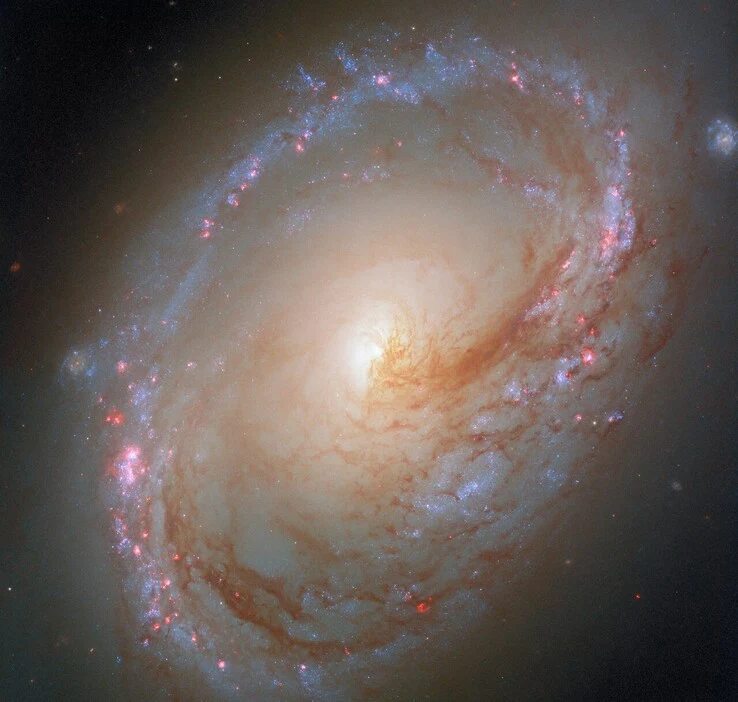
2. Hubble’s latest image reveals new star formation in pink regions along the galaxy’s spiral arms, where young stars interact with hydrogen gas.
3. The galaxy exhibits an irregular shape and uneven gas and dust distribution, influenced by gravitational interactions with nearby galaxies.
4. The core of Messier 96 glows milky white due to the light from many stars, with dark red dust strands partially obscuring it.
5. This new image enhances scientific understanding of star formation in dusty gas clouds and the interactions between dust and starlight.
The NASA/ESA Hubble Space Telescope has taken another look at a galaxy known as Messier 96. This spiral galaxy is situated 35 million light-years away in the Leo constellation, also known as The Lion. Its size and mass are roughly comparable to that of our own Milky Way galaxy, making it the most luminous galaxy within its group.
New Insights on Star Formation
Previously, Hubble shared images of this galaxy in 2015 and 2018. However, the latest image provides deeper understanding of star formation occurring within Messier 96. The image highlights pink areas along the galaxy’s spiral arms, which are regions where new stars are being born.
In these star-forming regions, young stars emit light that interacts with the surrounding hydrogen gas. Additionally, the blue areas visible in the spiral arms represent the light emitted by existing stars.
Unique Features of Messier 96
One notable aspect of this galaxy, as depicted in the image, is its irregular shape and the uneven spread of gas and dust. Furthermore, the galaxy contains a core that is not centered properly. These characteristics may be due to what ESA refers to as a “galactic tug of war.” It is believed that the gravitational influence from nearby galaxies is impacting the distorted shape of Messier 96.
The core of the galaxy is seen as a milky white glow, which results from the combined light of countless stars. In the image, dark red dust strands weave around the spiral arms, partially obscuring the central glow.
Contribution to Scientific Understanding
This new image will assist scientists in comprehending star formation within large, dusty gas clouds. Additionally, it will aid in investigating how dust interacts with starlight and the relationships between these stars and their surrounding environments.
Source:
Link
Leave a Reply