Category: Software

  • Xiaomi 14 Series First to Receive HyperOS 2 Update

    Xiaomi 14 Series First to Receive HyperOS 2 Update

    A leaked screenshot reveals Xiaomi 14 running on HyperOS 2.0.240703. Xiaomi initially introduced this device with HyperOS last year, and it is now undergoing tests with the HyperOS 2 operating system, suggesting an imminent release.

    Internal Testing in August

    HyperOS 2 is anticipated to be another successful custom skin from Xiaomi, built on Android. Since its debut, HyperOS has garnered considerable interest among Android users. According to industry insiders, HyperOS 2.0 will bring significant enhancements over its predecessor, addressing notable issues and introducing a range of exciting new features.

    The Xiaomi 14 series, Xiaomi's latest flagship, is expected to be the first to receive the HyperOS 2 update. Reports indicate that internal testing will commence in August.

    Upcoming Releases

    The Xiaomi 15 series, slated for a late October release, will come pre-installed with HyperOS 2. The global version of HyperOS 2 is anticipated to launch in late December or early next year. Besides the Xiaomi 14 series, the Redmi K80 series, and Poco F6 series are also among the first devices to receive this update.

    Although Xiaomi has yet to disclose specific improvements, the update is likely to enhance system functions, smoothen operations, and improve the overall user experience. Expectations are high for better system animations and the inclusion of some AI features.

    For those unfamiliar with Xiaomi’s HyperOS, it has a notably lighter footprint, occupying only 9.14 GB compared to the 12.53 GB required by a recent MIUI version. HyperOS also provides a simpler user interface, emphasizing a minimalist experience with its custom skin.

  • Nothing OS 2.6 Update: New Features, Game Mode, Bug Fixes

    Nothing OS 2.6 Update: New Features, Game Mode, Bug Fixes

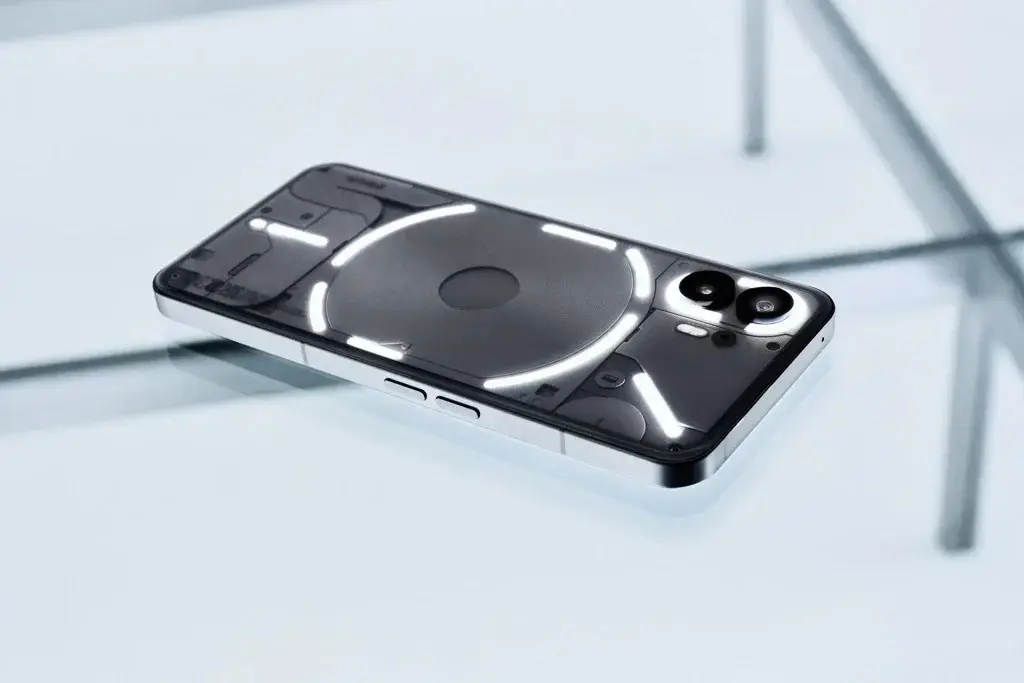
    Nothing has rolled out the latest Nothing OS 2.6 update for its Nothing Phone (2), bringing a host of new features, game mode improvements, and crucial bug fixes. This update has a size of 87MB. Below is the full changelog.

    New Features & Experience Improvements

    • Added support for deleting wallpaper history in Wallpaper Studio.
    • Enhanced initial setup for the Weather Widget/app with user-friendly prompts to add a specific city.
    • Added support for displaying CMF Watch battery level in the Quick Settings Bluetooth tile.
    • Optimized the Low Lag Mode experience for Nothing earbuds.

    Game Mode Enhancements

    • Tap the left sidebar for quick access to Game Dashboard during games.
    • Incoming calls during games can now appear in a pop-up view.
    • Added support to reject third-party app calls during gameplay.
    • Support for one-tap callback after rejecting a regular call.
    • Optimized light notifications to show more information during games.
    • Support for blocking notifications during gameplay to reduce distractions.

    Bug Fixes

    • Fixed an issue affecting voice and call recording in WhatsApp.
    • Resolved anomalies when making emergency calls in certain scenarios.
    • Fixed an issue where some apps could not use the Cloned Apps feature properly.
    • Other general bug fixes.

    As with most firmware updates, the Nothing OS 2.6 update is being deployed in stages. This staggered rollout allows Nothing to monitor for any potential issues and ensures a stable update process. Users who have not yet received the OTA notification can manually check for the update by going to Settings > System > System Update.

  • Google Fuchsia OS May Run Virtually on Android Devices: Report

    Google Fuchsia OS May Run Virtually on Android Devices: Report

    In a surprising development, Google’s mysterious Fuchsia operating system could soon be seen on Android devices, not as a complete replacement, but as a virtualized entity.

    Fuchsia OS was first unveiled in 2016 and debuted on its first commercial device in 2021 with the launch of the first-generation Nest Hub. However, its presence has not extended beyond the Nest Hub so far. A recent report, however, indicates that Fuchsia OS might operate as a virtual machine on Android devices.

    A New Foundation

    What sets Fuchsia apart is its unique foundation compared to Android and ChromeOS. Instead of relying on a modified Linux kernel, it is built from scratch using a microkernel named Zircon. This microkernel architecture promises increased efficiency, flexibility, and security by reducing the amount of trusted code in the system.

    The latest development involves a project called “microfuchsia.” This project reportedly aims to enable Fuchsia to run on existing devices through virtualization.

    How Virtualization Works

    Virtualization creates a software-based replica of a physical device, allowing it to function in a separate computing environment. This separation ensures that programs running on the main OS and within the virtual machine do not interfere with one another.

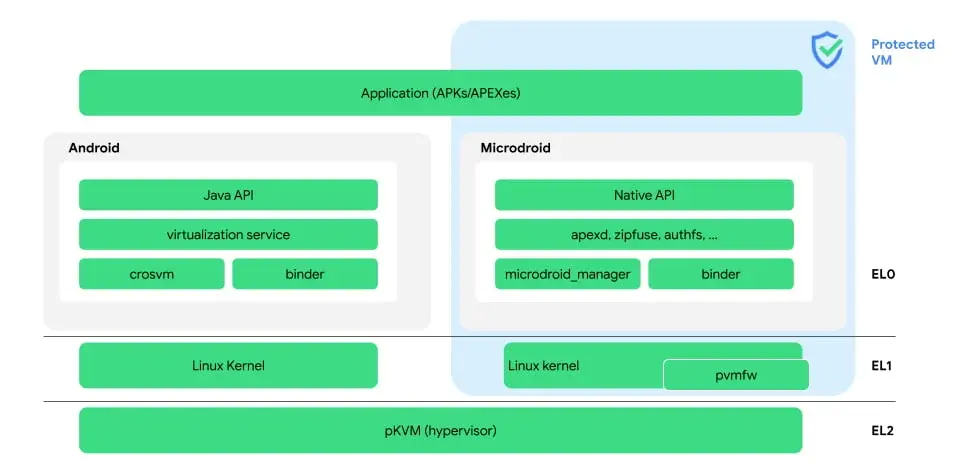
    Reports from the Fuchsia Gerrit code repository indicate that microfuchsia will utilize virtualization software such as QEMU and pKVM. The latter, developed by Google, focuses on layered security for isolated workload execution. Intriguingly, Google also developed a lightweight Android variant called “microdroid” for this purpose.

    Unclear Future

    The potential role of microfuchsia on Android devices is still uncertain. Nonetheless, its similarities to microdroid suggest it might be used for tasks that require enhanced security.

    The rationale behind a separate Fuchsia solution, given the existence of microdroid, remains undisclosed. It is plausible that Google views Fuchsia as a more secure and efficient option for virtualized workloads within the Android ecosystem.

  • Google to Enhance Android Security with Microfuchsia Virtual Machine

    Google to Enhance Android Security with Microfuchsia Virtual Machine

    Fuchsia is an open-source operating system developed by Google with a focus on simplicity and security. Previously, Google made versions of Fuchsia available for Pixel-branded Chromebooks and Google Nest Hub smart home devices.

    Fuchsia's Foundation

    Fuchsia is built on a custom kernel named Zircon, which has its roots in the Little Kernel operating system. Google describes Zircon as a combination of a kernel and a limited set of userspace services, drivers, and libraries essential for core system functions, such as booting.

    The latest development reveals that Google is working on "Microfuchsia," a streamlined version of the Fuchsia operating system designed to operate on Android devices within a virtual machine. This new version is aimed at running in virtual machines on devices like the Nest Hub, marking a shift in how Fuchsia is being deployed.

    Microfuchsia's Potential

    Microfuchsia could serve to run specific functions in a secure, isolated environment. Although there have been rumors about Fuchsia OS eventually replacing Android, this seems improbable at the moment. Instead, Google is experimenting with the OS in various innovative ways, including developing a trimmed-down version to operate within Android devices via a virtual machine.

    Google has ambitious goals for Fuchsia OS, aiming to deploy it across smartphones, PCs, and smart home devices. The first-generation Nest Hub featured Fuchsia in 2021, followed by its inclusion in the second-generation Nest Hub. While the current focus isn't on replacing Android, the integration of Fuchsia could bring significant changes to some core functionalities of Android. Google notes that Microfuchsia is intended for use in virtualization solutions. However, it will likely be incorporated into Android only if it enhances the user experience.

    Advancements in Virtualization

    With the introduction of pKVM, a hypervisor for the Android Virtualization Framework (AVF) in Android 13 on select devices, Google aims to run certain types of workloads securely in an isolated environment. The development of Fuchsia could potentially bolster the security of specific functions on Android devices.

    (Via)

  • Xiaomi Begins Testing HyperOS 2.0

    Xiaomi Begins Testing HyperOS 2.0

    Xiaomi has begun testing HyperOS 2.0. According to the XiaomiTime team, new details have surfaced confirming the official testing of HyperOS 2.0. There had been rumors circulating about HyperOS 2.0 for several weeks, but their credibility was uncertain. Now, the XiaomiTime team has uncovered significant evidence proving that HyperOS 2.0 is indeed in the testing phase. This crucial information will now be shared: HyperOS 2.0 is set to be officially unveiled in October.

    Xiaomi Accelerates Work on HyperOS 2.0

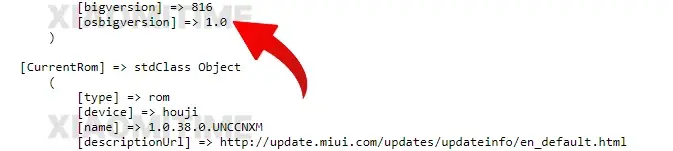
    Xiaomi has officially ramped up efforts on HyperOS 2.0. A newly identified extension called [OSBigversion] has been found on the Xiaomi OTA server. This extension is designed to specify HyperOS versions. For instance, if you’re using HyperOS 1.0, the extension will appear as [OSBigversion] => 1.0. Similarly, if you’re on HyperOS 2.0, it will show as [OSBigversion] => 2.0.

    In the past, there was no OSBigversion extension; instead, a [Bigversion] extension was used for major MIUI versions. This [Bigversion] extension indicated the major MIUI versions, such as "[bigversion] => 14" for MIUI 14. Xiaomi has utilized this type of extension for many years. Now, a special "OSBigversion" extension has been introduced specifically for HyperOS.

    Ensuring Smooth Updates

    This new extension has been added to the OTA server to distinguish between different HyperOS versions. With the implementation of the [OSBigversion] extension, new HyperOS versions will be delivered to devices seamlessly, ensuring smooth updates without any issues. This development signifies that the work on HyperOS 2.0 has officially commenced.


  • Apple Approves Rival App Store: New Era of Competition Begins

    Apple Approves Rival App Store: New Era of Competition Begins

    Apple is undoubtedly one of the world’s most profitable companies. However, if you think the tech giant’s revenue comes solely from hardware sales like iPhones, iPads, Macs, and AirPods, you’re mistaken. The company also generates substantial income from its App Store, which technically offers alongside these products.

    However, this revenue has been under threat due to the European Union requiring Apple to open its ecosystem to third-party app marketplaces. The situation is so dire that Apple has had to allow marketplaces from adversaries it has been in legal battles with, such as Epic Games. Here are the details…

    Apple Approves Epic Games’ App Store

    The battle between Epic Games and Apple continues at full speed. This rivalry, which made headlines in the past with events like the removal of Fortnite from the App Store and Epic’s lawsuit against Apple, has recently resurfaced with the third-party app marketplace issue. Allegedly, Apple has been intentionally delaying the approval needed for Epic Games to launch its own app store in the EU region.

    Apple has been using excuses like the store’s close resemblance to the original App Store during this process. Epic Games made the following statement regarding the issue:

    Apple has rejected our Epic Games Store notarization submission twice now, claiming the design and position of Epic’s “Install” button is too similar to Apple’s “Get” button and that our “In-app purchases” label is too similar to the App Store’s “In-App Purchases” label. We are using the same “Install” and “In-app purchases” naming conventions that are used across popular app stores on multiple platforms, and are following standard conventions for buttons in iOS apps. We’re just trying to build a store that mobile users can easily understand, and the disclosure of in-app purchases is a regulatory best practice followed by all stores nowadays.

    However, according to Apple, Epic Games is being a bit “dramatic.” The company states that the rejection is not due to a personal vendetta but simply because Epic Games did not meet the high standards required. In fact, Epic Games’ third-party app marketplace has been approved.

    The Real Competition Begins

    The real competition is just beginning. Unlike other App Store alternatives, Epic Games is a sizable company. With its connections, disdain for Apple, and vast resources, Epic Games has the potential to undermine App Store revenues in Europe. However, we can only wait and see if this will actually happen.

  • Authy Data Breach Exposes 33M Phone Numbers

    Authy Data Breach Exposes 33M Phone Numbers

    Twilio, the firm responsible for the two-factor authentication app Authy, has experienced a security breach that exposed 33 million phone numbers linked to Authy accounts due to an unsecured API endpoint.

    Details of the Breach

    On July 1, 2024, Twilio revealed the breach through a blog post. The incident was caused by an “unauthenticated endpoint” that permitted unauthorized access to data linked to Authy accounts. Fortunately, no passwords, two-factor authentication seeds, or other highly sensitive account details were compromised, but phone numbers associated with Authy accounts were exposed.

    Threat and Response

    The hacking group ShinyHunters has been identified as the culprits behind the breach. They have released a file containing the exposed phone numbers on a hacking forum, which has heightened the risk of phishing attacks and SIM swapping. In response, Twilio has secured the vulnerable endpoint and assured users that no other Twilio systems or sensitive data were accessed. Users are encouraged to update their Authy apps to the latest versions (Android v25.1.0 or later, iOS v26.1.0 or later) to boost security.

    Preventive Measures for Users

    Authy users should take the following steps to protect themselves:

    • Update the Authy App: Make sure you are using the latest version, which includes crucial security updates.
    • Enable SIM Lock: Protect your SIM card with a passcode to prevent unauthorized transfers.
    • Beware of Phishing and Smishing: Be vigilant of unsolicited messages or calls asking for login information, as these could be attempts to steal your credentials.
    • Consider a Different Authenticator App: You may also switch to a different 2FA app. Aegis Authenticator is a free-to-use option for Android users.

    Official Statement from Twilio

    Twilio has reiterated its dedication to security and transparency, stating, “We believe that the security of our products and our customer’s data is of paramount importance and when an incident occurs that might threaten that security, we tell you about it.”

    Twilio’s Security Incident Response Team is closely monitoring the situation and will provide updates as necessary. Users experiencing issues with their Authy accounts are urged to reach out to Authy support for assistance.

  • Airtel denies data breach claims affecting 375 million users

    Airtel denies data breach claims affecting 375 million users

    Bharti Airtel, a major player in the Indian telecommunications sector, is currently embroiled in accusations of a data breach affecting an astounding 375 million users. The company has categorically refuted these allegations, labeling them a “desperate attempt to tarnish Airtel’s reputation by vested interests.”

    Reports from the Dark Web

    Dark Web Informer on X.com disclosed that an unidentified vendor named “xenZen” has put the data of 375 million Airtel subscribers up for sale on a hacker forum called BreachForums. The purported data includes sensitive information such as names, family details, contact information, and even Aadhaar numbers, the unique 12-digit identification number assigned to Indian citizens.

    Airtel’s Official Response

    Airtel quickly issued a statement through a spokesperson, stating, “There has been an ongoing report alleging that Airtel customer data has been compromised. This is nothing short of a desperate attempt to tarnish Airtel’s reputation by vested interests. We have done a thorough investigation and can confirm that there has been no breach whatsoever from Airtel systems.”

    Previous Breach Claims

    Alarmingly, xenZen also took credit for another recent data leak involving the Indian Ministry of External Affairs (MEA). This breach, discovered in late June, reportedly compromised data from approximately 200,000 users registered on the MEA’s eMigrate portal. Nevertheless, the authenticity of both claims remains unconfirmed.

    Safeguarding Personal Information

    While the veracity of these claims is still uncertain, the situation underscores the perpetual risk of cyberattacks. Here are some measures to protect your personal data:

    • Be cautious about the information you share online. Limit the amount of personal data you share on public platforms and websites.
    • Use strong and unique passwords for all your online accounts. Consider using a password manager to generate and store complex passwords.
    • Enable two-factor authentication (2FA) wherever possible. This adds an extra layer of security by requiring a second verification code in addition to your password when logging in.
    • Be wary of phishing attempts. Don’t click on suspicious links or attachments in emails or text messages, even if they appear to be from legitimate sources.

    By adhering to these basic security practices, you can help protect your personal information and reduce the potential damage from a data breach.

  • OnePlus 12R Boosts Gaming & Animations with New OxygenOS Update

    OnePlus 12R Boosts Gaming & Animations with New OxygenOS Update

    The OnePlus 12R has begun receiving a significant update to OxygenOS 14.0.0.810 in India. This update will soon be available in other regions as well.

    The firmware version for this new release is IN: CPH2585_14.0.0.810(EX01), initially rolled out in small batches with a wider release anticipated soon. Users are encouraged to report any problems through the OnePlus Community Thread.

    OnePlus 12R OxygenOS 14.0.0.810 Update Changelog

    Animations:

    • Smoother Animations: Enhanced animations for launching and closing apps. New transition animation for Quick Settings and dragging app icons on the Home screen.
    • Blur Effects: Gaussian blur effects added for app icons when opening and closing. New transition animations for Home screen and clock widgets.

    Gaming:

    • Stability: Improved stability during gaming sessions.
    • Bug Fix: Resolved an issue where the screen could turn black during gameplay.

    System Enhancements:

    • Music Controls: Music controls can now be shown in Fluid Cloud.
    • Storage Management: Fixed the issue where system data consumed excessive storage space.
    • Security: Integrated the June 2024 Android security patch.
    • NFC Payments: Resolved an issue preventing NFC-enabled payments.
    • Volume Control: Fixed the problem with volume sliders appearing at the same time.
    • Icon Overlap: Corrected overlapping icons on the Home screen and Recent tasks screen.

    Touch Control:

    • Faster Response: Improved response time for app icons on the Home screen.
    • Enhanced Responsiveness: Better touch control responsiveness when launching and closing apps.

    The update is being released in small batches to ensure stability. Users can manually check for the update by navigating to the settings page, selecting “About This Phone,” and clicking the blue ribbon at the top. To report bugs, users can dial *#800# and select the bug submission option.

  • Chinese Scientists Find Super-Survivor Moss for Extreme Environments

    Chinese Scientists Find Super-Survivor Moss for Extreme Environments

    Chinese scientists have discovered a potential candidate for life on Mars – Syntrichia caninervis, a moss that can withstand extreme conditions. This desert moss thrives in some of Earth’s harshest environments, such as the cold regions of Tibet and Antarctica.

    The moss even managed to regenerate under strict conditions

    Researchers subjected the moss to a series of rigorous tests to evaluate its tolerance limits, and the results were astonishing. Syntrichia caninervis endured dehydration of over 98% of its cellular water, flash-freezing at incredibly low temperatures (-196°C), and intense gamma radiation (over 5000 Gy).

    But the moss’s resilience extends further. Under simulated Martian conditions – which include low atmospheric pressure, freezing temperatures, a dense CO2 atmosphere, and strong UV radiation – Syntrichia caninervis not only survived but also managed to regenerate. This discovery redefines the boundaries of life’s endurance on our planet and paves the way for future space exploration possibilities.

    Future Research and Challenges

    The research, published in the journal “The Innovation”, suggests that this moss could be instrumental in developing habitable environments beyond Earth. However, there are still challenges to address. Martian soil contains chlorates, a toxic and corrosive chemical not yet considered in this study. Additionally, the constant Martian environment, unlike Earth’s cyclical changes, could impose long-term stress on the moss.