Category: Phones

Stay updated with the latest phone news, reviews, and trends. Discover cutting-edge smartphones, features, and innovations in our Phones category at GizNewsDaily

  • Samsung Galaxy Z TriFold Launch: $3,000 Price and 14mm Thickness

    Samsung Galaxy Z TriFold Launch: $3,000 Price and 14mm Thickness

    Key Takeaways

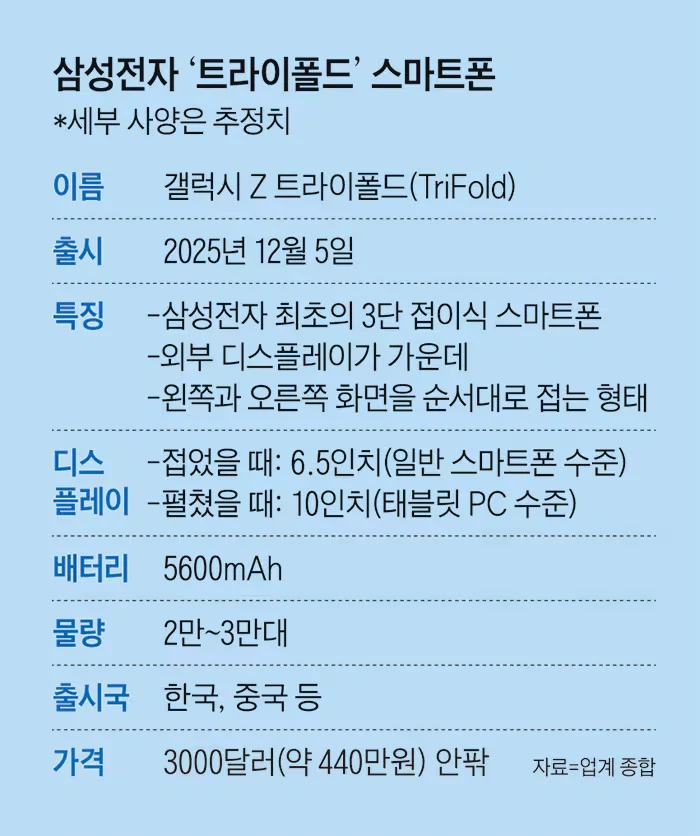
    1. Limited Availability: Samsung may only release 20,000 to 30,000 units of the Galaxy Z TriFold, primarily in Korea and a few Asian regions.

    2. High Price Point: The expected price for the Galaxy Z TriFold is around $3,000, significantly higher than the Galaxy Z Fold7.

    3. Enhanced Battery Capacity: The device is rumored to feature a 5,600 mAh battery, which is a 27% increase compared to the Galaxy Z Fold7.

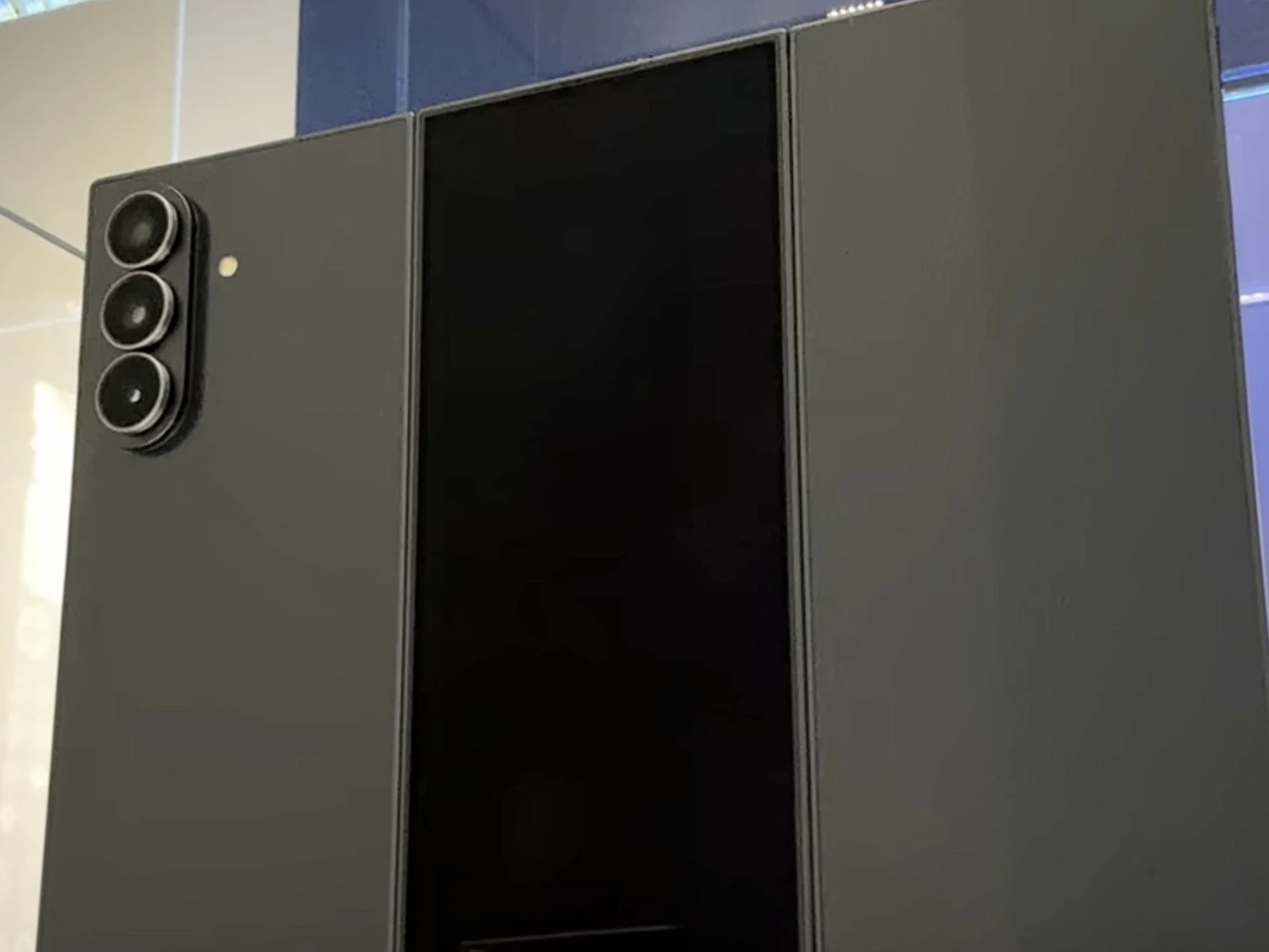
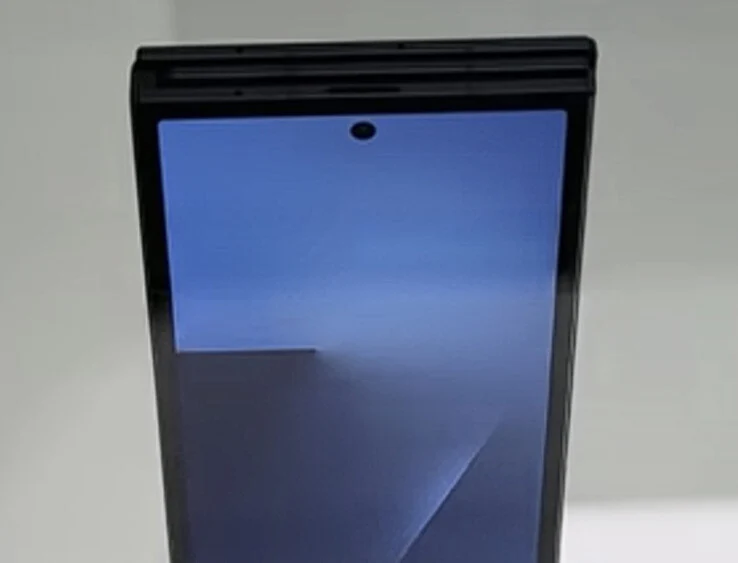
    4. Display Specifications: The Galaxy Z TriFold will have a 6.5-inch cover display and a 10-inch inner display that folds outwards.

    5. Thickness and Release Date: The folded thickness is expected to be 14 mm, making it thicker than its competitors, with a planned launch date of December 5.


    The Chosun Daily has reportedly obtained exclusive details regarding the Galaxy Z TriFold and its differences from the Galaxy Z Fold7, which Samsung launched this year (currently priced at $1,699 on Amazon). This information comes after Samsung has certified its first tri-foldable device for sale in Singapore, which supports dual-SIM connectivity.

    Limited Availability and Pricing

    According to the latest rumors, The Chosun Daily suggests that Samsung may only release between 20,000 and 30,000 units of the Galaxy Z TriFold. Additionally, it seems that the device will be “restricted to Korea and a few other Asian regions.” The report also mentions that the expected price for the Galaxy Z TriFold could be around $3,000, and that name might be the final title for the device.

    Improved Features

    For that hefty price, it is said that Samsung will equip the Galaxy Z TriFold with a 5,600 mAh battery, offering a 27% increase in capacity compared to the Galaxy Z Fold7. The Chosun Daily also claims that the cover display will measure 6.5 inches, similar to its Galaxy Z Fold equivalent, while the left and right edges will fold outward to reveal a 10-inch display inside.

    Dimensions and Release Date

    This hardware configuration is expected to lead to a thickness of 14 mm when the device is folded. To put this into perspective, the Galaxy Z TriFold could be roughly 9% thicker than the Mate XTs and nearly 60% bulkier than the Galaxy Z Fold7. As for the launch date, The Chosun Daily asserts that Samsung plans to unveil the Galaxy Z TriFold on December 5.

    Source:
    Link


  • Samsung Galaxy Z Flip8 & Fold8: Expectations and Hardware Updates

    Samsung Galaxy Z Flip8 & Fold8: Expectations and Hardware Updates

    Key Takeaways

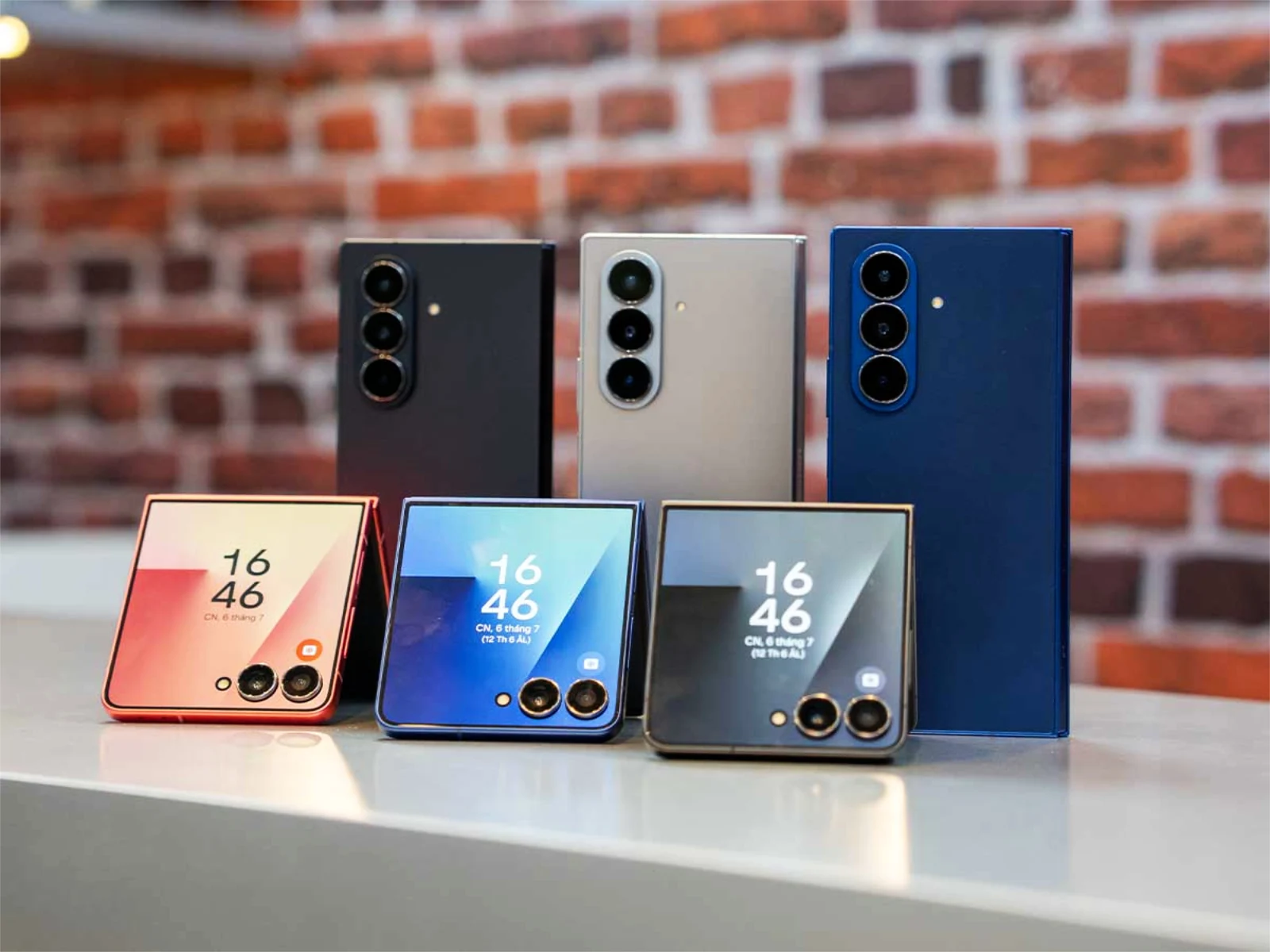
    1. Samsung will launch several premium smartphones, starting with the Galaxy Z TriFold, followed by the Galaxy S26 series in early 2026.
    2. The successors to the Galaxy Z Fold7 and Galaxy Z Flip7 are expected to be named the Galaxy Z Fold8 and Galaxy Z Flip8, with no mention of a Galaxy Z Flip8 FE.
    3. Samsung aims for a 10% increase in sales for its eighth-generation foldables, targeting a total of 6.7 million units shipped.
    4. The Galaxy Z Flip8 will feature a slimmer clamshell design, potentially reducing thickness by nearly 30% to about 9.5 mm.
    5. Advancements between the Galaxy Z Flip7 and Z Flip8 will be significant, similar to the improvements seen between the Galaxy Z Fold6 and Z Fold7.


    Samsung is gearing up for another series of premium smartphone launches in the coming months. Reports suggest that the Galaxy Z TriFold will be released first, followed by the Galaxy S26, Galaxy S26 Plus, and Galaxy S26 Ultra in early 2026.

    Upcoming Galaxy Models

    The Bell Korea has shared insights about Samsung’s future plans for the successors to the Galaxy Z Fold7 and Galaxy Z Flip7, which are currently priced at $1,099 on Amazon. These upcoming devices are likely to be named the Galaxy Z Fold8 and Galaxy Z Flip8, although there has been no talk of a Galaxy Z Flip8 FE at this time.

    Sales Expectations

    Despite this, Samsung is reportedly aiming for ambitious sales goals for its eighth-generation foldables, targeting a 10% increase compared to the seventh generation. According to industry sources and the Samsung Mobile eXperience Business Plan for 2026, The Bell Korea states that Samsung has set a goal to ship 6.7 million units in total, with many of these gains attributed to enhancements in the Galaxy Z Flip hardware.

    Design Changes

    It’s said that Samsung plans to utilize the Galaxy Z Flip8 to unveil a significantly slimmer clamshell foldable design, among other modifications. The Bell Korea reports that the advancements between the Galaxy Z Flip7 and Galaxy Z Flip8 will be comparable to those between the Galaxy Z Fold6 and Galaxy Z Fold7. If true, this could mean a reduction in thickness of nearly 30%, bringing the Galaxy Z Flip8’s folded thickness down to about 9.5 mm.


    Source:
    Link


  • Xiaomi 17 Ultra Launch Details: Two Snapdragon 8 Gen 5 Phones Rumored

    Xiaomi 17 Ultra Launch Details: Two Snapdragon 8 Gen 5 Phones Rumored

    Key Takeaways

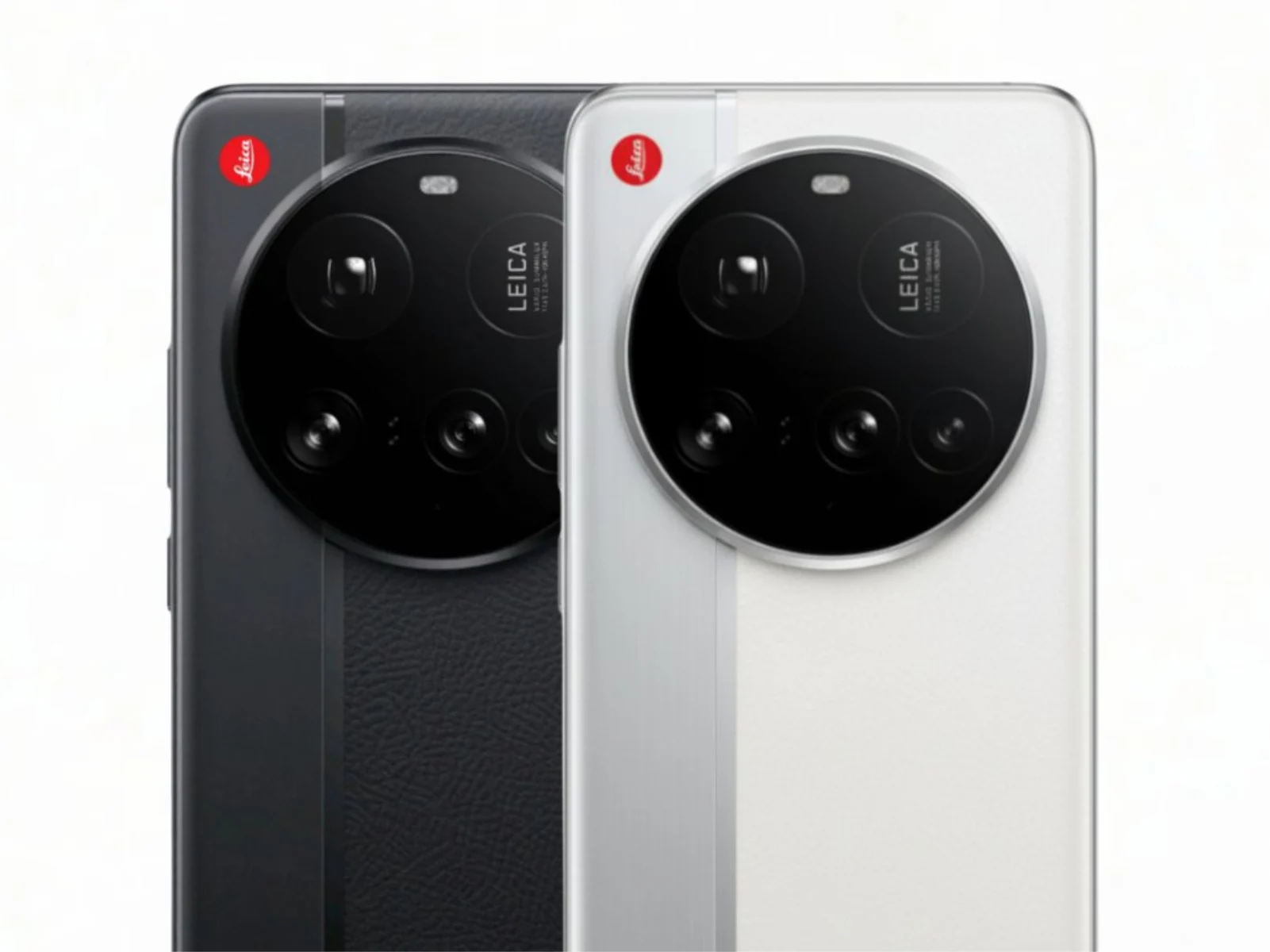
    1. Xiaomi has a pattern of launching Ultra versions of flagship phones about four months after the initial release.
    2. The Xiaomi 17, 17 Pro, and 17 Pro Max were launched on September 25, 2024, with rumors of a Xiaomi 17 Ultra following soon after.
    3. Speculation suggests the Xiaomi 17 Ultra may launch in December 2024, featuring camera improvements and satellite connectivity.
    4. Two new smartphones powered by Snapdragon 8 Gen 5 are also expected in December, likely under the Civi and Redmi Turbo lines.
    5. Current release predictions for the Xiaomi 17 Ultra and the Snapdragon 8 Gen 5 models are primarily for China, with international availability still uncertain.


    In the past few years, Xiaomi has typically waited about four months before launching an Ultra version of its flagship phones. For example, the Xiaomi 15 Ultra was introduced on February 27 and soon after became available worldwide, alongside the Xiaomi 15 (currently priced at $889 on Amazon). In contrast, the Xiaomi 15 was released together with the Xiaomi 15 Pro in China on October 29, 2024.

    New Releases and Rumors

    This year, the Xiaomi 17, Xiaomi 17 Pro, and Xiaomi 17 Pro Max were all launched on September 25. Shortly after, rumors about a possible Xiaomi 17 Ultra started to circulate, mentioning enhancements to the camera and the addition of satellite connectivity. There were also hints that Xiaomi might aim to offer the Xiaomi 17 Ultra by the year’s end in some form.

    December Launch Predictions

    Digital Chat Station reported that the speculation about a December launch for the Xiaomi 17 Ultra is correct. The same source has also mentioned that Xiaomi plans to unveil two smartphones powered by Snapdragon 8 Gen 5 in that same month—one focused on having a large battery for performance, and the other designed for photography in a slim profile. According to recent leaks, these two new models may belong to the Civi and Redmi Turbo lines, serving as successors to the Civi 5 Pro and Redmi Turbo 4 Pro.

    Regional Availability Concerns

    At the moment, this expected release timeframe is believed to only apply to China. It is still uncertain if Xiaomi intends to hold off until MWC 2026 in early March to launch the Xiaomi 17 Ultra globally. The international availability for the two rumored Snapdragon 8 Gen 5 phones is also not yet known.

    Source:
    Link


  • Honor 500 Series Leak Shows iPhone Air-Inspired Design Before Launch

    Honor 500 Series Leak Shows iPhone Air-Inspired Design Before Launch

    Key Takeaways

    1. Honor is set to launch the Honor 500 series, likely featuring two mid-range smartphones.
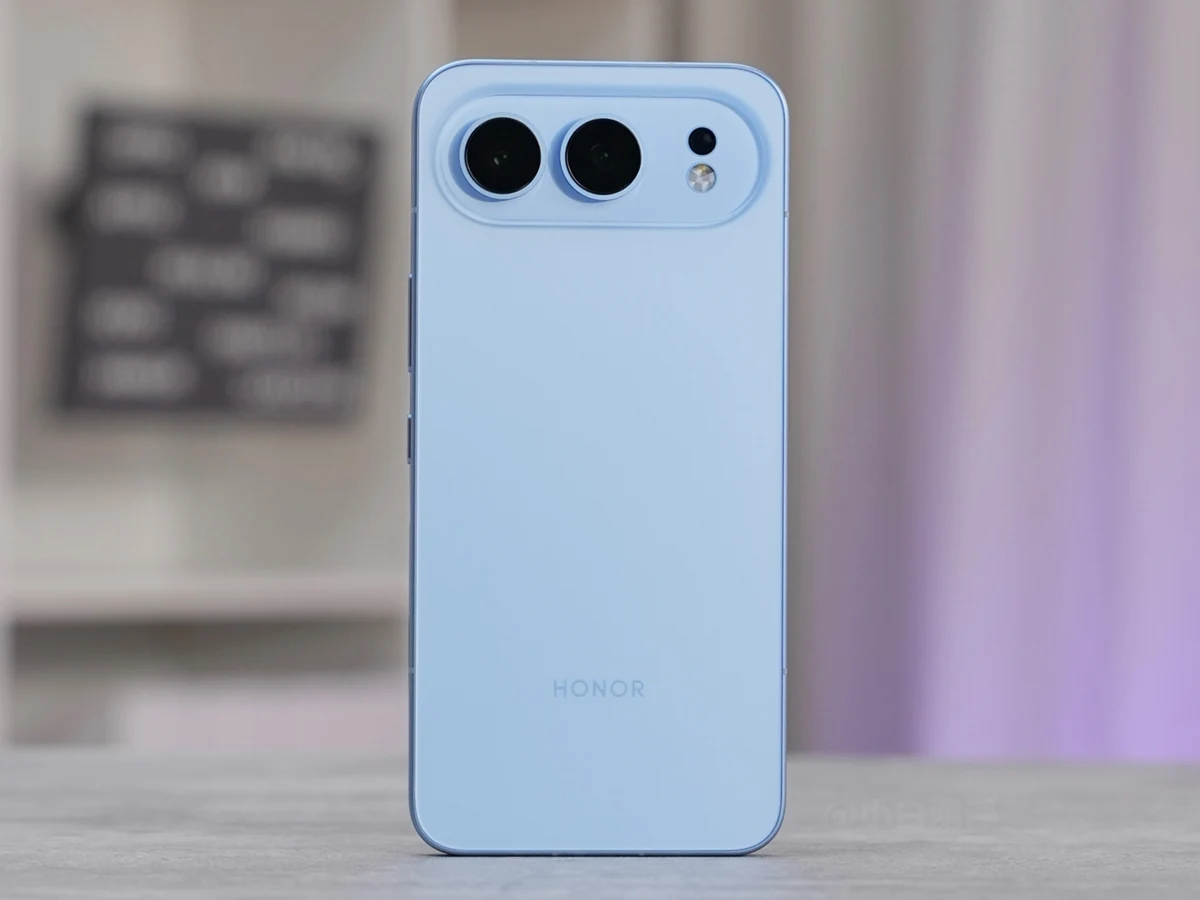
    2. Design leaks show the Honor 500 resembling the iPhone Air, with the standard version having two large camera lenses.
    3. The Honor 500 Pro will have a similar design but will include three camera lenses on the rear.
    4. Both models are expected to have a premium build quality, with the non-Pro version featuring a metal frame and a flat 6.55-inch display.
    5. The Honor 500 series will be unveiled in China on November 24, 2025, with further teasers to come.


    Honor is preparing to reveal the Honor 500 series, which will likely include two mid-range smartphones. Recently, the brand shared an official teaser that hints at the impending launch. Although the phones have not been officially announced yet, a recent leak has provided insights into their design.

    Design Leaks

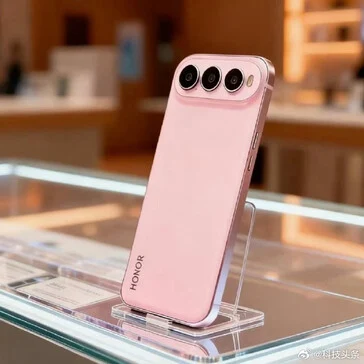
    The leak, which originated from multiple Weibo users including Digital Chat Station, displays the Honor 500 resembling the iPhone Air. The images depict the standard version of the phone featuring a “camera plateau” on its back, but unlike a single lens, Honor’s model includes two large camera lenses instead.

    Camera Features

    On the other hand, the Honor 500 Pro appears to maintain a similar design but is equipped with three significant camera lenses on its rear. According to Digital Chat Station, a trusted leaker on Weibo, the non-Pro variant will have a flat display, anticipated to measure 6.55 inches, complete with generously rounded corners.

    Build Quality and Specifications

    The tipster further explains that the overall build quality is expected to resemble that of Honor’s flagship models. The non-Pro version is likely to feature a metal frame and a “unibody cold-carved finish.”

    Earlier reports indicated that the Honor 500 will run on the Snapdragon 8s Gen 4 processor, while the Pro variant is expected to utilize the Snapdragon 8 Elite. Both models are rumored to come with a 200 MP rear camera and come with sizable batteries, with one possibly having a capacity of 8,000 mAh (10K Iniu Mini power bank is currently priced at $26.69 on Amazon).

    Launch Date

    As for the launch timeline, the Honor 500 series is set to be unveiled in China on November 24, 2025. The brand is likely to reveal more information about the lineup through forthcoming teasers.

    Source:
    Link


  • Faster Night Photos: Galaxy S26 Leak Shows LPDDR5X RAM Upgrade

    Faster Night Photos: Galaxy S26 Leak Shows LPDDR5X RAM Upgrade

    Key Takeaways

    1. The Galaxy S26 lineup is expected to feature 12 GB of LPDDR5X RAM with a speed of 10.7 Gbps, making it the fastest available.
    2. The RAM speed of the Galaxy S26 is 26% faster than the Galaxy S25 series, enhancing memory bandwidth for tasks like AI and image processing.
    3. Potential improvements from the faster RAM may include better image quality in low-light conditions, even with minimal camera hardware upgrades.
    4. Expectations should be tempered, as the camera system is likely to be similar to previous models, despite advancements by competitors.
    5. The Unpacked event for the Galaxy S26 series is expected to take place in a few months, revealing more details.


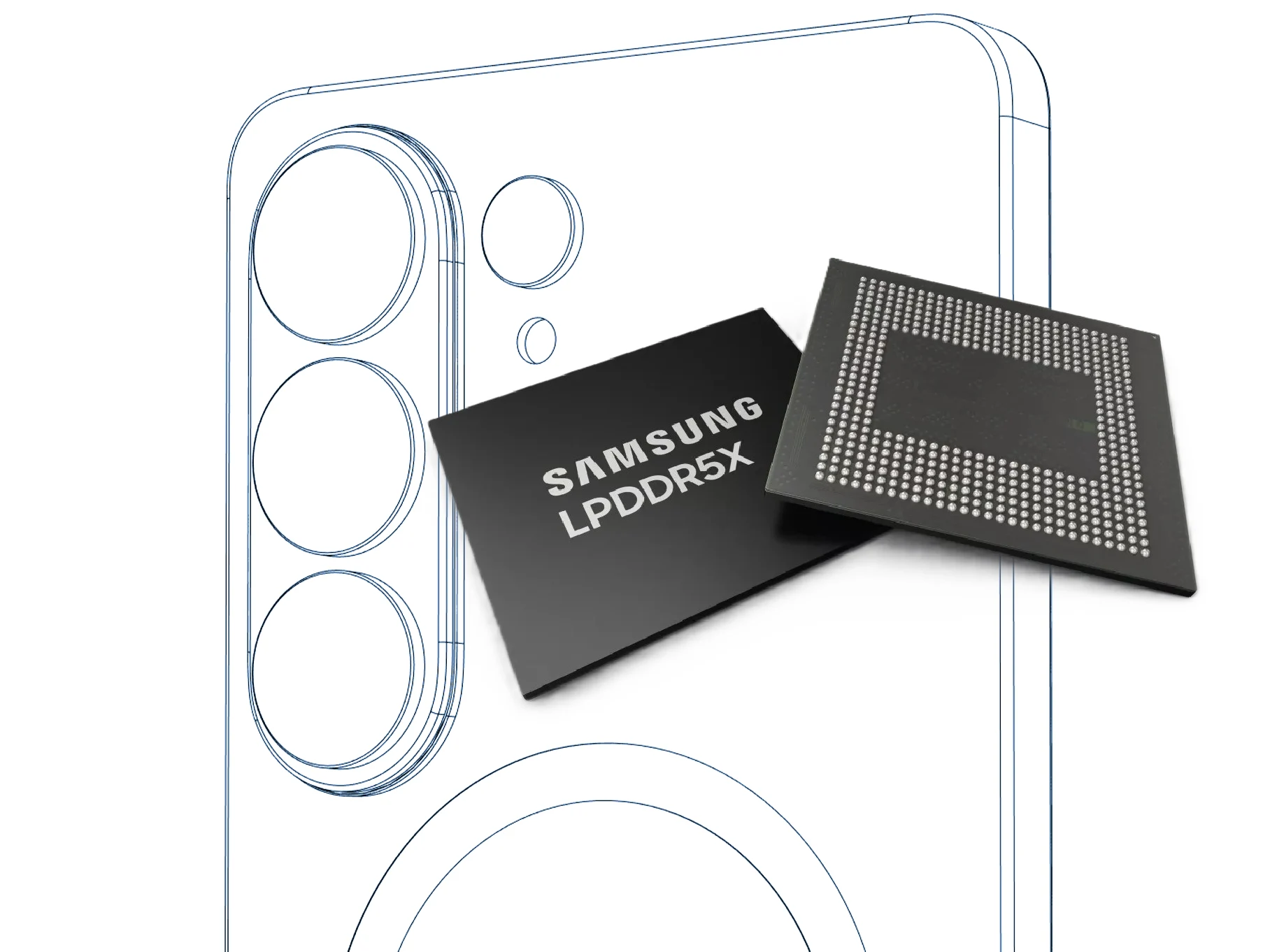
    Another day, another leak about the Galaxy S26! This time, the leaker Ice Universe has shared details about the LPDDR5X RAM that Samsung is likely to include in the Galaxy S26 lineup. The Galaxy S26, Galaxy S26 Plus, and Galaxy S26 Ultra are expected to come with a starting point of 12 GB of LPDDR5X memory, which will operate at a speed of 10.7 Gbps. This is currently the fastest LPDDR5X memory available on the market.

    Faster RAM Speeds

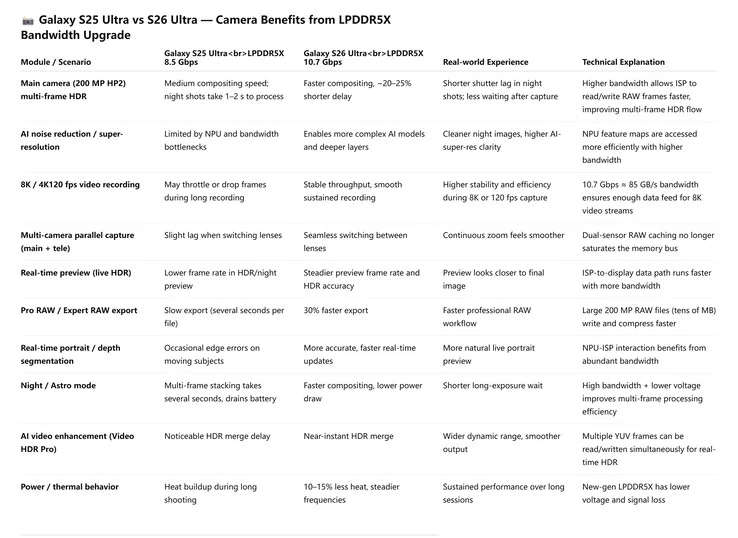
    When we compare it to the Galaxy S25 series, the leaked RAM speed for the Galaxy S26 is 26% quicker, since the Galaxy S25 Ultra only reaches 8.5 Gbps. Therefore, the Galaxy S26 is anticipated to benefit from a significant boost in memory bandwidth, which should assist in memory-heavy tasks such as on-device AI and image processing.

    Possible Enhancements

    Now, you might wonder what benefits the Galaxy S26’s faster memory could provide. Ice Universe has created a helpful table outlining potential improvements in image processing, AI, and energy efficiency that could result from the enhanced 10.7 Gbps RAM of the Galaxy S26. Some key upgrades could include:

    Even if the Galaxy S26 has just a few upgrades to its camera hardware, we could see some pleasing enhancements in image quality, particularly in low-light conditions.

    Keeping Expectations Realistic

    That said, it’s wise to temper our expectations, as all the leaks suggest that the camera system will be fairly similar to what we’ve experienced in recent years. This is a bit underwhelming, especially when we observe how Chinese manufacturers are consistently innovating in mobile photography. Even Apple, a brand known for being cautious with big changes, has introduced impressive new cameras in the iPhone 17 Pro.

    We won’t have to wait too long to uncover Samsung’s plans, as the Unpacked event showcasing the Galaxy S26 series is just a few months away.

    Source:
    Link


  • New Blackberry QWERTY Keyboard Tile Revealed in Sidephone Promo

    New Blackberry QWERTY Keyboard Tile Revealed in Sidephone Promo

    Key Takeaways

    1. Sidephone is introducing a new QWERTY keyboard tile, moving beyond its initial T9 keyboard design.
    2. The QWERTY tile features a compact setup with predictive typing, potentially similar to the Blackberry SureType system.
    3. Users can customize the color of the QWERTY tile to match the phone’s frame for personalization.
    4. The QWERTY module’s appearance in promotional materials suggests a possible upcoming pre-order announcement or reveal.
    5. Sidephone is targeting users who prefer tactile control and modular interfaces with its various keyboard options.


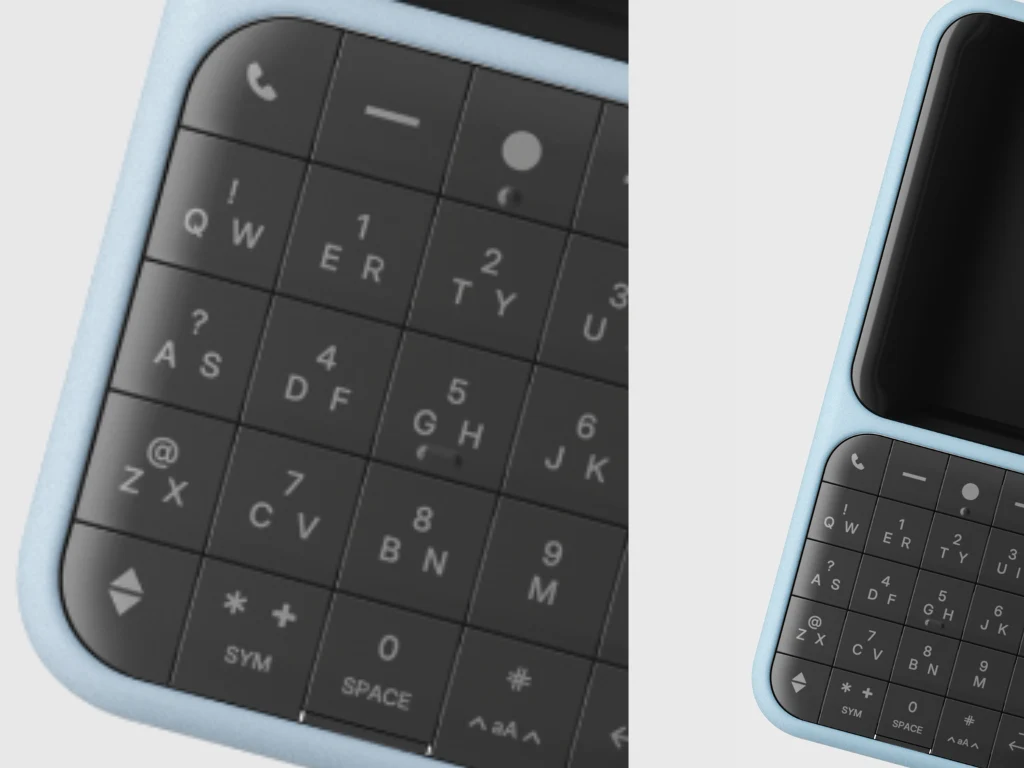
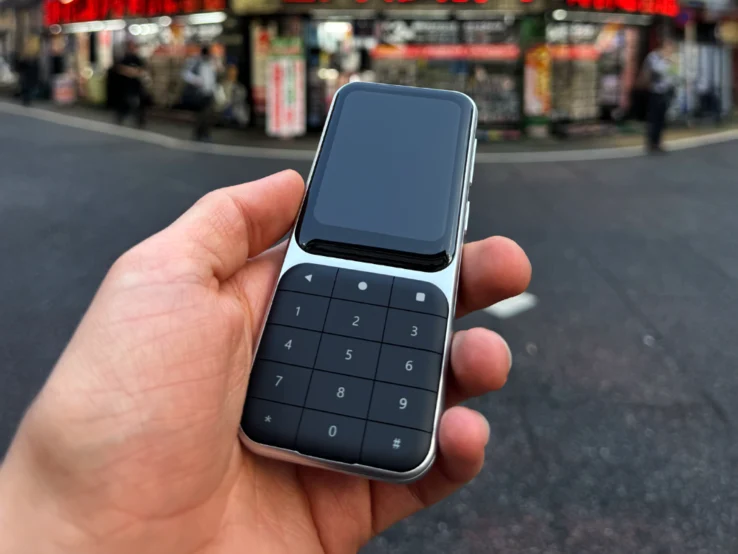
    Sidephone, the modular “dumb phone” that’s gradually gaining popularity due to its minimalist design and focus-driven interface, is now hinting at what might be one of its most ambitious accessories yet – a full QWERTY keyboard tile. The latest image making rounds on Reddit provides a clearer view of the attachment, showing how the company is branching out from its initial T9 keyboard and the recently introduced dial-style “Sundial” keypad.

    New Keyboard Design

    From the promotional picture, the QWERTY tile appears to have a compact yet familiar setup with closely arranged keys, somewhat similar to older Blackberry SureType designs. Unlike a complete physical keyboard, this one looks like it combines predictive typing with fewer keys – possibly grouping several letters on each key while using software prediction to figure out the intended word. This topic was discussed within the community as well, with users wondering if it operates like the SureType system, where you press combinations of keys, and the system predicts the word in real-time.

    Customization Options

    The render also suggests the same color customization that Sidephone previously displayed for its modular tiles – the blue QWERTY layout matches with the phone’s frame, meaning users will be able to mix and match tiles for personalization. While there hasn’t been any clear announcement regarding a release window for this QWERTY module, its appearance in a promotional email indicates that Sidephone could be preparing for either a pre-order announcement for the new keypad or an early reveal of the accessory. By providing various modular interfaces (the circular dial and now a compact keyboard), the Sidephone seems to be establishing a niche audience for those who prefer tactile control and the ability to switch out interfaces.

    Source:
    Link


  • Photos in Complete Darkness: Discover Innovative Camera Tech

    Photos in Complete Darkness: Discover Innovative Camera Tech

    Key Takeaways

    1. The Oukitel WP60 features a large battery for extended off-grid use.
    2. It has an 8-megapixel camera with limited sharpness and autofocus issues.
    3. The night vision capability allows users to capture images in total darkness up to 10 meters.
    4. Black-and-white photos can be taken in well-lit conditions, but night vision does not support video recording.
    5. The smartphone has a 7.2-inch screen and impressive battery life, lasting nearly 24 hours in WiFi testing.


    The Oukitel WP60 allows users to do more than just splash around in shallow waters and embark on extended adventures without power. Its large battery ensures that you can stay off the grid for longer periods. Additionally, this outdoor smartphone features a night vision camera that captures images in total darkness using infrared light.

    Camera Performance

    The camera has an 8-megapixel resolution, which isn’t very sharp, something we noticed in the photos we captured during our testing. When zooming in on an orange hanging from a tree, the image gets quite blurry. We also found that the autofocus occasionally has trouble, as evidenced by the photo of the watch we took.

    Night Vision Range

    The night vision’s maximum distance is about 10 meters, which is decent. However, objects that are close by often look as if they’ve been lit up by a flash, thanks to the restricted beam from the infrared LEDs, while the background tends to remain quite dim.

    Apart from just taking standard pictures, this phone has more to offer. With its night vision capability, users can see in the dark without alerting animals, making it useful for watching wildlife.

    Black-and-White Photos

    You can snap black-and-white images in well-lit environments since the camera isn’t overwhelmed by bright lights. Unfortunately, Oukitel’s night vision functionality does not support video recording.

    While the night vision feature is a cool addition, potential buyers of the Oukitel WP60 should consider other factors as well. For example, this rugged phone boasts a massive 7.2-inch screen, which is among the largest available on any smartphone today. Its impressive battery life of nearly 24 hours in our WiFi testing is also a strong selling point for this device. For more insights and details, check out our comprehensive review of the Oukitel WP60.


  • PITAKA iPhone 17 Cases: Gold Glints in Aramid Fiber Design

    PITAKA iPhone 17 Cases: Gold Glints in Aramid Fiber Design

    Key Takeaways

    1. PITAKA introduces the Glints of Gold finish for iPhone 17 cases, focusing on artistry and texture rather than just protection.
    2. The finish is a collaboration with British artist Gordon Hunt, emphasizing fluid light and water reflections in the design.
    3. Two unique finishes are available: Lucid Blue, resembling ocean gradients, and Golden Glint, featuring reflective components.
    4. A limited “Artist Edition” collector’s gift box will include the Lucid Blue case, a matching ring holder, a power bank, signed postcards, and a display panel.
    5. PITAKA offers three case series for the iPhone 17: Edge (minimal bulk), Ridge (enhanced protection), and Apex (strengthened material).


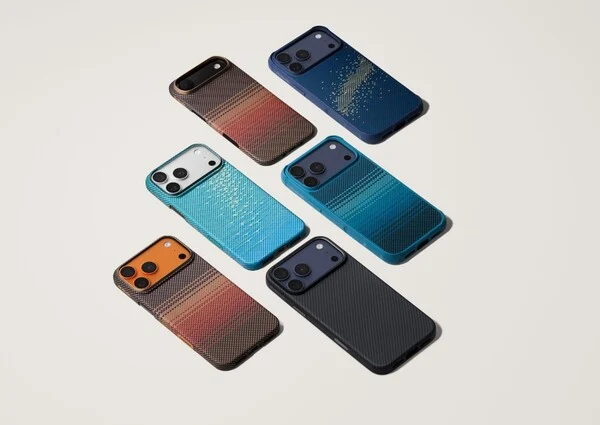
    PITAKA is adding to its selection of iPhone 17 cases with a fresh finish named Glints of Gold, which introduces a creative twist to a market often centered on strength and usability. These cases merge artistry and craftsmanship, focusing more on aspects like light, texture, and tactile experience rather than solely on safeguarding the device.

    Artistic Collaboration

    The Glints of Gold finish is included in PITAKA’s Moment collection and was created in partnership with British artist Gordon Hunt. Hunt is celebrated for his tranquil artwork that highlights soft lighting and reflections of water. Instead of using paint, his style is expressed through materials, transforming his fascination with glimmering surfaces into a texture for phone cases that aims to suggest fluid movement and gentle shifts in light.

    Two Unique Finishes

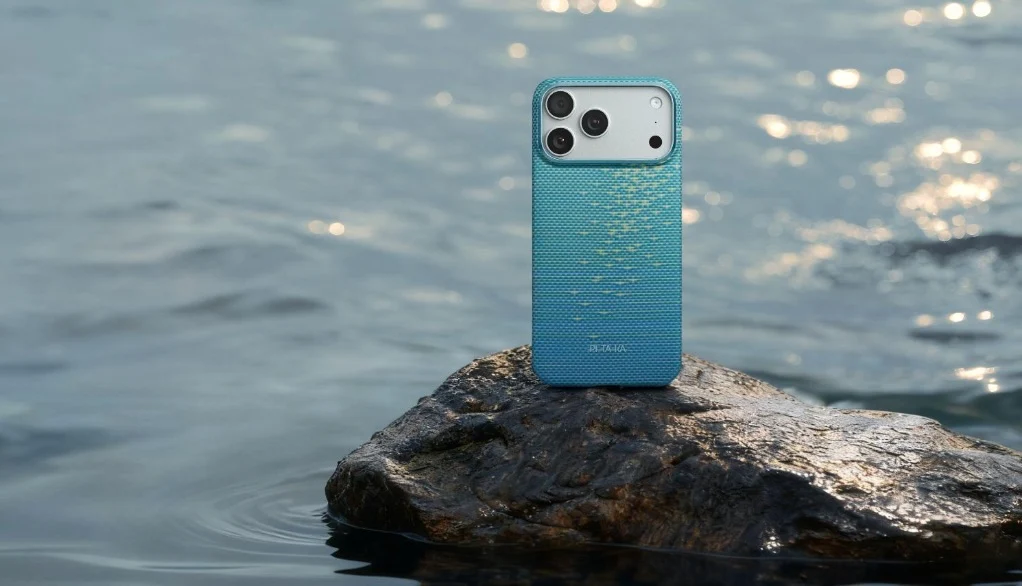
    This new series comes in two distinct finishes: Lucid Blue, which features a gentle gradient reminiscent of peaceful ocean vistas, and Golden Glint, which includes small reflective components designed to mimic light bouncing off calm water. The company applies its Fusion Weave – LightRipple technology to create this effect, using exact tension control to develop a textured surface that seems to change as it interacts with light. The outcome is a case that serves not just as protection but also as a piece of art for daily use.

    Special Collector’s Edition

    As mentioned earlier, a limited “Artist Edition” gift box for collectors will be available soon. This box will contain the Lucid Blue case, a matching ring holder, a power bank, five postcards signed by the artist, and a light-up display panel. The idea is to consider the case as something to showcase, store, or pass on, rather than merely a typical phone accessory. Besides the Glints of Gold finish, PITAKA will present three case series for the iPhone 17.

    Case Series Details

    For example, the Edge Series aims for minimal bulk, measuring just 0.84 to 0.89 millimeters thick and weighing about 18 to 21 grams. It features the company’s PitaTap capacitive layer and is compatible with MagSafe. The Ridge Series prioritizes protection, including cushioned corners and military-grade drop resistance up to 8 feet. This case is thicker at 2.00 to 2.05 millimeters and weighs between 33.5 to 39 grams. Finally, the Apex Series utilizes 3D full-wrap thermoforming and Orca Resin, enhancing material strength by 200%. It has a thickness of 2.03 to 2.05 millimeters and weighs 34 to 36 grams.


  • OnePlus 15, iPhone 17 Pro Max, Xiaomi 17 Pro Max Battery Test Results

    OnePlus 15, iPhone 17 Pro Max, Xiaomi 17 Pro Max Battery Test Results

    Key Takeaways

    1. The OnePlus 15 features a Snapdragon 8 Elite Gen 5 chipset and a 7,300 mAh silicon-carbon battery.
    2. It has a 6.78-inch OLED display with a resolution of 1272 × 2772 pixels and a 50 MP triple-camera system.
    3. In battery testing, the OnePlus 15 lasted 13 hours and 40 minutes, outperforming the Xiaomi 17 Pro Max and iPhone 17 Pro Max.
    4. The Xiaomi 17 Pro Max, despite having a larger 7,500 mAh battery, powered down first at 12 hours and 50 minutes.
    5. All three flagship phones (OnePlus 15, Xiaomi 17 Pro Max, iPhone 17 Pro Max) have similar dimensions and weight, but the OnePlus 15 showed the best battery performance.


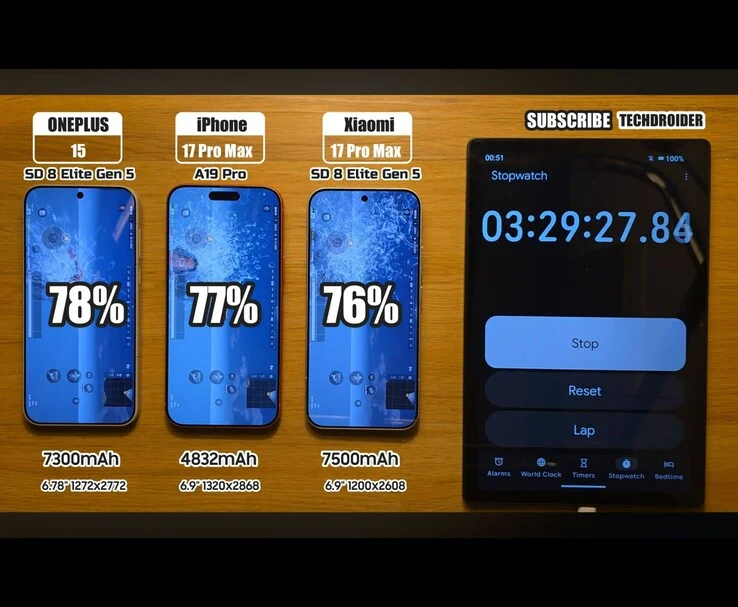
    Before the worldwide release of the OnePlus 15, we’ve already got a glimpse of its performance through benchmarks like Geekbench 6. We’ve also seen how the new flagship handles thermal challenges with its advanced cooling tech. True to its flagship status, it’s powered by Qualcomm’s Snapdragon 8 Elite Gen 5 chipset and boasts a hefty 7,300 mAh silicon-carbon battery. At this point, we are familiar with most of the OnePlus 15’s specs, which include a 6.78-inch OLED display with a resolution of 1272 × 2772 pixels, a 50 MP triple-camera system, UFS 4.1 flash storage, and more.

    Real-World Performance Tested

    With all these impressive specifications, the OnePlus 15 has been put through its paces in real-world scenarios. The YouTube channel TechDroider has carried out a thorough battery comparison among the OnePlus 15, the Xiaomi 17 Pro Max, and the iPhone 17 Pro Max.

    To give some background, the Xiaomi 17 Pro features a slightly larger 6.9-inch OLED display at a resolution of 1200 × 2608 pixels. It also comes with a slightly bigger 7,500 mAh silicon-carbon battery and runs on the same Qualcomm Snapdragon 8 Elite Gen 5 chipset.

    Battery Testing Results

    On the other hand, the Apple iPhone 17 Pro Max, powered by the A19 Pro chip, also has a 6.9-inch OLED display, but with a higher resolution of 1320 × 2868 pixels and a smaller 4,832 mAh conventional lithium-ion battery.

    The battery test kicked off with a three-hour gaming session on PUBG Mobile, where the OnePlus 15 had 78% battery left, the iPhone 17 Pro Max had 77%, and the Xiaomi 17 Pro Max stood at 76%. Following this, there was three hours of watching 1080p YouTube videos, which brought the remaining battery percentages down to 66% for the OnePlus, 64% for the iPhone, and 64% for the Xiaomi.

    After an hour and a half of browsing the web and using Instagram, the battery levels still remained close: 53% on the OnePlus, 48% on the iPhone, and 47% on the Xiaomi. In the final stage, all three devices recorded 4K videos at 60 fps until they ran out of juice.

    OnePlus 15 Takes the Lead

    Despite its larger 7,500 mAh battery and HyperOS optimization, the Xiaomi 17 Pro Max was the first to power down after 12 hours and 50 minutes. The iPhone 17 Pro Max followed at 13 hours and 2 minutes, demonstrating the impressive efficiency of Apple’s A19 Pro Bionic chip and iOS. The OnePlus 15 stood out as the overall champion, lasting 13 hours and 40 minutes, the best performance among the three.

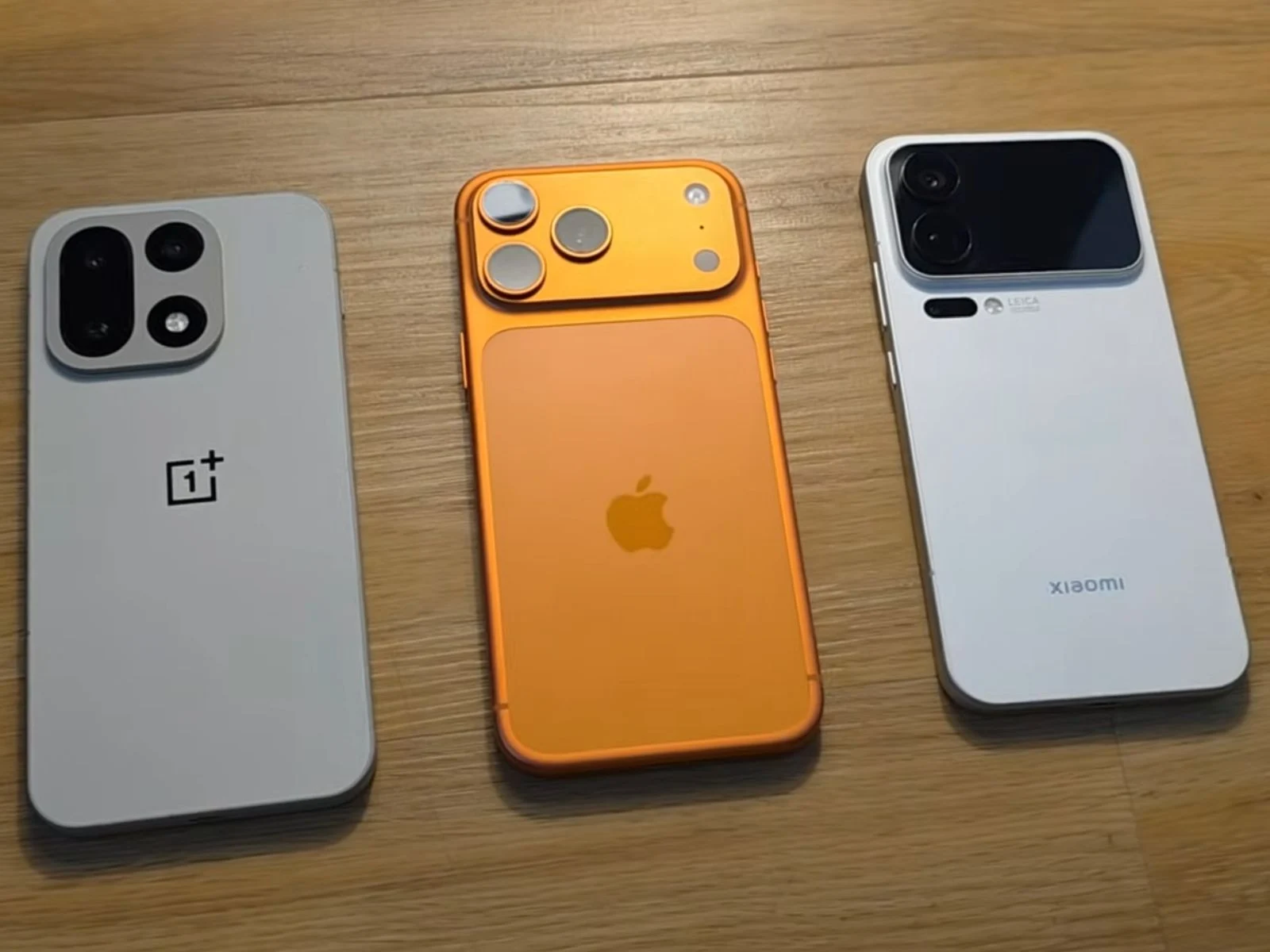
    TechDroider also highlighted that even though the OnePlus 15 has a larger 7,300 mAh battery, it remains nearly the same size as the Xiaomi 17 Pro Max (162.9 × 77.6 × 8 mm, 219 g) and the iPhone 17 Pro Max (163.4 × 78 × 8.8 mm, 233 g). All three phones share similar dimensions, weight, and thickness while providing comparable battery life in their category.

    In conclusion, the OnePlus 15 outperforms two of the top flagship competitors in a practical battery test. You can view the complete battery testing video below.

    Source:
    Link


  • Motorola Edge 70 Ultra Surfaces on Geekbench with Snapdragon Chip

    Motorola Edge 70 Ultra Surfaces on Geekbench with Snapdragon Chip

    Key Takeaways

    1. Motorola is preparing to launch the Edge 70 Ultra after recently releasing the Edge 70.
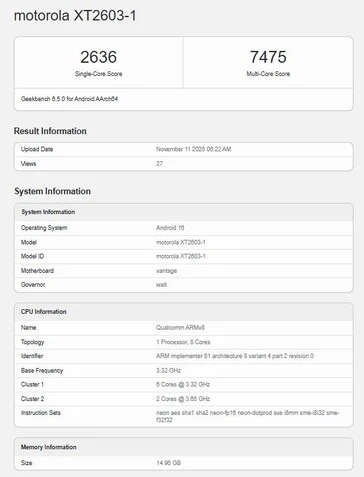
    2. The Edge 70 Ultra features 16 GB of RAM and impressive Geekbench scores: 2,636 (single-core) and 7,475 (multi-core).
    3. Its performance slightly exceeds current top Snapdragon 8 Gen 3 devices but is not as powerful as the Snapdragon 8 Elite.
    4. There is speculation that the device may be powered by the Snapdragon 8 Gen 5 or a unique variant like the Snapdragon 8s Gen 5.
    5. The Motorola Edge 2025 will be available for purchase on Amazon.


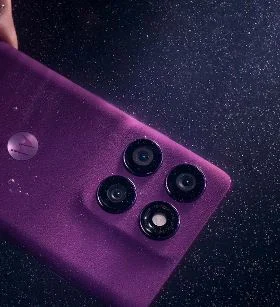
    As reported recently, Motorola is gearing up to unveil the Edge 70 Ultra. After launching the Edge 70 just last week, the company seems poised to showcase its more high-end models, with the Edge 70 Ultra appearing to make its first appearance on Geekbench.

    Performance Details

    In the Geekbench database, the device is identified by the model number “Motorola XT2603-1,” and it boasts an impressive 16 GB of RAM. In terms of performance, the phone achieves a single-core score of 2,636 and a multi-core score of 7,475. These figures indicate a computing performance that slightly surpasses that of the top Snapdragon 8 Gen 3 devices tested so far.

    Chipset Speculations

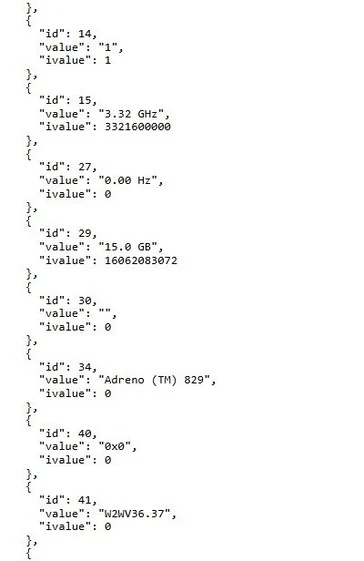
    However, it remains uncertain which chipset is actually powering this phone, as its performance is better than the Snapdragon 8 Gen 3 but not as strong as the Snapdragon 8 Elite. Rumors suggest that it might be the upcoming Snapdragon 8 Gen 5, yet the reported clock speeds and GPU—an Adreno 829—do not align with the leaked information regarding that chipset. While these leaks could be wrong, there’s also a possibility that this SoC might be a unique addition to the Snapdragon 8 series, possibly something like a Snapdragon 8s Gen 5. We will keep you posted on any developments.


    Source:
    Link