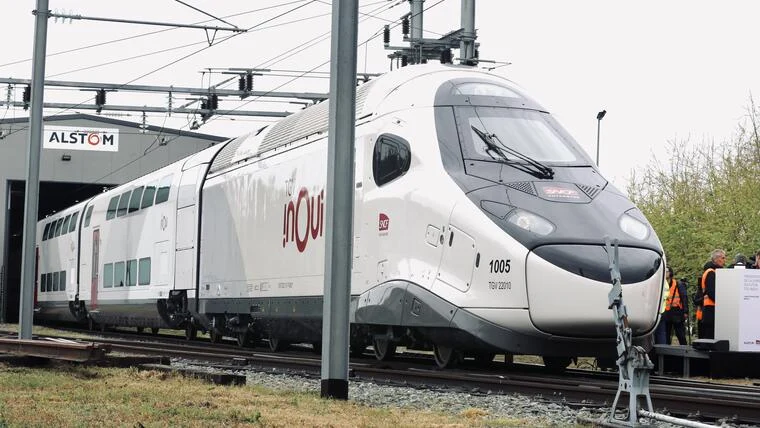
– TGV-M (Alstom Avelia Horizon) cleared EU safety approval and could enter service around Aug/Sep 2026 for SNCF in France.
– Train design features two power cars, Jacobs bogies, two decks, and up to 200-meter multi-unit formations with 740 seats (up from 600).
– Capacity and efficiency gains: ~20% more seats and ~20% lower energy use (potentially up to 30% for Horizon family); 5G Wi-Fi planned.
– Speed capability varies by system: up to 320 km/h on ETCS/TVM, 220 km/h under KVB, and 160 km/h in Crocodile network; designed for cross-border, multi-voltage operation (1.5 and 25 kV in France; Horizon family supports multiple electrifications, aiding Eurostar compatibility).
France’s TGV-M is allowed to run. As Elias Van Deun discovered, Alstom’s new high-speed train has cleared the approval hurdle of the European Union Agency for Railways. The step was long overdue, although rolling stock has repeatedly suffered from approval problems in recent years. The news comes a few days after the travel and tourism magazine Voyages D’Affaires pointed out that operator SNCF is no longer giving any dates for the possible commercial entry into service of the new TGV-M trainsets.
Approval timing and entry into service
However, the approval that has now taken place matches information from the magazine that the train could transport passengers for the first time in August or September 2026. The TGV-M is the first train based on Alstom’s Avelia Horizon platform. In 2018, according to Alstom, SNCF ordered 100 trainsets and later placed an additional order.
Platform and cross-border capabilities
The Horizon will also be important for the Eurostar network with its special requirements, especially when used in the Channel Tunnel. Here, 30 units are intended to replace the aging fleet. They are also intended to support four electrification voltages for the necessary compatibility across national borders. The now approved TGV-M is designed for France and two voltages: 1.5 and 25 kV.
Train architecture and flexibility
The Avelia Horizon follows the classic TGV principle: there are two power cars that provide the drive. They are therefore not conventional replaceable locomotives, but the traction equipment is not distributed beneath the cars either. In Germany, this corresponds to the first ICE generation. The train also again uses Jacobs bogies for its running gear. This means that two wagons rest on one bogie.
Length and capacity
In regular operation, the trains cannot just be shortened or lengthened. That said, changes to the length of the ICE 1 were also quite rare. Most recently, the train was shortened. However, there is still flexibility with the TGV-M, because a trainset is 200 meters long and can operate in multiple unit formation to provide more capacity.
Seating, efficiency, and technology
The new trains also rely on two decks again. Alstom manages, however, to get over 20 percent more seats into the train. According to SNCF, the capacity is now 740 instead of 600 seats. In addition, the energy requirement is expected to drop by another 20 percent. According to Alstom, the potential of the Horizon series is even 30 percent.
Onboard connectivity and speed
The trains in the SNCF network will also offer 5G-based Wi-Fi. The maximum speed of the TGV-M depends on the train protection system. According to approval information, 320 km/h is possible under ETCS and TVM. This is especially important for the high-speed lines of the LGV type. Under KVB 220 km/h is possible and in the Crocodile network it is 160 km/h.