
Key Takeaways
1. DLSS 4 technology enhances visuals and game performance with new AI features like RTX Neural Materials and Neural Texture Compression.
2. New technologies aim to reduce VRAM usage by up to 96%, improving efficiency in texture compression and rendering.
3. Initial tests indicate potential performance boosts of up to 80% and VRAM reduction by 90% using Nvidia’s Neural Texture Compression and DirectX Raytracing 1.2.
4. AI capabilities can be utilized across various hardware, not just Nvidia GPUs, though current drivers are lacking for AMD and Intel competitors.
5. Testing showed impressive results on AMD GPUs, suggesting that AI advancements could benefit older GPUs with lower VRAM capacities, though support for older generations remains uncertain.
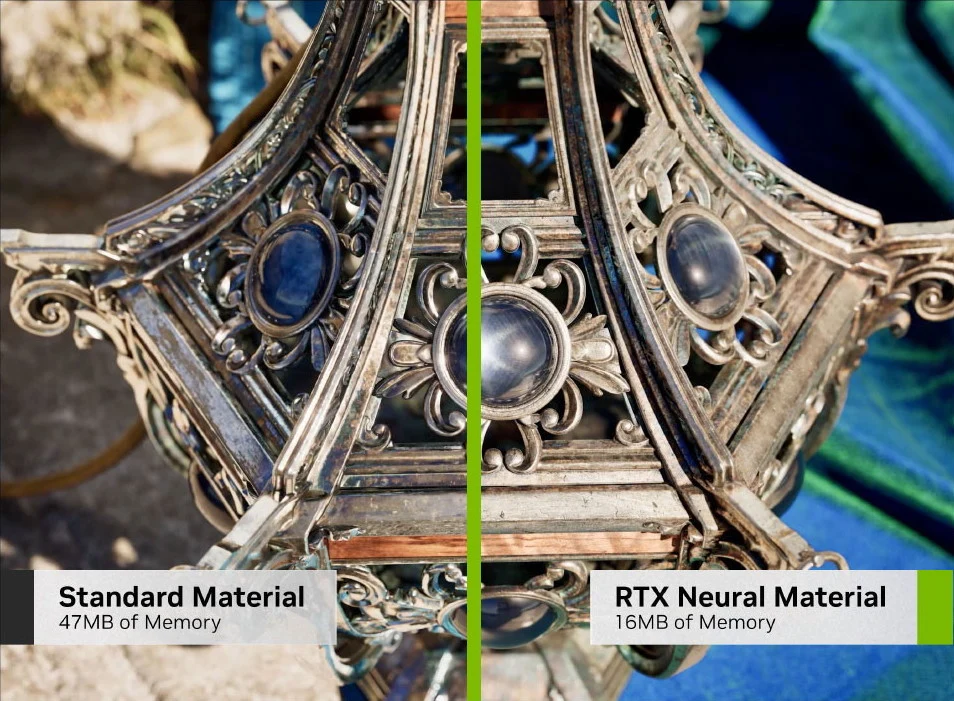
Announced during CES 2025, DLSS 4 technology is said to enhance visuals and game performance. Alongside Multi Frame Generation and the Transformer neural model, Nvidia also unveiled new AI features, including RTX Neural Materials and Neural Texture Compression (as noted in our report).
Faster and More Efficient Tech
These technologies focus on speeding up texture compression and rendering, which leads to less VRAM usage and possibly improved performance. They claim to reduce VRAM usage by up to 96%, but there were no real-life demonstrations of these new technologies for a while—until now. Surprisingly, recent (though preliminary and very basic) tests indicate that Nvidia and Microsoft’s future tech may indeed meet those claims.
Initial Test Results
As noted by X user @opinali (a software engineer at Google), who is recognized for sharing brief and useful GPU performance tests, he was able to perform the first benchmarks using Nvidia’s new Neural Texture Compression (NTC) along with Microsoft’s DirectX Raytracing 1.2 Cooperative Vector. To achieve this, @opinali (almost) managed to install Nvidia’s preview driver version 590.26 alongside the RTX NTC Beta from Github, using a GeForce RTX 5080 for testing.
Performance Boost
According to the author, this initial comparison is quite basic but showcases how Nvidia’s NTC and DXR 1.2 can potentially increase performance by up to 80% and significantly cut VRAM usage by an astonishing 90%—figures that might seem hard to believe at first.
In essence, these remarkable results come from small neural networks that have been integrated into texture rendering and compression processes. The key point is that these technologies could only be implemented thanks to Microsoft’s DirectX 12 Cooperative Vectors, which allows the use of any AI-capable hardware, not limited to Nvidia GPUs. However, there is a downside: currently, there are no DXR 1.2 drivers available for main competitors like AMD and Intel.
Testing with AMD GPUs
Nevertheless, @opinali was still able to perform Neural Texture Compression tests using the AMD Radeon RX 9070 XT, which also yielded impressive results (+10% over the RTX 5080 when using Vulkan, for instance).
If Nvidia can maintain such significant enhancements in the final driver release, it could breathe new life into GPUs with lower VRAM capacities (4GB, 6GB, 8GB models), making the old joke about needing to download more VRAM a reality.
That being said, it remains uncertain if older GPU generations from AMD, Nvidia, and Intel will support these new features. Many gamers may still need to invest in a newer GPU, but not necessarily the priciest ones, if AI can help ease the VRAM demands of modern games.
Source:
Link
Leave a Reply