Tag: Nvidia DLSS 4

  • No Man’s Sky Voyagers Update: Build Spaceships & Explore Space

    No Man’s Sky Voyagers Update: Build Spaceships & Explore Space

    Key Takeaways

    1. Introduction of a new Corvette class of ships that players can build and explore both inside and outside.
    2. Added ability for players to exit spaceships for spacewalks and parachute down to planets.
    3. New detailed cockpit design for the Titan-class ship with real-time information displays.
    4. Exclusive rewards for completing the corvette expedition, including unique plasma drive modules.
    5. Technical enhancements that improve graphics, including support for Nvidia DLSS 4 and Sony PSSR for PlayStation VR 2.


    Since it first came out nine years ago, No Man’s Sky has seen many free updates that have added a lot of new stuff, including ships, enemy types, and gameplay features. The technology behind the game has also been significantly improved over time. Now, Hello Games has dropped yet another update, which they are calling “Voyagers.”

    New Corvette Class

    Version 6.0 mainly brings in corvettes, a fresh class of ships that players can build from scratch, allowing for almost endless creative options. These corvettes can be explored not just from the outside, but players can also roam around inside them, a feature that was only available in large freighters before. This makes it much easier to take friends along for adventures in multiplayer mode.

    Exciting Spacewalks and More

    Another interesting addition is the ability to exit spaceships for spacewalks or just to drift in zero gravity. While in the atmosphere, players can jump out of their ships to parachute down to the planet’s surface. The new cockpit design of the Titan-class is said to be very detailed, featuring multiple displays that show real-time information about the ship and its environment. The new Thunderbird-class habitats take inspiration from outlaws, sporting visible wiring and makeshift wall coverings to create a looter-like vibe.

    Exclusive Rewards and Technical Enhancements

    Players who finish the new corvette expedition will earn exclusive plasma drive modules, which may not speed up your ship but sure look cool. The update also brings technical enhancements, making transparent glass panels appear nicer and allowing the player character to reflect light more realistically. Thanks to this update, No Man’s Sky now supports Nvidia DLSS 4 and Sony PSSR when played on PlayStation VR 2.

    Source:
    Link


  • 90% Less VRAM Usage: Nvidia AI Boosts Gaming Performance

    90% Less VRAM Usage: Nvidia AI Boosts Gaming Performance

    Key Takeaways

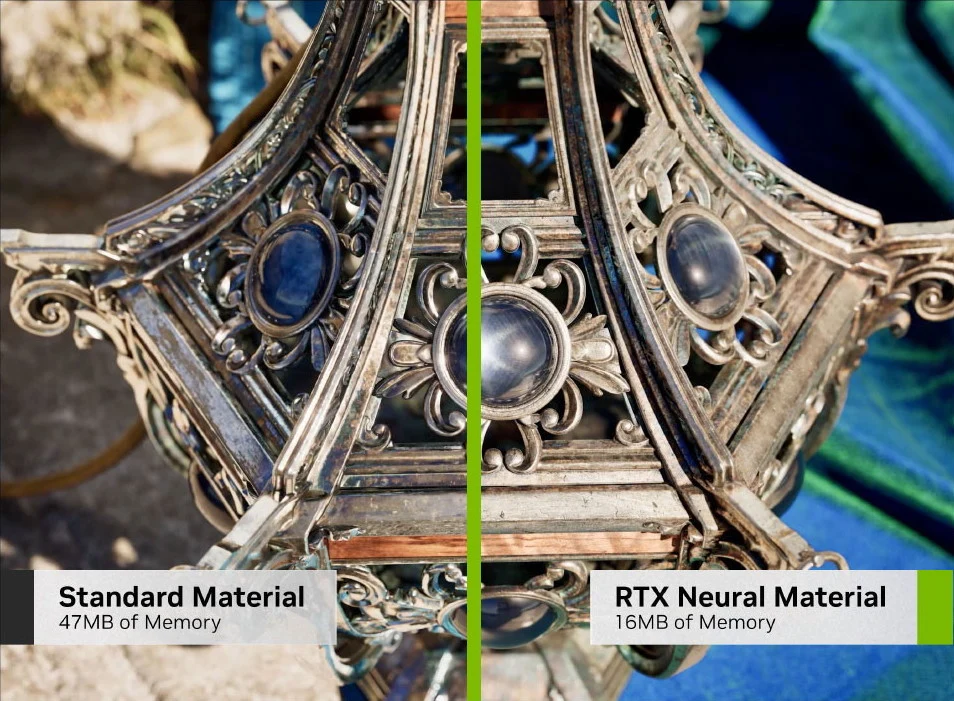
    1. DLSS 4 technology enhances visuals and game performance with new AI features like RTX Neural Materials and Neural Texture Compression.
    2. New technologies aim to reduce VRAM usage by up to 96%, improving efficiency in texture compression and rendering.
    3. Initial tests indicate potential performance boosts of up to 80% and VRAM reduction by 90% using Nvidia’s Neural Texture Compression and DirectX Raytracing 1.2.
    4. AI capabilities can be utilized across various hardware, not just Nvidia GPUs, though current drivers are lacking for AMD and Intel competitors.
    5. Testing showed impressive results on AMD GPUs, suggesting that AI advancements could benefit older GPUs with lower VRAM capacities, though support for older generations remains uncertain.


    Announced during CES 2025, DLSS 4 technology is said to enhance visuals and game performance. Alongside Multi Frame Generation and the Transformer neural model, Nvidia also unveiled new AI features, including RTX Neural Materials and Neural Texture Compression (as noted in our report).

    Faster and More Efficient Tech

    These technologies focus on speeding up texture compression and rendering, which leads to less VRAM usage and possibly improved performance. They claim to reduce VRAM usage by up to 96%, but there were no real-life demonstrations of these new technologies for a while—until now. Surprisingly, recent (though preliminary and very basic) tests indicate that Nvidia and Microsoft’s future tech may indeed meet those claims.

    Initial Test Results

    As noted by X user @opinali (a software engineer at Google), who is recognized for sharing brief and useful GPU performance tests, he was able to perform the first benchmarks using Nvidia’s new Neural Texture Compression (NTC) along with Microsoft’s DirectX Raytracing 1.2 Cooperative Vector. To achieve this, @opinali (almost) managed to install Nvidia’s preview driver version 590.26 alongside the RTX NTC Beta from Github, using a GeForce RTX 5080 for testing.

    Performance Boost

    According to the author, this initial comparison is quite basic but showcases how Nvidia’s NTC and DXR 1.2 can potentially increase performance by up to 80% and significantly cut VRAM usage by an astonishing 90%—figures that might seem hard to believe at first.

    In essence, these remarkable results come from small neural networks that have been integrated into texture rendering and compression processes. The key point is that these technologies could only be implemented thanks to Microsoft’s DirectX 12 Cooperative Vectors, which allows the use of any AI-capable hardware, not limited to Nvidia GPUs. However, there is a downside: currently, there are no DXR 1.2 drivers available for main competitors like AMD and Intel.

    Testing with AMD GPUs

    Nevertheless, @opinali was still able to perform Neural Texture Compression tests using the AMD Radeon RX 9070 XT, which also yielded impressive results (+10% over the RTX 5080 when using Vulkan, for instance).

    If Nvidia can maintain such significant enhancements in the final driver release, it could breathe new life into GPUs with lower VRAM capacities (4GB, 6GB, 8GB models), making the old joke about needing to download more VRAM a reality.

    That being said, it remains uncertain if older GPU generations from AMD, Nvidia, and Intel will support these new features. Many gamers may still need to invest in a newer GPU, but not necessarily the priciest ones, if AI can help ease the VRAM demands of modern games.

    Source:
    Link

  • FSR 4 Support for Radeon RX 9070: Monster Hunter Wilds & Marvel Rivals

    FSR 4 Support for Radeon RX 9070: Monster Hunter Wilds & Marvel Rivals

    Key Takeaways

    1. Players are eager to learn the pricing for the RX 9070 XT and RX 9070 during the February 28 reveal on YouTube.
    2. FSR 4 is AMD’s AI-based upscaling technology aimed at competing with Nvidia’s DLSS 4, but it is limited to AMD’s new GPUs.
    3. An updated list of over 30 games compatible with FSR 4 has been shared, but not all games may support it at launch.
    4. Initial footage of FSR 4 shows improved image upscaling with fewer artifacts, enhancing graphical fidelity.
    5. Gamers are comparing the value of AMD’s RX 9070 series against Nvidia’s RTX 5070 Ti and RTX 5070, especially concerning performance and availability.


    During the reveal on February 28 via YouTube, players are looking forward to discovering the pricing for the RX 9070 XT and RX 9070. AMD might also present some of the newest games that showcase the capabilities of the RDNA 4 architecture. FSR 4 is an AI-based upscaling technology that aims to compete with Nvidia’s DLSS 4. Unlike DLSS 4, however, the advantages of FSR 4 are limited to AMD’s upcoming GPUs. Game compatibility is also crucial, and VideoCardz has shared an updated roster of over 30 games that will be compatible with FSR 4.

    Game Compatibility Concerns

    It’s important to note that this game list isn’t finalized. Moreover, not every game may support FSR 4 when the RX 9070 series launches. However, many key titles are anticipated to take advantage of AMD’s frame generation tech. Capcom’s latest release stands out, especially given the performance challenges highlighted during the Monster Hunter Wilds open beta.

    Additionally, Marvel Rivals is included on the list, which typically performs well on less powerful setups. Nevertheless, not every player is happy with the optimization in the Unreal Engine 5 hero shooter. Other significant titles like Kingdom Come: Deliverance II and Civilization 7 could be utilized by AMD to showcase FSR 4. Previous reports have indicated that more than 75 games will support its features by the close of 2025.

    FSR 4 Technology Insights

    Initial footage of FSR 4 indicates that it upscales images with fewer artifacts and maintains graphical fidelity. This advancement can help FidelityFX Super Resolution narrow the gap with Nvidia’s DLSS 4, but the requirement for an RDNA 4 GPU can limit its attractiveness. On a brighter note, current games that utilize FSR 3.1 can be upgraded to FSR 4 without much hassle.

    Gamers are also eager to see if the RX 9070 and RX 9070 XT deliver more value for their pricing compared to the RTX 5070 Ti and RTX 5070. Nvidia’s Blackwell cards rely heavily on DLSS 4 to achieve better performance than the RTX 40 series. However, if RDNA 4 cards are seldom available, support for FSR 4 in games won’t matter much.

    Source:
    Link