
Tag: Neural Texture Compression

  • 90% Less VRAM Usage: Nvidia AI Boosts Gaming Performance

    90% Less VRAM Usage: Nvidia AI Boosts Gaming Performance

    Key Takeaways

    1. DLSS 4 technology enhances visuals and game performance with new AI features like RTX Neural Materials and Neural Texture Compression.
    2. New technologies aim to reduce VRAM usage by up to 96%, improving efficiency in texture compression and rendering.
    3. Initial tests indicate potential performance boosts of up to 80% and VRAM reduction by 90% using Nvidia’s Neural Texture Compression and DirectX Raytracing 1.2.
    4. AI capabilities can be utilized across various hardware, not just Nvidia GPUs, though current drivers are lacking for AMD and Intel competitors.
    5. Testing showed impressive results on AMD GPUs, suggesting that AI advancements could benefit older GPUs with lower VRAM capacities, though support for older generations remains uncertain.


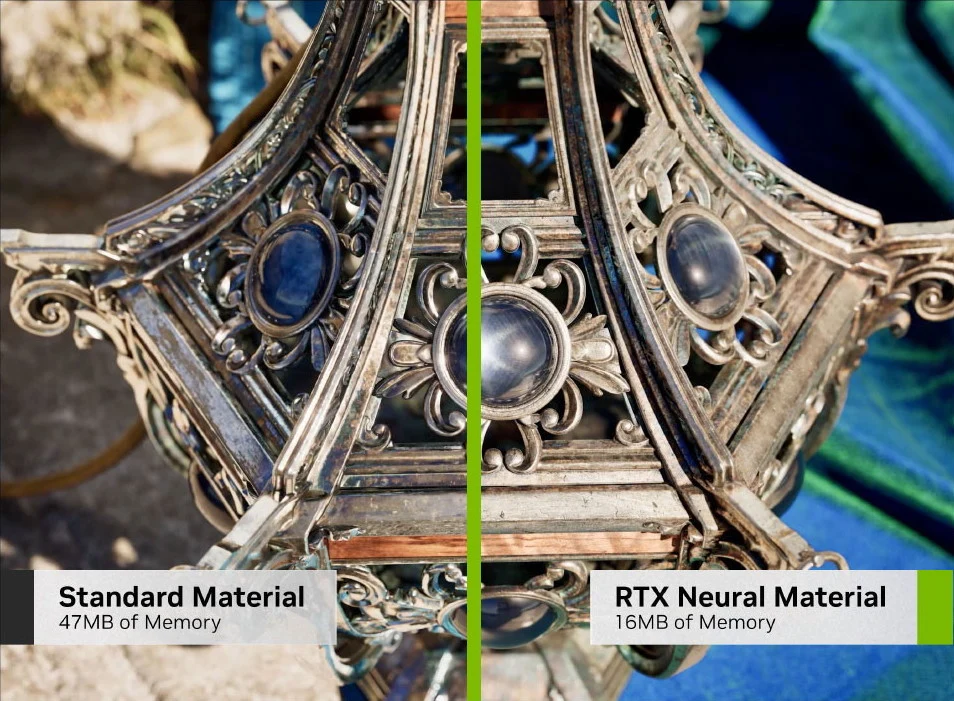
    Announced during CES 2025, DLSS 4 technology is said to enhance visuals and game performance. Alongside Multi Frame Generation and the Transformer neural model, Nvidia also unveiled new AI features, including RTX Neural Materials and Neural Texture Compression (as noted in our report).

    Faster and More Efficient Tech

    These technologies focus on speeding up texture compression and rendering, which leads to less VRAM usage and possibly improved performance. They claim to reduce VRAM usage by up to 96%, but there were no real-life demonstrations of these new technologies for a while—until now. Surprisingly, recent (though preliminary and very basic) tests indicate that Nvidia and Microsoft’s future tech may indeed meet those claims.

    Initial Test Results

    As noted by X user @opinali (a software engineer at Google), who is recognized for sharing brief and useful GPU performance tests, he was able to perform the first benchmarks using Nvidia’s new Neural Texture Compression (NTC) along with Microsoft’s DirectX Raytracing 1.2 Cooperative Vector. To achieve this, @opinali (almost) managed to install Nvidia’s preview driver version 590.26 alongside the RTX NTC Beta from Github, using a GeForce RTX 5080 for testing.

    Performance Boost

    According to the author, this initial comparison is quite basic but showcases how Nvidia’s NTC and DXR 1.2 can potentially increase performance by up to 80% and significantly cut VRAM usage by an astonishing 90%—figures that might seem hard to believe at first.

    In essence, these remarkable results come from small neural networks that have been integrated into texture rendering and compression processes. The key point is that these technologies could only be implemented thanks to Microsoft’s DirectX 12 Cooperative Vectors, which allows the use of any AI-capable hardware, not limited to Nvidia GPUs. However, there is a downside: currently, there are no DXR 1.2 drivers available for main competitors like AMD and Intel.

    Testing with AMD GPUs

    Nevertheless, @opinali was still able to perform Neural Texture Compression tests using the AMD Radeon RX 9070 XT, which also yielded impressive results (+10% over the RTX 5080 when using Vulkan, for instance).

    If Nvidia can maintain such significant enhancements in the final driver release, it could breathe new life into GPUs with lower VRAM capacities (4GB, 6GB, 8GB models), making the old joke about needing to download more VRAM a reality.

    That being said, it remains uncertain if older GPU generations from AMD, Nvidia, and Intel will support these new features. Many gamers may still need to invest in a newer GPU, but not necessarily the priciest ones, if AI can help ease the VRAM demands of modern games.

    Source:
    Link

  • Nvidia RTX Neural Texture Compression Cuts VRAM Usage by 96%

    Nvidia RTX Neural Texture Compression Cuts VRAM Usage by 96%

    Key Takeaways

    1. Nvidia’s new RTX toolkit beta features “Neural Rendering,” enhancing gaming visuals and performance through AI technologies.
    2. RTX Neural Materials allow for faster rendering of complex materials, making games capable of using more detailed assets.
    3. RTX Neural Texture Compression can reduce graphics memory usage by up to seven times, significantly lowering texture size while maintaining quality.
    4. The technology may impact frame rates, with an average FPS drop of 5.6% due to the computational demands of texture compression, especially at higher resolutions.
    5. Nvidia aims to create highly realistic human characters in games by combining 3D motion data with extensive photographic data of real individuals.


    Nvidia has launched a new beta version of its RTX toolkit, which includes a feature named “Neural Rendering,” hinting at what the future of gaming might look like. While DLSS has already been using artificial intelligence to upscale games to higher resolutions and add three extra frames per second, Nvidia’s forthcoming AI shaders promise to enhance this experience.

    AI Innovations in Gaming

    A key feature of these new AI advancements is RTX Neural Materials. This innovative technology leverages AI to compress intricate materials, enabling them to be rendered up to five times quicker, which opens the door for games to use much more intricate assets. Additionally, RTX Mega Geometry dynamically recalculates the geometry of objects in real time, paving the way for improved path tracing and more lifelike lighting effects.

    Enhanced Texture Management

    On the flip side, RTX Neural Texture Compression is aimed at compressing thousands of textures in less than a minute. This technology can decrease graphics memory usage by up to seven times when compared to traditionally compressed textures of the same quality.

    A video from Compusemble demonstrates RTX Neural Texture Compression and shows how AI-driven compression can significantly lower the memory usage of a 1440p model by as much as 96% compared to the reference texture. However, this comes at a cost, as the average frame rate dips by 5.6% due to the computing power needed for texture compression. The performance gap widens even more at higher resolutions; with 4K textures, average FPS on an Nvidia GeForce RTX 4090 nearly drops by half.

    Future of Gaming Characters

    Despite this, in games that struggle with the limited VRAM found in GPUs like the GeForce RTX 4060 (starting at $299 on Amazon), this texture compression may result in much better frame rates. Since Neural Texture Compression operates on tensor cores, it is expected to perform better on GeForce RTX 5000 series graphics cards compared to their older counterparts.

    Nvidia’s RTX kit also aims to create human characters in games that are so lifelike they are nearly indistinguishable from actual people. To achieve this realism, Nvidia merges raster data of a face from photographs or AI-generated images with 3D motion data, crafting the most authentic models possible. Nvidia states that building such a model requires thousands of images of a real person, captured from various angles and expressing a wide range of emotions for accurate reproduction later on.

    Source:
    Link