Tag: Valve

  • New Valve VR Headset Launch Expected Soon for Steam Users

    New Valve VR Headset Launch Expected Soon for Steam Users

    Key Takeaways

    1. Valve is developing a new VR headset called “Steam Frame,” which may function as a standalone device similar to the Meta Quest 3 and connect wirelessly to PCs.
    2. An announcement for the Steam Frame VR headset could happen on Wednesday, November 12th, according to leaks from various sources.
    3. A potential release for the Steam Frame is anticipated during the Holiday season of 2025, aligning with typical gaming console launch timing.
    4. There are indications of a new, unconfirmed Steam controller, suggesting further product developments from Valve.
    5. Caution is advised regarding these rumors, as previous announcements of similar nature did not materialize as expected.


    It’s pretty much common knowledge now that Valve is working on a new VR headset for PC. Internally called “Deckard”, this headset is said to be named “Steam Frame”. It’s rumored to be a standalone device, similar to the Meta Quest 3, which will connect wirelessly to a PC without needing any cords. Previous reports have suggested that Valve plans a significant launch with an estimated production in the hundreds of thousands annually.

    Possible Announcement Date

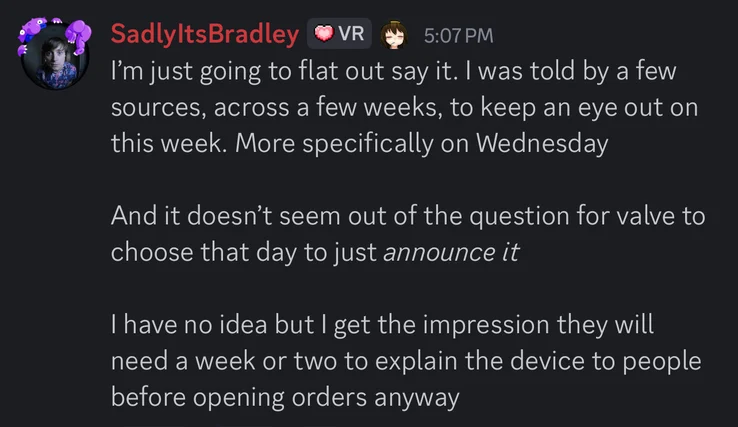
    Recent information suggests we may be very close to the official launch. According to details shared by SadlyItsBradley on their Discord (via r/GamingLeaksAndRumors), Valve might make an announcement for the Steam Frame VR headset on Wednesday, November 12th. This info reportedly comes from “a few sources, over a few weeks”. The leaker adds that Valve could take one or two weeks to finalize their messaging about the Steam Frame before starting pre-orders.

    Anticipated Release Timing

    While we can’t verify the exact release date for the Valve Steam Frame, a launch during the Holiday season of 2025 appears to be a likely option for Valve’s next gaming console. The Holiday period has always been a popular time for releasing gaming consoles, as it helps to ensure high demand. Additionally, we’ve seen our first glimpse of a new, unconfirmed Steam controller, suggesting that things are aligning for a new Valve VR console.

    Skeptical Outlook

    That being said, we recommend taking this information with a big pinch of salt, since we previously heard a similar rumor in mid-September about an upcoming Wednesday launch that didn’t happen. So, seeing another rumor about a Wednesday announcement definitely raises some eyebrows.

    Source:
    Link


  • Steam Deck Update: New Low-Power Mode Enables Background Downloads

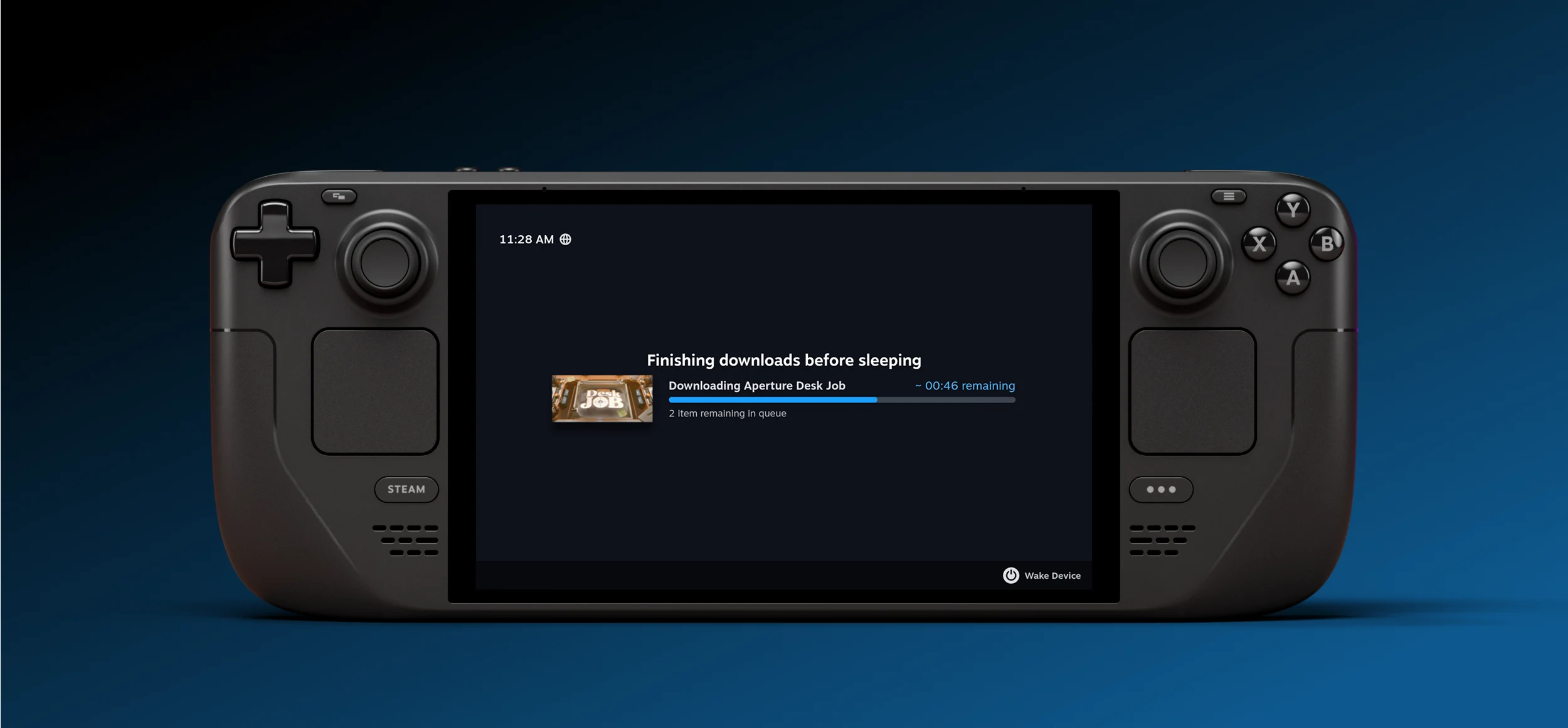
    Steam Deck Update: New Low-Power Mode Enables Background Downloads

    Key Takeaways

    1. Users can now download content on the Steam Deck while in power-saving mode.
    2. Downloads continue in the background when the power button is pressed.
    3. The Steam Deck automatically switches to off-screen download mode when idle.
    4. The new feature is currently in the beta version of SteamOS but will be available for all users soon.
    5. The Steam Deck is the only console that can update games in the background, helping to reduce screen burn-in.


    Valve has quietly introduced what might be one of the top enhancements for the Steam Deck’s user experience. Now, users are able to download content even when the device is in power-saving mode. In the past, it was necessary to keep the console active for the entire duration of downloads, which could take several days if the internet connection was slow. By default, off-screen downloads are turned on whenever the Steam Deck is plugged into a power source. Yet, users can activate this feature for battery mode through the settings.

    Downloading Made Easier

    When a download is in progress and the power button is pressed, an additional option will appear allowing the download to continue running in the background. Moreover, if the Steam Deck is idle while downloads are active, it will automatically switch to this mode. If the battery percentage goes below 20%, the console will enter sleep mode. Currently, this feature is exclusive to the beta version of SteamOS, but it’s expected to be available for all users soon.

    Keeping Games Updated

    In essence, the Steam Deck stands out as the only console capable of updating games in the background. It’s worth noting that Steam was among the first applications to integrate this feature on desktop platforms, so it makes sense for them to include it on this new device form. This update will be particularly beneficial for Steam Deck OLED users by lowering the chances of screen burn-in.

    Source:
    Link


  • Half-Life 3 Reveal Expected in November 2025

    Half-Life 3 Reveal Expected in November 2025

    Key Takeaways

    1. Half-Life 3 appears to be complete, generating excitement among fans of the series.
    2. A trailer for the game may be released in November, according to Tyler McVicker.
    3. The game is in an advanced phase of development, with potential plans to reveal it at The Games Awards 2025.
    4. Caution is advised due to Valve’s lack of official communication about Half-Life 3.
    5. Reliable information about the game’s development remains scarce until Valve makes an official announcement.


    Fans of the Half-Life series will surely be thrilled to learn that the third installment of the game appears to be complete. Additionally, Tyler McVicker has mentioned that a trailer might be released in November.

    Excitement Builds

    This game is highly anticipated by countless gamers globally, and for solid reasons. The first two games in the series were incredibly popular, leaving a significant mark on the gaming industry. Half-Life 3 is expected to clarify many mysteries surrounding the storyline of this beloved franchise.

    Development Insights

    Tyler McVicker has shared his insights, claiming that the game is in a very advanced phase of its development during his recent HLX Files episode. He further suggests that the trailer for Half-Life 3 is already being made, with Valve planning to reveal it alongside the game’s launch. According to his insights, a potential release could coincide with The Games Awards 2025 in November.

    Caution is Key

    Despite the buzz, it’s important to be cautious due to Valve’s silence regarding Half-Life 3. The game has reached a legendary status, leading to numerous theories, some of which lack credibility.

    Until Valve officially communicates about the game, obtaining reliable information on its development remains challenging. We will have to wait till November to determine if Tyler McVicker’s predictions hold true and whether the game lives up to players’ hopes.

    Source:
    Link


  • Counter-Strike 2 Patch Costs $2B+ in Skin Market, Knives Craftable

    Counter-Strike 2 Patch Costs $2B+ in Skin Market, Knives Craftable

    Key Takeaways

    1. Valve has introduced a patch for Counter-Strike 2 that changes the skin trading system, allowing players to trade multiple items for a knife or gloves.
    2. The total skin market cap dropped from approximately $6 billion to around $4.27 billion within a day, losing nearly $2 billion in value.
    3. The prices of rare items, especially knives and gloves, have decreased significantly (40%–60%) due to increased crafting ease, while red skins have gained value.
    4. The update is seen as a way to correct an inflation bubble in the skin market, making high-tier items less rare and more accessible.
    5. This change may increase trading activity on the Steam marketplace, benefiting Valve financially by encouraging more in-game transactions.


    Valve, the firm behind the leading PC gaming platform, has quietly introduced a patch for Counter-Strike 2 that significantly alters the game’s multi-billion-dollar skin marketplace. This update allows players to trade five StatTrak™ Covert items for a single StatTrak™ knife, or swap five regular Covert items for one regular knife or a pair of gloves from the available collections.

    Rapid Market Changes

    The effects of this update were immediate and severe. The tracking platform PriceEmpire recorded a rapid decrease in the total skin market cap, plummeting from approximately $6 billion to around $4.27 billion within a day. This represents a loss of nearly $2 billion in market value, disappearing almost instantly.

    Impact on Rare Items

    Rare items, especially knives and gloves that were previously hard to obtain through trade-ups, suffered the most. Many sought-after knives that were once valued at several thousand dollars have seen their prices drop by 40%–60% as the ease of crafting them has increased. Conversely, the red skins used in trade-up contracts have skyrocketed in value, as they have now become the new “currency” for creating high-tier items.

    Economic Implications

    The reasoning behind this change is straightforward: by allowing players to create knives and gloves from previously lower-value items, Valve has reduced the rarity of its top-tier items and initiated a necessary re-evaluation of the overall market. Some traders believe this move corrects a long-term inflation bubble within the skin market, while others see it as a threat to the value for those who invested for the long haul. A comment on the r/CS2 subreddit encapsulates this sentiment: “I got burned a bit … but honestly, this is a good move for the game’s future … it’s now easier for people to get the skins they desire.”

    Business Benefits for Valve

    From a business angle, this update could boost activity on the Steam marketplace. With lower price points for sought-after skins, more players may become involved in trading, leading to an increase in transactions from which Valve can profit in-game, instead of missing out on off-platform trades. As one Reddit user remarked: “Valve just executed a brilliant strategy in platform capitalism.”

    While Valve has not yet officially addressed the market consequences, the effects are already becoming apparent. Whether you’re a collector or simply after your first knife, this update has transformed the landscape overnight and carries significant implications for what many traders once viewed as appreciating digital assets.

  • Valve Steam Frame headset leaks, mass production for 2023 release

    Valve Steam Frame headset leaks, mass production for 2023 release

    Key Takeaways

    1. Valve’s new VR headset, informally named “Deckard” and possibly launching as “Steam Frame,” is in large-scale production for a 2025 release.
    2. The production is expected to yield between 400,000 and 600,000 units annually, demonstrating Valve’s serious commitment to the VR market.
    3. The headset will focus on wireless streaming from PCs, and new controller models have been found in SteamVR code.
    4. The launch could reshape the competitive landscape for high-end PC-connected VR and rekindle market interest.
    5. Official specifications and pricing are still pending, but the anticipated high price point and standalone streaming capabilities suggest significant hardware improvements.


    Valve’s new VR headset is said to have started large-scale production, with fresh insights coming from a Chinese analyst group. This new information also aligns with earlier industry rumors.

    Production Details

    As per the XR Research Institute, Valve’s upcoming VR headset, which is informally named “Deckard” and may be launched as “Steam Frame,” is currently being manufactured for a planned release in 2025. They estimate that production will result in between 400,000 and 600,000 units each year.

    Serious Commitment to VR

    These figures highlight Valve’s strong commitment to re-entering the VR hardware market on a large scale. The company has acknowledged through various public announcements and developer codes that they are developing a new headset that emphasizes wireless streaming from PCs. Mentions of “Deckard” have been spotted in SteamVR code since at least 2021. Additionally, towards the end of 2024, new “Roy” controller models, which look similar to the Oculus Touch, were discovered in SteamVR clues. A trademark application for “Steam Frame” along with newer code snippets suggests that this is likely to be the final product name, moving away from the Deckard label.

    Impact on the Market

    With shipments anticipated this year, the launch of this device could significantly influence the competitive landscape and rekindle interest in high-end PC-connected VR. Previous speculations have indicated a high price point, standalone streaming capabilities with PC tethering, and substantial hardware enhancements, but official confirmation of these specifications is still awaited. Given that the latest leak points to a 2025 launch, an official announcement should be forthcoming soon.

    Source:
    Link


  • Valve Bans CS2 Transit Map for Racial Slur and Copyright Issues

    Valve Bans CS2 Transit Map for Racial Slur and Copyright Issues

    Key Takeaways

    1. Valve removed the community-created Transit map from Counter-Strike 2’s official matchmaking just two days after its release due to a hidden racial slur in the map’s files.

    2. Transit was developed for the Wingman mode and took over a year to create, alongside three other new maps included in the recent update.

    3. The controversy arose when players discovered an inappropriate entity label and other references related to a Russian Ponzi scheme hidden in the map.

    4. The map had various easter eggs featuring the Stray cat, with an animation activated by collecting posters throughout the game.

    5. Developer Maxim “Rikuda” admitted the offensive content was a forgotten joke and expressed frustration over Valve’s decision to remove the map without contacting him for a fix.


    Valve has recently pulled the community-created Transit map from Counter-Strike 2’s official matchmaking lineup, just two days after its debut on October 2, 2025, without offering any explanation. Players like Ozzny_CS2 on X quickly spotted a racial slur hidden in the map’s files, which sparked the controversy.

    About the Transit Map

    Transit was crafted for the Wingman mode, taking place in a Vietnamese town. It was one of four fresh maps brought in with the recent update, alongside Rooftop for Wingman, Palacio, and Golden for Competitive, Casual, and Deathmatch modes.

    The creators of Transit had spent over a year developing the map before Valve selected it from the Steam Workshop, aiming to enhance player engagement.

    The Controversy Unfolds

    The issue gained momentum when players, employing console commands like “ent_fire,” found an entity labeled “n*a_cat” linked to interactive posters featuring the orange cat from the PlayStation game, Stray.

    This appears to be a forgotten crude joke inserted during the development of Transit, which also violated copyright laws.

    Upon closer inspection, more scattered references hinted at cryptocurrency schemes, including a notorious Russian Ponzi scheme called MMM, inscribed in the skybox as well as mentions of FPIBank. This memecoin seems to be an inside joke among Russian developers.

    Easter Eggs and Reactions

    In addition to this, there were various easter eggs involving posters of the Stray cat throughout the map. Players who collected all these would activate an animation showing the cat racing along a wire in a bucket, accessible through CS2’s console.

    Valve’s update log simply stated: “Removed Transit from official matchmaking,” without providing any extra details. However, players interested in Transit can still find the map available in the Steam Workshop.

    Maxim “Rikuda,” one of the developers of Transit, admitted to the mistake on Discord. He explained that it was “just a joke that I then forgot to rename.” He clarified that it was meant to be a nod to a recurring phonetic meme on YouTube and wasn’t intended to offend.

    While he acknowledged that “it was incredibly stupid,” he felt frustrated that Valve didn’t contact him, mentioning that fixing the issue would’ve taken “five minutes” or even just “a simple two-minute task.”

    He expressed disappointment, realizing that “Valve will probably never add his maps to the game again due to this incident.”

    Source:
    Link


  • Steam Deletes BlockBlasters After $150K Crypto Theft

    Steam Deletes BlockBlasters After $150K Crypto Theft

    Key Takeaways

    1. Valve removed the game BlockBlasters from Steam due to its involvement in stealing cryptocurrency from players’ wallets.
    2. An update to BlockBlasters included malware that disabled antivirus programs and targeted cryptocurrency wallets.
    3. The malware collected personal data such as IP addresses and login information before draining crypto funds.
    4. Approximately $150,000 in cryptocurrency was stolen, affecting around 478 Steam accounts, according to security reports.
    5. A notable victim was Twitch streamer Raivo “RastalandTV” Plavnieks, who lost $32,000 in crypto while live streaming fundraising for his cancer treatment.


    Valve has taken down the game BlockBlasters from its Steam store due to the game’s involvement in stealing cryptocurrency from players’ wallets. BlockBlasters, a 2D platform game, was launched on the platform on July 30, 2025. After being available for a month without any problems, it received an update in August that included malware designed to drain crypto funds from users.

    Malicious Code Uncovered

    The harmful software, discovered by G-DATA, had a batch file that turned off the Anti-Virus programs on users’ computers. It gathered personal data such as IP addresses, locations, and login information. Once the security software was disabled, it would methodically check the cryptocurrency wallets installed on the computer and start emptying their balances.

    Investigations and Reports

    BleepingComputer has reported unverified information suggesting that the perpetrator may be an Argentine immigrant living in the United States. Scam investigator ZachXBT mentioned on X that around $150,000 in cryptocurrency was allegedly taken during the month the malware was active. Another security organization, VXUnderground, has released a list of usernames, identifying almost 478 Steam accounts impacted by this scam.

    High-Profile Victim

    One notable victim was Twitch streamer Raivo “RastalandTV” Plavnieks, who experienced the theft live while he was raising money for his cancer treatment. He is currently fighting Stage-4 Sarcoma. After he installed the game at the suggestion of a viewer, he ended up losing $32,000 in crypto from his wallet. This high-profile case was what ultimately prompted Valve to remove BlockBlasters from its store.

    Source:
    Link


  • Steam Ends Support for Windows 10 32-Bit by 2026

    Steam Ends Support for Windows 10 32-Bit by 2026

    Key Takeaways

    1. Steam will stop supporting Windows 10 32-bit on January 1, 2026, marking the end of over twenty years of support for 32-bit operating systems.
    2. As of August 2025, Windows 10 32-bit usage is only 0.01%, while 64-bit versions dominate with Windows 11 at 60.39% and Windows 10 at 35.08%.
    3. Existing Steam installations on 32-bit systems will still work temporarily, but will not receive updates or support for new security issues.
    4. Valve’s decision is driven by technical limitations, focusing future versions of Steam on 64-bit systems for better performance and security.
    5. Users on Windows 10 32-bit are encouraged to upgrade to a 64-bit version or consider alternatives like Linux or dedicated gaming devices before the support cutoff.


    Valve has announced the final date for supporting Steam on 32-bit operating systems, marking the close of a significant chapter in PC gaming history that has lasted over twenty years. Beginning on January 1, 2026, Steam will discontinue support for Windows 10 32-bit, which is the last 32-bit OS version the platform has been backing.

    Current Usage Statistics

    According to Steam’s Hardware Survey from August 2025, Windows 10 32-bit represents only 0.01% of all surveyed computers. In comparison, Windows 11 64-bit takes the lead with 60.39% usage, while Windows 10 64-bit comprises 35.08% of the market share. With Steam boasting a vast user base of 132 million active users as of June 2024, this change could still impact thousands of gamers across the globe.

    Transition Details

    The shift won’t happen overnight or cause immediate chaos. Existing Steam installations on Windows 10 32-bit systems will continue to work “for the near term,” but they will become outdated. There won’t be any new updates, including security fixes that defend against emerging vulnerabilities and malware. Additionally, Steam Support will cease to provide help for problems arising on these older systems.

    Valve cites technical limitations as the reason for this decision. The company stated, “Core features in Steam rely on system drivers and other libraries that are not supported on 32-bit versions of Windows.” From now on, future versions of Steam will only focus on 64-bit Windows systems, enabling Valve to take advantage of modern system capabilities without being held back by older technology.

    Ongoing Modernization Efforts

    This decision is part of Valve’s ongoing effort to modernize the platforms that Steam supports. Earlier, in January 2024, the company stopped supporting Windows 7, Windows 8, and Windows 8.1 due to similar technical and security issues. At that time, these older operating systems represented around 0.89% of Steam’s user base.

    It’s crucial to note that ending 32-bit OS support will not impact game compatibility. Players using 64-bit versions of Windows 10 or Windows 11 can continue to enjoy their entire collection of 32-bit games without any problems. Contemporary 64-bit Windows systems have strong compatibility layers for older 32-bit applications, ensuring that classic games can still be played.

    Recommendations for Users

    For the few users still on Windows 10 32-bit, there are various alternatives available. Valve highly advises upgrading to a 64-bit version of Windows 10 or Windows 11 before the January cutoff. For hardware that cannot run Windows 11, options include switching to Linux distributions compatible with Steam or looking into dedicated gaming devices like the Steam Deck.

    Source:
    Link


  • Valve Set to Reveal Deckard Steam Frame VR Headset This Week

    Valve Set to Reveal Deckard Steam Frame VR Headset This Week

    Key Takeaways

    1. Valve’s upcoming VR headset, known as Deckard, may have received its official title but details remain undisclosed.
    2. Speculation about an announcement is fueled by hints from VR YouTubers and community members, including a special report scheduled for September 17.
    3. VR YouTuber Nathie hinted at a trip to Seattle, potentially linking to Valve’s location and upcoming developments.
    4. Clues from recent SteamVR updates include references to ‘Frame’ interfaces, suggesting progress on the headset.
    5. Valve is reportedly securing a new trademark for the Steam Frame, indicating an official reveal may be imminent.


    For a while now, there have been buzzes about Valve’s upcoming VR headset, which is often referred to as Deckard. It seems that Deckard is the internal name for the headset, and it may have recently received its official title. Since Valve has not yet disclosed any details regarding the headset, everything is still based on guesswork, but it appears we might not have to wait too long for an official announcement.

    Possible Update Coming Soon

    As noted by Reddit user ‘___Steve,’ Valve might be gearing up for some kind of announcement regarding the Deckard, or whatever the final name will be. This information comes from well-known VR YouTuber habie147, who concluded their recent video by stating, “I will see you next, on Wednesday. Special report incoming. First time ever Wednesday posting. Big deal. Set an alarm. Alert the Post Office.”

    Hints from the VR Community

    To further spark interest, another VR YouTuber, Nathie, shared on Threads on September 7 that they are excited about an upcoming trip to Seattle, hinting they could be visiting Bellevue, where Valve is located. In addition, Norman Chan from Tested tweeted a puzzling message on BlueSky on September 10, which might relate to the next Half-Life game. They mentioned, “plateau? more like mesa.”

    All these clues suggest that an update concerning the Steam Frame, Valve’s next VR headset, may be coming on Wednesday, September 17.

    Speculations and Clues

    While these events could be random and unrelated to any Steam Frame update, the timing does seem notable. Back in 2019, Valve kept quiet about the Index VR headset until it was unexpectedly introduced during a livestream by Facebook (now Meta).

    Additionally, the recent updates for SteamVR have included many references to ‘Frame’ interfaces and menus. Valve has also been working on securing a new trademark for the Steam Frame with the United States Patent and Trademark Office (USPTO). Whether or not an announcement will happen this week, it looks like the company is getting closer to officially revealing something new.

    Source:
    Link


  • Steam Deck 2 Expected Release in 2028: Latest Updates

    Steam Deck 2 Expected Release in 2028: Latest Updates

    Key Takeaways

    1. A rumor suggests the Steam Deck 2 could be released in 2028, as stated by hardware expert KeplerL2.
    2. Valve’s Lawrence Yang indicated that a next-generation Steam Deck will only debut when significant performance improvements are achievable.
    3. The longer development cycle for the Steam Deck 2 may allow AMD to advance its future APU designs.
    4. The original Steam Deck, released in February 2022, remains a top choice among handheld gaming devices, especially after the OLED refresh in November 2023.
    5. Approach the rumor with caution, as while KeplerL2 has a reliable history, confirmation of this timeline is still needed.


    The previous time we discussed the Steam Deck 2, most of the conversation revolved around Valve’s overall plans for hardware. This included speculation about a potential new home console and a closer partnership with Sony in the portable gaming market. Recently, however, a new rumor has emerged that sharpens the focus on the Steam Deck’s next version, suggesting it could be released in 2028.

    Rumor Details

    This information comes from a hardware expert named KeplerL2, who made a short post on the gaming forum NeoGAF, stating simply, “Steam Deck 2 is 2028.” Although this comment lacks detailed information, it reinforces earlier remarks from Valve’s Lawrence Yang. In late 2023, Yang mentioned that a genuine “next-generation” Steam Deck would not debut until significant performance enhancements were achievable. The current model, the Steam Deck OLED, is priced at $769.99 on Amazon.

    Implications of the 2028 Release

    If KeplerL2’s assertion is correct, a release in 2028 indicates that Valve is opting for a longer development cycle for its handheld devices. This approach would also give AMD’s future APU designs the time they need to develop and advance.

    The original Steam Deck was released in February 2022 and has quickly become a top choice in the handheld PC gaming category. It ranks among the best-selling gaming handhelds, right behind the Nintendo Switch, which is quite an accomplishment. The device is powered by a customized AMD APU and operates on SteamOS, featuring Proton compatibility. The OLED refresh that came out in November 2023 improved display quality and efficiency due to its 6nm manufacturing process but did not overhaul the hardware significantly. You can find our review of the Steam Deck OLED here.

    Caution with Rumors

    As with any leak, it’s important to approach this information with some skepticism, even though KeplerL2 has a reliable history. The rumor aligns with Valve’s previously shared views, so we will need to keep an eye out for any updates that confirm this timeline.

    Source:
    Link