Tag: TUV Rheinland certification

  • Samsung QLED TVs Earn ‘Real Quantum Dot’ Certification Upgrade

    Samsung QLED TVs Earn ‘Real Quantum Dot’ Certification Upgrade

    Key Takeaways

    1. Samsung’s QLED TVs have received TÜV Rheinland certification, confirming their status as Real Quantum Dot Displays, which strengthens their position in the high-end TV market.

    2. The TÜV certification validates that Samsung’s QLED TVs meet the IEC 62595-1-6 standard, ensuring effective isolation and emission of red, green, and blue wavelengths for improved color accuracy.

    3. The certification includes a range of QLED models, including high-end Neo QLED 8K and 4K series, which utilize over 3,000 parts per million of quantum dot material for enhanced color precision and brightness.

    4. Samsung’s quantum dots are cadmium-free, using indium phosphide to improve safety and eco-friendliness while still achieving high performance in color and brightness.

    5. Samsung’s Knox security platform addresses privacy concerns related to smart TVs, providing multi-layered protection against unauthorized access and data leaks, further enhancing consumer trust.


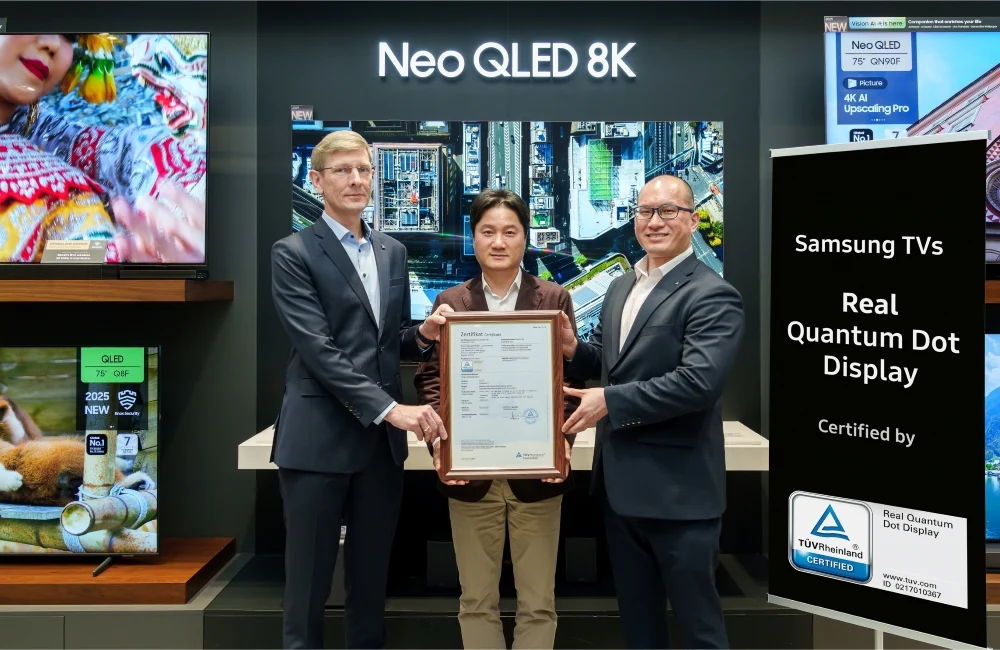
    Samsung’s QLED TVs have been officially recognized as Real Quantum Dot Displays by TÜV Rheinland, which confirms the company’s long-standing claims regarding its display tech.

    Strengthening Market Position

    This certification strengthens Samsung’s QLED models in the high-end TV market, particularly amid ongoing scrutiny about the genuine use of quantum dots in LED displays.

    The TÜV Rheinland certification is not just a promotional claim; it validates that Samsung’s QLED TVs comply with the IEC 62595-1-6 standard for quantum dot displays.

    Technical Benchmark

    This standard assesses how effectively displays can isolate and emit red, green, and blue wavelengths. For a display to be deemed a true quantum dot display, these wavelengths should have minimal overlap, a requirement that many less expensive or imitation panels fail to meet.

    TÜV performed independent evaluations and confirmed that Samsung’s QLED panels exhibit the expected spectral separation associated with authentic quantum dot materials. This results in a noticeable improvement in color accuracy and vibrancy on the screen.

    Range of Certified Models

    According to Samsung, the certification includes various QLED models, such as the high-end Neo QLED 8K series (QN990F and QN900F), Neo QLED 4K models (QN90F, QN85F, QN80F, QN70F), and mid-range QLED 4K variants (Q8F, Q7F, Q6F).

    All these televisions incorporate Samsung’s Quantum Dot Sheet layer, which is situated between the backlight and the LCD panel. This layer contains over 3,000 parts per million of quantum dot material, enhancing color precision, contrast, and brightness while also improving energy efficiency.

    Samsung utilizes AI-driven picture processing to enhance clarity and adjust images in real-time according to the content type being shown.

    Environmentally Friendly Quantum Dots

    A key point is that Samsung’s quantum dots are free of cadmium. Cadmium helps improve light conversion efficiency, which can enhance image brightness and color saturation. However, cadmium is toxic and is heavily regulated in many areas, especially under EU RoHS guidelines.

    To avoid these issues, Samsung employs indium phosphide-based quantum dots. These are more eco-friendly and have received high recognition, including a Nobel Prize in Chemistry in 2023 for researchers who advanced quantum dot uses in medical imaging and display tech.

    Certification organizations like SGS and RoHS have confirmed that Samsung’s quantum dot films are completely cadmium-free, ensuring safety for both consumers and the manufacturing process.

    Addressing Privacy Concerns

    Another aspect of Samsung’s QLED promotion is its Knox security platform. While this is less related to display quality, it tackles growing worries about smart TV privacy and data security. Knox offers multi-layered protection that encompasses hardware, system software, and network connections, aimed at preventing unauthorized access, tampering, and data leaks.

    Initially developed for Samsung smartphones, Knox has since been integrated into the company’s ecosystem, including TVs and appliances.

    In recent times, numerous TV brands have used the term “QLED” for marketing while not actually employing real quantum dot materials.

    Instead, they have depended on broad color filters or hybrid technologies that don’t reach true QD performance, leading to consumer confusion and sometimes misleading claims.

    Samsung’s new TÜV Rheinland certification aids in differentiating its products from those that take shortcuts or misrepresent quantum dot technology.

    Source:
    Link
  • Fast Charging Details Revealed as Samsung Galaxy A55 Receives TUV Rheinland Certification

    Fast Charging Details Revealed as Samsung Galaxy A55 Receives TUV Rheinland Certification

    Samsung Galaxy A55 Receives TUV Rheinland Certification for 25W Fast Charging

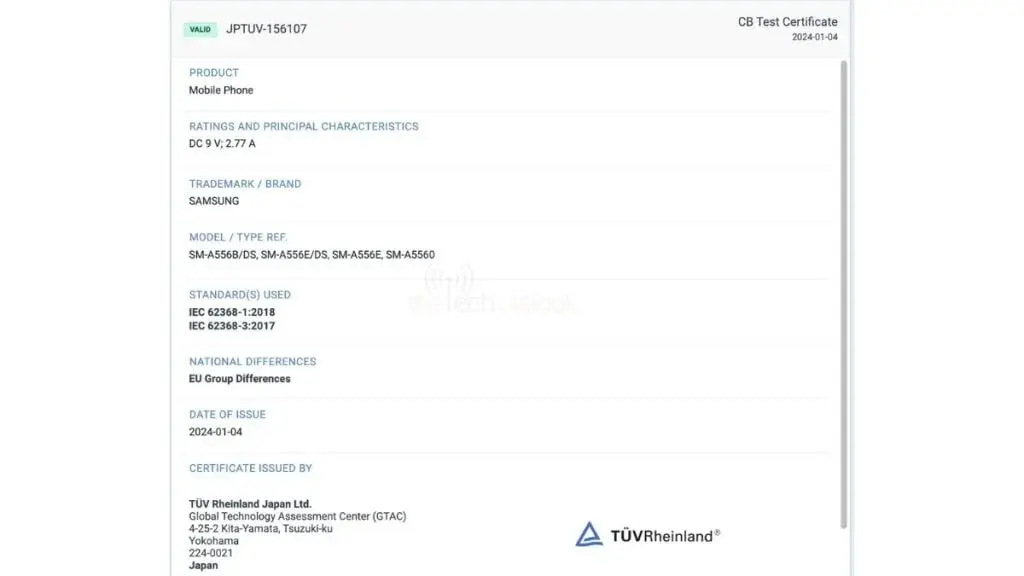
    Samsung is gearing up to launch its highly anticipated Galaxy S24 series flagship smartphones on January 17. Following this, the brand will introduce its A-series mid-range devices, with the Galaxy A55 taking the spotlight this year. The latest development reveals that the Galaxy A55 has received the TUV Rheinland certification, shedding light on its charging capabilities.

    According to information uncovered by The Tech Outlook, the Galaxy A55, identified by model numbers SM-A556B/DS, SM-A556E/DS, SM-A556E, and SM-A5560, will come with support for 25W fast charging. Samsung has been incorporating 25W fast charging in most of its smartphones, while reserving the faster 45W fast charging for its flagship Galaxy S-series models.

    Impressive Charging Capabilities

    The TUV Rheinland certification confirms that the Galaxy A55 will offer users the convenience of 25W fast charging. This means that users can quickly recharge their devices, ensuring they spend less time plugged in and more time enjoying their smartphones.

    Exciting Specifications on the Horizon

    Apart from its fast charging capabilities, the Galaxy A55 is rumored to pack impressive specifications. It is expected to be powered by the Exynos 1480 chipset, paired with 8GB of RAM and 256GB of storage. The device is also likely to debut with Android 14, featuring the latest One UI 6.1.

    Stunning Display and Color Options

    Rumors suggest that the Galaxy A55 will sport a 6.5-inch flat display with a 120Hz refresh rate and Full HD+ resolution. This means users can expect a smooth and vibrant visual experience while consuming content or navigating through apps.

    In addition to its powerful performance and display, the Galaxy A55 is expected to come in three stylish color variants. Leaks have hinted at the availability of Awesome Ice Blue, Awesome Lilac, and Awesome Navy Blue options, adding a touch of elegance and personalization to the device.

    Conclusion

    With its TUV Rheinland certification for 25W fast charging, the Samsung Galaxy A55 promises to deliver a seamless and efficient charging experience. Combined with its impressive specifications and eye-catching design, the Galaxy A55 is set to be a highly sought-after mid-range device. Stay tuned for more updates on Samsung’s upcoming A-series lineup.

  • TUV Rheinland Certifies Realme Note 50, Leak Reveals Specifications

    TUV Rheinland Certifies Realme Note 50, Leak Reveals Specifications

    Thailand’s NBTC certification platform has recently listed the Realme Note 50 (model number RMX3834), revealing some key details about the upcoming smartphone. One notable feature is that the device will only support LTE connectivity, lacking the increasingly common 5G capabilities that many smartphones now offer.

    Battery and Charging Details

    The Realme Note 50 has also obtained TUV Rheinland certification, which has shed light on its battery capacity. The smartphone is equipped with a respectable 4890mAh battery, ensuring long-lasting usage. However, the same certification suggests that the device might come with a relatively slow 10W charger, which could potentially lead to slower charging times.

    Display and Camera Specifications

    According to tipster Paras Guglani, who cites industry sources via PassionateGeekz, the Realme Note 50 is rumored to sport a 6.67-inch HD+ LCD display with a water-drop notch. This display size should provide users with an immersive viewing experience.

    In terms of camera capabilities, the smartphone is expected to feature a dual camera setup on the back. The primary camera will be a 13MP lens, accompanied by a 0.8MP secondary camera. For selfies, the Realme Note 50 will offer a 5MP front-facing camera.

    Memory, Storage, and Software

    While the report did not mention the specific SoC (System on Chip) details, it did reveal that the Realme Note 50 will be powered by a chipset from Unisoc. The smartphone is also expected to come with 4GB of RAM and 64GB of internal storage, providing ample space for users to store their files, apps, and media.

    On the software front, the Realme Note 50 will feature Realme T UI, which is speculated to be a toned-down version of the standard Realme UI. This user interface will likely offer a smooth and intuitive user experience.

    Pricing and Availability

    As for the price, the Realme Note 50 is expected to fall within the range of 7,000 to 8,000 INR. However, it is important to note that these details are still preliminary and subject to change. Therefore, it is advisable to take them with a grain of salt.

    Budget-Friendly Option

    Despite the limited information available at this stage, the certifications obtained by the Realme Note 50 suggest that it will likely be a budget-friendly smartphone. This could make it an attractive option for consumers who are looking for an affordable device without compromising on essential features.

    In conclusion, the Realme Note 50 is set to offer LTE connectivity, a powerful battery, a large display, decent camera capabilities, and sufficient memory and storage options. While more details are yet to be revealed, this smartphone appears to be a promising choice for budget-conscious individuals.

  • Samsung Galaxy A25 5G Receives TUV Rheinland Certification

    Samsung Galaxy A25 5G Receives TUV Rheinland Certification

    TUV Rheinland Certification Discloses 25W Fast Charging Support for Samsung Galaxy A25 5G

    The much-anticipated Samsung Galaxy A25 5G smartphone has been causing a stir in the tech industry of late. With a plethora of leaks and certification listings circulating, it appears that the unveiling of the device is imminent. Adding to the anticipation, the Galaxy A25 5G has now surfaced on the TUV Rheinland certification platform, providing further affirmation of its existence.

    Details of Certification

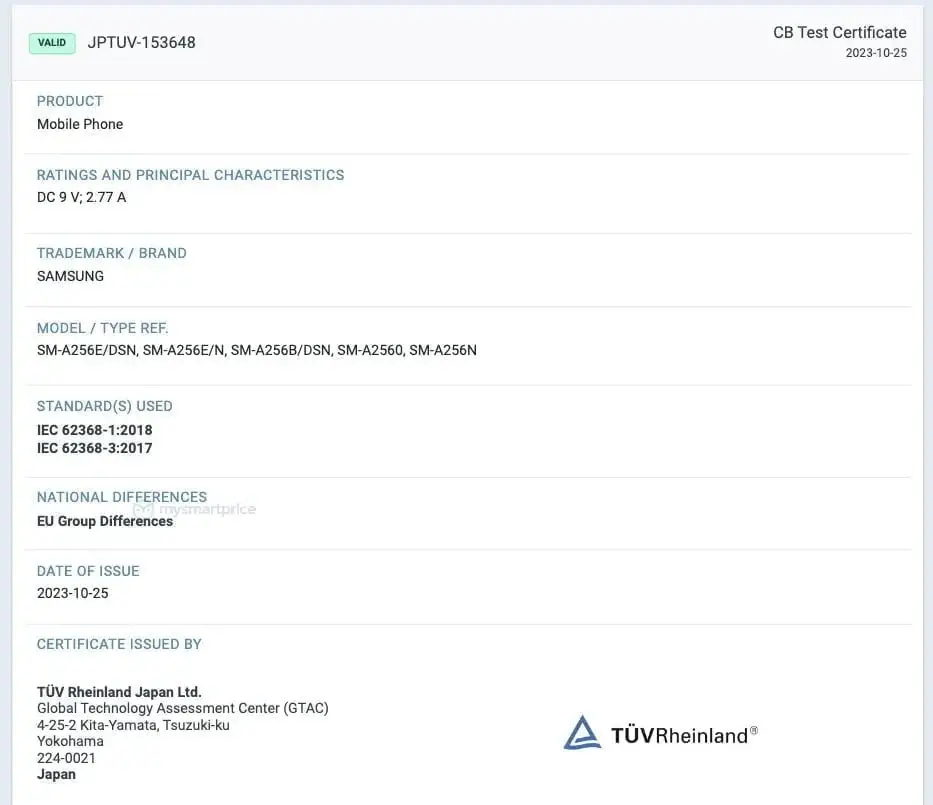
    As per the TUV Rheinland documentation, the Samsung Galaxy A25 5G is recognized by the model number SM-A256E/DSN, aligning with the BIS and FCC certifications. While the certification does not offer extensive additional details, it does unveil an exciting aspect – the inclusion of 25W fast charging support.

    Design and Range of Colors

    Leaked images of the Galaxy A25 5G exhibit its design language. Envisaged features include a waterdrop notch display and a marginally thick lower chin. When it comes to color choices, users can anticipate selections from black, blue, lime green, and light blue variants. The rear panel of the device will be home to three vertically aligned camera sensors.

    Technical Specifications

    An unveiled comprehensive spec sheet has shed light on the Samsung Galaxy A25 5G’s functionalities. The smartphone is projected to flaunt a 6.5-inch FHD+ display with a 90Hz refresh rate, providing a seamless and vivid viewing experience. For enthusiasts of selfies, a 13MP front camera is on the cards. On the rear end, it is speculated that the camera arrangement will encompass a 50MP primary sensor, an 8MP ultra-wide-angle lens, and a 2MP macro module, enabling users to capture breathtaking photos from various angles.

    Beneath the surface, the Galaxy A25 5G is rumored to be fueled by an Exynos 1280 processor, ensuring competent performance and effective multitasking. It is anticipated to come with up to 8GB of RAM and provide generous storage with a capacity of up to 256GB of internal memory. To sustain the device over the course of a day, a sturdy 5,000mAh battery is anticipated.

    In Conclusion

    With the Samsung Galaxy A25 5G securing the TUV Rheinland certification, it is evident that the smartphone is edging closer to its official debut. Although specifics regarding pricing and a precise launch date remain undisclosed, the leaked specifications and design aspects hint that the Galaxy A25 5G will stand out as a potent and visually alluring choice for consumers in search of a 5G smartphone adventure. Stay updated for further developments on this forthcoming Samsung offering.