
Key Takeaways
1. Samsung’s QLED TVs have received TÜV Rheinland certification, confirming their status as Real Quantum Dot Displays, which strengthens their position in the high-end TV market.
2. The TÜV certification validates that Samsung’s QLED TVs meet the IEC 62595-1-6 standard, ensuring effective isolation and emission of red, green, and blue wavelengths for improved color accuracy.
3. The certification includes a range of QLED models, including high-end Neo QLED 8K and 4K series, which utilize over 3,000 parts per million of quantum dot material for enhanced color precision and brightness.
4. Samsung’s quantum dots are cadmium-free, using indium phosphide to improve safety and eco-friendliness while still achieving high performance in color and brightness.
5. Samsung’s Knox security platform addresses privacy concerns related to smart TVs, providing multi-layered protection against unauthorized access and data leaks, further enhancing consumer trust.
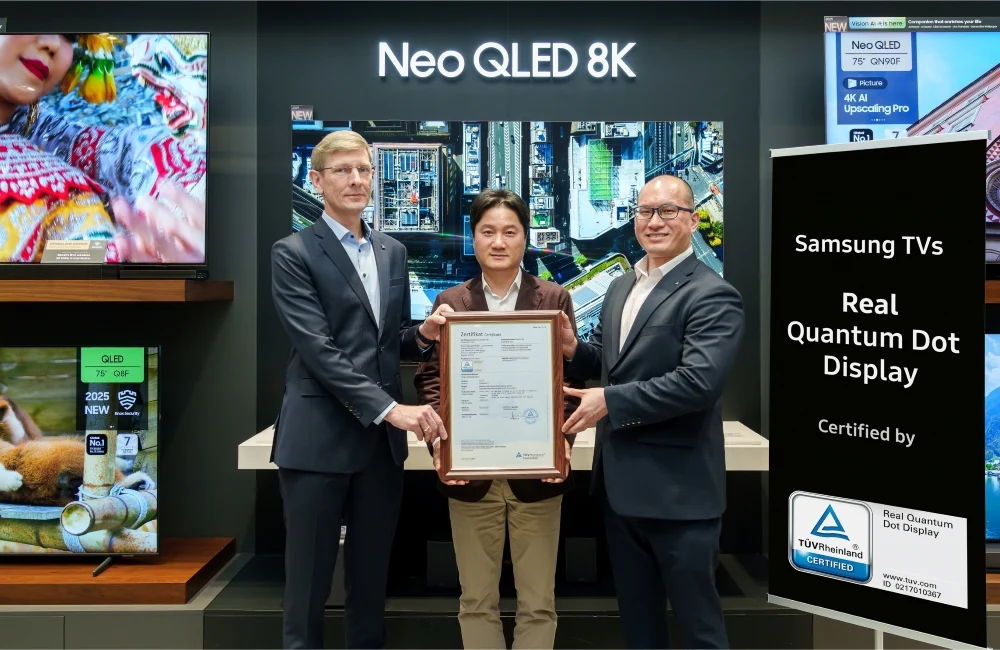
Samsung’s QLED TVs have been officially recognized as Real Quantum Dot Displays by TÜV Rheinland, which confirms the company’s long-standing claims regarding its display tech.
Strengthening Market Position
This certification strengthens Samsung’s QLED models in the high-end TV market, particularly amid ongoing scrutiny about the genuine use of quantum dots in LED displays.
The TÜV Rheinland certification is not just a promotional claim; it validates that Samsung’s QLED TVs comply with the IEC 62595-1-6 standard for quantum dot displays.
Technical Benchmark
This standard assesses how effectively displays can isolate and emit red, green, and blue wavelengths. For a display to be deemed a true quantum dot display, these wavelengths should have minimal overlap, a requirement that many less expensive or imitation panels fail to meet.
TÜV performed independent evaluations and confirmed that Samsung’s QLED panels exhibit the expected spectral separation associated with authentic quantum dot materials. This results in a noticeable improvement in color accuracy and vibrancy on the screen.
Range of Certified Models
According to Samsung, the certification includes various QLED models, such as the high-end Neo QLED 8K series (QN990F and QN900F), Neo QLED 4K models (QN90F, QN85F, QN80F, QN70F), and mid-range QLED 4K variants (Q8F, Q7F, Q6F).
All these televisions incorporate Samsung’s Quantum Dot Sheet layer, which is situated between the backlight and the LCD panel. This layer contains over 3,000 parts per million of quantum dot material, enhancing color precision, contrast, and brightness while also improving energy efficiency.
Samsung utilizes AI-driven picture processing to enhance clarity and adjust images in real-time according to the content type being shown.
Environmentally Friendly Quantum Dots
A key point is that Samsung’s quantum dots are free of cadmium. Cadmium helps improve light conversion efficiency, which can enhance image brightness and color saturation. However, cadmium is toxic and is heavily regulated in many areas, especially under EU RoHS guidelines.
To avoid these issues, Samsung employs indium phosphide-based quantum dots. These are more eco-friendly and have received high recognition, including a Nobel Prize in Chemistry in 2023 for researchers who advanced quantum dot uses in medical imaging and display tech.
Certification organizations like SGS and RoHS have confirmed that Samsung’s quantum dot films are completely cadmium-free, ensuring safety for both consumers and the manufacturing process.
Addressing Privacy Concerns
Another aspect of Samsung’s QLED promotion is its Knox security platform. While this is less related to display quality, it tackles growing worries about smart TV privacy and data security. Knox offers multi-layered protection that encompasses hardware, system software, and network connections, aimed at preventing unauthorized access, tampering, and data leaks.
Initially developed for Samsung smartphones, Knox has since been integrated into the company’s ecosystem, including TVs and appliances.
In recent times, numerous TV brands have used the term “QLED” for marketing while not actually employing real quantum dot materials.
Instead, they have depended on broad color filters or hybrid technologies that don’t reach true QD performance, leading to consumer confusion and sometimes misleading claims.
Samsung’s new TÜV Rheinland certification aids in differentiating its products from those that take shortcuts or misrepresent quantum dot technology.
Source:
Link
Leave a Reply