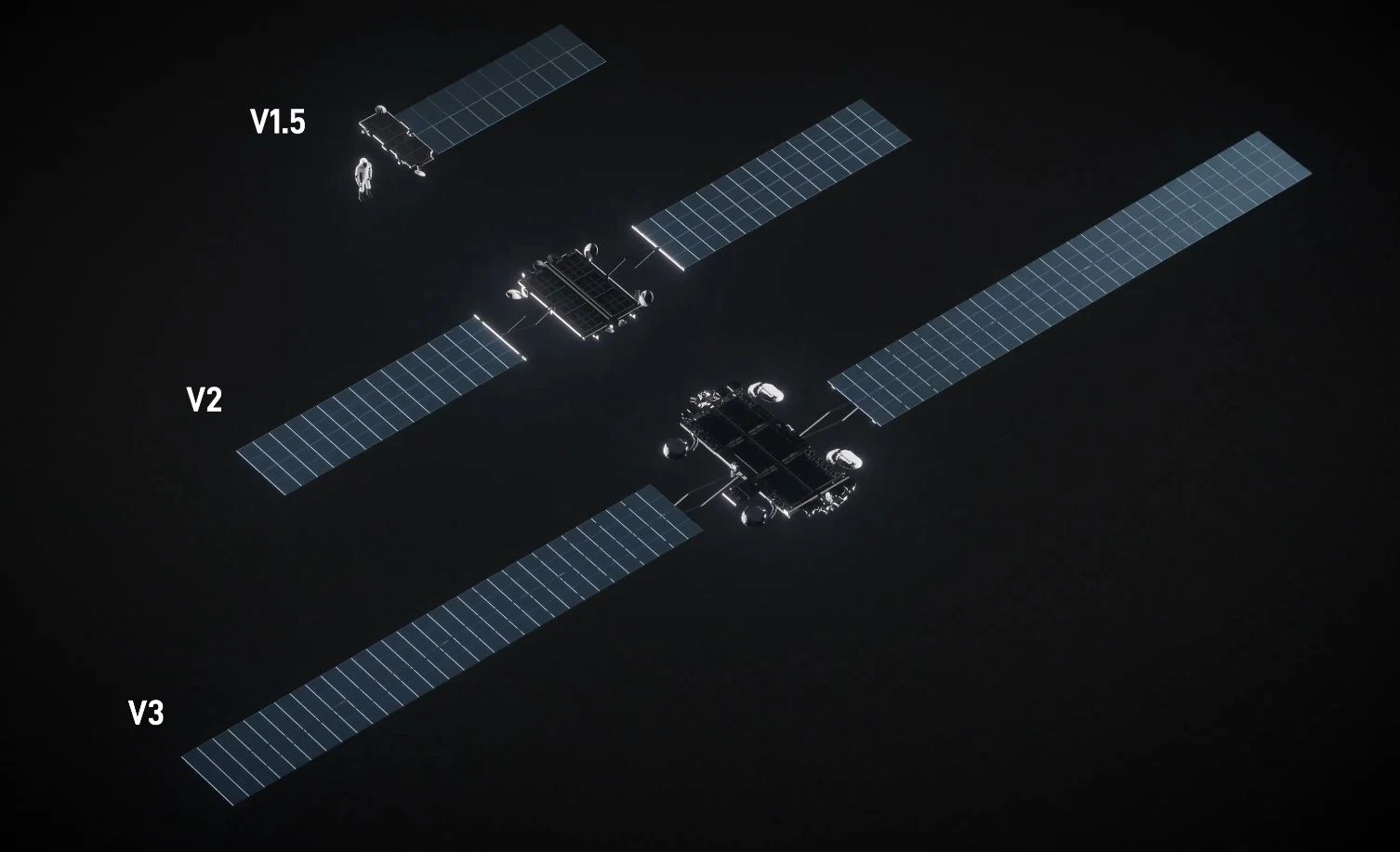
Tag: Starlink V3

  • Elon Musk Announces SpaceX Plans for Orbital Data Centers

    Elon Musk Announces SpaceX Plans for Orbital Data Centers

    Key Takeaways

    1. Major tech leaders, including Elon Musk, are exploring the possibility of data centers in space to meet increasing computing power demands driven by AI.

    2. SpaceX plans to utilize its Starlink V3 satellites, equipped with fast laser communication links, to establish cloud computing services in orbit.

    3. Advantages of space-based data centers include abundant solar energy and reduced environmental impact compared to terrestrial facilities.

    4. Significant challenges remain, including high costs and technical complexities associated with building and powering orbital data centers.

    5. SpaceX’s Starlink V3 satellites promise much higher capacity than competitors, potentially giving the company a competitive edge in this emerging market.


    As AI continues to drive the global need for computing power, major players in the tech world are now looking up to the stars for solutions. The concept of data centers in space — once thought to be just a theory — is starting to gain real traction. After notable interest from figures like Jeff Bezos of Amazon and Eric Schmidt, the former CEO of Google, Elon Musk has revealed that SpaceX is investigating the possibility of orbital data centers, leveraging the advanced Starlink V3 satellites as their base.

    SpaceX’s Ambition

    Musk shared on social media that SpaceX is committed to developing data centers in space, implying that the upcoming Starlink V3 satellites, each designed with fast laser communication links, could render this idea feasible. “SpaceX will be doing this,” Musk stated, hinting at a plan to turn Starlink’s worldwide internet service into a crucial framework for cloud computing in orbit.

    Advantages and Challenges

    The potential benefits are evident: solar energy is plentiful and free in space, which removes many of the land and environmental issues associated with terrestrial data centers. However, some critics point out that the expenses and technical challenges involved in creating and energizing such large orbital facilities are still significant obstacles.

    SpaceX’s Starlink V3 satellites are a major advancement in terms of capacity. While the existing Starlink V2 minis can reach around 100 Gbps, the V3 models are projected to provide up to 1 Tbps each. In comparison, Boeing’s Viasat-3 — another satellite in the same capacity range — took nearly ten years and hundreds of millions of dollars to bring to fruition. SpaceX plans to launch 60 high-capacity Starlink V3 satellites with each Starship mission, aiming for as early as 2026.

    A Competitive Edge

    Experts like Caleb Henry from Quilty Space believe that the scale and effectiveness of Starlink V3 launches could position SpaceX well ahead in this new market. “Nothing else in the rest of the satellite industry comes close to that amount of capacity,” Henry remarked.

    Despite the skepticism, SpaceX has a track record of turning doubt into achievement. Starlink, which was once regarded as overly ambitious, now provides broadband access to millions around the globe. If Musk can apply the same innovative approach and economic strategy to computing infrastructure, the vision of space-based data centers could transition from a distant fantasy to a working reality.

    Source:
    Link



  • Starlink Launching 5G Service with Major Satellite Expansion

    Starlink Launching 5G Service with Major Satellite Expansion

    Key Takeaways

    1. SpaceX is seeking FCC approval to launch 15,000 new V3 generation direct-to-cell satellites to enhance mobile service coverage.
    2. The new satellites will provide 20 times the throughput of the current Starlink V2 satellites, enabling full 5G service for mobile phones.
    3. Plans include expanding the Starlink ground station network to improve coverage, speed, and reduce latency, with projected speeds of up to 100 Mbps.
    4. SpaceX aims to establish itself as a major player in the mobile network industry, akin to traditional carriers like AT&T and Verizon.
    5. The launch of the V3 satellites depends on the success of the Starship 3 rocket tests, with a targeted launch date for the satellites set for 2026.


    SpaceX is getting ready to send a huge number of direct-to-cell satellites into orbit, aiming to create the largest satellite constellation that will transmit its new 5G service to mobile phones on Earth.

    Launching a New Era

    In its latest application, SpaceX is asking the FCC to approve the launch of an astonishing 15,000 new V3 generation direct-to-cell satellites. These new satellites are designed to provide 20 times the throughput of the current roughly 650 V2 satellites that Starlink uses for mobile service.

    Currently, the Starlink direct-to-cell satellites can only enable messaging and limited data for certain optimized apps through partnerships, such as the T-Satellite service with T-Mobile. With the new fleet of up to 15,000 V3 satellites, Starlink expects to establish a cellular network capable of delivering 5G data to any phone on the ground.

    Expanding the Network

    In its filing, SpaceX also plans to grow its extensive network of Starlink ground stations to enhance coverage, improve speeds, and reduce latency. The Starlink 5G service is projected to reach speeds of up to 100 Mbps, similar to what the Starlink Mini dish currently provides, but this will be achieved through a special satellite modem chip inside carrier phones.

    As for partnerships, while SpaceX is making deals with companies like T-Mobile for Starlink satellite connections, it appears to have ambitions to become the first space carrier in the world. Thanks to the vast spectrum it acquired for $17 billion from Dish’s parent company, Elon Musk mentioned that “you should be able to have Starlink like you have an AT&T, or T-Mobile, or Verizon [service]” in the near future.

    A Game Changer

    It’s clear that such a Starlink 5G service could transform the industry, even if Musk tends to downplay its potential due to the fact that U.S. carriers still “own a lot of spectrum.” While the Starlink 5G network may only offer downloads of 100 Mbps, that speed is comparable to the median LTE speeds offered by Verizon and AT&T just last year.

    All these ambitious plans depend on the successful tests of the Starship 3 rocket, which will be used to launch the V3 satellites that are about the size of a Boeing 737 when deployed. SpaceX is aiming for the first flight of the Starship 3 this year and hopes to launch the V3 satellites in 2026, which will also allow it to activate its gigabit speed network for dedicated devices like the new Performance dish.

    Source:
    Link


  • Starlink 5G Mobile Chip for Phones: SpaceX Leverages Dish Spectrum

    Starlink 5G Mobile Chip for Phones: SpaceX Leverages Dish Spectrum

    Key Takeaways

    1. SpaceX will launch V3 Starlink satellites next year, offering 10 times the throughput of the current V2 generation with a capacity of 1 Tbps.
    2. Dedicated equipment, such as the expensive Performance kit, is needed to access gigabit speeds, though improvements to the Starlink Standard dish may be forthcoming.
    3. The new V3 satellite constellation aims to create a 5G Starlink network that can connect directly to smartphones, with some models already compatible with an additional solution.
    4. SpaceX is developing custom connectivity chips with mobile processor manufacturers to allow smartphones to connect directly to Starlink’s 5G service, with testing beginning in 2026.
    5. Strategic partnerships with major mobile chipset manufacturers are in progress to integrate Starlink connectivity directly into smartphones, moving away from reliance on carrier partnerships.


    SpaceX is set to initiate the launch of its V3 satellites next year, kicking off its gigabit network. The new Starlink satellites are comparable in size to a Boeing 737 and will offer 10 times the throughput of the current V2 generation, with a staggering capacity of 1 Tbps. Users can expect peak Starlink speeds to surpass 1 Gbps for downloads and 160 Gbps for uploads, with the uplink being 24 times faster than what’s currently available on the Starlink network.

    Dedicated Gear Needed

    To fully experience the gigabit Starlink speeds, dedicated equipment is essential. The only dish that can currently support these speeds is the expensive Performance kit, which is aimed at enterprise clients. There is a possibility that Starlink may enhance the Starlink Standard dish, which is presently on sale at Amazon, to accommodate gigabit speeds, at least theoretically. Additionally, the company intends to provide fast satellite Internet access directly to cell phones.

    Future of Connectivity

    The forthcoming launch of its direct-to-cell V3 satellite constellation will enable SpaceX to establish a 5G Starlink network that transmits data from space. The company is already considering ways to connect every phone to Starlink. Currently, smartphones in the new Pixel 10 series and the Galaxy Z Fold 7 and Z Flip 7 can connect to the Starlink direct-to-cell satellites with an additional solution. However, after acquiring $17 billion worth of Dish spectrum, SpaceX is contemplating a more integrated solution.

    Custom Chips in Development

    SpaceX is reportedly in discussions with leading mobile processor manufacturers to incorporate a custom Starlink satellite connectivity chip into their devices. These new chipsets would allow iPhones, Pixels, Samsung Galaxies, and others to connect directly to the future Starlink 5G service, eliminating the need for the current dish kit.

    Testing for the first phones equipped with these Starlink chips is expected to begin in 2026, with Starlink aiming to complete its V3 direct-to-cell satellite constellation by 2027. By that time, most smartphones should have the capability to access fast satellite Internet data directly. However, it’s important to note that while SpaceX’s Starlink service will comply with the 5G network standard, due to its space-based nature, it may reach speeds closer to LTE Advanced, around 100 Mbps.

    Despite these advancements, this remains a significant upgrade compared to current carrier satellite connectivity services, like the T-Satellite collaboration with T-Mobile, which primarily supports messaging and image sharing, with only a select number of apps such as Google Maps optimized for Starlink direct-to-cell satellite data.

    Strategic Partnerships

    Gwynne Shotwell, SpaceX’s President, mentioned that the company is currently working on a custom Starlink connectivity modem for major mobile chipset manufacturers like Qualcomm, Apple, or MediaTek. The aim is to ensure that the appropriate Starlink chip is integrated into all phones, rather than depending on carrier partnerships such as T-Satellite. Shotwell noted, “Now it’s our spectrum, but we want to collaborate with them, essentially providing capacity and wholesaling it to their customers.”

    Source:
    Link


  • Starlink to Launch Gigabit Satellite Internet Plans in 2026

    Starlink to Launch Gigabit Satellite Internet Plans in 2026

    Key Takeaways

    1. The upcoming Starship 3 rocket from SpaceX will launch the next generation of Starlink V3 satellites, capable of delivering ten times the bandwidth of the current V2 satellites.

    2. Starlink V3 satellites will provide gigabit Internet speeds, with uplink speeds potentially reaching 160 Gbps, expected to be available by 2026.

    3. The inaugural flight of Starship 3 is planned for later this year, with each rocket carrying 100 Starlink V3 satellites, significantly increasing downlink capacity.

    4. Only the expensive $2,000 Performance Kit dish will support gigabit speeds; cheaper kits like the Starlink Mini and Standard Kit will not be able to utilize these speeds.

    5. Starlink plans to implement service upgrades for gigabit speeds in 2026, likely at a premium cost, but no hardware changes will be needed for new Performance Kit users.


    During a recent talk titled “Making Life Interplanetary,” Elon Musk shared that the upcoming Starship 3 rocket from SpaceX will be capable of launching the next generation of Starlink V3 satellites.

    Satellite Capabilities

    The V3 satellites, which are as large as a Boeing 737 when their solar panels are opened, will deliver ten times the bandwidth compared to the existing V2 satellites, reaching speeds of up to 1 Tbps. This advancement means that Starlink is set to provide gigabit satellite Internet speeds once the new V3 satellite network begins to take shape next year.

    After a detailed post about the specifications of the existing Starlink kits, Elon Musk confirmed that Starlink plans to offer gigabit Internet speeds by 2026. He also implied that the uplink speeds for Starlink will see significant enhancements, as the V3 satellites can achieve 24 times the current upload speeds, potentially reaching 160 Gbps.

    Launch Plans

    The inaugural flight of the Starship 3 rocket is anticipated to occur later this year, with each rocket designed to transport 100 Starlink V3 satellites into space. This will result in a sudden increase of 100 Tbps in downlink capacity, allowing the gigabit-speed satellite network to develop rapidly.

    Sadly, budget-friendly kits like the Starlink Mini dish, which is priced at $349 on Amazon, or the Standard Kit, won’t be able to take advantage of the forthcoming gigabit satellite Internet speeds. For those looking for better options, Starlink has launched the Performance Kit, featuring a robust dish that promises a ten-year lifespan and resistance to vibrations from rocket landings. The costly $2,000 Performance dish is currently the only model that Starlink claims can support gigabit download speeds.

    Future Improvements

    “Starlink is working on network improvements that will enable gigabit speeds starting in the most isolated areas of the planet with the Performance Kit,” according to SpaceX. They also suggest “service plan upgrades” for 2026, which likely means that these gigabit satellite Internet speeds will come at a premium, even for commercial customers targeted by the Starlink Performance Kit.

    At the moment, the priciest option within Starlink’s business offerings is the 2 TB Global Priority plan, which costs $2,150 a month and provides coverage wherever Starlink is available. While this high price point includes download speeds of up to 400 Mbps, it remains uncertain whether the new gigabit Internet plans will be even more costly.

    Fortunately, Starlink assures that “no hardware changes will be necessary” for new Performance Kit users when gigabit speeds become available in 2026.

    Source:
    Link


  • Starlink V3: Boeing 737-Sized Satellite for 10x Faster Internet

    Starlink V3: Boeing 737-Sized Satellite for 10x Faster Internet

    Key Takeaways

    1. SpaceX will launch advanced Starlink V3 satellites, expected to enter a lower Earth orbit by early 2026.
    2. Each V3 satellite is nearly the size of a Boeing 737 and will be deployed using the new Mars-capable Starship 3 rocket.
    3. The satellites will be positioned at 350 km altitude, reducing latency to below 20 milliseconds, with potential for as low as 5 ms.
    4. V3 satellites will provide download speeds of 1 Tbps and upload speeds of 160 Gbps, significantly faster than current models.
    5. New Starlink satellite Internet equipment will be released, initially targeting enterprise customers for the enhanced gigabit speeds.


    SpaceX is set to begin the launch of its advanced Starlink V3 satellites, which are expected to enter a lower Earth orbit this year or by early 2026.

    Size and Design

    Elon Musk revealed during his keynote “Road to Making Life Multiplanetary” that each Starlink V3 satellite is nearing the dimensions of a Boeing 737. These substantial satellites will be deployed into orbit using the new, Mars-capable Starship 3 rocket, which is anticipated to be operational by the year’s end.

    Improved Performance

    The new satellites will be positioned at a lower altitude of 350 km, a reduction from the current orbit of 550 km. This adjustment will allow Starlink V3 to provide significantly lower latency, dipping below 20 milliseconds, which is ideal for gaming. Musk even hinted at playing Diablo while airborne, noting that the latency could potentially reach as low as 5 ms.

    In addition to the lower orbit benefits, the Starlink V3 satellites promise faster Internet connections and reduced latency. This is due to the laser beams transmitting data packets, which move 40% quicker than fiber optics in a vacuum.

    Enhanced Speed

    The V3 satellites, once fully deployed, will achieve download speeds of 1 Tbps, which is over ten times faster than the current V2 models. For uploads, the enhancements are even more impressive, offering speeds that are 24 times faster, reaching 160 Gbps.

    Furthermore, the new Starship 3 rockets, comparable in size to a 747, will enable SpaceX to launch twice the number of V3 satellites into orbit with each mission, despite each satellite weighing nearly two tons. This capability leads to projections of SpaceX potentially sending 5,000 Starlink satellites into orbit per year.

    Musk mentioned that the V3 satellites, which offer enhanced Internet speeds, reduced latency, and increased subscriber capacity, are set for launch within the next six to nine months, promising significant improvements in Starlink satellite Internet coverage by next year.

    Upcoming Equipment

    Additionally, SpaceX is gearing up to release new Starlink satellite Internet equipment designed to utilize these groundbreaking gigabit speeds, although these kits are likely to be available primarily for enterprise customers at first.

    Source:
    Link