Tag: RISC-V

  • Bit-Brick K1: Raspberry Pi 5 Alternative with M.2 and PCIe Support

    Bit-Brick K1: Raspberry Pi 5 Alternative with M.2 and PCIe Support

    Key Takeaways

    1. The Bit-Brick K1 is a single-board computer powered by a RISC-V SpacemiT K1 chipset with eight X60 CPU cores and an IMG BXE-2-32 GPU, achieving 2 TOPS of AI performance.
    2. It supports various operating systems, including Bianbu OS and Open Harmony, but has less compatibility than x86 and ARM devices.
    3. The board measures 3.5 x 3.1 inches, features a Gigabit Ethernet port, and offers display connections via HDMI 1.4 (up to 1080p) and DSI, but lacks built-in WiFi.
    4. It includes multiple ports for connectivity, such as USB 3.0, USB 2.0, a 3.5 mm headphone jack, MIPI CSI for cameras, and three M.2 slots.
    5. The Bit-Brick K1 is priced around €80 on Aliexpress, with options for higher-priced packages that include additional accessories like a memory card and WiFi module.


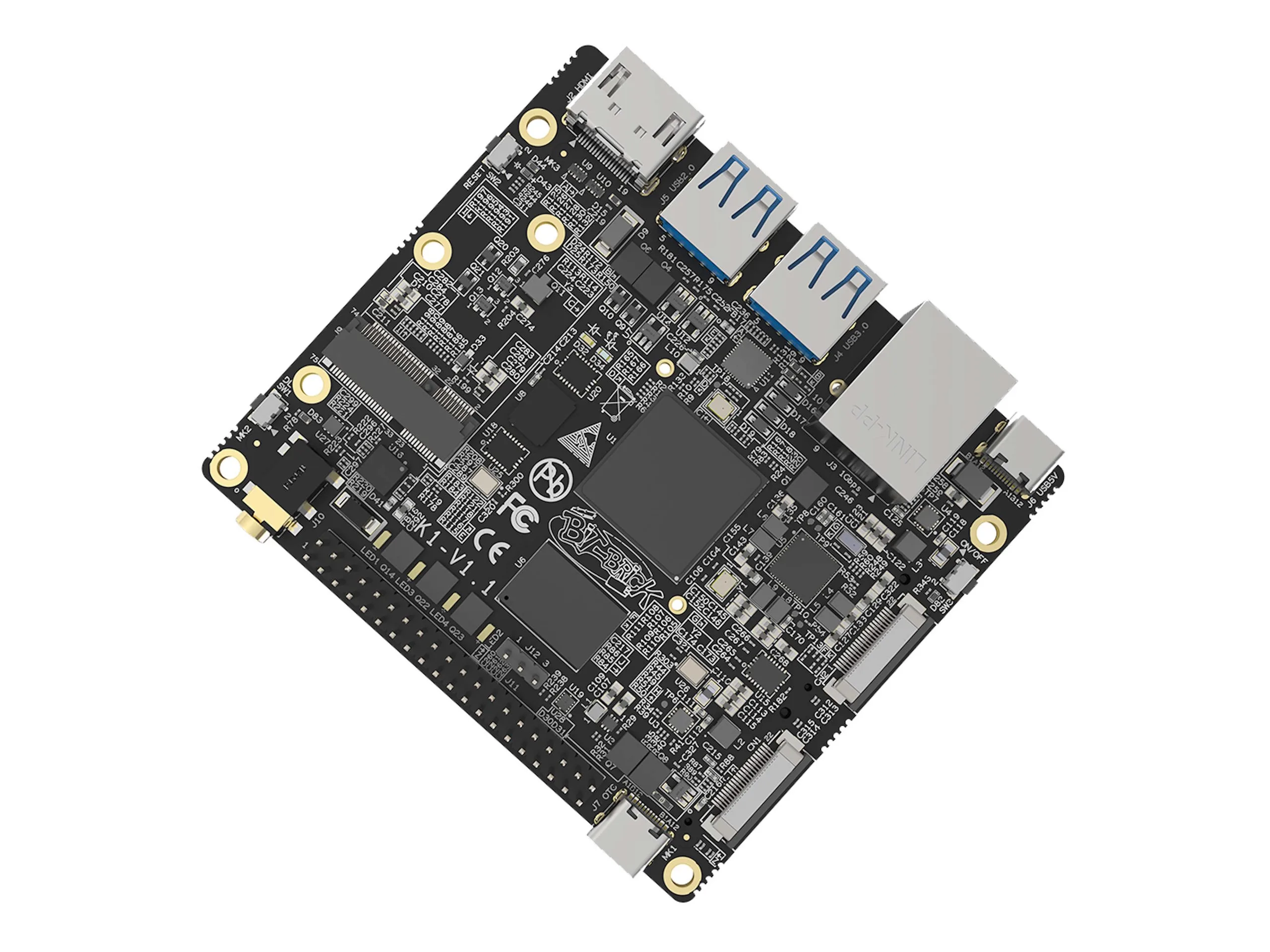
    We recently shared news about the Bit-Brick K1 Pro. The K1 is also a new single-board computer that is based on a similar idea as the Pro version, but it has some differences. Instead of using an ARM-based SoC, this SBC is driven by a RISC-V chipset known as the SpacemiT K1. This processor has eight X60 CPU cores and an IMG BXE-2-32 GPU, providing a total AI performance of 2 TOPS. The manufacturer claims that several operating systems can be used, although the compatability is not as broad as that of x86 and ARM-based devices. For example, Bianbu OS and Open Harmony are among the supported systems.

    Specs and Features

    The board measures 3.5 x 3.1 inches and features a Gigabit Ethernet port; however, unlike the Raspberry Pi 5, it lacks built-in WiFi. Displays can be connected through HDMI 1.4 or DSI, but the HDMI connection is restricted to a resolution of 1920 x 1080 pixels at 60Hz. Cameras can be linked using MIPI CSI, while the USB 3.0 and USB 2.0 ports are available for connecting other devices. It also includes a 3.5 mm headphone jack and has two microphones integrated. Additionally, the SBC features three M.2 slots in total—one Key E and two Key M. There’s also a 40-pin header for connecting different sensors and motors.

    Pricing and Availability

    Currently, the Bit-Brick K1 is available via direct import from Aliexpress for approximately €80. It comes with 4GB LPDDR4X RAM. For those looking for more, higher-priced packages include a memory card, heatsink, and a WiFi module.

    AliExpress, Bit-Brick

    Source:
    Link
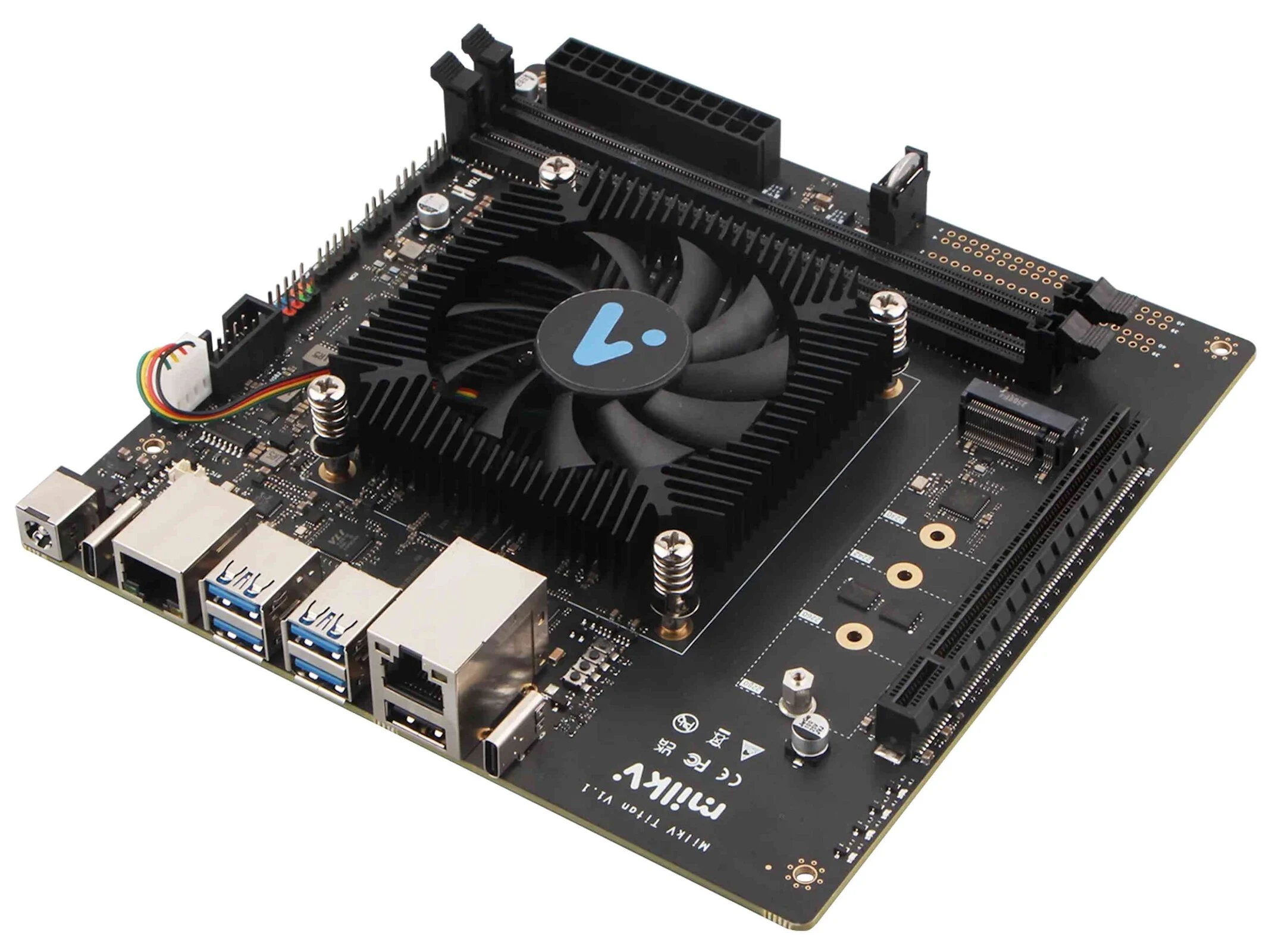


  • Milk-V Titan: RISC-V Mini-ITX Board with dGPU & 64GB ECC RAM

    Milk-V Titan: RISC-V Mini-ITX Board with dGPU & 64GB ECC RAM

    Key Takeaways

    1. The Milk-V Titan is available for preorder at $329, with a delivery wait time of up to 45 days.
    2. Buyers are responsible for any import fees and shipping costs may vary by country.
    3. The motherboard features an UltraRISC UR-DP1000 processor with eight cores and up to 2GHz clock speed.
    4. It includes two DDR4 RAM slots supporting up to 64GB of ECC memory and an M.2 SSD slot with PCIe 4.0 lanes.
    5. The system supports various Linux-based operating systems, including Ubuntu, and has connectivity options like Gigabit Ethernet and four USB ports.


    The Milk-V Titan is available for preorder at Arace for $329, but buyers should be prepared for a wait since delivery could take up to 45 days, depending on where it’s being sent. Customers also need to be aware of the shipping conditions, as the store clearly mentions that any import fees will be the responsibility of the buyer. Additionally, shipping costs can differ from one country to another.

    Motherboard Overview

    This device is a motherboard that comes with a processor already installed. It’s built on the RISC-V architecture, so it’s likely to appeal mainly to hobbyists and tech enthusiasts who are interested in this less common processor type. The UltraRISC UR-DP1000 features eight cores and can reach clock speeds of up to 2GHz. Users will find two DDR4 RAM slots that can accommodate up to 64GB of ECC memory.

    Features and Connectivity

    Measuring 6.69 x 6.69 inches, the motherboard includes an M.2 SSD slot connected through four PCIe 4.0 lanes for optimal performance. There’s also an option to add a dedicated graphics card, thanks to a PCIe slot that offers 16 PCIe 4.0 lanes. For connectivity, it comes with Gigabit Ethernet and four USB ports, each capable of a maximum data transfer speed of 5Gbps. Lastly, this RISC-V system is compatible with various Linux-based operating systems, including the popular Ubuntu.

    Source:
    Link


  • Debian 13 Trixie OS Adds Official 64-bit RISC-V Support

    Debian 13 Trixie OS Adds Official 64-bit RISC-V Support

    Key Takeaways

    1. Debian 13, named Trixie, will officially support 64-bit RISC-V architecture starting August 9, 2025.
    2. Trixie aligns with other Linux distributions in supporting the open standard RISC-V architecture, specifically for 64-bit, little-endian processors.
    3. RISC-V was created in 2010 and is managed by RISC-V International, promoting it as a free alternative to proprietary architectures like ARM, AMD, and Intel.
    4. Trixie’s main focus is on stability, security, and transitioning from 32-bit to 64-bit timekeeping to address future clock overflow issues.
    5. Users interested in Trixie can purchase RISC-V computers online and find additional resources in the Debian release notes and wiki.


    Debian 13 is set to debut with its official 64-bit RISC-V compatibility on August 9, 2025.

    Trixie and Its Support

    Known by the name Trixie, this operating system aligns itself with various other Linux distributions such as Fedora, FreeBSD, OpenBSD, openSUSE, and Ubuntu, in its official support for the RISC-V architecture, which is an open standard. It’s important to note that Trixie exclusively supports 64-bit, little-endian RISC-V processors.

    Background of RISC-V

    The RISC-V architecture was created in 2010 by researchers at the University of California, Berkeley. Since 2015, it has been managed by RISC-V International, promoting it as a free and open architecture standard. This is in contrast to other architectures like those from ARM, AMD, and Intel, which require licensing fees. Debian itself was first introduced in 1993 and is one of the pioneering free Linux distributions, serving as a foundation for many other distributions.

    Stability and Security in Trixie

    The main goal of this distribution is to offer a stable, dependable, and secure operating system. Along with the standard security enhancements, Trixie will transition from 32-bit to 64-bit timekeeping. This change aims to tackle clock overflow issues that are expected to arise in 2038.

    For those interested in trying out the newest Debian OS, a RISC-V computer can be purchased from Amazon. Additionally, readers can find more information about the architecture in a book available on Amazon.

    Emilio Pozuelo Monfort has shared insights on the Debian mailing list, and further information can be found in the Debian 13 release notes and on the Debian wiki.

    Source:
    Link


  • Nvidia Adds CUDA Support for RISC-V Architecture

    Nvidia Adds CUDA Support for RISC-V Architecture

    Key Takeaways

    1. Nvidia announced native support for CUDA on RISC-V, highlighting its potential as a competitor to x86 and ARM architectures.
    2. The announcement was made by Nvidia’s VP, Frans Sijstermans, at a RISC-V summit in China, showcasing how RISC-V can manage CUDA drivers.
    3. The integration of CUDA with RISC-V may help Nvidia expand its ecosystem in China, where RISC-V is growing rapidly.
    4. AMD is developing its own alternative to CUDA, called ROCm, which has also added support for RISC-V, indicating competition in the market.
    5. The adoption of ROCm is slow, suggesting it may take time before there is significant competition against Nvidia’s CUDA in computing software.


    Back in 2021, researchers focusing on RISC-V showed that Nvidia’s CUDA code could operate on non-proprietary hardware like a Vortex GPGPU that is based on RISC-V, utilizing an OpenCL translator. While this might not be the most effective method to implement CUDA support for RISC-V, it clearly indicated a rising interest in RISC-V as a serious competitor to x86 and ARM processing architectures. Nvidia is now formally recognizing the potential of RISC-V in the computing field by announcing the native support of CUDA for RISC-V.

    Significant Announcement

    The announcement was made by Frans Sijstermans, Nvidia’s Vice President of Hardware Engineering, during a RISC-V summit held in China. Sijstermans is also a director on the RISC-V board. A diagram showcased during the event illustrated how the RISC-V processor can manage CUDA drivers at the operating system level, while Nvidia’s GPUs run the CUDA kernels. There is a Data Processing Unit (DPU) mentioned, presumably from Nvidia as well, which indicates that the diagram depicts a computing system for high-performance computing (HPC) and data centers.

    Industry Reactions

    According to Tom’s Hardware, this step to provide CUDA support for open-source architectures like RISC-V might allow Team Green to broaden its ecosystem in China, where RISC-V is experiencing rapid growth, despite the limitations on marketing AI accelerators like the GB200 and GB300 in that area.

    In contrast, AMD is pushing its own alternative to Nvidia’s CUDA through ROCm, which is now in its seventh version and has already added support for the RISC-V architecture. Numerous companies have voiced their opposition to the dominance of CUDA, and Team Red is making efforts to challenge the monopoly. However, the adoption of ROCm remains gradual, and it may take a few more years before we witness true competition in the realm of computing software.

    Source:
    Link

  • New Emulator for Steam & AAA Games on RISC-V Processors

    New Emulator for Steam & AAA Games on RISC-V Processors

    Key Takeaways

    1. RISC-V is an open and adaptable instruction set architecture (ISA) that serves as an alternative to proprietary architectures like x86 and ARM.
    2. RISC-V is gaining popularity in various tech areas, including embedded devices and microcontrollers.
    3. The felix86 emulator allows x86 and x86-64 applications to run on RISC-V processors, including notable games and the Linux Steam client.
    4. Despite the ability to launch games, felix86 faces significant performance challenges on RISC-V systems.
    5. Current RISC-V processors have limited raw performance and fewer processing cores available for users.


    RISC-V is a freely available instruction set architecture (ISA) that lays the groundwork for creating custom processors, providing a substitute for proprietary architectures like x86 and ARM. Due to its open nature, adaptability, and cost-effectiveness, RISC-V is rapidly gaining traction across various areas of the tech industry, appearing in embedded devices, microcontrollers, SSD controllers, and more. One lesser-known use of RISC-V is in the field of emulation.

    Felix86 Emulator Rising

    Within this framework, felix86 is a Linux userspace emulator that enables the execution of x86 and x86-64 applications on RISC-V processors. Initially introduced in March, felix86 has recently attracted interest for its capability to run notable games and even the Linux Steam client on RISC-V systems. In a blog entry about version 25.07, the developers demonstrated that high-profile video games can indeed be executed via felix86, including titles like The Witcher 2, The Witcher 3, and Crysis.

    Performance Challenges Ahead

    Nonetheless, just because these games can be started doesn’t mean they run smoothly; the felix86 emulator is reportedly still facing significant performance challenges. To make matters worse, the current raw capabilities of RISC-V processors are not incredibly robust. The quantity of processing cores available on these systems for end users remains significantly restricted.

    Source:
    Link

  • EBC77: PCIe Single-Board Computer Developed with Canonical

    EBC77: PCIe Single-Board Computer Developed with Canonical

    Key Takeaways

    1. The Eswin EBC77 is a new single-board computer powered by the RISC-V architecture with the EIC7700X SoC.
    2. It supports LPDDR5 RAM and includes an 8MB SPI NOR flash, but requires a microSD card for OS installation.
    3. The device allows for an SSD upgrade and supports PCIe 3 with a single lane configuration.
    4. The EIC7700X SoC features an NPU for AI applications, offering up to 20 TOPS performance, and includes various connectivity options like HDMI, USB, and Gigabit Ethernet.
    5. The EBC77 is priced at $149 in the U.S. and benefits from Canonical’s involvement, appealing to developers and tech enthusiasts.


    Eswin and Canonical have introduced a fresh single-board computer to the market. Known as the EBC77, this device is powered by the EIC7700X SoC, which utilizes the RISC-V architecture instead of the widely used ARM architecture seen in the Raspberry Pi 5 and other similar devices. The SBC is capable of supporting LPDDR5 RAM and includes an 8MB SPI NOR flash. However, like many single-board computers, it does not come with built-in mass storage, so users must install the operating system on a microSD card. Additionally, the Eswin EBC77 allows for an SSD upgrade. Similar to the Raspberry Pi 5, this compact computer supports PCIe 3 with a single lane configuration.

    Features of the EIC7700X SoC

    The EIC7700X SoC is equipped with an NPU, which is specially designed to enhance AI applications with a performance of up to 20 TOPS. For video output options, the SBC uses HDMI and MIPI DSI, and cameras can be attached through MIPI CSI or USB. Furthermore, the device includes two USB 3.2 Gen 1 ports and two USB 2.0 ports. A Gigabit Ethernet port is also present, along with Wi-Fi 802.11 ac supporting both the 2.4GHz and 5GHz frequency bands. Users can connect sensors and actuators through the standard 40-pin header.

    Pricing and Availability

    In the United States, Eswin’s new single-board computer is officially listed at $149 on Amazon. Canonical’s involvement in this project adds credibility and strength to the device, making it an attractive option for developers and tech enthusiasts alike.

    Source:
    Link


  • Alpha-One Mini PC: Run AI Locally – Available Now

    Alpha-One Mini PC: Run AI Locally – Available Now

    Key Takeaways

    1. The Pine64 Alpha-One is priced at $330 and is aimed at early adopters.
    2. It is powered by a SiFive P550 SoC with four cores clocking up to 1.8GHz and features a 20 TOPS NPU for enhanced AI capabilities.
    3. The mini PC comes with 32GB of RAM and a preinstalled 64GB eMMC module for running various LLMs locally.
    4. It features a passively cooled aluminum design, external WiFi antenna, and supports both wired and wireless networking options.
    5. Connectivity includes multiple USB ports and HDMI support for 4K resolution at 60Hz, along with an audio jack for microphones.


    We’ve talked about plenty of SBCs and mini PCs before, and now a new device is finally up for grabs. The EU version of the Pine64 Alpha-One is available directly from the manufacturer for $330, but it’s wise for potential buyers to check the shipping specifics first. The maker also claims this product is aimed at early adopters.

    Specifications and Performance

    This mini PC is built on the StarPro64-SBC and is powered by a SiFive P550 SoC. This RISC-V chip has four cores that can clock up to 1.8GHz. Additionally, it includes an NPU that offers a performance of 20 TOPS. While NPUs in current Intel or AMD chips are often more potent, the AI capabilities of the Alpha-One are still significantly better than many other single-board computers. This small machine also comes with 32GB of RAM and is intended to run various LLMs locally. The preinstalled 64GB eMMC module includes all the necessary software.

    Design and Connectivity

    The passively cooled SBC is encased in aluminum, which helps in dissipating heat via a heatpipe. For networking, users can connect through WiFi on both 2.4GHz and 5GHz bands, or utilize wired connections with two Gigabit Ethernet ports. The WiFi antenna is external. In addition, there are several USB ports for plugging in peripherals, and users can connect monitors through HDMI with support for 4K at 60Hz. Finally, the Pine64 Alpha-One features an audio jack that works with microphones.

    Source:
    link

  • Prototype 2T1R Control Chip for Neuromorphic Computing Developed

    Prototype 2T1R Control Chip for Neuromorphic Computing Developed

    Key Takeaways

    1. In-memory computing is changing computer architecture by moving processing closer to memory for improved efficiency.
    2. A new 2T1R memristor design enhances energy efficiency for AI and edge devices by minimizing sneak path currents and leakage.
    3. The design supports analogue vector-matrix multiplication (VMM), crucial for machine learning applications.
    4. It effectively addresses virtual ground issues and wire resistance to boost performance and reduce power usage.
    5. This technology paves the way for faster, more integrated AI operations in memory, hinting at a future where hard drives could process information more intelligently.


    What if your hard drive did more than just store your files? Imagine it could think and react to information right where it’s located. This idea is part of in-memory computing, which is changing the way computers are built by moving processing closer to memory to improve efficiency.

    New Memristor Design

    Researchers from Forschungszentrum Jülich and the University of Duisburg-Essen have introduced a fresh design based on a 2T1R memristor. This innovation aims to facilitate a more energy-efficient approach for AI and edge devices.

    The details of this design, shared on arXiv, include the integration of two transistors and one memristor in each cell, which helps regulate current to minimize sneak path currents—an issue often faced in memristor arrays. Unike regular memory, this new design connects both memristor terminals to ground when not in active use. This method could enhance signal stability and cut down on leakage.

    Enhancing Machine Learning

    The architecture is meant to enable analogue vector-matrix multiplication (VMM), a key element in machine learning. It achieves this by managing memristor conductance with built-in DACs, PWM signals, and controlled current paths. A functional 2×2 test array was successfully created using standard 28 nm CMOS technology.

    By tackling virtual ground concerns and the impact of wire resistance, the design seeks to boost performance reliability and decrease power usage. Compatible with RISC-V control and digital connections, the 2T1R structure may set the stage for scalable neuromorphic chips, allowing for speedier and more compact AI acceleration directly in memory.

    Future of AI and Memory

    While your hard drive isn’t quite thinking yet, the technology that could make this a reality is already being developed in silicon. This progression hints at a future where AI operates faster and more seamlessly integrated with memory.

    Source:
    Link

  • StarPro64: Powerful Raspberry Pi Alternative with NPU and PCIe

    StarPro64: Powerful Raspberry Pi Alternative with NPU and PCIe

    Key Takeaways

    1. The StarPro64 is a new developer board from Pine64, priced at $250 but currently out of stock.
    2. It features an ESWIN EIC7700X processor with four SiFive P550 cores based on RISC-V architecture, making it a competitor to the Raspberry Pi 5.
    3. The board includes a high-performance NPU capable of 19.95 TOPS for local AI applications, such as surveillance tasks.
    4. Key specifications include 32 GB of LPDDR5 RAM, 128Mb SPI boot flash, and options for eMMC storage and microSD booting.
    5. Connectivity features consist of PCIe 3, multiple USB ports, 4K HDMI output, dual Gigabit Ethernet ports, WiFi 6, and Bluetooth 5.3.


    The StarPro64 has been officially introduced – or at least it is now featured on Pine64’s online shop. The listed price is $250, but currently, the board seems to be “out of stock,” indicating that it’s sold out at this time.

    Developer Board Details

    The StarPro64 serves as a developer board and is basically a competitor to the Raspberry Pi 5. However, it’s equipped with a different processor architecture, specifically an ESWIN EIC7700X, which includes four SiFive P550 cores based on RISC-V architecture. One notable feature is its high-performance NPU, which reportedly delivers INT8 performance of 19.95 TOPS per second, making it quite powerful for running local AI applications. A realistic application could be in the field of surveillance cameras, particularly for face or license plate recognition.

    Specifications and Features

    Standard features include 32 GB of LPDDR5 RAM and 128Mb SPI boot flash. Users have the option to add an eMMC module (up to 256GB) and utilize a microSD slot for booting purposes. For connectivity, it offers a four-lane PCIe 3 connector, two USB 3.0 ports, and two USB 2.0 ports. Additionally, there are MIPI DSI and MIPI CSI interfaces for connecting displays and cameras. It also supports HDMI output at 4K resolution and 60 Hz. Furthermore, network capabilities include two Gigabit Ethernet ports alongside dual-band WiFi 6 and Bluetooth 5.3.

    Conclusion

    Pine64’s new offering, the StarPro64, appears to be a compelling choice for developers looking for advanced features and performance. However, potential buyers might need to wait until it’s back in stock to secure their own unit.

    Source:
    Link

  • Alpha-One Mini PC with NPU and 20 TOPS Performance

    Alpha-One Mini PC with NPU and 20 TOPS Performance

    Key Takeaways

    1. Most AI models are cloud-based, which can create legal issues with sensitive data.
    2. AMD and Intel are integrating NPUs into their chipsets, while more devices emphasize local AI capabilities.
    3. The Pine64 Alpha-One mini PC features a robust NPU with 20 TOPS INT8 performance, based on RISC-V architecture.
    4. It builds on the StarPro64 SBC and includes 64GB of eMMC storage and a preloaded 7b Deepseek/Oen LLM.
    5. The device operates quietly with passive cooling, uses less than 30 watts, supports 4K monitors, and is priced at $330.


    The majority of AI models today operate in the cloud, relying on external computers. While this is easy to use, it can lead to (legal) complications when handling sensitive data for analysis. Even though regular users typically do not run AI models on their own devices, companies such as AMD and Intel are already incorporating NPUs into their existing chipsets. Additionally, some network storage devices and security cameras are beginning to emphasize local AI capabilities.

    New Mini PC with RISC-V Architecture

    Recently, a new mini PC utilizing the RISC-V architecture and boasting a robust NPU has been introduced. The Pine64 Alpha-One features an NPU with an INT8 performance reaching 20 TOPS. It’s important to mention that other contemporary APUs could be considerably more powerful in this area.

    Based on Existing Technology

    The Pine64 device is not completely novel, as it builds off the StarPro64 SBC. This board is equipped with an ESWIN EIC7700X SoC which has four SiFive 550 processing cores that can operate at speeds of up to 1.4GHz. In addition, the Alpha-One includes 64GB of eMMC storage, and comes preloaded with 7b Deepseek/Oen LLM in Docker containers. The manufacturer also asserts that it achieves a throughput of about 3.5 tokens per second (for a 7b LLM), which should suffice for many novices eager to run AI models locally.

    Power and Connectivity Features

    Power is delivered through a DC barrel plug at 12 volts, and USB Type-C PD is not available. This mini PC has a passive cooling system, ensuring that there’s no fan noise, as the SoC’s temperatures are regulated by a heat pipe. The device operates on less than 30 watts and provides various connectivity options like Ethernet, USB 3.0, and USB 2.0. Furthermore, the Pine64 Alpha-One is capable of supporting 4K monitors at resolutions up to 60Hz, and PCIe Gen 3 with four lanes can be utilized for specific expansion modules. The new mini PC is priced at $330, yet no specific release date has been announced yet.

    Source:
    Link