Tag: Qualcomm

  • Snapdragon 6 Gen 4 Launches with Major Performance Boost

    Snapdragon 6 Gen 4 Launches with Major Performance Boost

    Key Takeaways

    1. New Chip Introduction: Qualcomm launched the Snapdragon 6 Gen 4 (SM6650) as an upgrade to the Snapdragon 6 Gen 3 for mid-range smartphones.

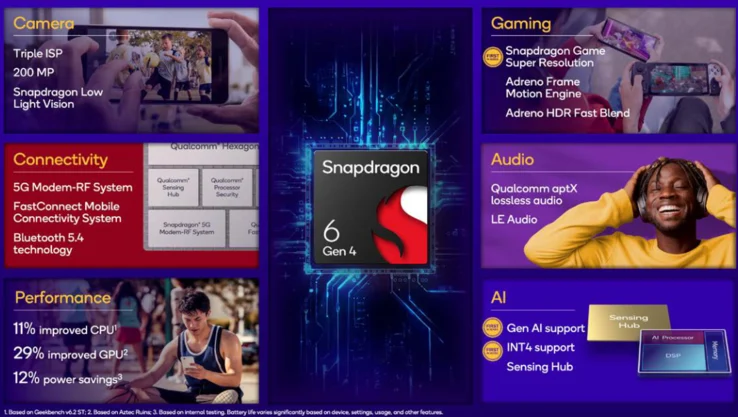
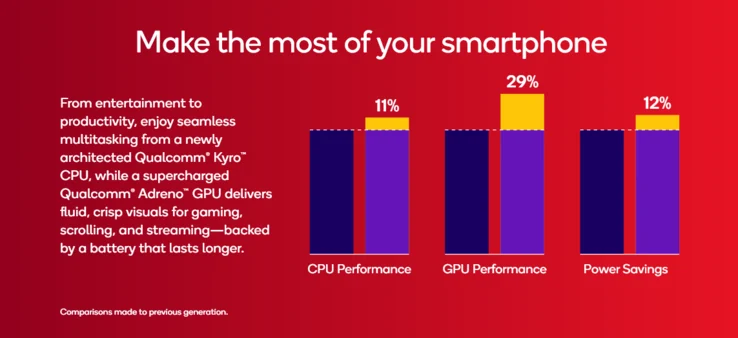
    2. Improved Performance: The Snapdragon 6 Gen 4 features a tri-core CPU configuration and an Adreno GPU, offering a 29% performance boost and an 11% increase in Geekbench scores compared to the previous generation.

    3. Enhanced Connectivity: This chip supports Wi-Fi 6E, Bluetooth 5.4, and both sub-6GHz and mmWave 5G networks, along with advanced audio technologies like aptX Adaptive and aptX Lossless.

    4. Display and Camera Support: The Snapdragon 6 Gen 4 can drive FHD+ displays at up to 144 Hz and supports a 200 MP camera with 4K video recording at 30 FPS.

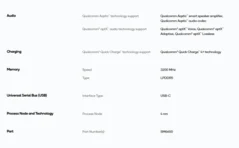
    5. Manufacturing Process: The chip is manufactured using a 4 nm TSMC process, contributing to its efficiency and performance improvements in mid-range smartphones.


    Qualcomm has introduced a new system-on-chip (SoC) designed for mid-range smartphones. The Snapdragon 6 Gen 4, also known as SM6650, takes the place of the Snapdragon 6 Gen 3 and offers significant upgrades, including a redesigned CPU architecture and Arm v9 cores. Manufactured on a 4 nm TSMC process, this chip boasts a notable performance boost compared to its predecessor, making it a strong contender in the 6 series lineup.

    Performance Details

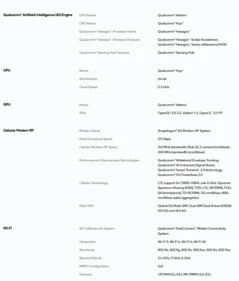
    The Snapdragon 6 Gen 4 features a tri-core configuration, consisting of one Cortex-A720 core running at 2.3 GHz, two additional Cortex-A720 cores clocked at 2.2 GHz, and four Cortex-A520 cores operating at 1.8 GHz. It includes an undisclosed Adreno GPU that Qualcomm claims offers a 29% performance improvement over the previous generation, the Adreno 710. In terms of CPU performance, the Snapdragon 6 Gen 4 shows an 11% increase in Geekbench scores.

    Connectivity and Memory

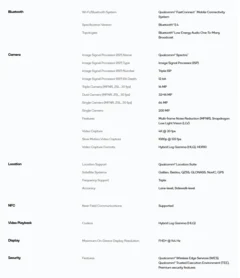
    For wireless connectivity, the Snapdragon 6 Gen 4 supports Wi-Fi 6E and Bluetooth 5.4, along with compatibility for both sub-6GHz and mmWave 5G networks. It also features Qualcomm’s proprietary aptX Adaptive and aptX Lossless audio technologies, which are uncommon in budget devices. However, there are some limitations regarding memory support; the Snapdragon 6 Gen 4 can only accommodate LPDDR5-3200, which is on the slower side, although it can work with UFS 3.1 storage solutions.

    Display and Camera Capabilities

    The Snapdragon 6 Gen 4 is capable of driving a single FHD+ display at refresh rates up to 144 Hz. Its image signal processor (ISP) can support a 200 MP camera module with Zero Shutter Lag functionality. When it comes to video, this SoC can record at 4K resolution at 30 frames per second (FPS), and it also allows for slow-motion video capture at 1080p and 120 FPS.

    Qualcomm’s latest chip aims to enhance mid-range smartphones, making them more powerful and efficient than before.

    Source:
    Link


  • Snapdragon X Elite Windows Laptops Surge in Popularity December 2024

    Snapdragon X Elite Windows Laptops Surge in Popularity December 2024

    When Qualcomm introduced the Snapdragon X ARM APUs, there was a lot of buzz since it seemed like Windows devices would finally match MacBooks in energy efficiency. However, it’s clear now that the Snapdragon X SoCs didn’t live up to the expectations many had.

    Performance Comparison

    To start with, Qualcomm’s APUs aren’t giving any significant performance boost compared to the latest Intel and AMD processors. While the Snapdragon X Elite and X Plus chips are indeed efficient, many laptops featuring Intel Lunar Lake or AMD Strix Point APUs offer similar or even better battery lives.

    App Compatibility Issues

    Another concern is the app compatibility with the Snapdragon X SoCs, along with the absence of affordable Snapdragon X Windows laptops. All these factors led us to conclude that “there are no real arguments for a Windows laptop with an ARM processor” in our review of the Microsoft Surface Laptop 7.

    Despite these clear drawbacks, Qualcomm has managed to secure a solid market presence as of December 2024.

    Market Share Insights

    In late November 2024, we reported that Snapdragon X-based Windows laptops held a meager 0.8% market share in Q3 2024. This finding was quite harsh, indicating that Qualcomm had a significant challenge ahead to meet its target of 30-50% market share by 2029.

    However, times seem to be improving for Qualcomm. CEO Cristiano Amon stated that “Snapdragon X Series had more than 10% share of the greater than $800 Windows laptops in U.S. retail.” If these numbers are correct, December 2024 shipments show a notable improvement from previous reports.

    Limited Claims on Global Market

    Nevertheless, observant readers may have realized that Cristiano Amon is referring to a >10% share only for laptops above a certain price point. Therefore, Qualcomm hasn’t made any statements about global shipments or laptops priced under $800. This is logical as there’s a shortage of budget-friendly Snapdragon X Windows devices available. Yet, this news is encouraging for Qualcomm and fans of Snapdragon who want to see better performance from Windows ARM laptops.

    That being said, Qualcomm still has considerable work ahead to ensure that Snapdragon laptops can compete evenly with Intel and AMD machines throughout the Windows ecosystem.

    Challenges Ahead

    A major challenge for laptops using the Snapdragon X Elite and X Plus SoCs is the inconsistent app compatibility. This has been a concern since Microsoft first promoted ARM-based Windows laptops as a genuine alternative. Although the situation has improved, both Microsoft and Qualcomm still have quite a bit of work left to address these issues.

    Moreover, the absence of budget Snapdragon laptops will certainly limit the company’s ability to reach a broader customer base. This is especially true internationally and in regions where consumer spending habits are much lower than in the U.S. Qualcomm aims to tackle this issue with the introduction of the 8-core Snapdragon X SoC.

    Finally, to truly excel beyond the current x86 competition, Qualcomm must deliver enhanced performance and energy efficiency.

    Regardless of the outcome, it’s encouraging to see Qualcomm making strides in the market. Increased competition is always beneficial for consumers.

    Source:
    Link

  • New Snapdragon X Chip Laptops Launching in India This Month

    New Snapdragon X Chip Laptops Launching in India This Month

    Qualcomm has recently revealed its new Snapdragon X platform that will be the driving force behind forthcoming Windows PCs. Now, we have confirmation on when this innovative processor will debut in India. This marks the third addition to the series, so let’s dive into the details.

    Launch Date of Snapdragon X

    To refresh your memory, the chip manufacturer expanded its Snapdragon X series with the introduction of the Snapdragon X. This model serves as the basic option in the collection, functioning as an entry-level SoC alongside the already successful Snapdragon X Plus and Snapdragon X Elite processors. Qualcomm’s goal with this chipset is to make a deeper impact in the laptop market. The Snapdragon X is intended to cater to both budget-conscious and mid-range consumers.

    PCs Powered by Snapdragon X Chip

    In a recent promotional poster, the company announced that the new Snapdragon X platform designed for AI-powered PCs will arrive in India on February 24, 2025. Initially revealed for Windows PCs, this processor will be available in laptops from brands like Acer, ASUS, HP, Dell, and Lenovo, all priced below $600. However, it remains uncertain which specific laptop models in India will incorporate this new budget-friendly AI chip.

    Specifications and Features

    According to previous announcements, the Snapdragon X is equipped with eight CPU cores that can reach speeds of up to 3.0GHz. It boasts a total memory cache of 30MB and is built on the ARM architecture, akin to its more advanced counterparts. The Snapdragon X comes with an Adreno GPU capable of delivering up to 1.7 TFLOPS, which is adequate for casual gaming, older video games, and various everyday tasks. One of its standout features is the dedicated NPU that provides 45 TOPS of AI performance, making it suitable for Copilot+ functionalities. Thus, this new chip could bring significant improvements to the budget laptop market in India.

  • Next-Gen Snapdragon X2 Chips Expected to Launch Soon

    Next-Gen Snapdragon X2 Chips Expected to Launch Soon

    With their Snapdragon X series of ARM chipsets aimed at laptops, Qualcomm has made a significant entry into the PC market. The company has provided impressive energy efficiency and performance, along with capabilities for AI tasks. There are indications that Qualcomm may be developing successors to these chipsets, which could be revealed in the near future.

    Snapdragon X2 Elite & X2 Plus Development

    To refresh your memory, last year Qualcomm launched the Snapdragon X Elite and Snapdragon X Plus. However, it appears that the Snapdragon X2 series might be on its way, potentially introducing a new flagship chip as well. The new Snapdragon X2 series could feature an additional “Ultra Premium” category. The Snapdragon X Elite and X Plus have certainly made waves in the market, challenging competitors like Intel and AMD.

    AI Focus and Competitive Landscape

    A primary emphasis of these new chipsets was AI, which was an area that other manufacturers largely overlooked. Following the Snapdragon X announcement, both Intel and AMD quickly released their own chips equipped with dedicated NPUs, allowing them to catch up with Qualcomm. While Qualcomm has faced some challenges regarding performance, leaked shipping manifests (shared by Olrak_29 on X) indicate that the Snapdragon X2 is indeed under development.

    Upcoming Features and Expectations

    The Snapdragon X2 name appeared alongside the “Ultra Premium” label, suggesting a more robust processor is on the horizon. For those who might not know, these upcoming chipsets will be the next generation of ARM processors, similar to their predecessors. Right now, we only have Plus and Elite options available, but a Snapdragon X Ultra variant could be introduced soon. We can look forward to enhanced performance, upgraded NPUs, and improved graphics capabilities. These chips are expected to launch later this year, as previously reported. This is all the information currently available, so stay tuned for updates.

  • Snapdragon 8 Elite 2 Production by TSMC Confirmed in Report

    Snapdragon 8 Elite 2 Production by TSMC Confirmed in Report

    Qualcomm has unveiled its newest top-tier processor, the Snapdragon 8 Elite, which is made using TSMC’s advanced third-generation 3nm (N3E) technology. It looks like Qualcomm is sticking with a trusted ally for its upcoming chip, the Snapdragon 8 Elite 2, as whispers indicate it will be crafted with TSMC’s even more cutting-edge 3nm N3P process.

    Confirmation of Production

    A recent report from Gamma’s Hardware info (via Jukanlosreve) has confirmed that the Snapdragon 8 Elite 2 will indeed be produced with TSMC’s 3nm (N3P) tech. This implies that Qualcomm is still not ready to switch over to Samsung Foundry for its chip manufacturing needs.

    GOOD NEWS: THE PRODUCTION OF SNAPDRAGON 8 ELITE 2 BY TSMC HAS BEEN CONFIRMED. PIC.TWITTER.COM/EN0SDOR60G
    — Jukanlosreve (@Jukanlosreve) January 21, 2025

    Specifications of the Chip

    The Snapdragon 8 Elite 2 is said to carry the model number SM8850 and bears the codename Kaanapali. The report also suggests that Samsung made attempts to create the 8 Elite 2 using its own process, which was supposedly referred to as “KaanapliS.”

    Nonetheless, the report indicates that “KaanapliS” is no longer appearing in logistics data. This hints that the anticipated Samsung-made SM8850 is unlikely to come to fruition. Consequently, the production has been redirected to TSMC, with the new codename

    Source:
    Link

  • Qualcomm Snapdragon 8 Elite Ships with Slower Variant and Core Missing

    Qualcomm Snapdragon 8 Elite Ships with Slower Variant and Core Missing

    Qualcomm made a big splash when it introduced the Snapdragon 8 Elite at the end of October. But soon after, the excitement was dampened by ARM’s choice to terminate Qualcomm’s design license, leading to a legal fight that has now been mostly resolved.

    New Version Emerges

    Recently, Qualcomm has been seen quietly launching a new, less powerful version of the Snapdragon 8 Elite. Initially, this chipset was available with two Oryon Gen 2 Prime CPU cores and six Oryon Gen 2 Performance CPU cores, clocking in at 4.3 GHz and 3.5 GHz, respectively. To clarify, Qualcomm refers to this original version as ‘SM8750-AB’, which is used in premium devices worldwide, such as the Magic7 Pro, OnePlus 13, and RedMagic 10 Pro (currently $749 on Amazon).

    Changes to the Chipset

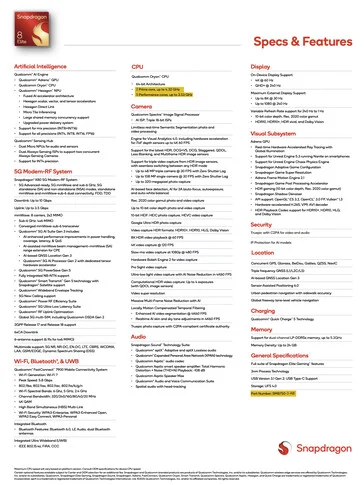
    Now, Qualcomm has updated its product page for the Snapdragon 8 Elite to show the new ‘SM8750-3-AB’, which removes one Performance CPU core but keeps all other specs of the SM8750-AB intact. To make matters a bit confusing, Qualcomm claims that the SM8750-3-AB offers the same CPU performance improvements over the Snapdragon 8 Gen 3 as the original SM8750-AB, even with one less CPU core. Unfortunately, Qualcomm hasn’t provided any additional information beyond the brief product description and the image we included below.

    Source:
    Link


  • Arm Plans Price Hike, Raising Concerns in Chip Industry

    Arm Plans Price Hike, Raising Concerns in Chip Industry

    Arm Holdings is making bold moves in the semiconductor sector to enhance its revenue and market power. The company plans to raise royalty rates for certain chip designs by as much as 300%, aiming to generate an extra $1 billion every year over the next ten years. This effort, called the “Picasso” project, centers on the new Armv9 architecture and targets clients that utilize off-the-shelf chip designs.

    Revenue Comparisons

    In the fiscal year 2024, Arm reported revenue of $3.23 billion, which is quite small compared to that of major clients such as Apple. In fact, Apple’s earnings from devices powered by Arm technology are more than 90 times greater. To close this gap, Arm is pondering a major transition by starting to design and produce its own chips. Should this happen, Arm would be competing directly with its biggest clients like Qualcomm and Apple.

    Potential Risks

    The idea of entering the chip manufacturing arena has sparked concerns among both customers and industry analysts. Arm’s potential chip offerings include chiplets, which are tiny components that can be combined into larger processors. However, this approach risks alienating essential customers, who might retaliate by creating their own chips and leaning less on Arm’s existing solutions. Qualcomm has already begun to lessen its dependency on Arm’s technology.

    Arm has been looking into these strategies since 2019, as revealed by internal discussions and court records. CEO Rene Haas has been quite vocal about the need for change, showing frustration with the company’s heavy reliance on major clients and advocating for more control over its technology.

    Support and Challenges

    SoftBank Group, which holds 90% of Arm, has backed these ambitious expansion plans. Nevertheless, the strategy is not without challenges. Increasing royalty rates and going head-to-head with clients could disrupt long-term relationships. Additionally, Arm is up against rival chip designers who might take advantage of any dissatisfaction among current customers.

    In a recent legal battle, Arm accused Qualcomm of violating licensing agreements, but a jury in the U.S. sided with Qualcomm. This outcome might encourage other customers to consider options outside of Arm’s technology.

    While Arm’s new plan seeks to transform the semiconductor landscape and increase revenue, its success hinges on balancing growth with the need to keep customer trust intact. The company’s daring ambitions could reshape its position within the industry, but they also involve considerable risks.

  • Qualcomm Snapdragon 8s Elite: Competing Devices & Launch Timeframe

    Qualcomm Snapdragon 8s Elite: Competing Devices & Launch Timeframe

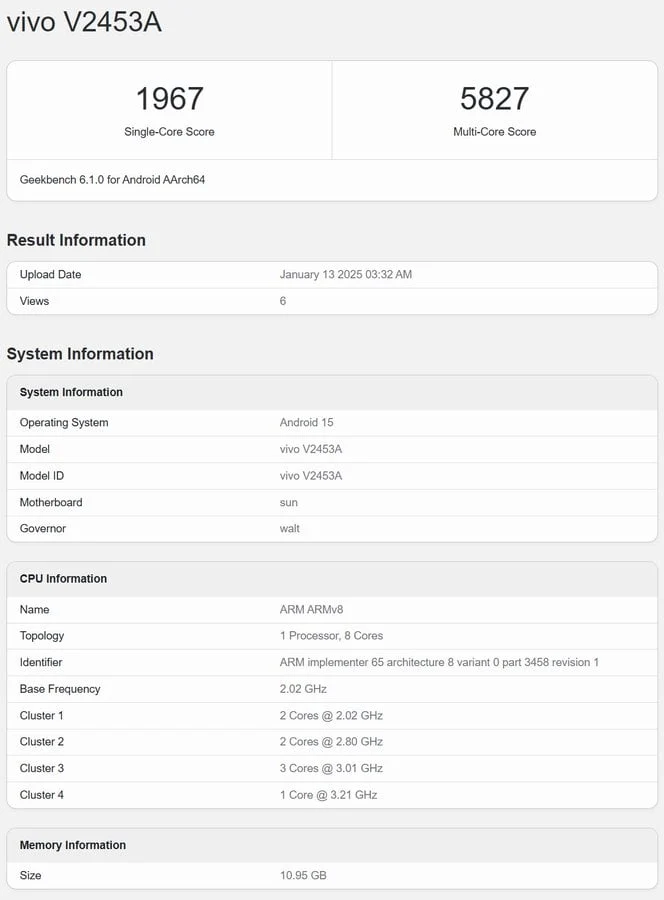
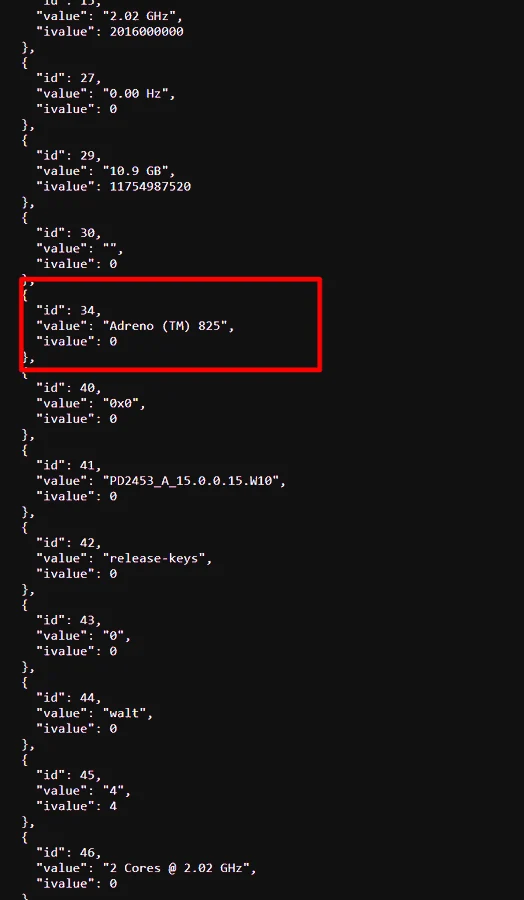
    The Qualcomm Snapdragon 8s Elite, also known as SM8735, has recently caught some eyes after being listed on Geekbench, showcasing impressive performance stats. An early listing showed its advanced CPU design includes one Cortex-X4 core running at 3.21GHz, three Cortex-A720 cores at 3.01GHz, two more Cortex-A720 cores clocked at 2.8GHz, and two energy-saving Cortex-A520 cores operating at 2.02GHz. Additionally, it comes with an Adreno 825 GPU that runs at 1100MHz. According to Geekbench, the single-core performance is around 1900 points, while the multi-core performance is close to 6000 points, suggesting that this chipset is still being fine-tuned and could see further improvements.

    Snapdragon 8s Elite Overview

    When comparing the Snapdragon 8s Elite with the Snapdragon 8s Gen 3, the Elite offers a notable upgrade in its CPU setup. With its powerful Cortex-X4 core clocked at 3.21GHz, it is expected to deliver superior single-thread performance. The multi-core performance also benefits from the additional high-performance cores, likely exceeding the capabilities of the 8s Gen 3. However, while the Adreno 825 GPU is newer, it may not provide a huge advancement in graphics, as the emphasis remains on CPU efficiency and overall performance.

    Comparing Snapdragon 8s Elite and Snapdragon 8 Gen 3

    The differences between the Snapdragon 8s Elite and the Snapdragon 8 Gen 3 are more significant. The 8 Gen 3 is equipped with a stronger Cortex-X4 core, extra high-performance Cortex-A720 cores, and an Adreno 750 GPU, making it better suited for gaming and demanding visual tasks. While the 8s Elite is efficient, it falls short of the raw power and GPU capabilities of the 8 Gen 3, making it a solid mid-range choice instead of a direct rival to Qualcomm’s leading chipset.

    Snapdragon 8s Elite Compared to Snapdragon 8 Elite

    The Snapdragon 8 Elite represents a major step forward for Qualcomm, featuring custom Oryon cores that are anticipated to outperform the 8s Elite’s ARM-based cores in both single and multi-core tasks. With higher clock speeds and a more sophisticated GPU, the 8 Elite would likely surpass the 8s Elite in benchmarks and real-world applications, particularly in gaming and artificial intelligence tasks.

  • Snapdragon 8s Elite Specs Leaked in iQOO Z10 Turbo Geekbench

    Snapdragon 8s Elite Specs Leaked in iQOO Z10 Turbo Geekbench

    Qualcomm is said to be developing the Snapdragon 8s Elite, a more simplified version of the Snapdragon 8 Elite chip. This new chip is anticipated to launch in the second quarter of 2025, taking the place of last year’s Snapdragon 8s Gen 3. The SD8sG3 has powered devices like the Realme GT 6, Realme GT Neo 6 (in China), Motorola Edge 50 Ultra, Poco F6, Xiaomi Civi 4 Pro, Civi 14 Pro, Redmi Turbo 3, Honor 200 Pro, and iQOO Z9 Turbo. It is thought that the Snapdragon 8s Elite will be used in the next generation of these smartphones. Recently, a Vivo/iQOO phone with this unannounced chip was found in Geekbench’s database, revealing its CPU and GPU information.

    Geekbench Listing for Snapdragon 8s Elite

    A new Vivo/iQOO device has been spotted on Geekbench. The Qualcomm chip inside has a 1+3+2+2 core arrangement, with a primary CPU core running at 3.21GHz. It also includes three CPU cores at 3.01GHz, two cores at 2.80GHz, and two more at 2.02GHz. For graphics processing, the chip features an Adreno 825 GPU.

    Speculation on Upcoming Chip

    These specifications do not align with any current Qualcomm chips, suggesting that it is indeed a future chip. According to tipster Digital Chat Station, this is the Snapdragon 8s Elite, identified by the SM8735 part number. The tipster had earlier indicated that the Snapdragon 8s Elite would maintain an X4 + A720 architecture, similar to the Snapdragon 8 Gen 3, and also follows the 1+3+2+2 configuration.

    Device Details and Future Releases

    The Geekbench entry shows that the device runs on Android 15 and has 12 GB of RAM. While the specific phone model is unknown, it might be the iQOO Z0 Turbo or Turbo Pro, which are expected to be among the first devices to utilize the Snapdragon 8s Elite chip. Besides the Z10 Turbo, other devices like the Redmi Turbo 4 Pro, Poco F7, Xiaomi Civi 5 Pro, and a flagship from Realme are also expected to be powered by the Snapdragon 8s Elite.


    Image 1
  • Qualcomm Snapdragon 8s Elite Specs and Performance Leaked

    Qualcomm Snapdragon 8s Elite Specs and Performance Leaked

    Qualcomm introduced the Snapdragon 8s Gen 3 last year as a budget-friendly option to the flagship Snapdragon 8 Gen 3 chipset. This year, the Snapdragon 8s Elite is expected to take its place, with new leaks providing some details about this upcoming sub-premium chipset.

    Performance Expectations

    According to leaker Digital Chat Station, the Snapdragon 8s Elite is anticipated to deliver performance that is similar to but not quite on par with the Snapdragon 8 Elite’s capabilities. It is rumored that the Snapdragon 8s Elite will achieve a score close to 2 million on AnTuTu. This performance leap should put it ahead of many Snapdragon 8 Gen 3 devices while still being roughly 20% less powerful than the Snapdragon 8 Elite phones.

    Specifications Insights

    If we look back at the Snapdragon 8s Gen, we can expect the Snapdragon 8s Elite to likely exceed the Snapdragon 8 Gen 3 in CPU performance, but it may fall short in GPU capabilities compared to the previous flagship chipset. Reports suggest that the Snapdragon 8s Elite will not include the new Oryon cores found in the Snapdragon 8 Elite; instead, it will feature a Cortex-X4 prime core along with A720 cores, similar to the Snapdragon 8 Gen 3.

    Anticipated Launch

    There’s a buzz about widespread adoption, with brands such as Xiaomi, Honor, iQOO, and OPPO reportedly preparing devices powered by the Snapdragon 8s Elite. These smartphones are expected to be released around April, which suggests that Qualcomm might announce the Snapdragon 8s Elite in either March or April.

    Source:
    Link