Tag: OpenAI

  • OpenAI’s Whisper Tool: Researchers Claim It Generates False Info

    OpenAI’s Whisper Tool: Researchers Claim It Generates False Info

    According to a recent report from ABC News (as mentioned by Engadget), OpenAI’s audio transcription tool, Whisper, has a tendency to create transcriptions that are not actually present in the original audio recordings.

    Concerns in Various Industries

    This raises serious concerns since Whisper is being utilized across multiple sectors, including healthcare facilities that depend on the tool to document consultations. This is happening even though OpenAI has made it clear that the tool should not be employed in “high-risk domains.”

    Issues Found in Transcriptions

    A machine learning engineer identified hallucinations in about 50% of over 100 hours of transcriptions. In addition, another developer reported finding them in all 26,000 transcriptions he reviewed. Researchers express that this situation could result in inaccurate transcriptions in millions of recordings globally. An OpenAI representative informed ABC News that the company is looking into these claims and will take the feedback into account for future model updates. The tool is used within Oracle and Microsoft Cloud, which serve thousands of clients around the world, amplifying the potential for risk.

    Harmful Results from Research

    Professors Allison Koenecke and Mona Sloane analyzed thousands of short segments from TalkBank and discovered that 40% of the hallucinations they found were harmful. For instance, in one recording, a speaker mentioned, “He, the boy, was going to, I’m not sure exactly, take the umbrella.” However, the tool transcribed this as, “He took a big piece of the cross, a teeny, small piece…I’m sure he didn’t have a terror knife so he killed a number of people.”

    Engadget, ABC News’
  • Apple Joins OpenAI Board as Observer, Gaining AI Future Insights

    Apple Joins OpenAI Board as Observer, Gaining AI Future Insights

    In a major development revealed last month, Apple will assume an observer role on OpenAI’s board. This collaboration aims to enhance Apple’s AI capabilities and its standing in the technology sector. Phil Schiller, who heads Apple’s App Store and is the former marketing chief, will take on this role later this year.

    Phil Schiller will participate in OpenAI’s board meetings, gaining crucial insights into their decision-making processes, though without the authority to vote or influence decisions. This position will allow Apple a closer look at OpenAI’s strategies and innovations.

    Competitiveness in AI

    This move aligns Apple with Microsoft, OpenAI’s largest backer and primary AI technology supplier, enabling Apple to remain competitive in the swiftly advancing AI field.

    However, this alliance could introduce complications due to the long-standing rivalry between Microsoft and Apple. Microsoft might prefer Schiller to be excluded from discussions about future AI projects involving both companies.

    Phil Schiller, an Apple Fellow, manages the App Store and oversees product launches. Although he stepped down as head of marketing in 2020, he is still a key figure at Apple. He also holds a director position at the medical technology company Illumina.

    Integration of ChatGPT with Apple Devices

    During the WWDC 2024 event in June, Apple announced that ChatGPT would be integrated into iPhones, iPads, and Macs as part of its AI feature suite. The forthcoming iOS 18 will introduce enhanced AI capabilities on Apple devices. ChatGPT will manage complex tasks, while on-device AI models will handle simpler tasks.

    This partnership is not financially driven. OpenAI gains access to millions of Apple users, and Apple benefits from integrating ChatGPT, potentially offering a paid version of ChatGPT that could generate revenue through App Store fees.

    Future AI Collaborations

    Apple is also negotiating with other AI developers, including Google, start-up Anthropic, Baidu, and Alibaba Group Holding, to explore further chatbot integrations. The new AI features, branded as “Apple Intelligence,” will first launch in American English, with plans for a global rollout.

    OpenAI has faced several controversies, such as the temporary removal of CEO Sam Altman and criticisms regarding AI safety. For Apple, securing an observer role with a high-profile partner like OpenAI is a rare occurrence, underscoring the importance of this alliance.

    This observer role for Apple on OpenAI’s board, coupled with the integration of ChatGPT into its devices, marks a significant step in Apple’s AI strategy. This partnership not only enhances AI capabilities on Apple devices but also paves the way for future advancements in artificial intelligence.


    Apple Joins OpenAI Board as Observer, Gaining AI Future Insights
  • Sundar Pichai Addresses OpenAI’s Alleged Unauthorized YouTube Use

    Sundar Pichai Addresses OpenAI’s Alleged Unauthorized YouTube Use

    OpenAI has introduced an impressive text-to-video tool named Sora, capable of generating lifelike video clips from simple text prompts. Since the release of this tool, there has been ongoing curiosity about the data used to train the model.

    Training Data Controversy

    When asked in an interview if YouTube videos were used to train the model, OpenAI's CTO couldn't provide a definite answer, saying, "I’m not sure about it." Similarly, the COO declined to confirm whether the model was trained using YouTube content. Despite these ambiguous responses, reports have surfaced alleging that OpenAI utilized YouTube videos for training Sora.

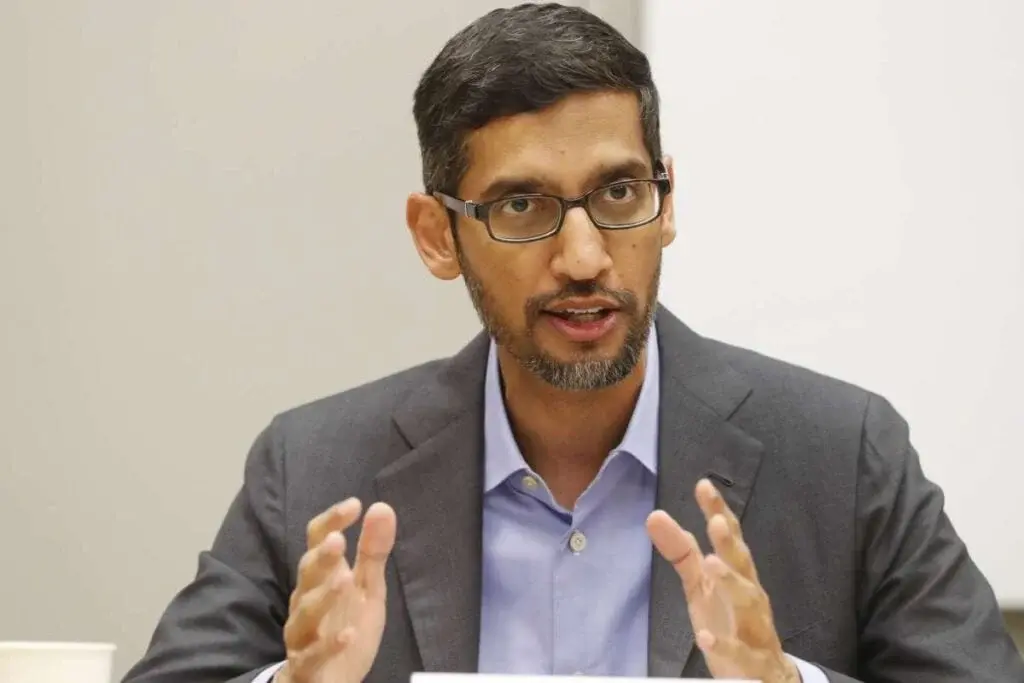
    In recent developments, Google’s CEO Sundar Pichai addressed the issue, stating that he would resolve it if the allegations prove to be accurate. According to a New York Times article, OpenAI employed over a million hours of YouTube content for Sora's training.

    Google's Response

    When questioned about potential violations of Google’s terms and conditions, Sundar Pichai responded, "Look, I think it’s a question for them to answer. I don’t have anything to add. We do have clear terms of service." He further mentioned, "And so, you know, I think normally in these things we engage with companies and make sure they understand our terms of service. And we’ll sort it out."

    Reportedly, The New York Times has already taken legal action against OpenAI for using their copyrighted content in AI training. However, Pichai did not disclose his strategy for addressing this issue.

    Creator Rights and AI Training

    Ideally, content creators should have the right to opt in or out of having their material used by others. AI training necessitates a vast amount of data, typically sourced from the internet, but this should be done with proper permission. When asked if YouTube content was used by OpenAI, the company’s COO hinted at future plans. He mentioned that alongside developing a tool to detect AI-generated images, they are also working on a "content ID system for AI" that would allow creators to see where their content is being used, who is training on it, and to opt in or out of such training.

  • OpenAI Developing Alternative to Google Search, Hiring Googlers

    OpenAI Developing Alternative to Google Search, Hiring Googlers

    With the advent of ChatGPT, Google recognized the necessity to develop a comparable large language model, resulting in the creation of Gemini. OpenAI, in turn, appears to have drawn inspiration from Google’s own product, Google Search. Recent reports reveal that OpenAI, the creator of ChatGPT, is actively recruiting individuals from Google to work on incorporating a search functionality into ChatGPT, positioning it to rival Google Search.


    ChatGPT has been granted access to the internet by OpenAI for approximately a year now. This access, however, is limited to paying subscribers who can utilize the chatbot to obtain real-time information from the web. Additionally, an integrated version of Microsoft’s Bing web browser within ChatGPT can assist users in retrieving web-based information. Nevertheless, this implementation comes with its unique attributes and restrictions, setting it apart from the original ChatGPT experience.

    According to reports from Bloomberg, OpenAI is now focusing on enhancing ChatGPT by introducing a search feature that will scour the web for updated information, complete with proper citations. The company is actively recruiting engineers from Google’s search team for this project, although the exact number of hires remains undisclosed.


    Developing an alternative to Google Search poses a formidable challenge, yet OpenAI has cemented its presence with a sizable user base. Additionally, OpenAI’s partnership with Microsoft could provide valuable computational resources for this endeavor. Meanwhile, Google is cognizant of the impending challenges and is reportedly working on making its search product more agile and adaptable to market changes. For instance, Google’s recent introduction of a generative AI feature, the Search Generative Experience, exemplifies its efforts. The evolution of Search in response to the competition between these tech giants promises an intriguing future ahead.

  • OpenAI GPT-5 Launch: Capabilities and Features Coming Soon

    OpenAI GPT-5 Launch: Capabilities and Features Coming Soon

    Are you prepared for the next leap beyond GPT-4? Brace yourself as the upcoming wave of large language models (LLMs) is on the horizon. Reports from Business Insider indicate that OpenAI is edging closer to the launch of GPT-5, with a potential arrival in just a few months. Early previews suggest a significant advancement, with enterprise clients who have experienced GPT-5 demos expressing positive feedback. One CEO has even described it as surpassing previous models in a substantial manner, while OpenAI presentations hint at the model's potential capabilities, such as independent AI agents.

    Progress Towards Launch

    Development of GPT-5 is progressing in tandem with demonstration activities. Stringent safety evaluations, including simulated attacks like "red teaming," are essential before the model is released. This meticulous process may cause a delay in the initial expectations of a summer launch. OpenAI has chosen to remain silent regarding a specific release date. These recent developments follow a year filled with speculation surrounding GPT-5. In April 2023, OpenAI had initially played down immediate training prospects, with CEO Sam Altman dismissing any rumors circulating at that time. Nonetheless, talks about a potential GPT-4.5 model persisted.

    Training Completion and Launch

    New reports indicate that training for GPT-5 was completed in 2023, setting the stage for a potential launch in 2024. Similar to its forerunner, GPT-5 is anticipated to cater primarily to OpenAI's corporate clientele. There is speculation that a future direction might involve a tiered system, akin to Google's Gemini LLMs.

    Evolving Landscape

    During the past year, users reported a decline in GPT-4's performance, marked by issues such as generating nonsensical responses. The causes were attributed to factors like training efficiency and resource constraints, leading to speculations about the strain on OpenAI's system due to the development of undisclosed LLMs.

    A leak in December 2023 hinted at the existence of "GPT-4.5" models with advanced features, further fueling anticipations. OpenAI's CEO chose not to comment when questioned online about these developments. With GPT-5 looming on the horizon, the landscape of large language models is on the verge of transformation. The forthcoming months will unveil the true capabilities of this next-generation model.

  • OpenAI to Release Sora to Public by 2024: Could Be Available in Just Months

    OpenAI to Release Sora to Public by 2024: Could Be Available in Just Months

    OpenAI recently introduced its innovative text-to-video tool, Sora, which has the capability to produce lifelike 1080p videos. At present, the tool is being tested by a select group of filmmakers and creators to identify and rectify any potential weaknesses before making it available to the public. According to OpenAI's chief technology officer Mira Murati in an interview with the Wall Street Journal, the plan is to release Sora to the public before 2025, with the possibility of this happening in just a few months.

    Advancements in Video Generation

    OpenAI's objective with Sora is to provide creators with a versatile tool for editing and content creation, aiming to cater to the creative needs of users.

    Safety and Future Prospects

    In contrast to a video featuring Will Smith consuming spaghetti that was revealed a year ago, content generated by Sora is described as "hyperrealistic" by the OpenAI CTO, with the exception of some anomalies in hand and finger representations. The company is adamant about ensuring the safety of the tool before its public release, with plans to watermark the Sora-generated videos, similar to other text-to-image tools.

    Impact on Creators and Data Usage

    CTO Murati emphasized that the text-to-video generation model is intended to complement creators' work rather than replace them, serving as a tool to enhance creativity. Regarding the training data for Sora, she mentioned that publicly available and licensed data, possibly sourced from platforms like YouTube, Facebook, and Instagram, was utilized.

    Moreover, Sora's generated clips do not include audio currently, but there are intentions to incorporate audio in the future, possibly in an enhanced version of Sora under a different name. Just like DALL-E, users may have to pay to access and use the model, with OpenAI focusing on creating an economically viable model that involves input from contributors in the film industry and beyond.

  • OpenAI Possibly Leaks GPT-4.5 Turbo in Blog Post

    OpenAI Possibly Leaks GPT-4.5 Turbo in Blog Post

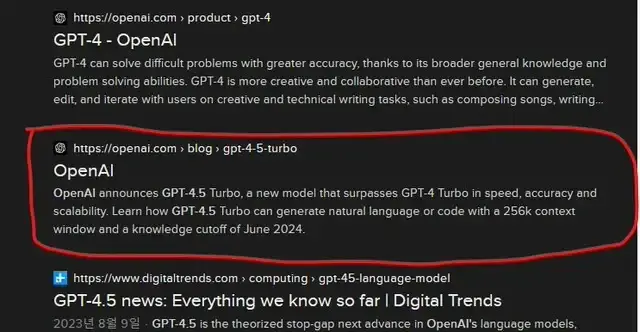
    Today marks a full year since OpenAI unveiled GPT-4, its advanced language model that brought incremental improvements over its predecessor. Upon its release, the model showcased exceptional human-level performance across various professional and academic benchmarks. Earlier today, speculation arose as OpenAI hinted at details regarding the upcoming GPT-4.5 Turbo large language model in a now-unavailable blog post. The new model was described as surpassing GPT-4 in terms of speed, accuracy, and scalability.

    Speculation on Release Date

    There is anticipation regarding a potential release around July or August, fueled by the intriguing mention of a "knowledge cutoff" set for June 2024. This indicates that the AI chatbot will have access to all online information until that specified date. While some view this as a potential error, others speculate that OpenAI might unveil GPT-4.5 Turbo in the near future before transitioning to their next-generation model, GPT-5.

    Enhanced Capabilities of GPT-4.5 Turbo

    A notable enhancement in GPT-4.5 Turbo is its expanded context length window of 256K tokens, doubling the capacity of GPT-4 Turbo's 128K tokens. This adjustment seems to be OpenAI's response to competitors rolling out models with larger context windows. Following Google's rebranding of Bard to Gemini and the introduction of new AI Model updates, discussions have emerged, pondering whether Gemini could become the preferred Large Language Model (LLM). The emergence of a new GPT model could potentially level the playing field for OpenAI or even push it ahead of Google's AI chatbot.

    OpenAI's Silence and Future Outlook

    OpenAI has yet to officially comment on the leak, maintaining an air of mystery around GPT-4.5 Turbo and the June 2024 deadline. The timing of the leak, coinciding with the first anniversary of GPT-4's launch, raises questions as to whether this was intentional. For further updates on OpenAI developments, keep an eye on GizmoChina.

  • Elon Musk Sues OpenAI, Seeks Public Release of Technology

    Elon Musk Sues OpenAI, Seeks Public Release of Technology

    Elon Musk, renowned for his contributions to electric cars and SpaceX, has taken legal action against OpenAI, an artificial intelligence (AI) research lab co-founded by him. Musk alleges that OpenAI has strayed from its original mission of developing beneficial, non-profit AI for the benefit of all. Notably, OpenAI, recognized for its ChatGPT language model, has garnered support from Microsoft, a move that has raised apprehension in Musk's view. He contends that the organization, initially intended to be transparent and non-commercial, has shifted its focus towards generating profits for its investors.

    Lawsuit Against OpenAI

    The legal dispute, initiated in San Francisco, urges the court to mandate OpenAI to disclose its research and technology to the public. This action would enable anyone to access and further build upon the advancements made by OpenAI, thereby promoting broader AI innovation. Additionally, the lawsuit seeks to restrain the utilization of OpenAI's cutting-edge AI model, GPT-4, for financial gains, encompassing both Microsoft and individuals affiliated with OpenAI. As of now, both OpenAI and Microsoft have refrained from issuing a public statement regarding the lawsuit.

    Musk's Concerns and AI Landscape

    Musk has consistently voiced apprehensions regarding the potential risks associated with AI, advocating for regulatory measures. Having resigned from OpenAI's board in 2018, he has been vocal about his skepticism concerning Microsoft's role in the organization. Musk perceives that the tech giant wields significant influence, if not direct control, over OpenAI. This legal confrontation adds a new dimension to the intricate domain of AI advancement. While the final outcome remains uncertain, it prompts critical reflections on the ethical considerations, objectives, and governance surrounding this potent technology.

    Musk's AI Venture and Future Prospects

    In parallel, Musk is advancing his own AI initiative, xAI, which strives to develop an AI system geared towards seeking maximum truth. Recently, the startup introduced its ChatGPT rival, Grok, which inadvertently divulged the actual formula for a drug when prompted. This development underscores Musk's ongoing engagement in the AI sphere and the evolving landscape of AI technologies.

  • OpenAI Valued at $80 Billion, CEO Altman Considers Entering AI Chip Market

    OpenAI Valued at $80 Billion, CEO Altman Considers Entering AI Chip Market

    OpenAI, the company behind the popular AI chatbot ChatGPT, has witnessed a meteoric rise in valuation, jumping to a staggering $80 billion according to a recent deal with venture capital firm Thrive Capital. This represents a nearly threefold increase from just nine months ago, highlighting the surging interest in artificial intelligence and its potential applications.

    Skyrocketing Valuation: OpenAI’s Leap to $80 Billion Amid AI Innovations

    Unlike a traditional funding round, this deal allows employees to sell their existing shares, offering them a significant windfall as OpenAI’s value skyrockets. This approach differs from last year’s tender offer, which raised new capital for the company while valuing it at around $29 billion.

    OpenAI Continues to Push the Boundaries of AI Technology

    OpenAI continues to push the boundaries of AI technology. Following the success of ChatGPT, they’ve recently unveiled Sora, a video generation platform that utilizes text prompts to create original content. However, public access to Sora remains limited as OpenAI prioritizes implementing safety measures to mitigate potential risks of bias and misinformation.

    Challenges and Uncertainties for OpenAI

    Sam Altman‘s aspirations extend beyond software, as he seeks to establish a new venture focused on AI chip manufacturing. This initiative aims to bolster global chip production capacity and potentially accelerate the development of AI-powered tools. However, securing U.S. government approval for such a venture could prove challenging due to potential antitrust concerns and national security implications.

    While OpenAI’s current trajectory is impressive, several uncertainties cloud its future. The company’s CEO faces an uphill battle in gaining approval for his chip venture, and the long-term viability of its AI products like Sora remains to be seen. Additionally, questions surrounding OpenAI’s ultimate goals and potential impact on society continue to spark debate.

    The company’s achievements highlight the immense potential of AI and its ability to disrupt various industries. However, the ethical and regulatory challenges associated with AI development require careful consideration as the technology continues to evolve.

  • OpenAI achieves $2 billion revenue milestone, stimulating ambitious Chip-making project

    OpenAI achieves $2 billion revenue milestone, stimulating ambitious Chip-making project

    OpenAI, backed by tech giant Microsoft, has achieved a monumental revenue milestone, surpassing $2 billion in December 2023. The achievement, first reported by Reuters and later corroborated by The Financial Times, signifies a remarkable trajectory for the San Francisco-based company, driven by burgeoning interest from corporate clients in its generative AI tools.

    Innovative Products Drive Revenue Surge

    The surge in revenue is attributed to OpenAI’s innovative products, particularly its ChatGPT offering, which has witnessed substantial adoption in various industries. The company’s annualized revenue soared to over $1.6 billion by December, a significant leap from $1.3 billion reported just two months earlier, as noted by The Information.

    Market Enthusiasm and Funding Talks

    Market enthusiasm for OpenAI is evident, with investors valuing the startup at a staggering $80 billion. Riding on this momentum, CEO Sam Altman has been actively engaged in discussions with potential investors, including prominent figures like Sheikh Tahnoon bin Zayed al-Nahyan from the UAE, to secure funding for a transformative initiative.

    Altman’s ambitious vision involves establishing a chip-making company, aiming to bolster global chip-building capacity and advance AI capabilities. Reports from Bloomberg indicate that Altman’s plan entails constructing modern manufacturing facilities, necessitating funding in the tens of billions of dollars and spanning several years for completion.

    Key players in these funding talks include TSMC from Taiwan and Softbank, underscoring the global significance of OpenAI’s endeavors. Sheikh Tahnoon’s involvement, given his strategic role in managing significant investment funds in the UAE, further underscores the international interest in OpenAI’s initiatives.

    Exploring Chip-Making Venture

    While the specifics regarding the structure of the new chip-making venture remain undisclosed, sources suggest that OpenAI will serve as its initial client. This move aligns with previous reports hinting at OpenAI’s exploration of manufacturing its chipsets to address the increasing demand for AI chips, catalyzed by the widespread adoption of AI applications like ChatGPT.

    The shortage of AI chips, exacerbated by increased demand, has prompted OpenAI to diversify its chip suppliers beyond Nvidia and explore collaboration opportunities with other manufacturers. The strategic move underscores OpenAI’s commitment to fostering innovation and meeting the evolving needs of its clientele.