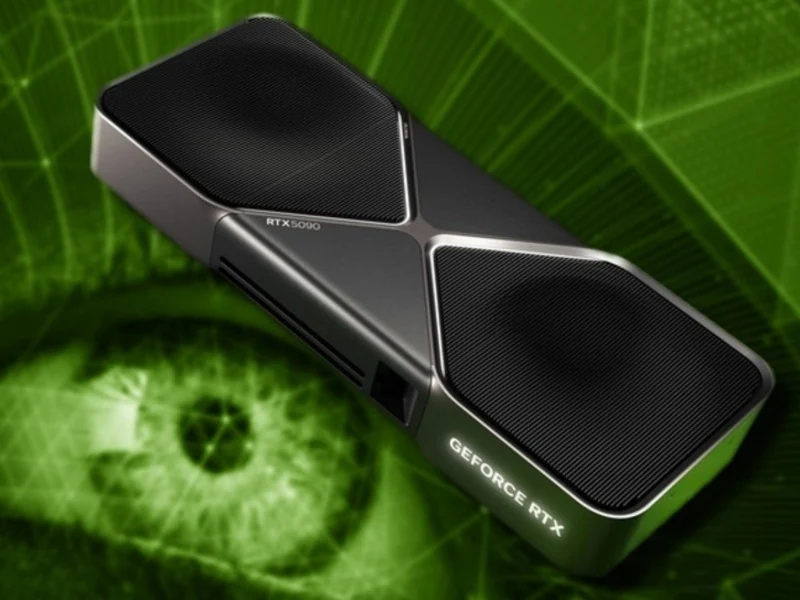
Tag: NVIDIA

  • Juggernaut RTX 5090 System Dominates GPU Compute Benchmark

    Juggernaut RTX 5090 System Dominates GPU Compute Benchmark

    Key Takeaways

    1. The Nvidia GeForce RTX 5090 initially underperformed on PassMark, scoring lower than the RTX 4090 and at RTX 4080 levels in GPU Compute tests.

    2. PassMark updated its testing methodology to support 64-bit components, allowing the RTX 5090 and RTX 5080 to better showcase their performance capabilities.

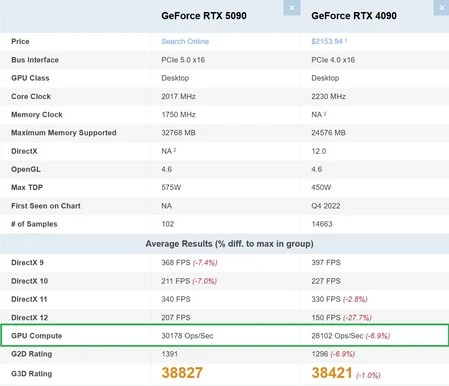
    3. After the update, the RTX 5090’s average GPU Compute score improved significantly from 23,050 Ops/Sec to 30,178 Ops/Sec.

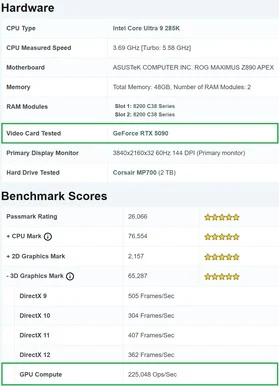
    4. High-end system configurations, such as those with an Intel Core Ultra 9 285K and 48 GB of RAM, can achieve impressive scores (e.g., 225,048 Ops/Sec) that highlight the RTX 5090’s potential.

    5. The advancements in testing and system setups emphasize the importance of having the right configuration to fully leverage the performance of high-end graphics cards like the RTX 5090.


    Over 100 samples of the Nvidia GeForce RTX 5090 graphics card have now been tested on PassMark’s platform, and the GPU Compute scores are looking significantly better. Earlier, the new Blackwell card faced challenges on the site, falling behind the RTX 4090 in overall performance, while it was nearly stuck at RTX 4080 levels for GPU Compute. The RTX 50-series cards seemed to be limited by their advanced tech, as PassMark had been using a 32-bit testing framework, but Nvidia had dropped support for OpenCL 32-bit in its latest graphics cards.

    Update on Testing Methodology

    Recently, PassMark implemented a patch for their site, allowing the GPU Compute test to use 64-bit components. This change means that graphics cards like the RTX 5090 and RTX 5080 can now show their actual performance capabilities. Although the official high-end video card rankings on the site haven’t been updated yet, the RTX 5090 page is already showcasing significant improvements in GPU Compute. Previously, the average score for the GeForce RTX 5090 in this benchmark was a rather disappointing 23,050 operations per second (Ops/Sec), compared to 28,240 Ops/Sec for the RTX 4090. It was surprising to see the RTX 5090 underperform on PassMark, especially given its strong results in our tests. Thankfully, the score for the Blackwell card has risen to a much more respectable 30,178 Ops/Sec.

    Impressive System Configurations

    Moreover, the recent visits by a few RTX 5090-based systems to the site have revealed some serious powerhouses. For example, even before the patch was available, one test run involving a PC with an Intel Core Ultra 9 285K and 48 GB of RAM on an Asus ROG Maximus Z890 Apex motherboard achieved an incredible score of 225,048 Ops/Sec in GPU Compute. This score is almost 10 times higher than the previous average score for the RTX 5090 and roughly 7.5 times faster than the latest average result. While the average score is crucial for understanding the overall performance of a graphics card like the GeForce RTX 5090, this remarkable score demonstrates that with the right setup, gamers and PC builders can really maximize the benefits of their $2,000+ investment.

    Source:
    Link

  • Nvidia Doubles Revenue in 2024: Blackwell Drives Growth

    Nvidia Doubles Revenue in 2024: Blackwell Drives Growth

    Key Takeaways

    1. Nvidia’s revenue for fiscal year 2024 surged by 114% to $130.5 billion, driven primarily by demand for AI technologies.
    2. The Data Center segment achieved a record $35.6 billion in revenue for Q4, a 93% increase year-over-year, and $115.2 billion for the entire year, climbing 142%.
    3. Strategic partnerships with major cloud service providers like AWS, Google Cloud, and Microsoft Azure significantly fueled AI demand.
    4. Nvidia increased production of Blackwell AI supercomputers, contributing to substantial sales in the gaming and AI PC segment, which generated $11.4 billion in revenue.
    5. Despite a 48% rise in operating expenses, Nvidia’s net income rose by 130% to $74.2 billion for the year.


    Nvidia shared its financial results for the fiscal year 2024, showing that its revenue soared by 114% to reach $130.5 billion. This impressive growth, revealed on Wednesday, was largely driven by the strong demand for Artificial Intelligence (AI) technologies.

    Record-Breaking Data Center Revenue

    A significant contributor to these results was the Data Center segment, which achieved a remarkable $35.6 billion in revenue for the fourth quarter. This marks a 93% increase compared to last year and a 16% rise from the previous quarter. For the entire year, this segment saw its revenue climb 142%, hitting an all-time high of $115.2 billion.

    AI Demand Fuels Growth

    The company attributed this growth in the Data Center segment to the surging demand for AI capabilities, bolstered by strategic partnerships with major cloud service providers such as AWS, Google Cloud, and Microsoft Azure.

    Jensen Huang, the founder and CEO, emphasized the importance of Blackwell in the annual results. “The demand for Blackwell is incredible as reasoning AI brings in another scaling law — having more compute for training makes models smarter, and more compute for long thinking leads to smarter answers,” he stated.

    Massive Production and Gaming Segment

    Throughout the year, Nvidia significantly increased the production of Blackwell AI supercomputers, which enabled the company to generate billions in sales during its first quarter.

    The gaming and AI PC segment also contributed notably, generating $11.4 billion in revenue, which represents a 9% increase year-over-year.

    Operating expenses for the full fiscal year rose by 48%. The company explained that this increase was mainly due to higher compensation and benefits costs stemming from employee growth and salary increases, along with engineering development, computing, and infrastructure costs related to new product launches.

    Despite these rising expenses, Nvidia’s net income saw a remarkable increase of 130%, reaching $74.2 billion for the year.

    Source:
    Link

  • RTX 5060 Ti Specs and Launch Date Leaked

    RTX 5060 Ti Specs and Launch Date Leaked

    Key Takeaways

    1. The RTX 5060 Ti will debut in two versions: a 16 GB model and an 8 GB model.
    2. The 16 GB version will feature 28 Gbps GDDR7 VRAM, a 128-bit bus, and a TDP of 180 Watts, launching in late March.
    3. The 8 GB version will be revealed in early April with similar specifications but on a different board.
    4. The standard RTX 5060 will be available only in an 8 GB version.
    5. Limited availability of the RTX 5060 Ti and RTX 5060 may push gamers to consider AMD’s upcoming RDNA 4 offerings.


    A recent leak from Wccftech seems to confirm an earlier EEC listing regarding the RTX 5060 Ti, which is set to debut in two versions. The first version will utilize a PG152 SKU 10 board and will feature 16 GB of 28 Gbps GDDR7 VRAM on a 128-bit bus, with a thermal design power (TDP) of 180 Watts. This model is anticipated to be available in the second half of March, just two weeks following the expected launch of the RTX 5070.

    Upcoming Variants

    In early April, the 8 GB version of the RTX 5060 Ti will be revealed. This variant also employs the same 28 Gbps modules on a 128-bit bus and shares the same TDP as its 16 GB counterpart. It will be installed on a PG152 SKU 15 board. Currently, there is no information on which GPU each model will utilize, but both are likely to feature a GB205 die. It remains uncertain whether they will use the same GPU or if the 16 GB model will have a few additional CUDA cores.

    The Basic RTX 5060

    Additionally, there is the standard RTX 5060, which is expected to come only in an 8 GB version. Another EEC listing has provided insights into the RTX 5050 desktop, a category that Nvidia appears to have left behind with the Ada Lovelace generation. Recently, their laptop versions were noted on HP’s website. Regardless, obtaining an RTX 5060 Ti or even an RTX 5060 upon launch may prove difficult due to limited availability, making it even more appealing for gamers to consider AMD’s Navi 44-powered RDNA 4 offerings, which currently lack a confirmed release date.

    Source:
    Link

  • RTX 5080 Owners Disappointed as GPU Lacks ROPs in RTX 50 Series

    RTX 5080 Owners Disappointed as GPU Lacks ROPs in RTX 50 Series

    Key Takeaways

    1. Nvidia acknowledged production flaws in RTX 5090, RTX 5090D, RTX 5070 Ti, and RTX 5080 GPUs, leading to missing ROPs.
    2. Affected RTX 5080 cards have 8 fewer ROPs, reducing the total from 112 to 104.
    3. Nvidia advises users to contact board manufacturers for replacements, potentially leaving many unaware of the issue.
    4. Performance tests suggest gamers may experience noticeable drops, with reports of up to 11% reductions in benchmarks.
    5. Nvidia’s claim of a 4% average performance drop remains unverified and should be approached with skepticism until independent evaluations are available.


    After Nvidia acknowledged that a small number of its RTX 5090, RTX 5090D, and RTX 5070 Ti GPUs had a production flaw resulting in some ROPs being absent, new reports have surfaced indicating that the RTX 5080 also faces similar problems. Nvidia has confirmed that certain RTX 5080 cards are missing 8 ROPs, bringing the total down to 104 instead of the expected 112.

    Nvidia’s Statement

    In a statement to The Verge, Nvidia revealed that “an early production build of the RTX 5080 GPUs were also affected by the same issue.” The company has once again advised users to “contact the board manufacturer for a replacement.” VideoCardz noted that Nvidia appears to be leaving the resolution of this issue largely to the customers. While this may work for knowledgeable gamers who can utilize tools like GPU-Z, it’s likely that many average users will remain in the dark about the problem.

    Performance Impact

    As a result, many unsuspecting gamers might experience a noticeable drop in performance, as indicated by recent tests.

    Interestingly, Nvidia claims that only about 0.5% of the RTX 5090/D, RTX 5080, and RTX 5070 Ti are impacted by the missing ROPs. This has sparked several questions from the media. For one, how did Nvidia come to discover that only around 0.5% of the RTX 5080 were affected shortly after the initial reports surfaced online? Is it possible that Nvidia was already aware of the issue and chose not to disclose it?

    Concerns on Performance Claims

    Additionally, there’s the matter of the 4% gaming performance reduction that Team Green has mentioned. As reported previously, the RTX 5070 Ti with 8 fewer ROPs displayed performance losses ranging from single digits up to 11% in 3DMark benchmarks. This indicates that the final impact may vary depending on different scenarios, which appears logical.

    Thus, Nvidia’s assertion of an average 4% performance drop remains unverified until we have thorough evaluations conducted by independent testers. Until then, it’s wise to approach any information shared online with a degree of skepticism.

    Source:
    Link

  • RTX 5070 Ti Performance Loss: Defects Cause Major Issues

    RTX 5070 Ti Performance Loss: Defects Cause Major Issues

    Key Takeaways

    1. Several RTX 50 models, including the RTX 5090 and RTX 5070 Ti, are missing some ROPs, impacting performance.
    2. Nvidia claims the performance loss is only about 4%, but independent tests show up to 11% reduction in benchmarks for the RTX 5070 Ti.
    3. Performance differences vary by benchmark, with some tests showing minimal gaps (around 3% slower) between affected and fully functional cards.
    4. Gamers who purchased the RTX 5070 Ti at high prices may feel disappointed due to these performance issues.
    5. AMD sees this situation as an opportunity to compete with its upcoming RX 9070 XT GPU, aimed at rivaling the RTX 5070 Ti.


    As reports emerge about the recent RTX 50 launch, it appears that a few models, specifically the RTX 5090, RTX 5090 D, and RTX 5070 Ti, have been found to be missing some ROPs. Nvidia has acknowledged this problem and asserts that the impact on gaming performance is only around 4%. However, independent tests conducted by a gamer using an affected RTX 5070 Ti suggest that the situation might be more severe.

    Performance Testing Reveals Issues

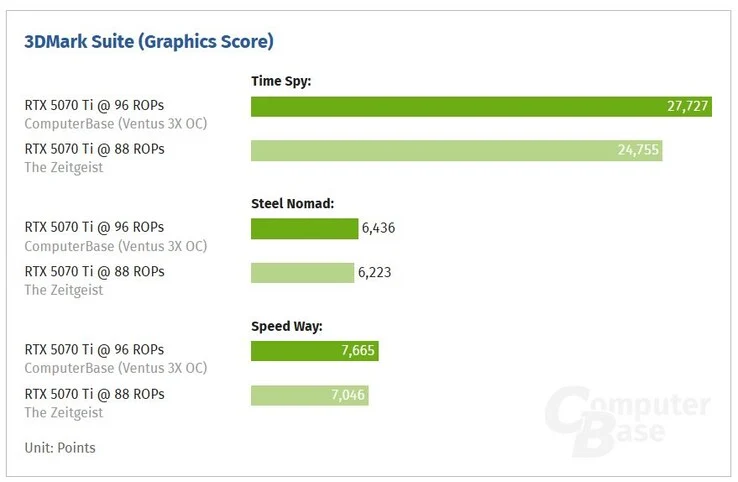
    In tests carried out by a user known as “Der Zeitgeist” on their MSI GeForce RTX 5070 Ti Gaming Trio OC, which has 8 fewer ROPs (88 instead of 96), the card showed around an 11% reduction in performance on the 3DMark Time Spy Graphics benchmark, scoring 24,755 compared to ComputerBase’s figure of 27,727. Additionally, in the 3DMark Speed Way benchmark, the flawed RTX 5070 Ti achieved a score of 7,046, which is 8% lower than the 7,665 score from ComputerBase.

    Minimal Differences in Some Benchmarks

    When it comes to the 3DMark Steel Nomad test, the performance gap between the RTX 5070 Ti with 88 ROPs and the complete 96 ROPs is the smallest. In this case, the impacted RTX 5070 Ti was around 3% slower than its fully functional counterpart.

    In summary, the RTX 5070 Ti that lacks some ROPs faces noticeable performance drops, with some tests showing losses that reach double digits, as highlighted by Der Zeitgeist’s findings. It remains unclear how significant the impact of the fewer ROPs will be in actual gaming scenarios. Even if Nvidia’s claim of a mere 4% deficit holds true, it is still disappointing for gamers who purchased the RTX 5070 Ti at prices exceeding the $749 MSRP.

    AMD’s Counterplay

    For AMD, this situation presents a golden chance to compete with the RX 9070 XT, which is designed to rival the RTX 5070 Ti. AMD is scheduled to unveil this GPU in just a few days.

    Source:
    Link


  • Nvidia Alerts Users: Performance Issues in RTX 5070 Ti and 5090 Series

    Nvidia Alerts Users: Performance Issues in RTX 5070 Ti and 5090 Series

    Key Takeaways

    1. Some GeForce RTX 5090 graphics cards were shipped with 168 ROPs instead of the expected 178 ROPs, leading to a performance drop of over 5%.
    2. The issue affects not only the GeForce RTX 5090 but also the GeForce RTX 5070 Ti and RTX 5090D, with Nvidia confirming it is not limited to one manufacturer.
    3. Only about 0.5% of the affected GPU units were shipped with fewer ROPs, and Nvidia has fixed the production issue.
    4. Nvidia advises customers who receive a card with fewer ROPs to contact their board manufacturer for a replacement.
    5. The problem has no impact on AI and Compute workloads, only affecting average graphical performance.


    Earlier this week, multiple sources discovered that some GeForce RTX 5090 graphics cards were being shipped with fewer Raster Output Pipelines (ROPs) than what was originally advertised. ROPs play a vital role in the performance of the GeForce RTX 5090 and other Nvidia graphics cards, especially for tasks like anti-aliasing and other critical GPU operations.

    Performance Impact

    According to GPU-Z, the affected GeForce RTX 5090 models showed 168 ROPs, which is 8 ROPs less than the expected reference specification. This decrease represents a 4.5% drop, but TechPowerUp found that the actual performance loss during testing was over 5% when comparing an impacted card to those that had the full 178 ROPs.

    Broader Implications

    Initially, it appeared that only a specific Zotac model was impacted. However, Nvidia has since stated that the issue isn’t limited to one board partner. Additionally, this problem also affects the GeForce RTX 5070 Ti and the GeForce RTX 5090D, which is only available in China. Notably, the GeForce RTX 5080, currently priced at $2,299.99 on Amazon, is not affected by this issue.

    Resolution and Advice

    It has been reported that only about 0.5% of the GeForce RTX 5070 Ti, GeForce RTX 5090D, and GeForce RTX 5090 units shipped with fewer ROPs than they were supposed to have. Although Nvidia claims to have fixed the “production anomaly,” there is still a possibility that affected cards may remain in circulation at retailers for a while. Currently, Nvidia advises customers who have received a card with fewer ROPs to “get in touch with the board manufacturer for a replacement.” Here’s Nvidia’s complete statement:

    “We have identified a rare issue affecting less than 0.5% (half a percent) of GeForce RTX 5090 / 5090D and 5070 Ti GPUs which have one fewer ROP than specified. The average graphical performance impact is 4%, with no effect on AI and Compute workloads. Affected consumers can contact the board manufacturer for a replacement. The production anomaly has been corrected.”

    Source:
    Link

  • GeForce RTX 5090 Beats RTX 4090 in Graphics Card Benchmark

    GeForce RTX 5090 Beats RTX 4090 in Graphics Card Benchmark

    Key Takeaways

    1. The RTX 5090 has fallen to second place in PassMark’s G3D Mark benchmark, overtaken by the RTX 4090.
    2. The average score for the RTX 4090 increased, while the RTX 5090’s average score decreased due to more extensive testing samples.
    3. Possible reasons for the RTX 5090’s performance dip include driver issues, limited sample size, and missing Raster Output Pipelines (ROPs) in some models.
    4. The RTX 5090 outperforms the RTX 4090 in DirectX 12 tests, showing a +39.3% advantage in average frames per second.
    5. Despite having more CUDA cores, the RTX 5090 lags behind the RTX 4090 in GPU compute benchmarks by -17.5%.


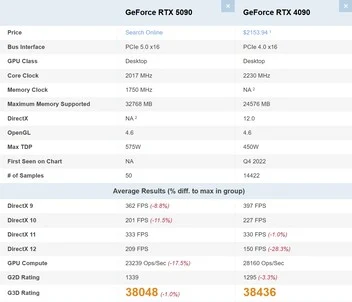
    As gamers anxiously anticipate the performance of the new Nvidia GeForce RTX 5070, the flagship RTX 5090 appears to be facing some challenges. After recently achieving the top position on PassMark’s G3D Mark benchmark list, the RTX 5090 has now fallen to second place, overtaken by the RTX 4090. Initially, the Blackwell card had a slight lead of +2.85% over the Ada Lovelace model, but further testing of both cards has eliminated that small edge.

    Performance Shifts

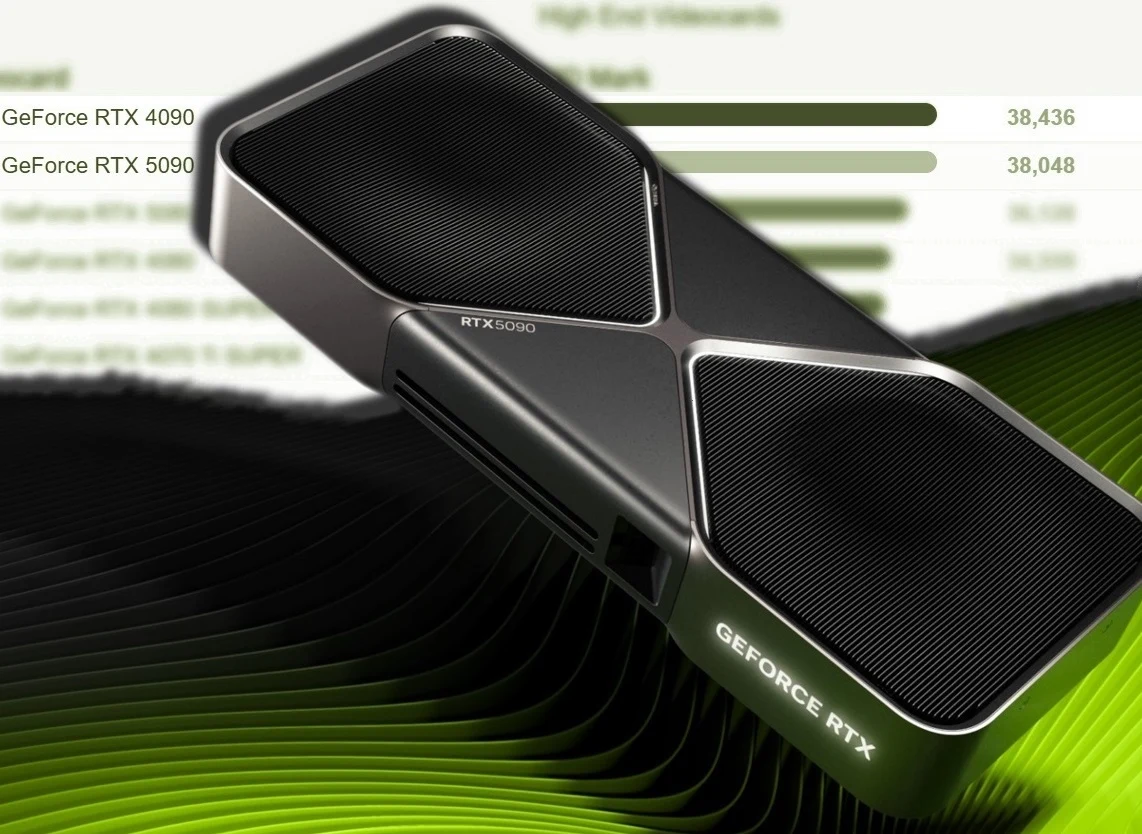
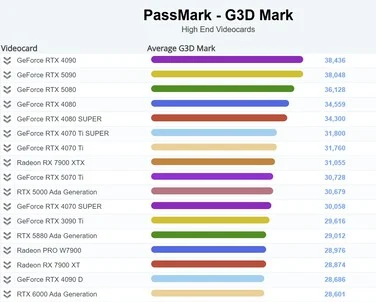
    Since our last update, a significant number of RTX 4090 graphics cards have been evaluated, leading to an increase in its average score from 38,422 to 38,436 based on 14,422 tests. Meanwhile, the testing pool for the GeForce RTX 5090 has expanded from 13 to 50 samples, causing its average score to drop from 39,516 to 38,048, resulting in a decrease of -3.71%. This fluctuation indicates that there remains a possibility for the RTX 5090 to regain its leading position in this benchmark if more samples are tested in the future. The tests conducted cover DirectX versions 9 to 12, along with GPU compute evaluations.

    Possible Explanations

    There are several reasons that might explain this surprising turn of events. Driver problems have been reported, with some RTX 5090 units allegedly malfunctioning post-software updates. The sample size for the Blackwell card is still relatively limited, particularly when compared to the RTX 4090. Additionally, it has come to light that certain GeForce RTX 5090 models were lacking Raster Output Pipelines (ROPs), which are crucial hardware components for image rendering. The limited availability of units will also influence the number of graphics cards eligible for benchmarking.

    DirectX 12 Performance

    It’s important to note that the RTX 5090 does outperform the RTX 4090 in DirectX 12 tests, boasting a significant advantage of +39.3% in average frames per second (209 vs. 150). However, as previously mentioned, the GeForce RTX 5090 lags in the GPU compute benchmark by -17.5%, even though it has +32.8% more CUDA cores than the RTX 4090, which are necessary for executing parallel processing tasks. While it’s too soon to claim that Nvidia is not keeping up, these results may give gamers pause when considering such a pricey piece of hardware.

    Source:
    Link


  • RTX 5070 Ti vs RTX 4070 Ti: Early Benchmark Results Explained

    RTX 5070 Ti vs RTX 4070 Ti: Early Benchmark Results Explained

    Key Takeaways

    1. The new Blackwell GeForce RTX 50-series, particularly the RTX 5090, is showing inconsistent benchmark results, sometimes ranking just below the older RTX 4090.
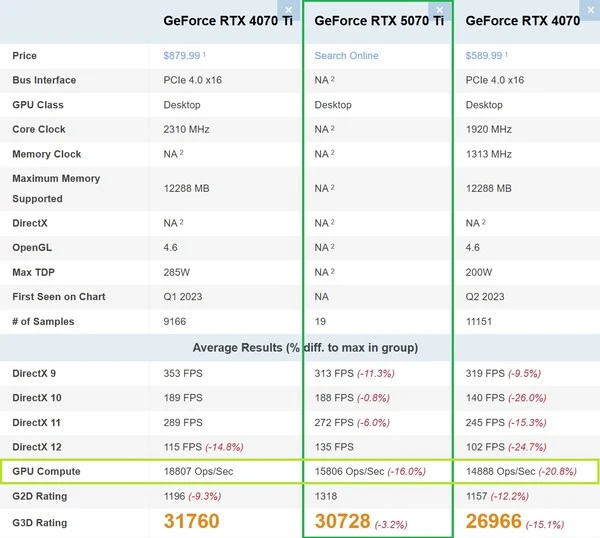
    2. The RTX 5070 Ti has a respectable average score of 30,728 points but falls short of surpassing the RTX 4070 Ti and RTX 4070 Ti Super.
    3. Limited sample size of the RTX 5070 Ti (only 19 samples) may lead to fluctuating results, with expectations for improvement over time through driver updates.
    4. The RTX 5070 Ti’s GPU Compute score is significantly lower than the RTX 4070 Ti, trailing by nearly 16%, despite enhancements in the RTX 50-series.
    5. Overall, the RTX 5070 Ti shows competitive performance in various benchmarks, often exceeding its RTX 4070 predecessors.


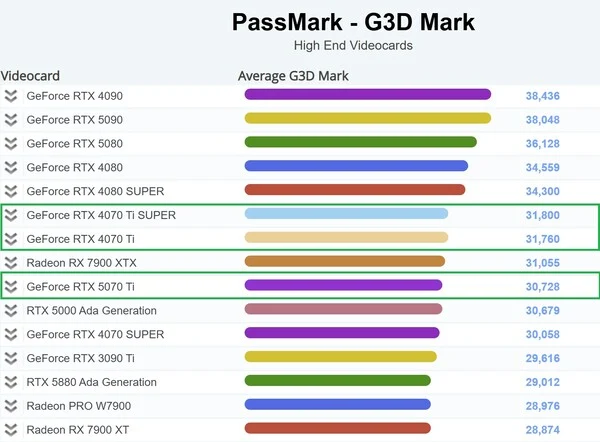
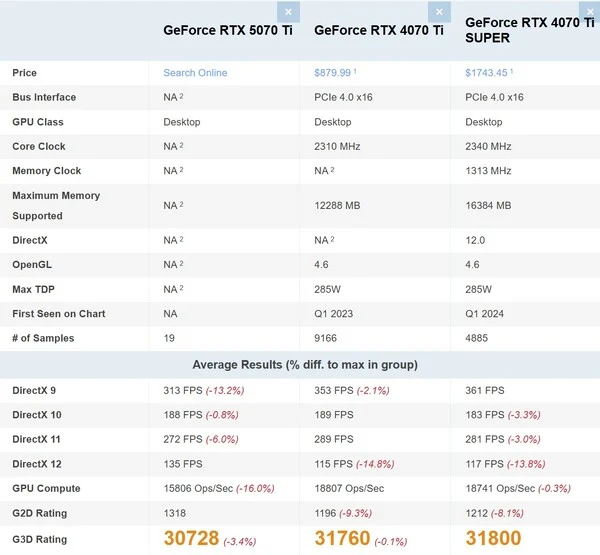
    It’s not clear whether the inconsistency comes from the benchmark or the graphics cards themselves, but the new Blackwell GeForce RTX 50-series has shown varied results on PassMark lately. The RTX 5090 has been swinging between being the top-tier video card and the second place behind the RTX 4090. Now, we also have some data for the Nvidia GeForce RTX 5070 Ti, which is telling a somewhat similar story regarding its generational performance. The RTX 5070 Ti achieved a respectable average score of 30,728 points, but it was unable to surpass the older RTX 4070 Ti (2023 – Asus TUF Gaming variant on Amazon) and the RTX 4070 Ti Super (2024) models.

    Limited Samples Affect Results

    So far, only 19 samples of the GeForce RTX 5070 Ti have been recorded on the site, leading to the expectation that these results will improve over time, particularly with driver updates and fixes for any issues like the missing ROPs. The RTX 5070 Ti’s score is just -3.25% lower than the GeForce RTX 4070 Ti and -3.37% behind the GeForce RTX 4070 Ti Super. Both of these Ada Lovelace generation cards have been tested with thousands of samples, so RTX 5070 Ti owners shouldn’t feel too worried about these early results. Moreover, this new graphics card has shown competitive performance in other benchmarks, often exceeding its RTX 4070 predecessors.

    Comparing GPU Compute Scores

    However, what might cause some concern is a comparison involving the RTX 5090 and RTX 4090: The GPU Compute score for the RTX 5070 Ti is significantly lower than that of the RTX 4070 Ti. The comparative results are 15,806 operations per second versus 18,807 operations per second, indicating that the Blackwell card trails by nearly -16% (see screenshot below). Nvidia has incorporated numerous enhancements into the RTX 50-series cards, including GDDR7 memory and new generations of RT cores and Tensor cores, but it still feels odd to see the RTX 5070 Ti (15,806 Ops/sec) comparable to a standard RTX 4070 (14,888 Ops/sec) in benchmarks like GPU Compute.

    Source:
    Link


  • Nvidia Follows Ferrari’s Strategy to Handle RTX 5090, 5080 Stock

    Nvidia Follows Ferrari’s Strategy to Handle RTX 5090, 5080 Stock

    Key Takeaways

    1. Nvidia launched the RTX 5090 and RTX 5080 on January 30th, but stock shortages are widespread.
    2. Retail prices for the RTX 5090 and RTX 5080 are $1,999 and $999, respectively, with limited availability at major retailers.
    3. Nvidia introduced a “Verified Priority Access” program to help select gamers and content creators purchase the GPUs.
    4. The program is open to Nvidia members who registered by January 30, 2025, and is limited to one GPU per selected individual.
    5. Currently, the Priority Access program is only available to users in the United States, leaving gamers in other regions without options.


    Nvidia has introduced the RTX 5090 and RTX 5080 on January 30th. Unfortunately, besides a few fortunate individuals, most gamers seeking these GPUs have faced significant stock shortages. A quick look at popular retailers like Newegg, Amazon, and Best Buy shows that both the RTX 5090 and RTX 5080 are unavailable at their retail prices of $1,999 and $999, respectively.

    Supply Situation

    While these stock issues are likely to improve eventually, there’s no quick fix in sight. To assist gamers wanting to buy the RTX 5090 or RTX 5080, Nvidia has rolled out a new “Verified Priority Access” program. This initiative resembles the exclusive programs run by high-end car brands like Ferrari, which allow devoted customers to purchase top-tier models, such as the LaFerrari hypercar, only through invitation.

    Program Details

    Next week, Nvidia’s Verified Priority Access program will commence, inviting chosen gamers and content creators to buy the RTX 5090/5080 Founders Edition GPUs via the company’s official store. This program is limited to Nvidia members who registered an account on or before January 30, 2025, at 6 AM Pacific Time. Members who meet the criteria can express their interest using a specified form. Nvidia will then inform selected individuals via email, enabling them to acquire one RTX 5090 or RTX 5080 from Team Green’s online store.

    Regional Limitations

    Regrettably, the Priority Access program is currently only for users located in the United States. This limitation is not surprising, given that the US is Nvidia’s primary market. However, it is disappointing news for gamers in other regions who are also facing shortages of GeForce products.

    Source:
    Link

  • RTX 5060 and 5050 Laptop GPUs Found with New HP Victus 16 Variant

    RTX 5060 and 5050 Laptop GPUs Found with New HP Victus 16 Variant

    Key Takeaways

    1. Nvidia showcased the RTX 50 series laptop graphics cards, including the RTX 5090, RTX 5080, RTX 5070 Ti, and RTX 5070, with the RTX 5060 Ti, RTX 5060, and RTX 5050 expected to follow.
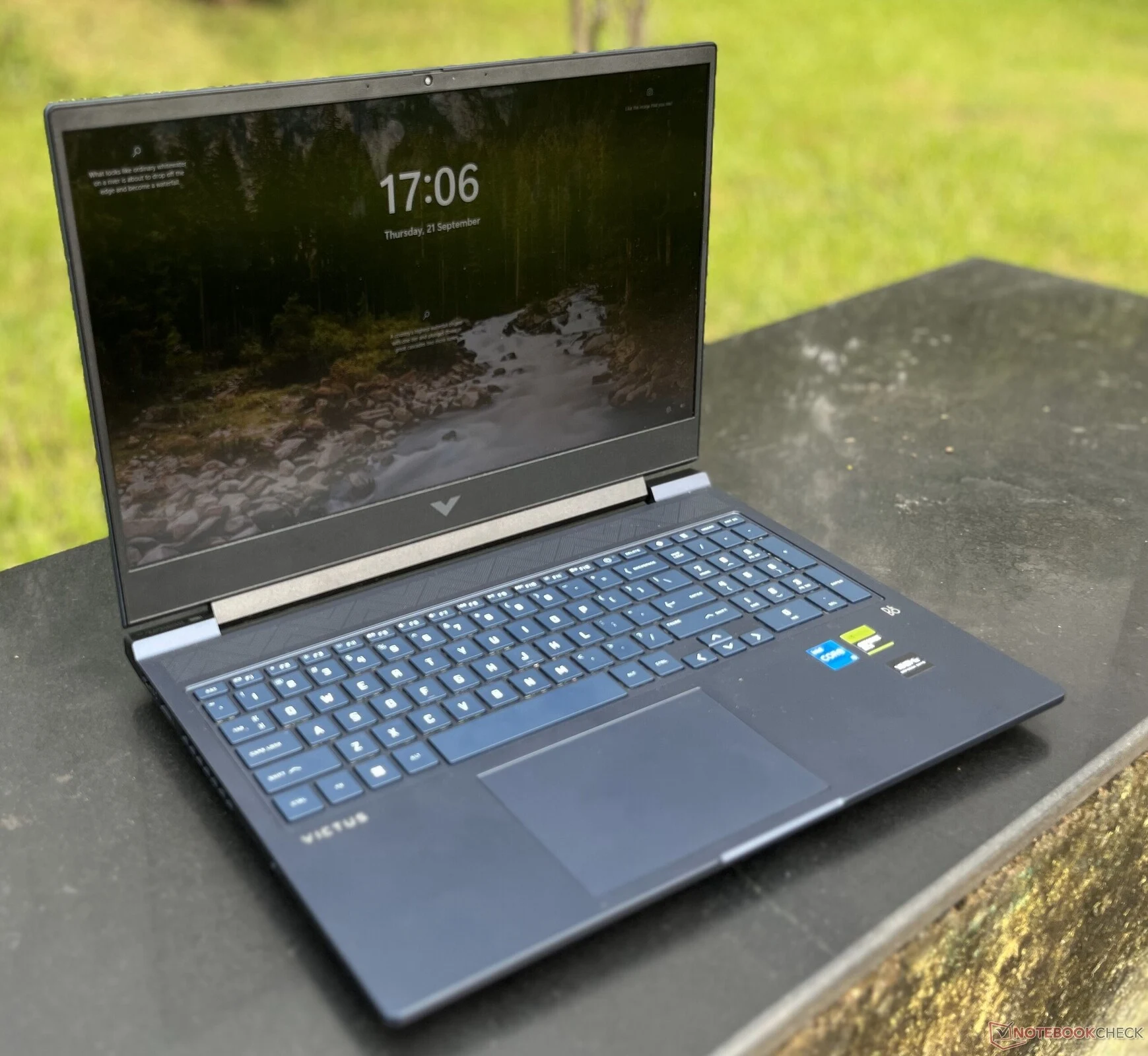
    2. The RTX 5060 and RTX 5050 are likely to be featured in HP’s Victus 16 gaming laptops, combined with various Intel Raptor Lake processors.
    3. No specifications have been released for the RTX 5060 or RTX 5050, but they may feature 8 GB of VRAM and possibly use GDDR6 memory.
    4. The performance improvement of the RTX 5060 and RTX 5050 may be minimal and dependent on power allocation from OEMs.
    5. Nvidia’s software features, including DLSS 4.0, are expected to enhance gaming performance, especially at 1080p resolution.


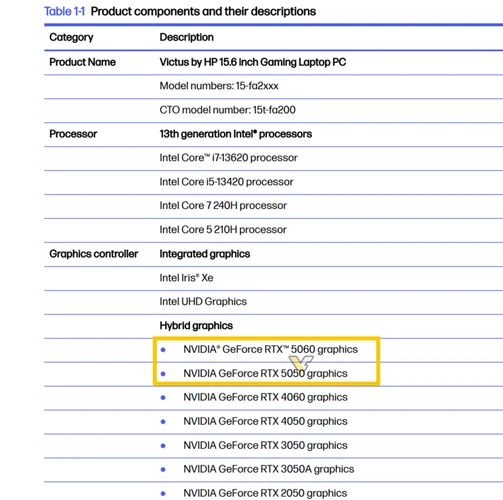
    At CES 2025, Nvidia showcased the premium models of its RTX 50 series laptop graphics cards, which included the GeForce RTX 5090, RTX 5080, RTX 5070 Ti, and RTX 5070. This leaves the possibility for the RTX 5060 Ti, RTX 5060, and RTX 5050 to follow. While the first is not yet confirmed, Videocardz has found the other models listed on HP’s website.

    Potential HP Gaming Laptops

    The RTX 5060 and RTX 5050 are expected to be featured in one of HP’s Victus 16 gaming laptops. These graphics cards will be combined with both current and previous-generation Raptor Lake processors like the Core 7 240H, Core 5 230H, Core i7-13620H, and Core i5-13420H. Notably, there are no AMD models mentioned at all. Some configurations may also pair these CPUs with older GeForce GPUs, such as the RTX 4050, RTX 3050 A, and RTX 2050.

    Specs Still Unknown

    Sadly, the listing does not provide any specifications for either the RTX 5060 or RTX 5050. Based on the Ada Lovelace architecture, it is likely that both cards will feature 8 GB of VRAM. There are rumors suggesting that one or both of these models might opt for GDDR6 memory instead of the more expensive GDDR7 to save costs. Regardless, it may take some time before they are available, as Nvidia has not yet rolled out the high-end RTX 50 laptop models, reportedly due to performance setbacks.

    Anticipated Performance

    In terms of performance, the RTX 5060 and RTX 5050 might not deliver a significant generational improvement. Their performance will largely be influenced by how much power the OEM allocates to the GPU. However, Nvidia’s extensive range of software features, including DLSS 4.0 and multi-frame generation, should enable gamers to play most games smoothly, especially at 1080p resolution.

    Source:
    Link