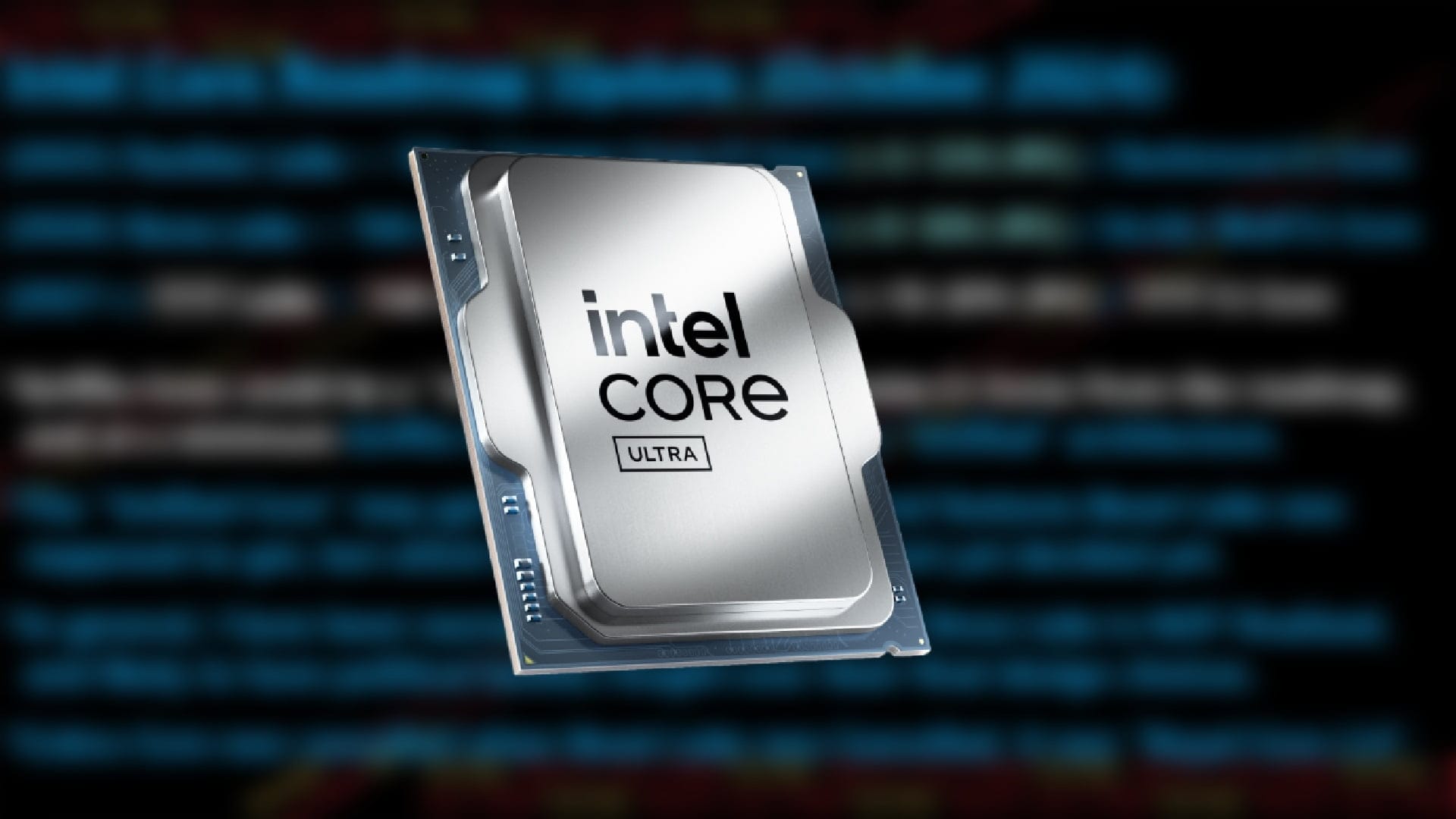
Tag: Nova Lake

  • Intel Desktop & Laptop CPU Roadmap: 2nd-Gen Unified Cores Revival

    Intel Desktop & Laptop CPU Roadmap: 2nd-Gen Unified Cores Revival

    Key Takeaway

    – Intel plans a multi-architecture rollout: Nova Lake (desktop/mobile) → Razer Lake (laptop/desktop) → Titan Lake (mobile-only) → Hammer Lake (major refresh with Hyperthreading return).
    – Razer Lake will rebadge Nova Lake for non-HX/high-end desktop variants, but high-end laptop/desktop RZL-S will use new Griffin Cove P-cores; Razer Lake-AX will be a renamed Nova Lake-AX with a 32 EU Xe3P iGPU.
    – Hammer Lake is the return of Hyperthreading and introduces Thunder Hawk unified cores (big P-cores and small E-cores) with a focus on platform longevity and broad Desktop/Laptop support.


    Leaker Moore’s Law Is Dead is known for dropping information-dense reports about Intel’s future desktop and mobile CPU architectures.

    This time, MLID has shared another massive leak revolving around the Intel Nova Lake-AX/Razer Lake-AX, Titan Lake, and Hammer Lake CPUs. Intel is reportedly planning to bring back a feature that it axed on the Arrow Lake and Panther Lake CPUs. The content reads as speculative gossip, yet it keeps readers hooked with a sense of impending hardware evolution.

    Speculative timelines and rebadging hints

    While the specs for architectures that are years away should be taken with a giant grain of salt, such leaks help us determine the direction that Intel might take with its future processors. So, they are always quite exciting to go through. Following the launch of the Intel Nova Lake desktop CPUs, possibly in late 2026, Intel will allegedly release the Razer Lake CPUs for both laptops and desktops in 2027. MLID claims that low-end and mid-range Razer Lake mobile and desktop CPUs will just be rebadged Nova Lake parts with the same Coyote Cove P-cores and Arctic Wolf E-cores.

    High-end distinctions and core changes

    However, for the mobile “HX” and high-end/flagship desktop RZL-S CPUs, Intel will utilize the new Griffin Cove P-cores, keeping the Arctic Wolf E-cores unchanged. Finally, MLID reports that Intel has renamed Nova Lake-AX, which is the company’s AMD Halo APU competitor, to Razer Lake-AX. The part has not been canceled and will be released with Coyote Cove P-cores, Arctic Wolf E-cores, and a 32 Execution Unit Xe3P iGPU.

    Titan Lake and mobile-only trajectory

    After Razer Lake, Intel reportedly plans to put the Titan Lake CPUs on the market in 2028. However, unlike Razer Lake, Titan Lake is a purely mobile CPU architecture. There will seemingly be no Titan Lake CPUs for desktops. We have been hearing about Intel’s partnership with Nvidia, and it looks like Titan Lake Halo CPUs will use large Nvidia iGPUs. These Halo products will rely on Razer Lake CPU dies with the same P and E cores.

    Copper Shark cores and unified design

    For the low-end U, P, and PX series Titan Lake laptop processors, Titan Lake chips will rely on Copper Shark CPU cores. These Copper Shark CPU cores are expected to be Intel’s first-gen “Unified Cores,” as Intel will use the same Copper Shark IP for big P and small E-cores. The strategy mirrors AMD’s Zen X and Zen Xc core designs, where the Zen Xc cores are essentially the same as the big Zen X cores but slimmed down.

    Hammer Lake: a return to multithreading

    MLID reports that Hammer Lake is Intel’s next major architecture refresh for both desktops and laptops after Razer Lake. More importantly, Hammer Lake is where Intel is seemingly bringing back Simultaneous Multithreading or Hyperthreading. This is a feature that Intel ditched starting with the mobile Lunar Lake processors. The upcoming Nova Lake desktop CPUs will also lack Hyperthreading.

    Thunder Hawk cores and platform longevity

    Furthermore, the Hammer Lake CPUs will reportedly feature the 2nd-gen Unified Cores titled Thunder Hawk. Intel will use these Thunder Hawk cores for both the big P and small E-cores, but MLID suggests that most Hammer Lake CPUs will rely exclusively on big P-cores. Finally, Intel might finally give Team Blue customers a taste of the platform longevity that AMD customers have enjoyed for a while now. MLID suggests that Nova Lake, Razer Lake, and Hammer Lake all share the same desktop socket design.

    Sources
  • Intel Acknowledges Arrow Lake Issues, Optimistic About Nova Lake SKUs

    Intel Acknowledges Arrow Lake Issues, Optimistic About Nova Lake SKUs

    Key Takeaways

    1. Intel has faced leadership changes and significant layoffs due to poor performance in recent years.
    2. The Meteor Lake processors showed only slight performance gains over Raptor Lake, with Arrow Lake expected to have similar results.
    3. Intel’s CFO admitted the company has struggled in the high-performance desktop market, particularly with Arrow Lake.
    4. Nova Lake is the upcoming generation of desktop CPUs, expected to offer improved performance and a wider range of SKUs for the high-end market.
    5. Intel remains optimistic about Nova Lake’s potential to enhance competitiveness, with a planned release next year.


    Intel has been undergoing significant changes with new leadership and considerable layoffs due to its poor performance in recent years. The Meteor Lake processors released in 2023 provided only slight performance gains compared to Raptor Lake, and the upcoming Arrow Lake, set for 2024, appears to follow suit. The company has acknowledged its shortcomings, particularly with Arrow Lake, but remains optimistic about its upcoming generation of desktop CPUs.

    Acknowledgment of Shortcomings

    In a report from Wccftech referencing a Deutsche Bank 2025 Technology Conference call, Intel’s CFO David Zinsner confessed that the company has struggled in the desktop market with Arrow Lake, failing to compete effectively. He stated:

    “As you know, we kind of fumbled the football on the desktop side, particularly high performance desktop side. So we’re as you kind of look at share on a dollar basis versus a unit basis, we don’t perform as well and it’s mostly because of this high end desktop business that we didn’t have a good offering this year.”

    Future Plans with Nova Lake

    Zinsner then mentioned Nova Lake, the forthcoming generation of desktop CPUs, indicating that it would offer a more comprehensive range of SKUs targeting the high-end desktop segment. The company is hopeful that Nova Lake will enhance its competitive stance in the market next year.

    Nova Lake is expected to deliver significant performance enhancements over both Arrow Lake and Arrow Lake Refresh. These CPUs are likely to incorporate the new Coyote Cove P-cores and Arctic Wolf E-cores. It remains uncertain whether they will utilize TSMC’s 2nm or Intel’s 18A-P manufacturing process. The processors will adopt the Core Ultra 400 naming scheme, with the top-tier model rumored to feature 52 cores—16 P-cores, 32 E-cores, and 4 LP island E-cores with a 150 W TDP. Additionally, some models may include 3D V-cache, similar to AMD’s X3D series.

    Optimism for the Future

    In summary, Intel’s Nova Lake series is poised to be a more substantial upgrade compared to the previous couple of generations. The CPUs seem to be on schedule for release next year, although a specific launch date has not yet been announced.

    Source:
    Link


  • Intel Panther Lake CPU Profitability Hit by Low 18A Yields

    Intel Panther Lake CPU Profitability Hit by Low 18A Yields

    Key Takeaways

    1. Intel’s Panther Lake laptop processors have no confirmed launch date, with speculation ranging from early 2026 to sooner.
    2. Intel is facing yield challenges, potentially selling chips at lower profit margins or losses due to poor production yields.
    3. The die size of Panther Lake chips is approximately 274.2 mm², larger than the previous Lunar Lake size of 220 mm².
    4. Production hurdles include yields reported at only 10%, significantly below the desired 50% for break-even, leading to high defect rates.
    5. Intel’s focus is on producing Panther Lake and Clearwater Forest chips while preparing for future Nova Lake desktop chips using TSMC’s advanced 2 nm node.


    Despite managing to power on, Intel’s new laptop processors that are built on the Panther Lake design still do not have a clear launch date. Some believe it could happen as soon as early 2026, while others think it might be sooner. However, Intel has remained quiet about the situation, making it difficult to know for sure. A recent report is trying to clarify what’s happening with Panther Lake.

    Yield Challenges

    Insiders informed Reuters that “Intel may have to sell some chips at a lower profit margin or at a loss,” suggesting that the situation with Intel 18A’s yield has not improved much. Yield figures are not very informative without knowing the die size, but a previous leak indicated that the die size would be around 274.2 mm², which is slightly larger than the Lunar Lake’s size of approximately 220 mm².

    Production Hurdles

    The report also mentions that Intel was hoping to achieve 50% yields at some point to break even, but if they are selling chips at a loss, this clearly hasn’t been achieved. Allegedly, “Panther Lake chips had about three times too many defects for Intel to start high-volume production.” Yields were reported to be at 10%, a claim that was also made in an earlier report, which Intel strongly refuted.

    Future Prospects

    With Intel 18A effectively limited to new external clients, its main goal is to successfully produce enough Panther Lake and Clearwater Forest chips. The upcoming Nova Lake desktop chips will utilize TSMC’s advanced 2 nm node for the CPU tile and various suppliers for other parts. This will also prepare the way for the next-generation 18A-P and the future 14A, marking Intel’s significant return to the foundry sector.

    Source:
    Link


  • Intel Titan Lake 2028: No More P-Cores, All-E-Core Design

    Intel Titan Lake 2028: No More P-Cores, All-E-Core Design

    Key Takeaways

    1. Intel plans to launch the Titan Lake series in 2028, featuring an impressive 100-core design focused on a single-core architecture based entirely on E-cores.

    2. The Razer Lake series, arriving in 2027, will be the last to use a mixed architecture of P-cores and E-cores, leading to a shift in Intel’s core design philosophy.

    3. Titan Lake’s all-E-core setup may include variations like dense 4C clusters and 2C clusters, optimizing performance-per-area (PPA) and performance-per-Watt (PPW).

    4. Nova Lake is expected to have a mixed core setup with 52 cores, while Titan Lake could potentially consist of two 48-core clusters and four low-power E-cores (LPE).

    5. The trend in the CPU/SoC market is shifting towards unified core designs, as seen with competitors like AMD and Qualcomm, which could influence Intel’s future architectures.


    Rumors about Intel’s future Nova Lake and Panther Lake architectures have started to emerge, and new information regarding the company’s plans for 2028 is also coming to light.

    Titan Lake’s Exciting Features

    If the whispers are correct, Intel is set to launch the Titan Lake series in 2028 featuring an astonishing…100 cores! Yes, you heard that right—one hundred cores! Unlike the current designs that use both P-cores and E-cores, Intel seems to be shifting towards a single-core architecture for this new lineup.

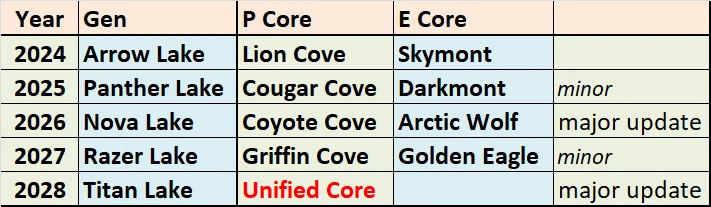
    This scoop comes from @Silicon_fly on X, referencing a leaked roadmap found on Zhihu.com that outlines Intel’s processor plans through 2028. The roadmap indicates that Razer Lake, arriving in 2027, will be the last to utilize the mixed P-core and E-core setup. Razer Lake will include Griffin Cove P-cores and Golden Eagle E-cores, serving as a small upgrade to Nova Lake, which is expected to launch next year.

    A New Direction for Core Design

    With the Titan Lake series, Intel appears to be moving towards an all-unified core design. Interestingly, the new cores will not include P-cores; rather, they will be entirely based on E-cores, likely evolved from the larger Arctic Wolf E-cores found in Nova Lake. This change could lead to improved performance-per-area (PPA) and performance-per-Watt (PPW).

    Any increase in die size and power consumption from using Arctic Wolf E-cores can be balanced out by enhanced PPA achieved through switching to a 14A process, without significantly raising the thermal design power (TDP). However, the new unified E-cores would still be more compact than the Coyote Cove and Griffin Cove P-cores used in Nova Lake and Razer Lake, respectively.

    Potential Variations in Core Clusters

    Although a unified core suggests an all-E-core setup, there could still be some differences within the architecture. @Silicon_fly theorizes that Intel might implement a mix of dense 4C clusters with shared L2 caches and 2C clusters that either share or have dedicated L2/L3 caches. Additionally, Titan Lake might incorporate a specialized core aimed at enhancing single-core performance.

    Given that Nova Lake is projected to have a 52-core setup featuring 16 P-cores, 32 E-cores, and 4 low-power E-cores (LPE), if Titan Lake truly abandons the large P-cores, it’s conceivable to see a 100-core design consisting of two 48-core clusters along with four LPE cores.

    All this remains speculative, of course, and there are still several generations to go before Titan Lake becomes a reality, so it’s wise to take this information lightly for now.

    Still, the details align with the current trends we observe in the CPU/SoC market. AMD has already adopted a mix of Zen 5 classic and Zen 5c compact cores in its Ryzen Strix Point APUs. MediaTek has shifted to an all-big core design, starting with the Dimensity 8400, which features a 1+3+4 configuration without efficiency cores. The flagship Dimensity 9400 SoC also utilizes a big core cluster in a similar fashion.

    Furthermore, Qualcomm has opted for a 2 Prime + 6 Performance all-Oryon architecture for its Snapdragon 8 Elite. It remains uncertain what Apple has planned for its upcoming A and M series chips, but the industry seems to be leaning more towards unified core clusters designed for various tasks rather than mixed architectures.

    Source:
    link


  • Intel Nova Lake Core Ultra 400: 10% Faster Single-Thread, 60% More Multi-Thread Performance

    Intel Nova Lake Core Ultra 400: 10% Faster Single-Thread, 60% More Multi-Thread Performance

    Key Takeaways

    1. Nova Lake Core Ultra 400 series will replace Arrow Lake-S and Arrow Lake-S Refresh processors, launching in 2026 with expected performance improvements.
    2. Leaks suggest a potential 10% boost in single-core performance and a 1.6x enhancement in multi-threaded performance for Nova Lake compared to Arrow Lake-S.
    3. Nova Lake may introduce a new low-power island feature, absent in previous Arrow Lake models, aiming for better energy efficiency.
    4. Speculation surrounds the inclusion of a large Last Line Cache in some Nova Lake models, but details remain unclear, warranting caution.
    5. Nova Lake is rumored to feature a flagship model with 16 P-cores and 32 E-cores, potentially reaching up to 52 cores, but comparisons with Arrow Lake-S may be misleading without further information.


    Intel’s upcoming Nova Lake Core Ultra 400 series is set to replace the existing Arrow Lake-S and the soon-to-be-released Arrow Lake-S Refresh desktop processors. Although Nova Lake won’t be available until 2026, early leaks suggest it will offer significant performance improvements compared to Arrow Lake-S.

    Performance Gains Expected

    A post from Game.Keeps.Loading (@G_melo_ding) on X claims that Nova Lake might provide as much as a 10% boost in single-core performance when compared to Arrow Lake. This enhancement is likely to result in better gaming experiences and improved responsiveness for single-threaded tasks. According to the leaked information, Nova Lake is touted to achieve “Leadership Gaming Performance,” boasting a 1.1x improvement in single-thread performance and a 1.6x enhancement in multi-threaded performance.

    Previous Concerns with Arrow Lake-S

    Our evaluation of the Arrow Lake-S Core Ultra 9 285K revealed some performance drops during gaming, despite standalone CPU benchmarks performing well. Intel did announce several Field Updates during CES 2025 to enhance gaming capabilities, but the actual improvements vary based on the specific game. It’s to be hoped that Nova Lake-S avoids facing such issues.

    New Low-Power Island on the Horizon

    Additionally, there’s news about a new low-power island being developed. Notably, Nova Lake could be the first desktop CPU to include this feature. While Arrow Lake-S and Arrow Lake-HX do not have low-power islands, the Arrow Lake-H does feature two low-power E-cores in its SoC tile. However, it’s unclear if these low-power cores are based on the new Skymont design or if they are simply modified Crestmont cores from Meteor Lake.

    From the information available, Nova Lake is anticipated to launch with fresh Coyote Cove P-cores and Arctic Wolf E-cores. It’s still uncertain whether they will utilize TSMC’s 2 nm process or Intel’s 18A-P technology. The Nova Lake-S series is rumored to include a flagship model, the Core Ultra 9 485K, featuring 16 P-cores, 32 E-cores, and 4 low-power island E-cores, all with a TDP of 150 W. We might also see a combination of Celestial and Druid integrated GPUs within the same SoC.

    Speculations and Cautions

    There is speculation that some Core Ultra 5 Nova Lake-S models will come equipped with a large Last Line Cache or bLLC, similar to AMD’s successful 3D V-cache. However, this rumor should be viewed with skepticism, as the leak lacks specific details on which CPU generation is being compared. If it is indeed against Arrow Lake-S, the single-core performance gains might not be as appealing, particularly since Nova Lake is still a year away from release.

    An Arrow Lake-S Refresh expected later this year might close the performance gap with the current Arrow Lake-S models. Moreover, we still lack information on clock speeds, making any claims of performance improvements quite vague.

    A 1.6x or 60% increase in multi-core capabilities sounds promising compared to Arrow Lake-S processors. However, Arrow Lake-S tops out at 24 cores in the Core Ultra 9 285K, while Nova Lake might feature a massive 52-core design, making the comparison somewhat unclear at this stage.

    There’s a chance that the performance figures mentioned in the leaked slide are based on a lower-tier Core Ultra 400 model. We should gain more insights in the upcoming months, so keep an eye out for further updates.

    Source:
    Link


  • Intel Nova Lake Core Count and TDP Details Leaked

    Intel Nova Lake Core Count and TDP Details Leaked

    Key Takeaways

    1. Intel’s Core Ultra 400 Nova Lake processors will focus on increasing core count to enhance multicore performance, with hyperthreading largely removed.
    2. The Core Ultra 9 processor is expected to feature a high core count and improved performance with new Coyote Cove P-cores and Arctic Wolf E-cores.
    3. Anticipated IPC (Instructions Per Cycle) increase of 20-40% compared to the previous Arrow Lake generation.
    4. Nova Lake processors are projected for release in 2026, with potential X3D-like models incorporating additional L3 cache.
    5. The Nova Lake CPU tile is likely to be manufactured using TSMC’s N2 node instead of Intel’s own advanced 18A/18AP process.


    Earlier predictions suggested that Intel would significantly boost the core count in its Core Ultra 400 Nova Lake processors. With hyperthreading largely removed, increasing the number of cores is the main way to enhance multicore performance in the new chips. A reliable leaker, @g01d3nm4ng0, has now disclosed the core counts for each CPU model.

    Tentative CPU Names

    The CPU names mentioned above are provisional and may be altered by the time they launch. However, the Core Ultra 9 processor is expected to stand out due to its massive core count. Moreover, its new Coyote Cove P-cores and Arctic Wolf E-cores are anticipated to deliver an IPC increase of around 20-40% compared to Arrow Lake. Additionally, the integrated GPU will combine elements from Celestial and Druid designs.

    A Long Wait Ahead

    Regardless, it’ll take some time before we get definitive details, as Nova Lake is not expected to be available until 2026. Still, the anticipation might be justified since Intel could introduce X3D-like models by pairing a CPU tile with additional L3 cache through Foveros 3D packaging technology. Lastly, it is widely believed that the Nova Lake CPU tile will be produced using TSMC’s N2 node rather than Intel’s advanced 18A/18AP process.

    Source:
    Link

  • Intel Nova Lake Desktop CPUs Rumored to Feature Up to 52 Cores

    Intel Nova Lake Desktop CPUs Rumored to Feature Up to 52 Cores

    Intel is planning to launch its next series of desktop CPUs, known as ‘Nova Lake’, in 2026, though there are many speculations regarding their specifications. Recent leaks suggest that one configuration could feature a whopping 52 cores, which is more than twice that of the previous models. Right now, not much is known about the Nova Lake CPUs or the Arrow Lake Refresh, which might not follow the expected trends.

    Configuration Insights

    A popular leaker, using the handle @Jaykihn, responded to an earlier leak on X that outlined potential configurations for the four anticipated Nova Lake CPUs. The initial report mentioned 48 cores, consisting of 16 Performance cores (P cores) and 32 Efficient cores (E cores) for the Nova Lake S CPU. However, Jaykihn revealed that there are also 4 Low-power Efficiency cores (LP E cores) included in this setup, bringing the total to 52 cores. Likewise, the Nova Lake HX CPU is rumored to have 28 cores rather than the previously thought 24, and the Nova Lake H CPU might come with 16 cores instead of only 12.

    Core Specifications

    In addition, the leaker has confirmed that these CPUs will include Coyote Cove P cores and Arctic Wolf E/LP E cores. It is anticipated that the Nova Lake series will be part of Intel’s Core Ultra 400 series, while the Arrow Lake Refresh will likely offer Core Ultra 300 series processors.

    Earlier, it was thought that Intel would increase the number of E cores to 32 for an Arrow Lake Refresh SKU, which, along with 8 Lion Cove P cores, would mean a total of 40 cores. However, another well-known leaker recently dismissed this rumor on the Chinese platform Weibo, suggesting that Intel may only enhance the NPU aspect of the chip.

    Unofficial Speculations

    As highlighted before, these are merely speculations, and there is no confirmed information about the configurations or how many SKUs will be available for Nova Lake or Arrow Lake Refresh processors.

    Source:
    Link

  • Intel Nova Lake CPUs: Up to 16 P-Cores & 32 E-Cores Rumored

    Intel Nova Lake CPUs: Up to 16 P-Cores & 32 E-Cores Rumored

    The new Arrow Lake Core Ultra 200 desktop CPUs have yet to persuade gamers to upgrade from the older i9-14900K models. The latest architecture fails to show any meaningful performance improvements, despite several months of software updates. It appears Arrow Lake is merely setting the stage for future innovations, particularly Nova Lake, which is anticipated in 2026.

    Speculation on Nova Lake’s Architecture

    Intel has not revealed any specifications for Nova Lake in their recent quarterly earnings report. However, co-CEO Michelle Johnston Holthaus let slip that “Nova Lake will actually have die both inside and outside for that process. So you’ll actually see compute tiles inside and outside.” This revelation sparked a flurry of speculation on Reddit about potential core counts for the upcoming generation of chips.

    Core Configurations and Variants

    According to a now-deleted post by Exist50 on Reddit, the premium Nova Lake desktop CPUs might include up to 2×8 Coyote Cove P-cores and 2×16 Arctic Wolf E-cores, aligning with the concept of dual compute tiles mentioned by Intel’s co-CEO. Additionally, Exist50 mentioned that there will be high-performance mobile Nova Lake variants with configurations of 8P + 16E cores, as well as mid-range desktop and mobile options featuring just 4P + 8E cores. There will also be ultra-low-voltage (ULV) versions that only have 4 P-cores without any E-cores.

    Future iGPU Tile and Production Nodes

    The specifics of the iGPU tile for Nova Lake remain ambiguous. However, it is confirmed that these chips will be manufactured using Intel’s 18A nodes, similar to the Panther Lake mobile processors set to launch in late 2025.

    Source:
    Link

  • Griffin Cove and Nova Lake IPC: Intel to Replace E-Cores with P-Cores

    Griffin Cove and Nova Lake IPC: Intel to Replace E-Cores with P-Cores

    Intel’s CPU plans appear to be ever-changing, based on the latest leaks. So far, it’s been revealed that Intel has scrapped Beast Lake, Beast Lake Next, and has also disbanded Jim Keller’s Royal Core initiative. Moreover, there are reports suggesting that Team Blue could launch Panther Lake desktop chips to compete against AMD’s Zen 6 by 2025.

    Future Innovations

    In a recent update regarding IPC metrics for Nova Lake, Moore’s Law Is Dead indicates that Intel might be developing a groundbreaking CPU architecture set to debut in 2027 or later. The source mentions that Intel is working on Griffin Cove P-cores for a yet-to-be-named architecture expected to arrive in 2027 or beyond. These P-cores might utilize the Intel 14A-P, which is an upgrade of the Intel 14A technology anticipated to commence production in 2026.

    Design Changes Ahead

    Interestingly, MLID suggests that Intel could adopt a “Unified Core” approach for E-cores, mirroring AMD’s strategy. The upcoming CPUs based on Griffin Cove or Griffin-Next might eliminate the distinction between P and E-cores, taking inspiration from Zen 5 and Zen 5c cores. Unlike Intel’s separate P and E-cores, the Zen 5 series features similar architecture with minor changes in the Zen 5c for size reduction. Intel seems to be planning to implement a similar design for its 2027 architecture, moving away from the two distinct core types within a single CPU.

    Performance Expectations

    On the performance front, MLID speculates that the Griffin Cove P-cores could see a 10-20% IPC increase compared to Nova Lake and its Coyote Cove P-cores. However, since Griffin Cove is still quite a ways off, any talk of “IPC enhancement” should be approached with skepticism. MLID is aware of this uncertainty and cautions in their video that “anything after Nova Lake is NOT finalized”.

    In addition, MLID claims a potential IPC boost of 9 to 18% for the Coyote Cove P-cores in Nova Lake, although no numbers are provided for the Arctic Wolf E-cores. The leaker further suggests that Nova Lake might implement the refreshed Intel 18A-P process instead of the previously rumored 14A and TSMC 2 nm.

    As we move forward, it remains to be seen what Intel has planned with Nova Lake. In the meantime, we can look forward to the reviews of the Arrow Lake Core Ultra 200 CPUs, which should roll out in the coming years. The end of 2024 is shaping up to be an exciting period for gamers, especially since AMD has announced that the Ryzen 9000X3D will launch next month.

    Moore’s Law Is Dead on YouTube, Teaser image: Intel, Moore’s Law Is Dead, edited.


    Image 1