Tag: Titan Lake

  • Intel Desktop & Laptop CPU Roadmap: 2nd-Gen Unified Cores Revival

    Intel Desktop & Laptop CPU Roadmap: 2nd-Gen Unified Cores Revival

    Key Takeaway

    – Intel plans a multi-architecture rollout: Nova Lake (desktop/mobile) → Razer Lake (laptop/desktop) → Titan Lake (mobile-only) → Hammer Lake (major refresh with Hyperthreading return).
    – Razer Lake will rebadge Nova Lake for non-HX/high-end desktop variants, but high-end laptop/desktop RZL-S will use new Griffin Cove P-cores; Razer Lake-AX will be a renamed Nova Lake-AX with a 32 EU Xe3P iGPU.
    – Hammer Lake is the return of Hyperthreading and introduces Thunder Hawk unified cores (big P-cores and small E-cores) with a focus on platform longevity and broad Desktop/Laptop support.


    Leaker Moore’s Law Is Dead is known for dropping information-dense reports about Intel’s future desktop and mobile CPU architectures.

    This time, MLID has shared another massive leak revolving around the Intel Nova Lake-AX/Razer Lake-AX, Titan Lake, and Hammer Lake CPUs. Intel is reportedly planning to bring back a feature that it axed on the Arrow Lake and Panther Lake CPUs. The content reads as speculative gossip, yet it keeps readers hooked with a sense of impending hardware evolution.

    Speculative timelines and rebadging hints

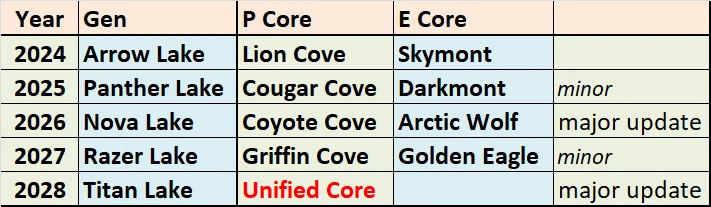
    While the specs for architectures that are years away should be taken with a giant grain of salt, such leaks help us determine the direction that Intel might take with its future processors. So, they are always quite exciting to go through. Following the launch of the Intel Nova Lake desktop CPUs, possibly in late 2026, Intel will allegedly release the Razer Lake CPUs for both laptops and desktops in 2027. MLID claims that low-end and mid-range Razer Lake mobile and desktop CPUs will just be rebadged Nova Lake parts with the same Coyote Cove P-cores and Arctic Wolf E-cores.

    High-end distinctions and core changes

    However, for the mobile “HX” and high-end/flagship desktop RZL-S CPUs, Intel will utilize the new Griffin Cove P-cores, keeping the Arctic Wolf E-cores unchanged. Finally, MLID reports that Intel has renamed Nova Lake-AX, which is the company’s AMD Halo APU competitor, to Razer Lake-AX. The part has not been canceled and will be released with Coyote Cove P-cores, Arctic Wolf E-cores, and a 32 Execution Unit Xe3P iGPU.

    Titan Lake and mobile-only trajectory

    After Razer Lake, Intel reportedly plans to put the Titan Lake CPUs on the market in 2028. However, unlike Razer Lake, Titan Lake is a purely mobile CPU architecture. There will seemingly be no Titan Lake CPUs for desktops. We have been hearing about Intel’s partnership with Nvidia, and it looks like Titan Lake Halo CPUs will use large Nvidia iGPUs. These Halo products will rely on Razer Lake CPU dies with the same P and E cores.

    Copper Shark cores and unified design

    For the low-end U, P, and PX series Titan Lake laptop processors, Titan Lake chips will rely on Copper Shark CPU cores. These Copper Shark CPU cores are expected to be Intel’s first-gen “Unified Cores,” as Intel will use the same Copper Shark IP for big P and small E-cores. The strategy mirrors AMD’s Zen X and Zen Xc core designs, where the Zen Xc cores are essentially the same as the big Zen X cores but slimmed down.

    Hammer Lake: a return to multithreading

    MLID reports that Hammer Lake is Intel’s next major architecture refresh for both desktops and laptops after Razer Lake. More importantly, Hammer Lake is where Intel is seemingly bringing back Simultaneous Multithreading or Hyperthreading. This is a feature that Intel ditched starting with the mobile Lunar Lake processors. The upcoming Nova Lake desktop CPUs will also lack Hyperthreading.

    Thunder Hawk cores and platform longevity

    Furthermore, the Hammer Lake CPUs will reportedly feature the 2nd-gen Unified Cores titled Thunder Hawk. Intel will use these Thunder Hawk cores for both the big P and small E-cores, but MLID suggests that most Hammer Lake CPUs will rely exclusively on big P-cores. Finally, Intel might finally give Team Blue customers a taste of the platform longevity that AMD customers have enjoyed for a while now. MLID suggests that Nova Lake, Razer Lake, and Hammer Lake all share the same desktop socket design.
    Sources
  • Intel x Nvidia Serpent Lake Leaks: Strix Halo Rival with RTX iGPU

    Intel x Nvidia Serpent Lake Leaks: Strix Halo Rival with RTX iGPU

    Key Takeaways

    1. Intel and Nvidia are collaborating on Hammer Lake APUs, combining Intel’s CPU chiplets with Nvidia’s RTX GPU chiplets for enhanced iGPU performance.
    2. Hammer Lake may be Intel’s first architecture to feature a “Unified Core” design, aiming for high performance metrics.
    3. Nvidia RTX iGPUs are not expected for Hammer Lake; those will debut with Intel’s Serpent Lake, which targets AMD’s Strix Halo APUs.
    4. Serpent Lake will use Titan Lake architecture and could support 16X LPDDR6 memory, with Nvidia’s RTX Rubin GPU architecture for integrated graphics.
    5. Intel’s partnership with Nvidia generates excitement for future products, including Intel Panther Lake chips and potential advancements in lightweight laptops and gaming consoles.


    In September 2025, it was noted that Intel and Nvidia seemed to be collaborating on Hammer Lake APUs for both desktops and laptops. These APUs are projected to incorporate Intel’s CPU chiplets alongside Nvidia’s RTX GPU chiplets, aiming for exceptional iGPU performance. A recent leak from RedGamingTech indicates that Hammer Lake might be the inaugural Intel CPU architecture to host a “Unified Core” design, which sets ambitious performance targets.

    Lack of Nvidia RTX iGPUs

    However, RGT does not mention any potential Nvidia RTX iGPUs for the Intel Hammer Lake. Instead, powerful RTX iGPUs are said to be launched with Intel’s Serpent Lake. This new series is described as Intel’s counter to AMD’s Strix Halo and Zen 6 Medusa Halo APUs, suggesting that Serpent Lake chips will include a robust CPU along with an even better Nvidia RTX GPU chiplet.

    CPU and GPU Details

    For the CPU, Intel is reportedly going to utilize the Titan Lake architecture, improved with Griffin Cove P-cores and Golden Eagle E-cores. The SoC tile, which contains the LP E-cores, might also rely on technologies from Intel Titan Lake.

    As for the GPU chiplet, Intel is said to be teaming up with Nvidia to implement the RTX Rubin GPU architecture, or something very similar, for the integrated graphics. The iGPU may be constructed on the TSMC N3P process node, which is anticipated.

    Memory and Future Expectations

    Furthermore, the leaker points out that the Serpent Lake APUs could also support 16X LPDDR6 memory.

    Lastly, RGT mentions that the collaboration between Intel and Nvidia on Serpent Lake appears to resemble the previously rumored Nova Lake-AX. Although there’s been little news on Nova Lake-AX for some time, it was considered Intel’s solution to AMD Strix Halo, featuring 8 P-cores, 16 E-cores, and a substantial 384 EU Xe3P iGPU. Thus, Intel might replicate this configuration in Serpent Lake, substituting the Nova Lake P/E-cores with Titan Lake ones and the Intel Arc iGPU with an Nvidia RTX variant.

    No matter the outcome, the partnership between Intel and Nvidia has us quite thrilled. We can only hope that Intel doesn’t abandon the Arc iGPUs. The latest versions of Arc iGPUs, such as the Arc 140V, are strong contenders and fare well against AMD’s offerings. With the forthcoming launch of Intel Panther Lake chips, featuring the next-gen Arc iGPUs, we are looking forward to exciting developments in upcoming Intel-based lightweight laptops and handheld gaming consoles.

    Source:
    Link


  • Intel’s Nova Lake-AX: New Strix Halo Competitor Leaked

    Intel’s Nova Lake-AX: New Strix Halo Competitor Leaked

    Key Takeaways

    1. Intel’s roadmap reveals plans for the Titan Lake architecture featuring 100 CPU cores on a single die post-2027.
    2. The upcoming Nova Lake-AX chip aims to compete with AMD’s Strix Halo-type processors and is expected to launch around 2026-27.
    3. Nova Lake-AX will include Coyote Cove P-cores and Arctic Wolf E-cores as part of the larger Nova Lake series.
    4. Intel needs to match or exceed AMD’s specifications, with the Strix Halo offering up to 128 GB of memory and a powerful integrated GPU.
    5. There is potential for Intel to use LPDDR6 memory, and the Nova Lake-AX is anticipated to have a thermal design power of over 100 Watts.


    A new Intel roadmap has come to light, revealing its plans for post-2027, which includes the Titan Lake architecture boasting an impressive 100 CPU cores on a single die. In the meantime, a well-known leaker on X has provided insights about a more imminent product aimed at directly rivaling one of AMD’s top laptop models.

    Introducing Nova Lake-AX

    This upcoming chip, named Nova Lake-AX, is set to compete against Strix Halo-type processors. However, by the time it officially hits the market in 2026-27, the Medusa Halo will likely have already been available for some time. Sadly, Jaykihn lacks further details regarding Nova Lake-AX right now. It is expected to incorporate a combination of Coyote Cove P-cores and Arctic Wolf E-cores, as part of the larger Nova Lake series.

    Focus on GPU and Memory

    The true innovation will be seen in its GPU and memory configurations. The Strix Halo provides up to 128 GB of 256-bit memory alongside a 40 CU RDNA 3.5 integrated GPU. For Intel to compete effectively with Team Red, it needs to offer similar or even superior specs. With JEDEC’s recent certification of LPDDR6 memory, there’s a strong possibility that Intel might leverage this for a competitive edge.

    As for the integrated GPU, a 20 Xe core SKU based on Intel’s Celestial architecture seems like a reasonable expectation. Concerning thermal design power (TDP), a minimum of 100+ Watts will likely be necessary given Nova Lake-AX’s intended high-performance profile.

    Source:
    link

  • Intel Titan Lake 2028: No More P-Cores, All-E-Core Design

    Intel Titan Lake 2028: No More P-Cores, All-E-Core Design

    Key Takeaways

    1. Intel plans to launch the Titan Lake series in 2028, featuring an impressive 100-core design focused on a single-core architecture based entirely on E-cores.

    2. The Razer Lake series, arriving in 2027, will be the last to use a mixed architecture of P-cores and E-cores, leading to a shift in Intel’s core design philosophy.

    3. Titan Lake’s all-E-core setup may include variations like dense 4C clusters and 2C clusters, optimizing performance-per-area (PPA) and performance-per-Watt (PPW).

    4. Nova Lake is expected to have a mixed core setup with 52 cores, while Titan Lake could potentially consist of two 48-core clusters and four low-power E-cores (LPE).

    5. The trend in the CPU/SoC market is shifting towards unified core designs, as seen with competitors like AMD and Qualcomm, which could influence Intel’s future architectures.


    Rumors about Intel’s future Nova Lake and Panther Lake architectures have started to emerge, and new information regarding the company’s plans for 2028 is also coming to light.

    Titan Lake’s Exciting Features

    If the whispers are correct, Intel is set to launch the Titan Lake series in 2028 featuring an astonishing…100 cores! Yes, you heard that right—one hundred cores! Unlike the current designs that use both P-cores and E-cores, Intel seems to be shifting towards a single-core architecture for this new lineup.

    This scoop comes from @Silicon_fly on X, referencing a leaked roadmap found on Zhihu.com that outlines Intel’s processor plans through 2028. The roadmap indicates that Razer Lake, arriving in 2027, will be the last to utilize the mixed P-core and E-core setup. Razer Lake will include Griffin Cove P-cores and Golden Eagle E-cores, serving as a small upgrade to Nova Lake, which is expected to launch next year.

    A New Direction for Core Design

    With the Titan Lake series, Intel appears to be moving towards an all-unified core design. Interestingly, the new cores will not include P-cores; rather, they will be entirely based on E-cores, likely evolved from the larger Arctic Wolf E-cores found in Nova Lake. This change could lead to improved performance-per-area (PPA) and performance-per-Watt (PPW).

    Any increase in die size and power consumption from using Arctic Wolf E-cores can be balanced out by enhanced PPA achieved through switching to a 14A process, without significantly raising the thermal design power (TDP). However, the new unified E-cores would still be more compact than the Coyote Cove and Griffin Cove P-cores used in Nova Lake and Razer Lake, respectively.

    Potential Variations in Core Clusters

    Although a unified core suggests an all-E-core setup, there could still be some differences within the architecture. @Silicon_fly theorizes that Intel might implement a mix of dense 4C clusters with shared L2 caches and 2C clusters that either share or have dedicated L2/L3 caches. Additionally, Titan Lake might incorporate a specialized core aimed at enhancing single-core performance.

    Given that Nova Lake is projected to have a 52-core setup featuring 16 P-cores, 32 E-cores, and 4 low-power E-cores (LPE), if Titan Lake truly abandons the large P-cores, it’s conceivable to see a 100-core design consisting of two 48-core clusters along with four LPE cores.

    All this remains speculative, of course, and there are still several generations to go before Titan Lake becomes a reality, so it’s wise to take this information lightly for now.

    Still, the details align with the current trends we observe in the CPU/SoC market. AMD has already adopted a mix of Zen 5 classic and Zen 5c compact cores in its Ryzen Strix Point APUs. MediaTek has shifted to an all-big core design, starting with the Dimensity 8400, which features a 1+3+4 configuration without efficiency cores. The flagship Dimensity 9400 SoC also utilizes a big core cluster in a similar fashion.

    Furthermore, Qualcomm has opted for a 2 Prime + 6 Performance all-Oryon architecture for its Snapdragon 8 Elite. It remains uncertain what Apple has planned for its upcoming A and M series chips, but the industry seems to be leaning more towards unified core clusters designed for various tasks rather than mixed architectures.

    Source:
    link