Tag: mixed reality headset

  • Pico Project Swan SDK Leaks Visuals

    Pico Project Swan SDK Leaks Visuals

    Key Takeaway

    – First detailed leak of Pico’s Project Swan headset shows design similar to Apple Vision Pro and Samsung Galaxy XR.
    – Hardware features dual 4K Micro-OLED displays, custom “Pico Silicon” processor, and claims 12ms mixed reality latency.
    – Includes separate battery pack, side-mounted control button, hand/head tracking, and motion controllers.
    – New Pico OS 6 with Spatial Engine allows standard Android apps to run in 360-degree immersive spaces.
    – Global launch expected in late 2026, with more details at GDC 2026.


    First Look at Pico’s Project Swan Mixed Reality Headset

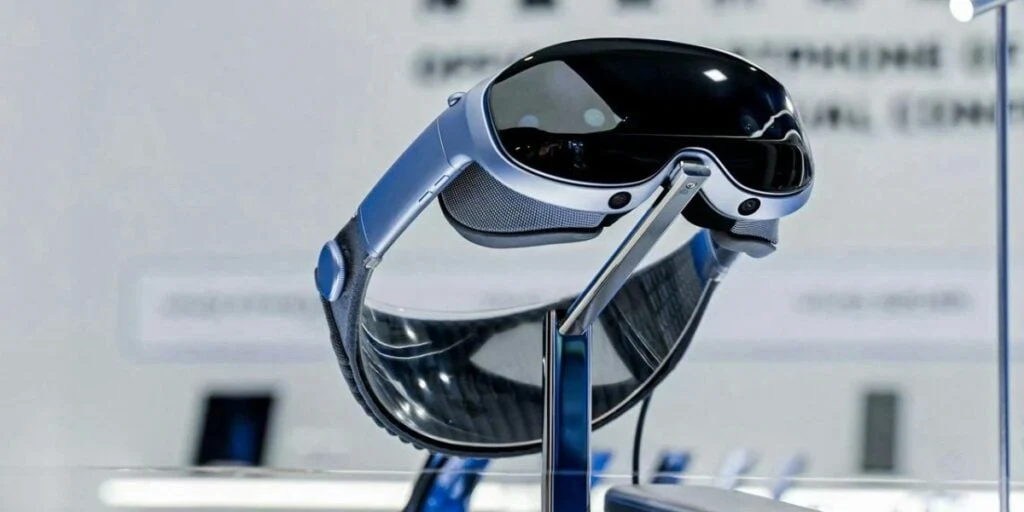
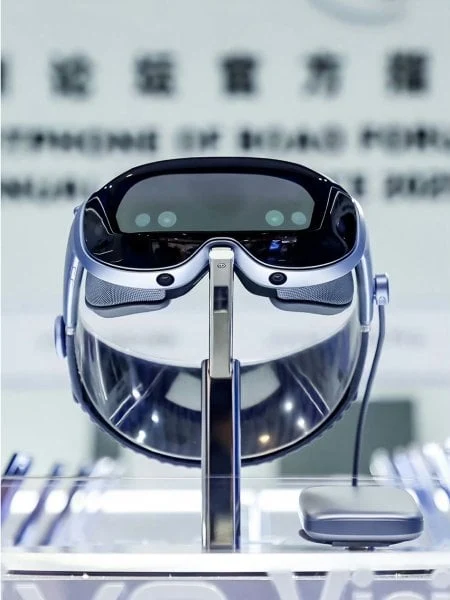
    A leaked video has offered what could be the first detailed look at Pico’s upcoming Project Swan mixed reality headset ahead of its official showcase. The footage was shared on X by user Luna (@Lunayian), who claimed it was publicly accessible via Pico’s software development kit (SDK) and that its authenticity had been independently verified. We were also able to locate visuals within the SDK that appear to match the silhouette of the individual shown in the leaked footage and the headset.

    Design and Controls

    Based on the video, Project Swan appears to borrow design elements from existing mixed reality headsets such as Apple’s Vision Pro and Samsung’s Galaxy XR. The headset features a centrally positioned side-mounted control button that appears to handle core system commands, while many interactions seem to rely on hand gestures and head tracking. The footage also showcases a separate battery pack with five LED indicators, a USB Type-C charging port, a power button, and what appears to be a detachable connection to the headset. Side-mounted speakers, detachable headband supports, multiple spatial tracking cameras, and a pair of motion controllers are also visible. The leak arrives shortly after Pico revealed additional technical details about Project Swan.

    Technical Specifications

    The headset is expected to feature dual 4K Micro-OLED displays with a pixel density approaching 4,000 pixels per inch and up to 40 pixels per degree, peaking at 45 PPD in the centre of the viewing area. Powering the device is a dual-chip architecture comprising a custom-built “Pico Silicon” processor designed for sensing, spatial computing, and image processing alongside a flagship SoC that Pico claims delivers more than twice the CPU and GPU performance of Qualcomm’s XR2 Gen 2 platform. The company also claims end-to-end mixed reality latency of just 12 milliseconds.

    Software and Launch Details

    Alongside the hardware, Pico recently unveiled Pico OS 6, which introduces a new Spatial Engine layer designed to integrate standard Android applications directly into immersive environments. Features such as PanoScreen allow users to position multiple application windows around them in a 360-degree workspace using hand gestures, controllers, keyboards, or mice for input. Project Swan is currently slated for a global launch in late 2026, with Pico expected to share additional details and live demonstrations during its GDC 2026 developer session next week.

    Sources

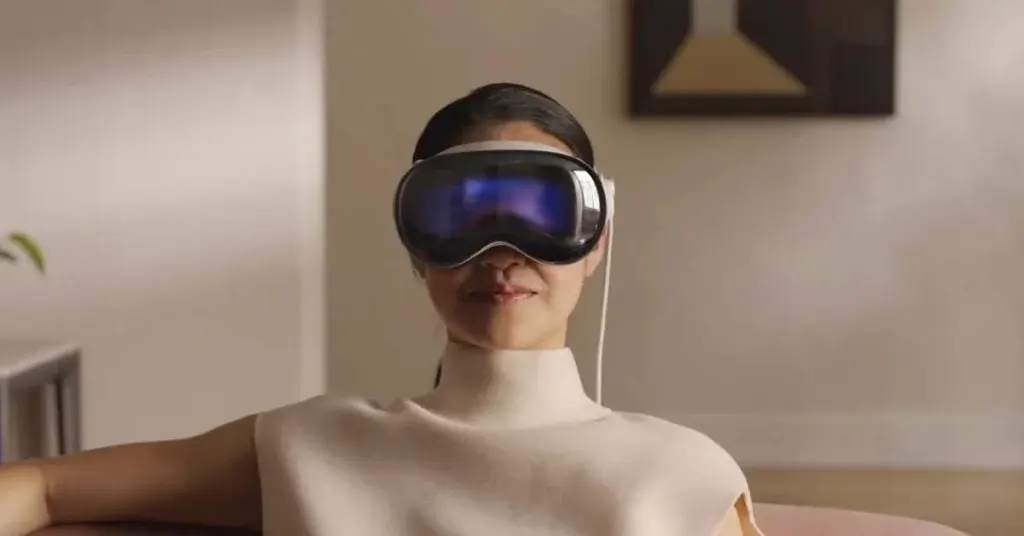
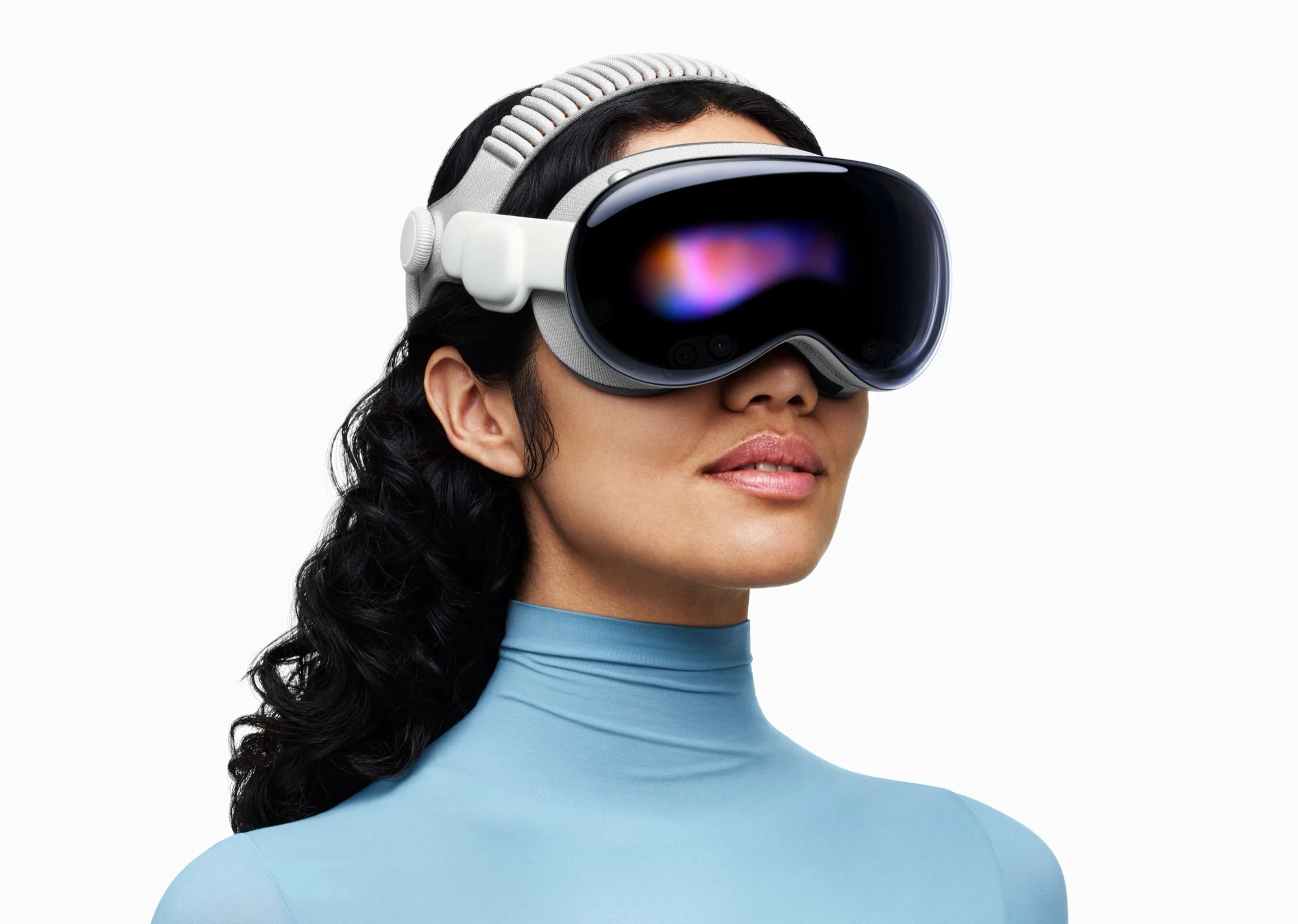
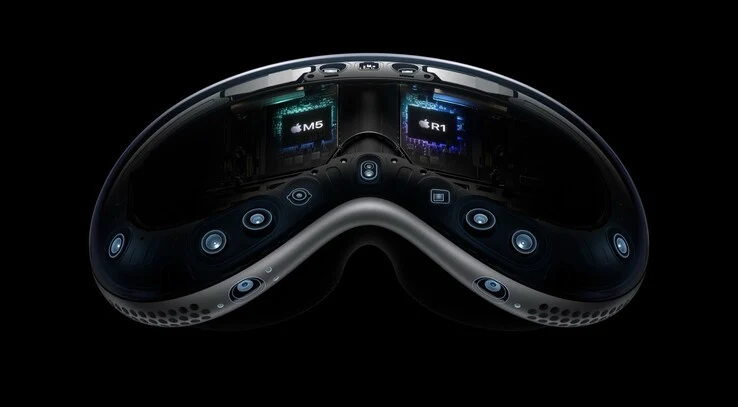
  • Apple Vision Pro Upgrade: M5 Chip, 120Hz Micro-OLED, More Comfort

    Apple Vision Pro Upgrade: M5 Chip, 120Hz Micro-OLED, More Comfort

    Key Takeaways

    1. Apple introduced an updated Vision Pro headset alongside the new 14-inch MacBook Pro and iPad Pro with the M5 chip.
    2. The new Vision Pro features improved performance and efficiency, including a 2.5-hour battery life and 10% sharper dual micro-OLED displays.
    3. The updated headset supports a refresh rate of 120Hz, up from the previous 100Hz.
    4. Users can navigate the Vision Pro with hand gestures, thanks to the R1 chip processing input from various sensors and cameras.
    5. The new Vision Pro is available for preorder, starting at €3,699 for the 256GB model and €3,899 for the 1TB version, with a comfortable knitted fabric headband included.


    Alongside the freshly unveiled 14-inch MacBook Pro and the iPad Pro powered by the innovative Apple M5 chip, the tech giant from Cupertino has revealed an updated version of the Vision Pro headset. The mixed-reality device encountered challenges in the market, primarily due to its steep price of $3,499. However, the new iteration is expected to enhance several important aspects compared to the original model.

    Improved Performance and Efficiency

    The Apple M5 offers a notable boost in performance and efficiency, which extends the battery life to 2.5 hours. With this upgrade, Apple can operate the headset’s dual micro-OLED displays at a resolution that is 10% sharper than what was offered before. Additionally, the latest version features displays boasting a refresh rate of 120Hz, a step up from the 100Hz seen in the first-generation Apple Vision Pro.

    Enhanced User Experience

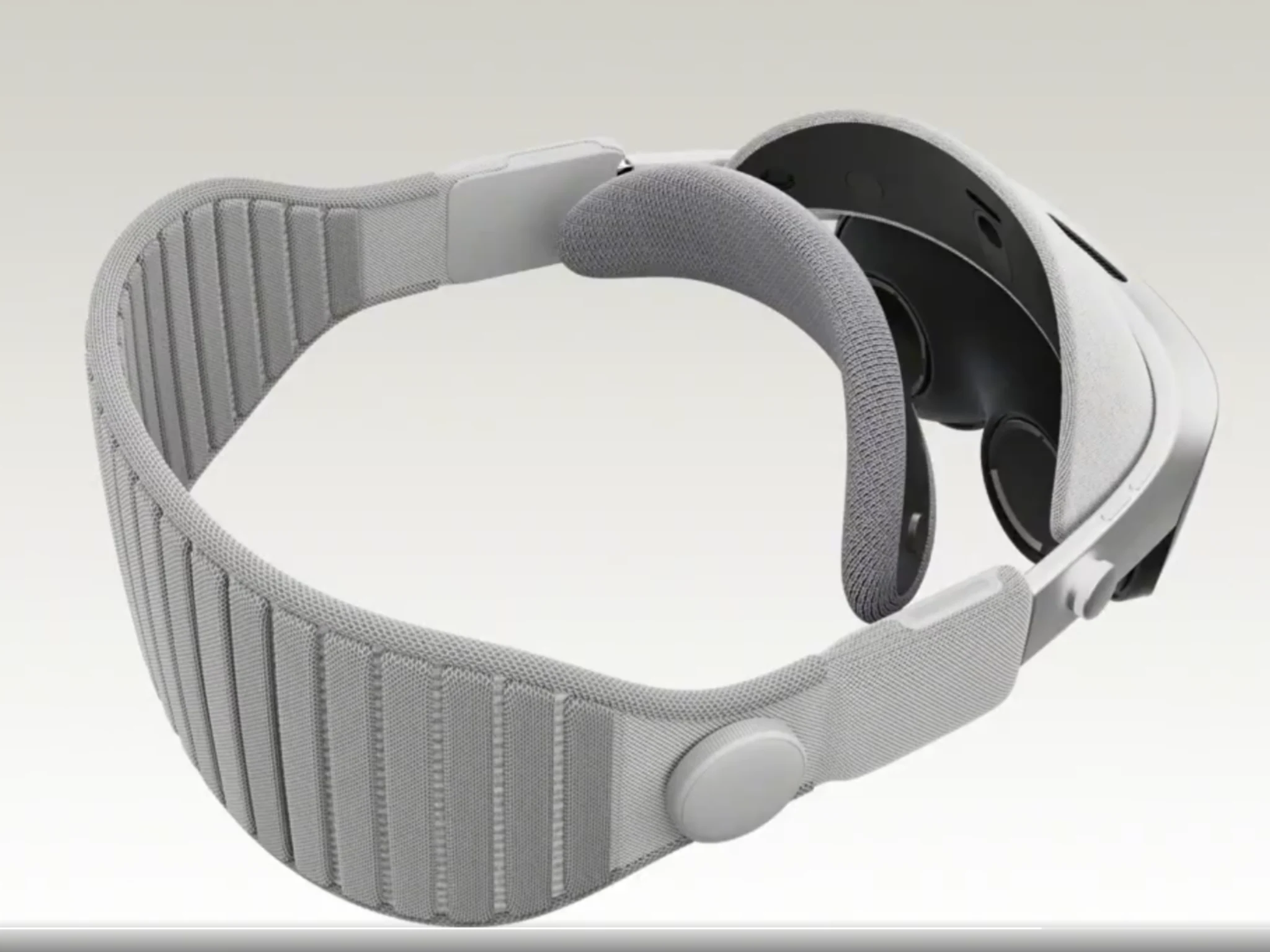
    Continuing to use the specialized R1 chip, Apple processes input from twelve cameras, five sensors, and six microphones, enabling users to navigate the Vision Pro using hand gestures. This time, Apple includes a knitted fabric headband in the packaging, designed for improved comfort. Customers can also buy this new headband separately for use with the original Vision Pro. Other than that, the set of features remains the same.

    The newly designed Apple Vision Pro, now equipped with the Apple M5 chip, is available for preorder on the official Apple Store website. The entry-level model, which comes with 256GB of storage, is priced at €3,699, while the higher-end version with 1TB storage costs €3,899. Alongside the mixed-reality headset and the new headband, the Vision Pro package also includes a battery, a 30W USB-C charger, and a polishing cloth.

    Source:
    Link


  • CheckMag: Vivo Vision MR vs Apple Vision Pro – Lighter & Cheaper

    CheckMag: Vivo Vision MR vs Apple Vision Pro – Lighter & Cheaper

    Key Takeaways

    1. Pricing Advantage: Vivo aims to offer a more affordable mixed-reality headset compared to Apple’s high-priced products, with competitors like Meta’s Quest headsets priced lower for gamers.

    2. Technical Features: Vivo’s headset boasts impressive specifications, including dual micro-OLEDs with 8K resolution, surpassing Apple’s pixel count and offering high color accuracy.

    3. Lightweight Design: Vivo’s headset is significantly lighter (14 oz) than Apple’s (21+ oz) and the Meta Quest 3 series, enhancing comfort for users during extended use.

    4. Virtual Experience Capabilities: Vivo’s headset supports immersive experiences like virtual movie viewing and 3D gaming, with features such as a large virtual display and low latency for productive applications.

    5. User-Friendly Features: The headset includes advanced tracking technology and multiple cameras for gesture control, while also providing options for glasses wearers and physical volume controls, making it accessible and convenient.


    Despite Apple’s venture into the mixed-reality arena, concepts like virtual reality, augmented reality, or what Apple dubs Spatial Computing, have yet to penetrate the mainstream market. This might be attributed to the steep starting price of Apple’s products, while Meta’s Quest headsets from Facebook are designed specifically for gamers, coming at much lower price points. Currently, the Meta Quest 3S is available for $290 on Amazon. Meanwhile, Vivo has just launched its Vivo Vision headset, which clearly draws inspiration from Apple’s design, but the Chinese firm hasn’t shared any final retail prices yet.

    Pricing and Technical Features

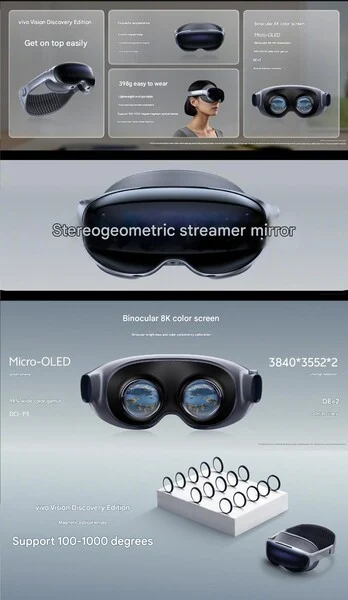
    Nevertheless, it’s evident that Vivo is aiming for a much lower entry price. They haven’t revealed all the technical specifications yet, but it is known that the dual micro-OLEDs provide an impressive combined 8K resolution, with 3840 x 3552 pixels per eye, which slightly surpasses Apple’s 3660 x 3200 pixels. Vivo claims to offer 94% coverage of the DCI-P3 color space, with Delta E < 2 color accuracy. The headset also features precise lens alignment designed to reduce discomfort. It operates on the Qualcomm Snapdragon XR2+ Gen 2 chipset.

    Weight and Design

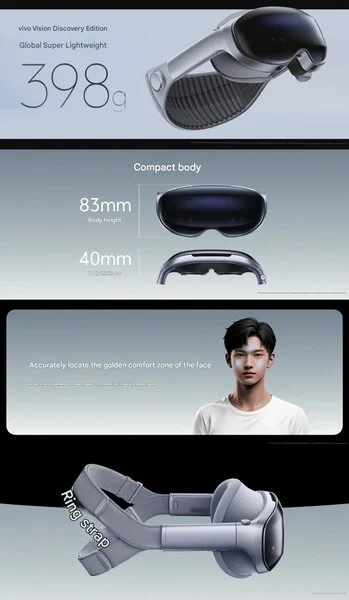
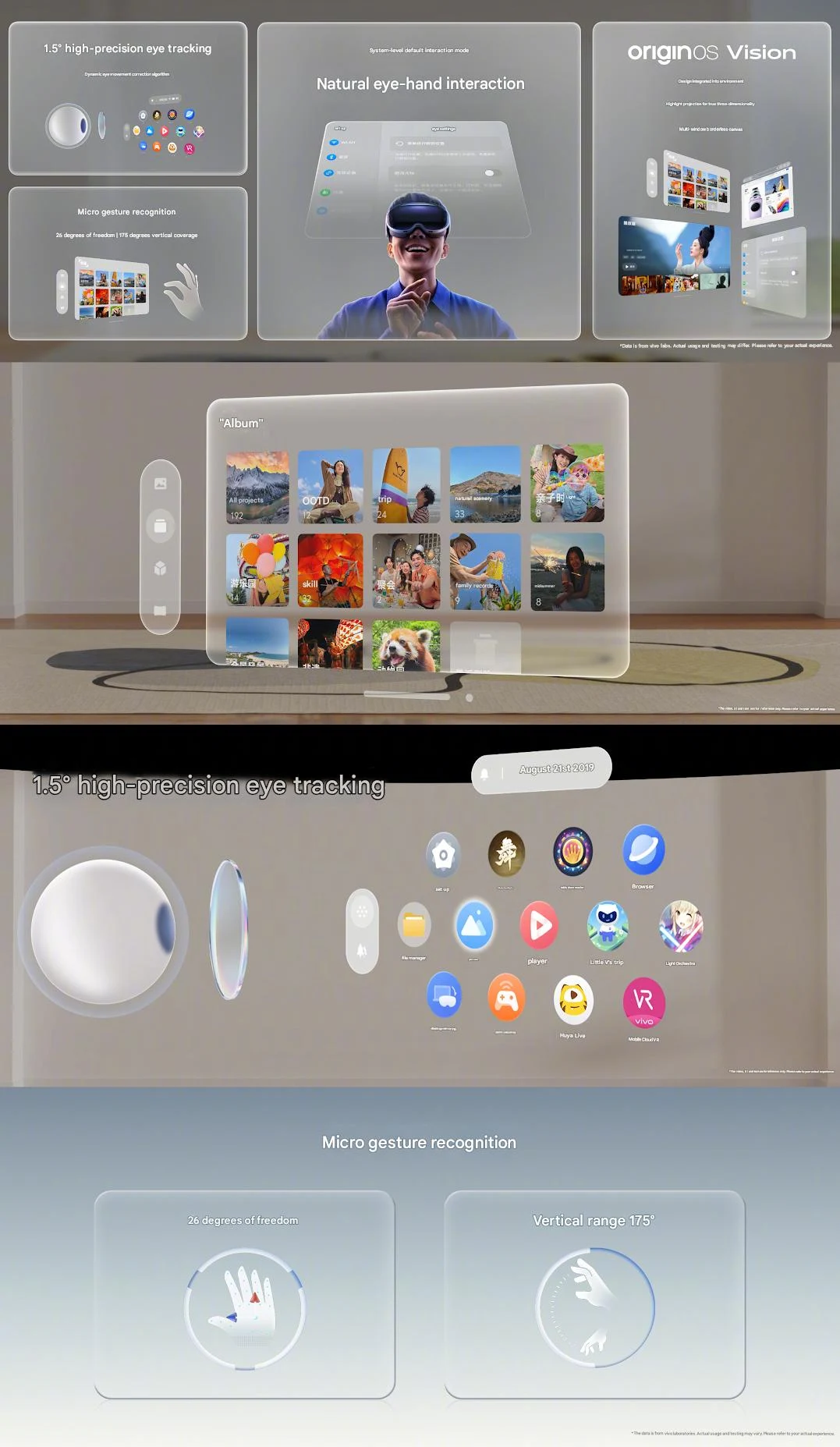
    A particularly notable aspect is its lighter weight when compared to the most recognizable competitors. Vivo’s headset weighs in at 14 oz, in contrast to Apple’s 21+ oz device, making it genuinely lightweight. Additionally, the Vivo headset is about 20% lighter than the Meta Quest 3 series. Vivo also highlights its compact dimensions of 3.27 x 1.57 inches and a ring strap at the back, designed to enhance comfort. With 1.5 degrees of eye-tracking precision and a vertical tracking range of 175 degrees, it promises natural gesture control relying on OriginOS Vision.

    Virtual Experience

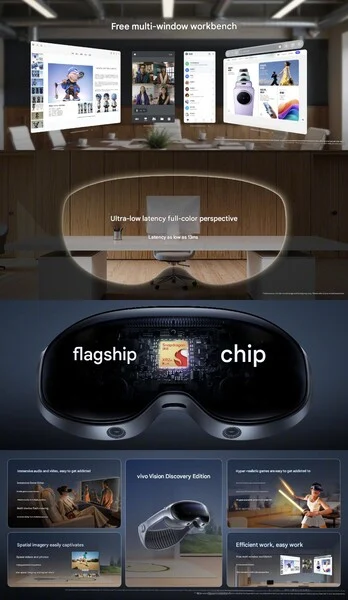
    The virtual “IMAX display” that appears before the user’s eyes can be as large as 118 ft or around 1400 inches. Alongside entertainment options like virtual movie viewing or immersive 3D gaming, there are also claims of support for productive applications, with low latency at 13ms. OriginOS Vision features a virtual workspace with multiple adjustable windows, akin to what Apple offers. It also accommodates Spatial Videos and Photos. At present, the headset is not available to the general public but can be tested in Vivo’s official stores in China as part of a Discovery Edition for selected reviewers.

    Several hands-on reviews of this intriguing competitor to Apple’s Vision Pro are circulating on platforms like Weibo and Bilibili. Similar to the US version, users must have their face measured to select the correct eye mask size. The battery is external, mirroring Apple’s design. Reviewers noted that the lighter weight is a significant advantage for the Vivo Vision, partly due to the different materials used. However, the audio quality reportedly falls short compared to Apple’s product. For glasses wearers, magnetic lenses can be utilized if they are aware of their prescription.

    The reviews further indicate that Apple’s mixed-reality offering is more advantageous for those with interpupillary distances that stray significantly from the average. Apple accommodates distances from 51 to 75 mm, whereas Vivo supports 57 to 71 mm. The Vivo headset is outfitted with eleven cameras—seven on the front, two beneath, and two internally. The camera quality is said to be comparable to that of Apple’s, though it tends to become noisier in darker settings. The video shows that finger gestures and the ability to configure the virtual space are largely in line with what is expected from Apple. Differences were noted in the system and volume controls, with Vivo employing two physical buttons for volume adjustment.

    Display and Gaming Capabilities

    The initial review concludes that the 90Hz display, offering a peak brightness of 100 nits, is of high quality and nearly reaches Dolby Vision cinematic standards. Following this, the hands-on video explores various mixed-reality capabilities, such as enjoying movies in a virtual IMAX theater, using Spatial Videos and Photos, or engaging in 3D gaming. Despite potentially less robust chipset performance, Vivo appears to hold an edge over Apple, especially in gaming scenarios. The tester commended the seamless integration of real-world elements, physical space, virtual objects, and hand movements experienced during gameplay. A specialized VR game controller is also supported, allowing users to stream VR games through Steam. In discussions with Vivo, it was revealed that the Vivo Vision headset aims to be more affordable and user-friendly compared to Apple’s initial mixed-reality offering in the near future.

    Source:
    Link


  • Vivo Launches First Mixed-Reality Headset with 8K Micro-OLED Lenses

    Vivo Launches First Mixed-Reality Headset with 8K Micro-OLED Lenses

    Key Takeaways

    1. Vivo has launched its first mixed-reality headset called the Vivo Vision Discovery Edition, resembling Apple’s Vision Pro in design.
    2. The headset features Micro-OLED lenses with 8K resolution at a 90 Hz refresh rate, powered by the Qualcomm Snapdragon XR2+ Gen 2 chipset.
    3. Vivo Vision offers a projection equivalent to a 120-inch display with a wide 180° field of view, all while being lightweight at 398 grams.
    4. The availability of the Vivo Vision in China has not been announced, but it will be showcased in twelve authorized experience stores.
    5. Vivo plans to introduce the headset to more stores in China in the future, but specific purchase details are not yet provided.


    Vivo has officially revealed its first mixed-reality headset after teasing the launch event last week. True to expectations, the Vivo Vision Discovery Edition, which is simply called the Vivo Vision, closely resembles Apple’s Vision Pro in its design. Nevertheless, the Vivo Vision diverges from its Apple rival in multiple aspects, as well as from the more budget-friendly Meta Quest 3 and Meta Quest 3S, which is currently priced at $299 on Amazon.

    Specifications and Features

    The Vivo Vision boasts Micro-OLED lenses that deliver an impressive 8K resolution at a refresh rate of 90 Hz. It’s assumed that the 8K resolution is combined rather than per eye. These lenses are powered by Qualcomm’s Snapdragon XR2+ Gen 2 chipset, which made its debut late last year. This combination is said to allow the Vivo Vision to create projections equivalent to a 120-inch display, featuring a notably expansive field of view that Vivo describes as ‘180°…up and down, left and right’, all while being lightweight at just 398 grams.

    Availability and Future Plans

    Currently, Vivo has not announced when the headset will be available in China. Instead, the company has mentioned that it will showcase the Vivo Vision in one of its twelve authorized experience stores within the country. While Vivo aims to introduce the Vivo Vision to additional stores in China down the line, it has not specified when or if the mixed-reality headset will become available for purchase.

    Source:
    Link


  • Vivo Launches Mixed Reality Headset Similar to Apple’s Design

    Vivo Launches Mixed Reality Headset Similar to Apple’s Design

    Key Takeaways

    1. Vivo has announced its mixed reality headset named Vision at the Boao Forum for Asia, resembling Apple’s headset design.
    2. The Vision features a ski goggle-style form with a sleek black glass front and multiple cameras for motion tracking and hand gesture recognition.
    3. The device includes an external battery pack with a magnetic connector, similar to Apple’s Vision Pro headset.
    4. Vivo plans to officially launch the Vision prototype in mid-2025, focusing on real-time spatial computing for future consumer robotics.
    5. A new robotics laboratory in China will develop AI-driven imaging and model learning to enhance future robotics applications.


    After a long period of guessing, Vivo has finally revealed its mixed reality (MR) headset during the Boao Forum for Asia. The device is named the Vision. If the name sounds familiar, just wait until you see what the device looks like.

    Design Features

    At first look, the Vivo Vision bears a striking resemblance to Apple’s headset. It has the same ski goggle-style form with a sleek black glass front covering. Inside the front glass, there are multiple cameras visible, as well as within the headset’s body. These cameras will probably be utilized for motion tracking and recognizing hand gestures, which is typical for devices in this category.

    Battery and Connectivity

    The similarities with Vision Pro don’t stop there. Like Apple’s headset, Vivo’s MR device also comes with an external battery pack that needs to be carried during use. The magnetic connector linking the battery to the headset also seems to share the same knob-like design as Apple’s offering.

    Future Prospects

    Currently, this is just an initial view. Vivo has not yet disclosed full specifications or software information about the headset, but they mention that the prototype will be officially launched in mid-2025. Vivo is positioning the Vision headset as part of a broader initiative toward real-time spatial computing, which they claim will be crucial for future consumer robotics applications.

    Additionally, Vivo has established a new robotics laboratory in China. This lab will be dedicated to creating AI-driven imaging and large model learning, aiming to help develop the “brain” and “eyes” of future robots. While Vivo is being secretive about its headset, they did confirm the launch of the Vivo X200 Ultra set for April. More details regarding the Vivo Vision may be revealed around that time, so we’ll need to stay tuned for what comes next.


  • Meta Quest 3S Launches at Meta Connect for $299 Starting Price

    Meta Quest 3S Launches at Meta Connect for $299 Starting Price

    The highly anticipated Meta Quest 3S MR headset has been officially revealed at Meta Connect 2024. This new headset serves as an affordable option, ideal for those exploring mixed reality for the first time or looking to upgrade from their Meta Quest or Meta Quest 2.

    Specifications and Features

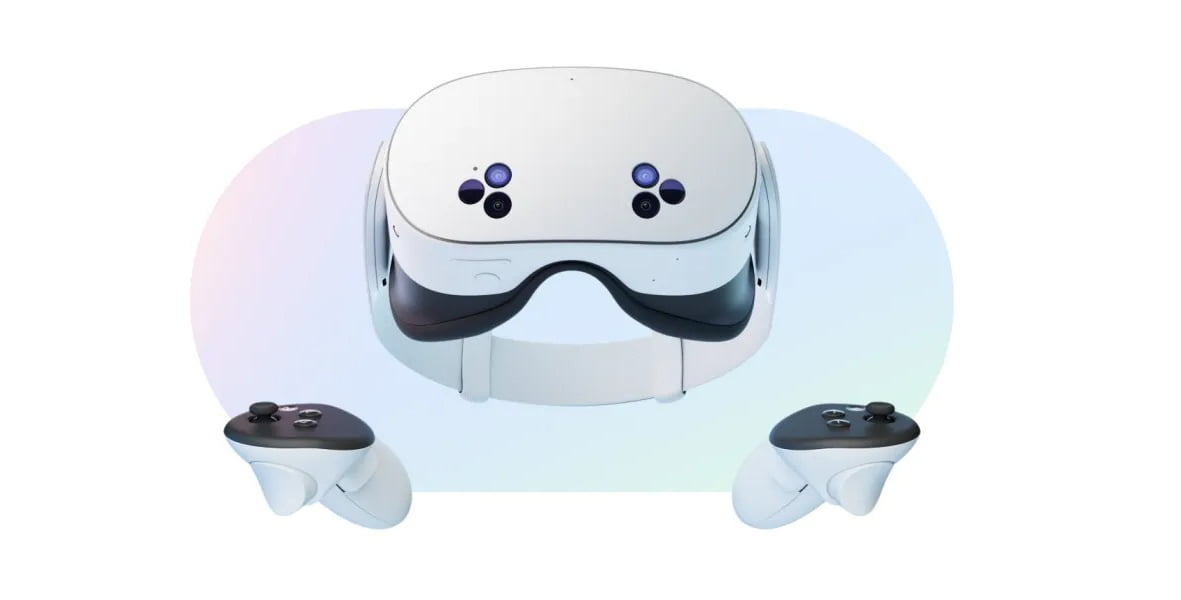
    The Meta Quest 3S is equipped with the Snapdragon XR2 Gen 2 chip, which is also found in the pricier Quest 3 headset (currently available on Amazon for $649). Unlike the Quest 3, it does not feature pancake lenses; instead, it utilizes Fresnel lenses with a slightly narrower field of view. A significant advantage is that it offers the full color Passthrough functionality similar to the Quest 3, accessible via a dedicated “Action Button” for toggling between passthrough and immersive experiences.

    With a resolution of 1832 x 1920 and refresh rates of 90Hz and 120Hz, the Quest 3S boasts a horizontal field of view of 96° and a vertical field of view of 90°. It includes 8GB of RAM and options for either 128GB or 256GB of storage. The device features a 4,324mAh battery, which, while smaller than the Quest 3’s 5,060mAh battery, still allows for up to 2.5 hours of usage, slightly better than the Quest 3’s 2.2 hours.

    Compatibility and Accessories

    Meta has ensured that the Quest 3S is compatible with several accessories from the Quest 3 lineup, including the Elite Strap, Elite Strap with Battery, Carrying Case, Compact Carrying Case, Link cable, controller-specific Charging Dock, and Active Straps. Additionally, it will come with an exclusive Breathable Facial Interface designed to keep users cool during vigorous gaming sessions or workouts.

    The Meta Quest 3S is now available for pre-order, with a release date set for October 15. The price for the 128GB version is $299.99, while the 256GB version is priced at $399.99. Both versions include a pair of Touch Plus controllers.

    Special Offers

    From now until April 30, 2025, every order of the Quest 3S will include a complimentary copy of Batman: Arkham Shadow, a game exclusive to the Quest 3 and Quest 3S, launching on October 22, 2024. Additionally, Meta will provide a free three-month subscription to Meta Quest+.


    Image 1
  • Introducing TikTok’s Apple Vision Pro Native App: A Sleek and Impressive Interface

    Introducing TikTok’s Apple Vision Pro Native App: A Sleek and Impressive Interface

    TikTok has recently launched a new app for Apple’s Vision Pro headset, bringing the popular video platform into the realm of augmented reality. This move allows users to enjoy TikTok in a way that is familiar yet takes full advantage of the capabilities of the Vision Pro.

    The Familiar Layout with Additional Windows

    The app’s layout closely resembles the mobile version, complete with videos playing vertically and buttons for liking, commenting, and sharing. However, TikTok has optimized the layout for the Vision Pro, making it easier to view comments and creator information without obstructing the video.

    Designed for the Vision Pro

    TikTok had previously announced its plans to develop an app specifically for the Vision Pro. The app is designed to allow users to watch videos either with a view of the real world or in a completely virtual space, such as on the moon. Additionally, it is designed to seamlessly integrate with other apps on the headset.

    A Cautionary Approach from Streaming Giants

    While TikTok is diving headfirst into augmented reality, other major streaming platforms are taking a more cautious approach. Disney, for example, fully supports Vision Pro users by offering movies in 3D. Similarly, Amazon Prime Video has also joined the bandwagon. However, Netflix and YouTube have chosen to stick to the basics, suggesting users watch through the browser. Although, YouTube might consider developing an app for the Vision Pro in the future.

  • Sony Unveils Maker-Focused Mixed Reality Headset

    Sony Unveils Maker-Focused Mixed Reality Headset

    Sony Introduces Spatial Content Creation System at CES 2024

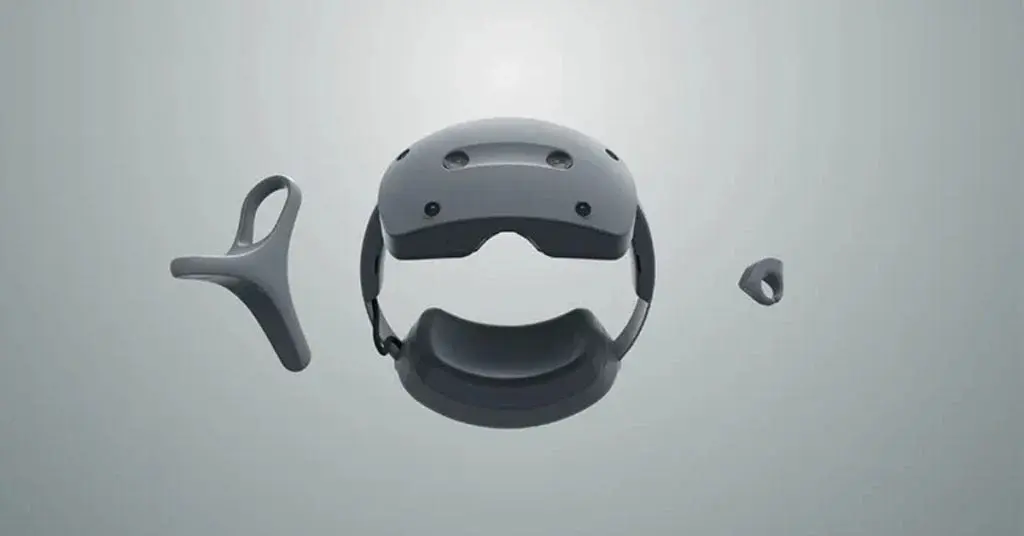
    Sony has unveiled its most recent innovation at CES 2024 – a spatial content creation system tailored for individuals in the realm of 3D design and animation. In contrast to its PlayStation VR equivalent, this headset-and-controller duo is not targeted at gamers but at professionals necessitating precision and intricacy in their endeavors.

    Enhanced Displays and Robust Platform

    The innovative Sony headset showcases high-resolution 4K OLED screens, operated by the Snapdragon XR2+ Gen 2 platform. This amalgamation assures that professionals can relish a genuinely engrossing encounter with top-notch image quality and clarity.

    Bridging the Divide Between Virtual and Physical Domains

    Kenichiro Yoshida, Sony’s CEO, accentuated the system’s capacity to amalgamate virtual elements with physical environments, broadening the scope of creation. This fusion is enabled through a special controller arrangement. Instead of conventional joysticks, the system incorporates a finger-worn ring and a handheld pointer. These instinctive tools emulate natural gestures, empowering creators to maneuver virtual objects seamlessly, almost as if they were physically present in the space.

    Smooth Transition to Reality

    In instances where users require a hiatus from the virtual realm, Sony offers a solution. The front section of the headset can be flipped up, facilitating users to effortlessly transit back to the physical world. This adaptability guarantees that creators can uphold a connection with their surroundings while still savoring the immersive advantages of the virtual workplace.

    Pioneering 3D Innovation

    Sony is no novice to the domain of 3D innovation. Their prior Spatial Reality Display acquainted users with this technology; however, the new system escalates it a notch higher. It integrates "proprietary rendering technology" that furnishes real-time, high-definition textures and authentic character expressions. This meticulous attention to detail vows to transform the process of 3D modeling and visualization.

    Launch Date and Rivalry

    While Sony has not revealed the precise launch date and cost of their system, they have affirmed that it will be accessible later this year. It will contend with Apple’s Vision Pro, slated to debut in stores next month. Nevertheless, Sony’s emphasis on professional creators and user-friendly controls may confer them an advantage in this budding market.

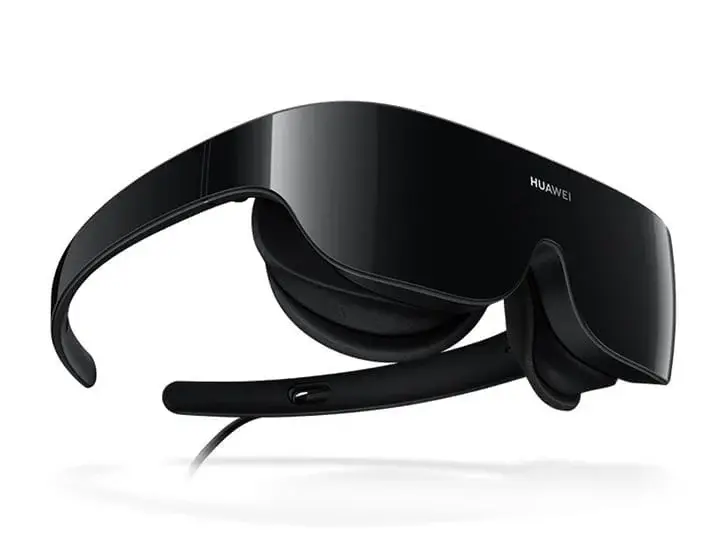
  • Huawei Challenges Apple’s Vision Pro with its Mixed Reality Headset.

    Huawei Challenges Apple’s Vision Pro with its Mixed Reality Headset.

    Report: Huawei Allegedly Developing High-End Mixed Reality Headset

    Rumors indicate that Huawei is currently developing its own mixed reality (MR) headset to rival Apple’s Vision Pro. This forthcoming wearable is projected to be a premium model akin to Apple’s device.

    Augmented Immersion via Top-Tier Processor

    The chatter suggests that Huawei’s MR headset will house a top-tier chipset, promising users a heightened level of immersion and fluidity. One of the main challenges in such gadgets is heat dissipation, a problem Huawei supposedly plans to tackle by incorporating a robust cooling system.

    Supplemental Battery Component

    Insiders disclosed that Huawei’s MR headset will possess an external battery attachment, mirroring the setup of Apple’s Vision Pro. Nevertheless, additional specifics about the device have not been divulged. Interestingly, rumors abound that Huawei’s former subsidiary, Honor, might be venturing into the mixed reality headset realm as well. This hints at a concerted effort by Chinese brands to penetrate the premium wearables sector in order to mount a stronger challenge against Apple.

    Unverified Reports

    It should be noted that these accounts are presently unverified, so it is advised to approach this information with caution. Critical details such as the launch date, specifications, and functionalities of the Huawei MR headset remain undisclosed. Nonetheless, if the objective is to compete with Apple’s Vision Pro, Huawei’s offering could potentially be more affordably priced compared to Apple’s $3,500 model.

    Final Thoughts

    Although information about Huawei’s mixed reality headset is somewhat scant, the grapevine indicates that the Chinese tech company is eyeing entry into the high-end wearable market. Armed with a flagship-grade chipset and a focus on managing thermal concerns, Huawei’s MR headset may deliver an enriched immersive experience for users. Stay tuned for further updates on this potential rival to Apple’s Vision Pro.

    [List of galleries not to be paraphrased.]

  • Apple Vision Pro Set to Launch in March 2024, Global Availability Postponed Until 2025

    Apple Vision Pro Set to Launch in March 2024, Global Availability Postponed Until 2025

    Apple Vision Pro to be Released in March 2024

    Apple introduced its mixed reality headset named Apple Vision Pro at an event last June. Unlike the company’s other products, the device did not immediately go on sale after the event. Instead, Apple announced that the headset, which combines virtual and augmented reality, would be available for purchase in 2024. Now, the exact release date has been revealed. Here are the details…

    Mark Gurman Reveals Release Date

    If you’re a tech enthusiast and a dedicated follower of TechHere, you’ve likely heard the name Mark Gurman. Gurman, especially knowledgeable about Apple, frequently reveals details about the company’s products that others may not know. Now, he has come forward with a claim about Apple Vision Pro. According to him, the much-anticipated mixed reality headset will first be available for purchase in the United States in March 2024.

    Delayed Release

    However, this was not Apple’s original plan. The company intended to release the product in January. Unfortunately, some issues in the supply chain and longer-than-expected testing disrupted these plans. As a result, the release of Apple Vision Pro was delayed by two months. So, when will the mixed reality headset be available for purchase in the rest of the World?

    Global Availability

    According to Gurman’s research, the device will be available for purchase in Canada and the United Kingdom by the end of 2024. Unfortunately, its release in the rest of the world will extend until the last months of 2025. Of course, queues for the $3,500 Apple product may not form in many countries. Still, such limited availability may not be well-received by users.

    Affordable Model in the Pipeline

    However, waiting until 2025 may not be as bad as it sounds. It is already known that Apple is working on a kind of affordable Vision Pro model. This model is expected to be released no later than the end of 2025 or the beginning of 2026. This way, users can have a product with very similar features at a much lower cost.

    Source: 1, 2