Tag: MIUI

  • Xiaomi 15 Ultra China Edition Features 6000mAh Battery

    Xiaomi 15 Ultra China Edition Features 6000mAh Battery

    Key Takeaways

    1. Xiaomi will unveil the Xiaomi 15v series, including the Xiaomi 15 and 15 Ultra, on March 2, with a special launch event planned for the Chinese market.
    2. The Chinese version of the Xiaomi 15 Ultra will feature a 6,000mAh battery, while the global version will have a 5,410mAh battery.
    3. Both versions of the Xiaomi 15 Ultra will support 90W wired and 80W wireless charging.
    4. The Xiaomi 15 Ultra will have a 6.73-inch micro-quad-curved AMOLED display with 2K resolution and a 120Hz refresh rate.
    5. The device will be powered by a Snapdragon 8 Elite processor, with up to 16 GB RAM and a quad-camera setup, including a 200-megapixel main camera.


    Xiaomi is planning to showcase the Xiaomi 15v series on March 2, which will include both the Xiaomi 15 and 15 Ultra. Additionally, the company is likely to organize a special launch event for the Chinese market later this month to introduce the Xiaomi 15 Ultra along with the SU7 Ultra car. It’s worth noting that the Xiaomi 14 Ultra had a 5,000mAh battery for the global market, while the Chinese model featured a bigger 5,300mAh battery. Recent information suggests that the Chinese version of the Xiaomi 15 Ultra will also come with a larger battery compared to its global version.

    Battery Size and Charging Features

    The battery size and charging capabilities of the Xiaomi 15 Ultra’s Chinese model have now been revealed. According to insider Panda is Bald, the Xiaomi 15 Ultra will include a 6,000mAh battery, along with support for 90W wired and 80W wireless charging. The device is expected to be about 9.4mm thick and weigh around 229 grams.

    A recent leak indicates that the global version of the Xiaomi 15 Ultra will sport a 5,410mAh battery, while maintaining the same charging features. This means that the larger 6,000mAh battery is likely specific to the Chinese edition of the Xiaomi 15 Ultra. It’s important to remember that the Xiaomi 14 Ultra had the same specifications for both its Chinese and global versions, aside from the battery size. Likewise, the Xiaomi 15 Ultra’s two editions may mainly differ in battery capacity, while other specs are anticipated to be similar.

    Expected Specifications

    Rumored details suggest that the Xiaomi 15 Ultra will boast a 6.73-inch micro-quad-curved AMOLED display, featuring a 2K resolution and a refresh rate of 120Hz. It will also include an ultrasonic in-screen fingerprint scanner and Xiaomi Shield Glass 2.0. Under the hood, the 15 Ultra will be powered by a Snapdragon 8 Elite processor, offering up to 16 GB of LPDDR5x RAM and up to 1 TB of UFS 4.0 storage.

    For selfies, it will have a 32-megapixel front camera. The rear camera configuration will consist of a quad-camera setup, including a 50-megapixel (LYT-900, OIS), a 50-megapixel (Samsung JN5, ultra-wide), another 50-megapixel (Sony IMX858, 3x telephoto, OIS), and a 200-megapixel (Samsung HP9, 4.3x periscope telephoto, OIS). The phone is expected to run on Android 15, layered with HyperOS 2.0 on top.


  • Realme GT 7 Pro Racing Edition: Snapdragon 8 Elite & 6500mAh Battery

    Realme GT 7 Pro Racing Edition: Snapdragon 8 Elite & 6500mAh Battery

    Key Takeaways

    1. Processor and Variants: The Realme GT 7 Pro Racing Edition features the Qualcomm Snapdragon 8 Elite processor, available in multiple RAM and storage configurations (12 GB + 256 GB, 12 GB + 512 GB, 16 GB + 256 GB, and 16 GB + 512 GB).

    2. Camera Setup: This edition has a dual rear camera system, including a 50 MP main camera with OIS and an 8 MP ultra-wide camera, omitting the telephoto lens found in the standard model. It also has a 16 MP front camera.

    3. Display Features: The smartphone sports a 6.78-inch 1.5K LTPO micro quad-curved OLED display with a peak brightness of 6000 nits, a 120 Hz refresh rate, and full Dolby Vision compatibility.

    4. Battery and Charging: It includes a 6,500 mAh battery with 120 W fast charging support, but lacks wireless charging capabilities.

    5. Pricing and Availability: The starting price is CNY 3,099 (approximately $425/€405) for the base model, with no current information on global availability outside China.


    Realme has introduced the new GT 7 Pro Racing Edition smartphone in China. This flagship device comes with slightly varied specifications compared to the standard model, particularly in camera, display, storage options, and battery size. Nonetheless, it shares the same powerful Qualcomm Snapdragon 8 Elite processor paired with an Adreno GPU, just like the regular Realme GT 7 Pro.

    Variants and Camera Setup

    The 5G-capable phone is available in several RAM and storage configurations: 12 GB + 256 GB, 12 GB + 512 GB, 16 GB + 256 GB, and 16 GB + 512 GB. In contrast to the standard version that features a triple rear camera system, the Racing Edition includes a dual rear camera setup. This consists of a 50 MP main camera with Optical Image Stabilization (OIS) and an 8 MP ultra-wide camera. Unfortunately, they removed the telephoto lens that was present on the GT 7 Pro. For selfies and video calls, there’s a front-facing 16 MP camera.

    Display and Design Features

    One of the key differences lies in the display. This flagship model sports a 6.78-inch 1.5K 8T LTPO micro quad-curved OLED screen that can reach a peak brightness of 6000 nits and offers a refresh rate of 120 Hz. The display covers the full 100% DCI-P3 color gamut and is Dolby Vision compatible. Additionally, it boasts an IP68 + IP69 rating for water and dust resistance and is available in two versions: Star Trail Titanium and Neptune Explorer Edition with blue finishes.

    Battery and Software

    Realme has equipped the GT 7 Pro Racing Edition with a substantial 6,500 mAh battery, which supports 120 W fast charging capabilities. However, wireless charging is not an option here. The device operates on Android 15 with Realme UI 6.0 pre-installed, but there’s currently no information on future software updates from the brand.

    Other features include an in-display optical fingerprint sensor, high-resolution ultra-linear dual speakers with OReality audio, bypass charging capability, and an extensive 11,480 mm² dual-chamber vapor cooling system. In terms of dimensions, it measures 162.4 x 76.8 x 8.5 mm (approximately 6.39 x 3.02 x 0.33 inches) and weighs 218 grams (0.48 lbs).

    The Realme GT 7 Pro Racing Edition is priced starting at CNY 3,099 (around $425/€405) for the basic 12 GB + 256 GB version, while the premium 16 GB + 512 GB model costs CNY 3,699 (about $550/€525). It is available for purchase in China through the official Realme China website and other authorized stores. However, there is no information yet on its release in global markets.


  • iQOO Neo 10R 5G: 6,400mAh Battery & 144Hz AMOLED Display

    iQOO Neo 10R 5G: 6,400mAh Battery & 144Hz AMOLED Display

    After the iQOO 13 was revealed in December 2024, there have been no new phone releases from iQOO in India. Rumors indicate that the iQOO Neo 10R 5G, which is currently being teased by the company, is set to launch in February 2025. Its upcoming availability on Amazon has shown off its dual-tone design and chipset. Additionally, a report from Gadgets360 has disclosed information about its battery and display features.

    Key Specifications of iQOO Neo 10R 5G

    According to sources from the industry, the iQOO Neo 10R 5G will come with an impressive 6,400mAh battery, marking it as the largest battery ever equipped in an iQOO smartphone. Although details about its fast charging have not been shared, it has been officially confirmed to include the Snapdragon 8s Gen 3 chipset.

    The latest report reveals that the iQOO Neo 10R will sport an AMOLED display that supports a 1.5K resolution and a refresh rate of 144Hz. Further specifications are likely to be released in the lead-up to its February launch.

    Pricing Insights

    Regarding pricing, this device is expected to be available for under Rs 30,000. This pricing hints that it could serve as a strong competitor against the recently launched Poco X7 Pro, which is powered by the Dimensity 8400.

    What Can We Anticipate from the iQOO Neo 10R 5G?

    The specifications mentioned earlier imply that the iQOO Neo 10R 5G might actually be a rebranded version of the iQOO Z9 Turbo Endurance Edition, which was introduced in China earlier this month. As a result, it is likely to feature 12 GB of LPDDR5x RAM, 256 GB of UFS 4.0 storage, and 90W fast charging capabilities.

    For photography enthusiasts, the phone could possess a 16-megapixel front camera and a dual-camera setup on the back consisting of a 50-megapixel main sensor (with OIS) and an 8-megapixel ultra-wide lens. This device will operate on FunTouch OS 15 based on Android 15. It may also include additional features like an in-display fingerprint scanner and an IR blaster.

  • Honor Magic7 Lite Launches in Europe with 6600mAh Battery

    Honor Magic7 Lite Launches in Europe with 6600mAh Battery

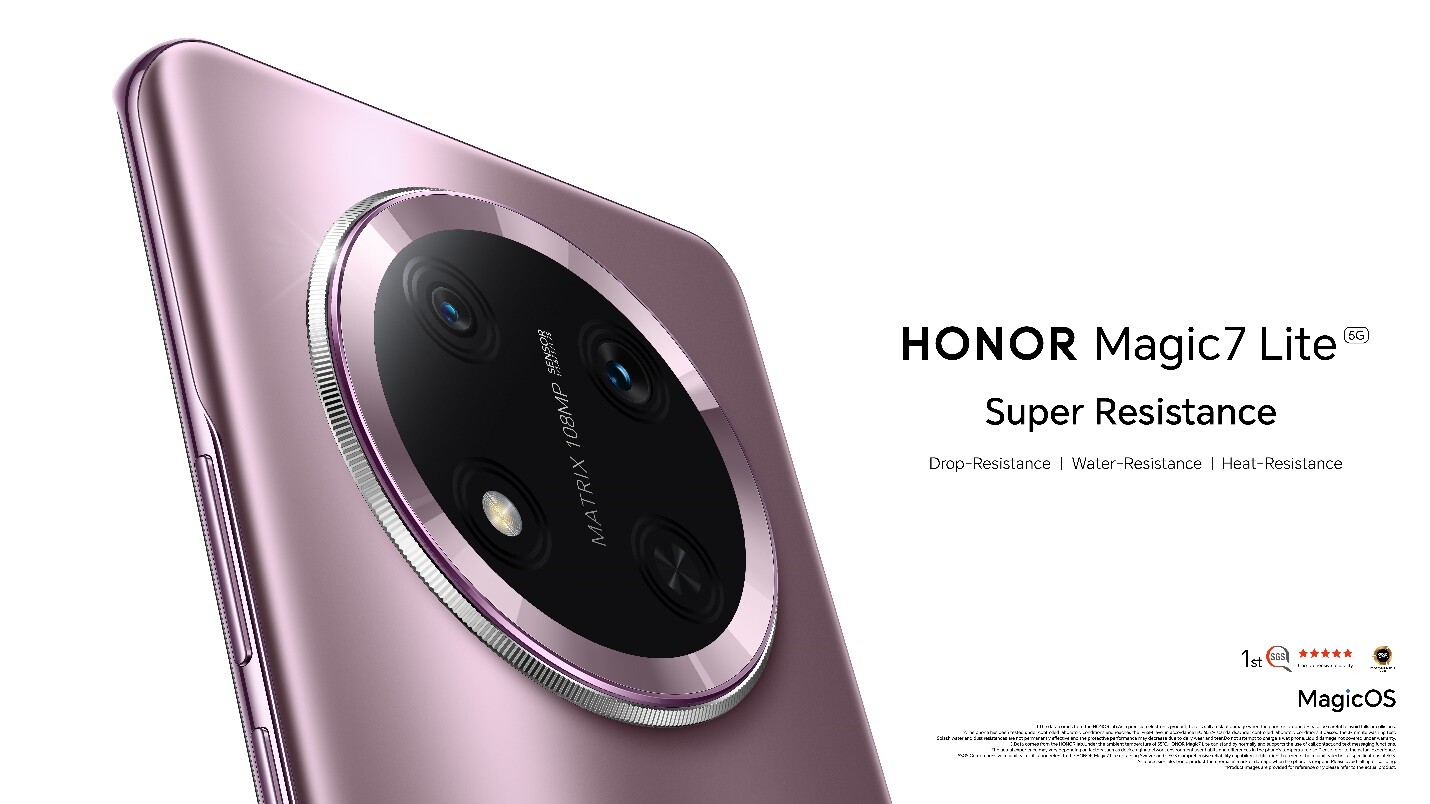
    Honor has just added a new smartphone to its Magic7 series, called the Magic7 Lite, which is now available in Europe. This mid-range device follows the Magic6 Lite that was launched in December 2023. When we compare it to its predecessor, the Magic7 Lite does not introduce any significant upgrades aside from its battery. It retains the same design, processor, and camera components as the earlier model.

    Battery Improvements

    Let’s dive into the battery details. As per Honor’s announcement, the Magic7 Lite is equipped with an innovative 6,600 mAh silicon-carbon battery, which supports 66 W wired charging. This is a notable increase from the 5,300 mAh battery found in the Magic6 Lite. Additionally, the battery is protected by a robust armor-level coating, and the company claims it can withstand extreme temperatures ranging from -30 °C (-22 °F) to 55 °C (131 °F).

    Processor and Storage

    This 5G-capable smartphone is powered by the same processor as its predecessor. It features a Qualcomm Snapdragon 6 Gen 1 chipset, coupled with 8 or 12 GB of RAM and storage options of 256 or 512 GB, with no option to expand the storage. The device runs on Android 14 with MagicOS 8.0 right out of the box, but there hasn’t been any announcement regarding future software updates from Honor.

    Camera and Display Features

    In terms of camera functionality, the Magic7 Lite boasts a dual rear camera system, which includes a 108 MP primary camera with Optical Image Stabilization (OIS) and a 5 MP ultrawide camera. For those who love selfies, there’s a 16 MP front-facing camera for both selfies and video calls. The smartphone showcases a 6.78-inch curved AMOLED screen with a resolution of 2700 x 1224 pixels, offering a peak brightness of 4000 nits, along with a refresh rate of 120 Hz.

    Dimensions and Availability

    In terms of size, the device measures 162.8 x 75.5 x 7.98 mm (LWD) or 6.40 x 2.97 x 0.31 inches and weighs in at 189 grams (0.41 lbs). It also has an IP64 rating for water and dust resistance and comes in two color options: Titanium Purple and Titanium Black.

    The Honor Magic7 Lite is priced starting at £399 (~$495/€479) for the 8 GB + 512 GB variant. Consumers can expect to get their hands on it starting January 15, 2025, in the UK through retailers like EE, Virgin Media 02, Three, Vodafone, Argos, Very, and Currys. For more information, you can visit the official product page.

    Source: Link


    Image 1
  • Vivo Y300 Launches: X200 Design, Super Speaker, Big Battery

    Vivo Y300 Launches: X200 Design, Super Speaker, Big Battery

    Vivo’s mid-range lineup can sometimes be quite perplexing. Just a few days ago, the company launched the Y300 in India, which is equipped with the Snapdragon 4 Gen 2 SoC. However, there’s now a different version of this model in China, which is an entirely distinct device powered by a MediaTek SoC.

    Specs and Performance

    This latest Vivo Y300 is built with the Dimensity 6300 processor, which can come with up to 12 GB of RAM and a generous 512 GB of storage. But it’s not just the chip that sets it apart. The design has also been revamped, giving it a rear appearance that closely resembles the flagship X200.

    Camera Features

    Although it seems to feature a quad-camera arrangement on the back, it actually contains a dual-camera system like its Pro counterpart. The main camera is equipped with a 50 MP sensor, along with a 2 MP portrait lens. For selfies, this new Vivo Y300 includes an 8 MP front camera.

    Battery and Additional Features

    A significant highlight of the Vivo Y300 is its battery. Like its Pro sibling, it boasts a robust 6,500 mAh battery. It supports 44-watt fast charging (with the 85 W Cuktech 15 power bank currently priced at $44.99 on Amazon), and the company claims that this mid-range device can deliver up to 25 hours of uninterrupted video playback.

    Moreover, the phone features what Vivo refers to as a “super speaker” system. This includes a three-speaker setup designed to provide a high-resolution audio experience. Other noteworthy features of the Y300 are its 6.77-inch OLED display with a 120 Hz refresh rate, compatibility with LDAC and aptX HD, and the new OriginOS 5.

    Pricing Information

    In terms of pricing, the new Vivo Y300 begins at CNY 1,399 (approximately $192), while the highest variant with full storage and RAM comes in at CNY 1,999 (about $274). There is no information available yet regarding its potential global release.

    Source: Link


    Image 1
    Image 1
    Image 1
  • OnePlus 13 Leaked Details Revealed on Camera FV-5 Listing

    OnePlus 13 Leaked Details Revealed on Camera FV-5 Listing

    The OnePlus 13 is likely to be unveiled in October, shortly after the introduction of the Snapdragon 8 Elite (or 8 Gen 4) chip. Recently, the device has been found on several certification sites such as Camera FV-5, TUV, and IMDA. This not only verifies various features of the phone but also hints at its soon-to-come launch.

    Camera Features

    From the information available in the Camera FV-5 listing, it appears that the phone is equipped with a 12.6MP primary camera, which is probably the 4-1 binned output from a rumored 50MP sensor. It features a focal length of 24.6mm, incorporates OIS, and has a 72.5-degree field of view. In binned mode, the sensor provides an equivalent pixel size of 2.0µm and has an exposure range from 1/12,801 up to 42.0 seconds. Previous speculations suggested it could utilize the 50MP Sony LYT 808 sensor, notable for its sizable 1/1.3-inch sensor.

    Selfie Camera Speculations

    Interestingly, the listing indicates a 16MP front-facing camera, contrasting earlier rumors that mentioned a 32MP sensor for selfies. The information suggests that the sensor has a binned resolution of 4MP, implying the real resolution to be 16MP. However, it might also be a 9-1 binned output from a 36MP sensor, which was previously cited with a 32MP resolution. This selfie camera has a 71.0-degree field of view and supports EIS stabilization, although it lacks autofocus, unlike the main camera.

    Performance Insights

    In terms of performance, the OnePlus 13 has been spotted on Geekbench, achieving single-core and multi-core scores of 3236 and 10049 respectively. These scores are higher than most Snapdragon 8 Gen 4 listings seen thus far. The device features a 6.8″ micro-curved 2K LTPO display utilizing the BOE X2 panel. It is expected to reach brightness levels of 1600 nits in direct sunlight (HBM) and 6000 nits while displaying HDR content. To support this display, the phone comes with a substantial 6,000mAh high-density silicon anode battery and offers 100W SUPERVOOC fast charging along with 50W magnetic wireless charging.


    Image 1
    Image 1
  • iQOO Neo 10 Pro Leak: Snapdragon 8 Gen 3, 6500mAh Battery

    iQOO Neo 10 Pro Leak: Snapdragon 8 Gen 3, 6500mAh Battery

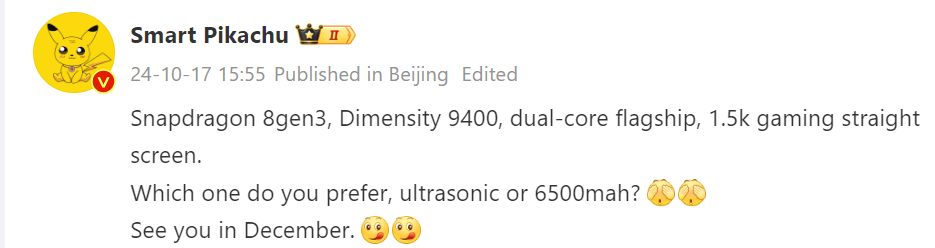
    As per the latest information, iQOO is set to launch its flagship device, the iQOO 13 5G, on October 30 in China. There are also whispers about a new Neo 10 series of smartphones currently in development. A recent leak from tipster Smart Pikachu sheds light on the expected features and release timeframe for both the Neo 10 and Neo 10 Pro.

    Specifications and Release Date

    Earlier leaks have suggested that the iQOO Neo 10 will be powered by the Snapdragon 8 Gen 3 chipset, while the Neo 10 Pro will run on the Dimensity 9400. According to the tipster, the Neo 10 series will come with a flat display designed for gaming, boasting a 1.5K resolution.

    In addition to that, the leaked information indicates that the Neo 10 series will include an ultrasonic in-screen fingerprint scanner and a robust 6,500mAh battery. The Neo 10 lineup is expected to be revealed in December in China. Other reports mention that both models will have a metal frame, operate on Android 15 with OriginOS 5 layered on top, and support 100W fast charging.

    Competition in the Market

    The Neo 10 series is likely to face strong competition from several other brands, including the OnePlus Ace 5 series, Realme GT Neo 7, and the Redmi K80 series. It is anticipated that the K80 series will be announced in November, while the Ace 5 and Realme GT Neo 7 may launch either in November or December.

    The upcoming Neo 10 series will be the successor to the Neo 9 and Neo 9 Pro, which were equipped with the Snapdragon 8 Gen 2 and Dimensity 9300 chipsets, respectively. Notably, the Neo 9 Pro was only available in the Chinese market, whereas the Neo 9 was released alongside its Pro variant in other regions.

  • iQOO Z9 Turbo+ Launches in China: 6,400mAh Battery, Dimensity 9300+

    iQOO Z9 Turbo+ Launches in China: 6,400mAh Battery, Dimensity 9300+

    iQOO has launched a new smartphone in its Z9 series in China. This series includes the Z9, Z9x, and Z9 Turbo models. The newest addition is the iQOO Z9 Turbo+, which serves as the flagship model. While it features an upgraded processor and a larger battery, the overall design and specifications remain consistent with the other models in the Z9 lineup.

    iQOO Z9 Turbo+ Specifications

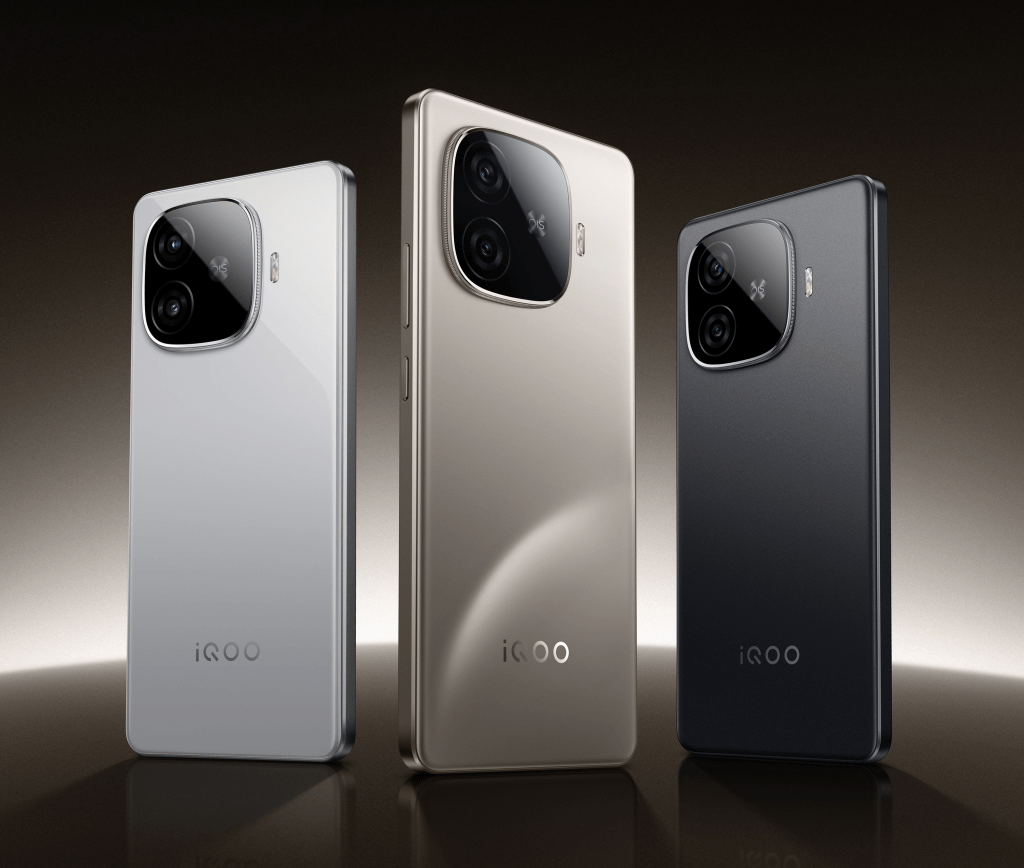
    The iQOO Z9 Turbo+ showcases a 6.78-inch Huaxing C8 OLED display, offering a resolution of 1.5K, a refresh rate of 144Hz, and impressive peak brightness of 4,500 nits. This combination provides a bright, smooth, and clear viewing experience. The display also includes a built-in fingerprint scanner. In terms of design, the smartphone features a flat frame and a squircle-shaped camera module on the rear. Additionally, it is IP65 certified for water and dust resistance.

    Camera Features and Performance

    The dual-camera system on the iQOO Z9 Turbo+ includes a 50MP Sony LYT-600 sensor with optical image stabilization (OIS) and an 8MP ultra-wide-angle lens. For selfies, there is a 16MP front camera.

    Powering the device is the MediaTek Dimensity 9300+ processor, complemented by up to 16GB of LPDDR5 RAM and 512GB of UFS 4.0 storage. The smartphone also integrates a proprietary Q1 chipset for improved performance and boasts a large 6K VC liquid cooling system. The device is fueled by a substantial 6,400mAh battery with support for 80W fast charging and runs on OriginOS 4, based on Android 14.

    Connectivity and Pricing

    The iQOO Z9 Turbo+ supports 5G, WiFi-7, Bluetooth 5.4, an IR Blaster, NFC, and features a USB-C port. It comes in three color options: Moon Shadow Titanium, Starlight White, and Midnight Black. The starting price is CNY 2,299 (~$330) for the base model with 12GB RAM and 256GB storage. The 16GB RAM and 256GB storage variant is priced at CNY 2,499 (~$355). The configurations with 12GB + 512GB and 16GB + 512GB are available for CNY 2,699 (~$385) and CNY 2,899 (~$410), respectively.iQOO Z9 Turbo+ supports 5G

  • Xiaomi Introduces New OS Logo: Transitioning from MIUI to HyperOS

    Xiaomi Introduces New OS Logo: Transitioning from MIUI to HyperOS

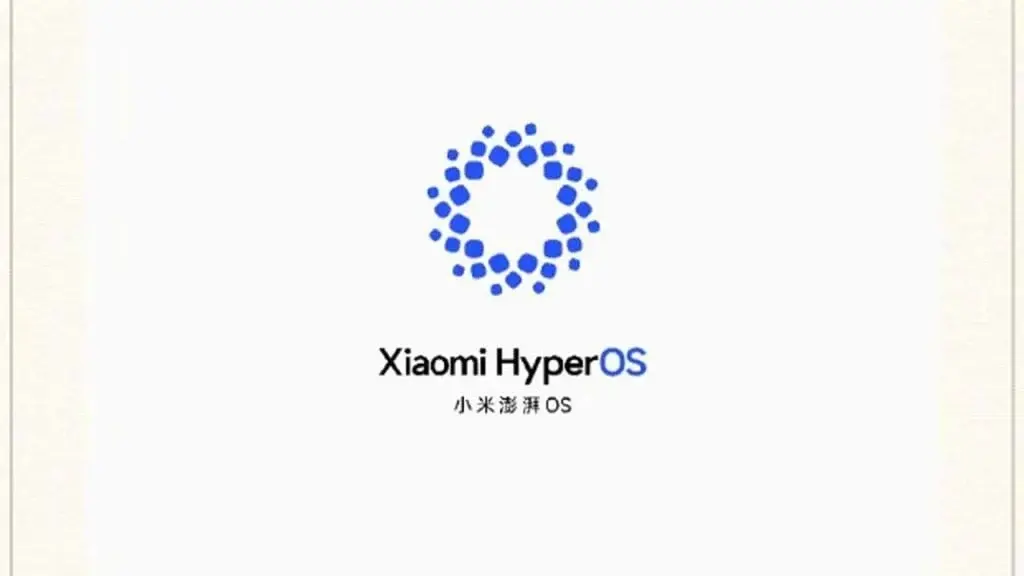
    Xiaomi, the renowned tech giant, is making waves in the industry once again. Known for its Android-based MIUI, which has been a staple in the company's smartphones and tablets, Xiaomi has now introduced a more comprehensive operating system called HyperOS. This strategic move aims to establish Xiaomi's own ecosystem, expanding its influence beyond traditional electronic devices to markets like electric vehicles. Recently, a Weibo post showcased Xiaomi's newly designed logo for HyperOS, further igniting excitement among Xiaomi users and tech enthusiasts alike.

    A Minimalist Design Emphasizing Ecosystem and Comprehensiveness

    The unveiling of HyperOS's new logo has generated quite a buzz. The design of the logo is minimalist, featuring a round shape that symbolizes the ecosystem and comprehensiveness that Xiaomi aims to achieve with its new operating system. This departure from the previous MIUI logos is a significant step forward for the company.

    In the past, Xiaomi opted for logos composed of letters rather than intricate designs. While this choice may have been lacking in terms of visual appeal, it made it easier to differentiate between different versions of MIUI. With the introduction of HyperOS, it raises the question of whether the logo will also evolve with each new version.

    Xiaomi's Journey Towards a Comprehensive Ecosystem

    Xiaomi's transition from MIUI to HyperOS marks a significant milestone in the company's quest to create its own ecosystem. By developing its operating system, Xiaomi aims to establish a seamless integration between its various product lines, including smartphones, tablets, and now electric vehicles. This move allows Xiaomi to have greater control over the user experience and tailor it to their specific needs.

    With the new logo for HyperOS, Xiaomi is signaling its commitment to this holistic approach. The minimalist design and round shape reflect the company's vision of a comprehensive ecosystem that encompasses a wide range of devices and services.

    The Future of Xiaomi and HyperOS

    As Xiaomi ventures into the electric vehicle market and expands its product offerings, the introduction of HyperOS is a strategic move to solidify its position as a tech giant. By developing its operating system, Xiaomi can differentiate itself from competitors and provide users with a unique and seamless experience across its devices.

    The new logo for HyperOS is just the beginning of Xiaomi's journey towards building its ecosystem. As the company continues to innovate and introduce new features and versions of HyperOS, it will be interesting to see how the logo evolves and represents the future of Xiaomi's comprehensive ecosystem.

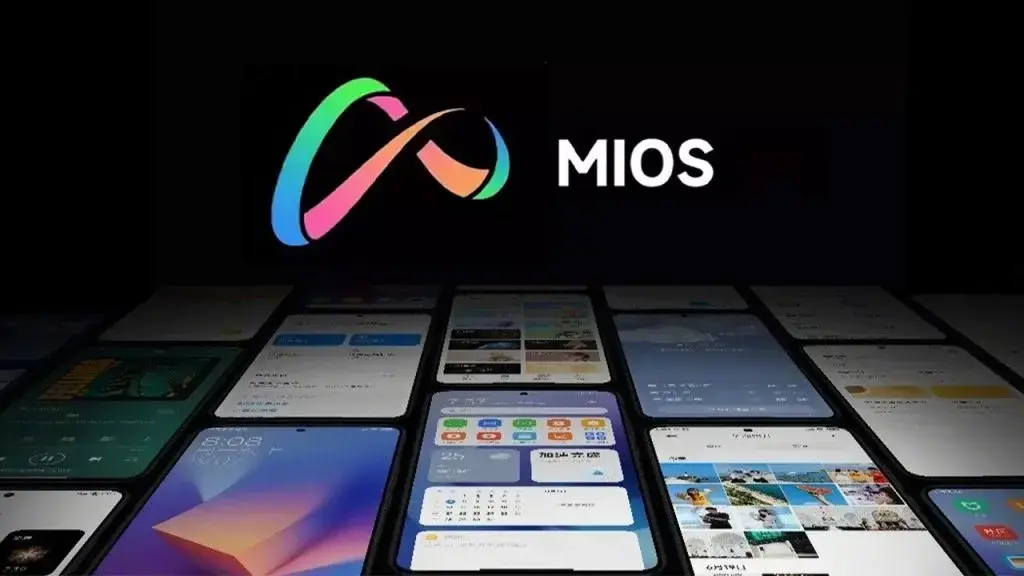
  • Xiaomi Poised for a Paradigm Shift: Transitioning from MIUI to MiOS

    Xiaomi Poised for a Paradigm Shift: Transitioning from MIUI to MiOS

    In a realm incessantly propelled by innovation, maintaining a competitive edge necessitates not merely keeping pace with evolution but oftentimes, spearheading it. Xiaomi, a distinguished luminary in the smartphone universe, is envisaged to be at the cusp of a monumental transition in its Android-based UI system. The pivot from the much-celebrated MIUI to a nascent operating system, MiOS, is speculated to be the company’s resolute stride towards encapsulating the new technological wave ushered in by Android 14.

    The Curtain Call for MIUI

    The discourse on Xiaomi’s software transition emerged from reliable industry conduits, hinting at a forthcoming farewell to MIUI with its 14th iteration. The MIUI, an acronym for Mi User Interface, has been the hallmark of Xiaomi’s Android interface since its inception, melding a user-centric design with a wide gamut of features. Its departure is seen as a bid adieu to an era embellished with iconic features and innovations​1​.

    The Dawn of MiOS

    The inception of murmurs regarding the transition was further fueled by a revelation from a credible tipster, Digital Chat Station, who unveiled Xiaomi’s possible plan to eschew the anticipated MIUI 15 in favor of launching a brand-new operating system, MiOS. The postulation extends to MiOS being a completely fresh construct, engineered from the ground up, with compatibility across a spectrum of devices including smartphones, tablets, and wearable technology​2​.

    An Augury of Enhanced User Experience

    MiOS is envisioned to be a highly-customized, self-developed operating system, signaling Xiaomi’s unwavering commitment to innovation and an enhanced user experience. This new ecosystem is anticipated to usher in a more streamlined and intuitive interface, optimized for superior performance, thereby promising a smoother user interaction. The development of MiOS also aligns with Xiaomi’s objective to diminish reliance on third-party software providers, thereby exuding greater control over the software ecosystem of their devices and offering a more cohesive user experience​3​.

    The conjecture surrounding Xiaomi’s software evolution reflects a broader industry trend towards embracing the perpetual technological advancement. Although the official release date for MiOS remains under wraps, the tech community and Xiaomi aficionados are on tenterhooks, awaiting further elucidation from the company regarding the features and capabilities of MiOS.

    The contrasting narratives around the release of MIUI 15 add a layer of complexity to the scenario, leaving the tech savants and Xiaomi’s clientele in anticipation of official communication from Xiaomi to dispel the clouds of uncertainty​4​.

    Sources: