Tag: Large Magellanic Cloud

  • The Large Magellanic Cloud Warps Its Galactic Neighbor

    The Large Magellanic Cloud Warps Its Galactic Neighbor

    Key Takeaway

    – The Large Magellanic Cloud distorts the Small Magellanic Cloud through gravitational pull.
    – Infrared observation by the Vista telescope over 11 years enabled detailed study of stellar motions.
    – Stars in the Small Magellanic Cloud’s center move away at 17 km/s due to this gravitational force.
    – The Small Magellanic Cloud was likely more compact in the past than its current shape.


    The Large Magellanic Cloud is a satellite galaxy of the Milky Way, located about 163,000 light-years away. Although it is frequently observed by astronomers, a new study has revealed its effect on the Small Magellanic Cloud.

    Observations with the Vista Telescope

    This dwarf galaxy, located 200,000 light-years from Earth, was observed during eleven years with the Vista telescope (Visible and Infrared Survey Telescope for Astronomy) in Chile. According to astronomers, this celestial object is distorted not only by the Milky Way but also by the Large Magellanic Cloud. The infared vision of this telescope was key for seeing through interstellar dust, allowing researchers to study the motion of stars within the Small Magellanic Cloud.

    Researchers Reaction to the Results

    Thus, it was thanks to the infrared vision of this telescope that this observation was possible. Researchers were able to see through interstellar dust and study the motion of stars within the Small Magellanic Cloud, providing interesting results, as Florian Niederhofer explains in a statement: “When I saw the results for the first time, I was amazed by the quality of the measured stellar motions. By combining observations that have been taken over a time baseline of more than a decade, we were able to map the internal kinematics of the Small Magellanic Cloud with a level of detail that is outstanding for observations from the ground.”

    Key Phenomenon and Speed Data

    While results had been revealed in previous years, this new study highlights a specific phenomenon. Indeed, the stars located at the heart of this dwarf galaxy are moving away from its center at a speed of 10.6 miles (17 kilometers) per second. This specific speed measurement is critical for understanding the gravitational dynamics between the two galaxies.

    Gravitational Pull and Past Structure

    Therefore, these results highlight the gravitational pull exerted by the Large Magellanic Cloud on its companion. And that’s not all, because according to astronomers, the Small Magellanic Cloud would have had a more compact structure in the past, very different from its current shape. The study provides evidence that the smaller galaxy once looked nothing like it does today.

    Astronomy & Astrophysics

    Sources

  • Hubble Space Telescope’s Stunning Picture of the Week

    Hubble Space Telescope’s Stunning Picture of the Week

    Key Takeaways

    1. N159 is one of the largest star-forming regions in the Large Magellanic Cloud, located about 160,000 light-years away in the constellation Dorado.

    2. A new Hubble Space Telescope image reveals bubble-like formations created by young stars in gas clouds, highlighting the presence of cold hydrogen gas.

    3. The hydrogen gas forms an intricate web with ridges and glowing threads, while young blue stars produce stellar winds and radiation that shape the surrounding gas.

    4. The intense radiation from these stars ionizes nearby hydrogen gas, causing it to glow in a deep red hue.

    5. The Hubble image showcases the relationship between stars and their environments, aiding astronomers in understanding star formation processes.


    N159 is recognized as one of the largest star-forming regions found within the Large Magellanic Cloud. Positioned approximately 160,000 light-years away, it can be seen in the constellation Dorado. The Large Magellanic Cloud is known as a dwarf galaxy that orbits our Milky Way, and it holds the title of the biggest among the smaller galaxies that circle around our galaxy.

    Hubble’s Latest Discovery

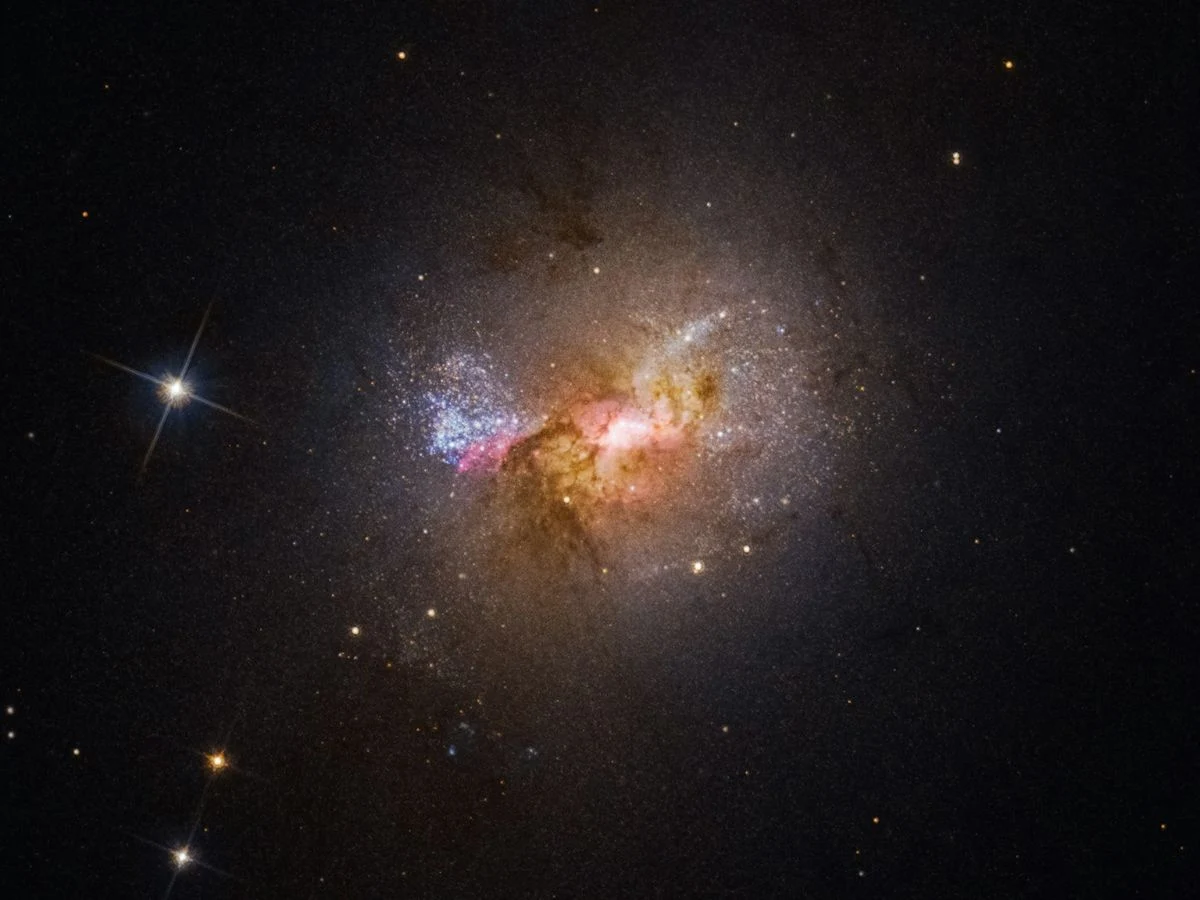
    A new image taken by the Hubble Space Telescope has revealed a portion of N159, showcasing the bubble-like formations produced by young stars within the gas clouds. This latest image presents a similar sight, but it shows that cold hydrogen gas is even more prevalent in this area.

    The Beauty of Hydrogen Gas

    The hydrogen gas creates an intricate web of ridges, cavities, and glowing threads. The bubble-like shapes are still visible in this new capture. Young, massive hot blue stars generate powerful stellar winds and intense radiation that carve out spaces in the surrounding gas. These processes lead to the formation of the bubble-like structures. Moreover, the intense radiation from these youthful stars also ionize the nearby hydrogen gas, causing it to glow in a deep red hue, as depicted in the image.

    Dark Dust and Stellar Relationships

    At the center of the photograph, there is a prominent presence of thick dark dust that obscures light from stars in that area.

    This Hubble image illustrates the intricate connection between stars and their surroundings. It has the potential to assist astronomers in deepening their understanding of the processes of star creation and the transformation of their environments.

    Source:
    Link


  • Stunning Hubble Image of Star-Forming Complex Named Image of the Week

    Stunning Hubble Image of Star-Forming Complex Named Image of the Week

    Key Takeaways

    1. N159 is an H II region located about 160,000 light-years away in the constellation Dorado, consisting of ionized hydrogen gas from young, massive stars.
    2. Young stars emit strong ultraviolet rays that ionize hydrogen atoms, leading to the release of light in the H-alpha spectrum, which gives N159 its reddish appearance.
    3. N159 is one of the largest star-forming clouds in the Large Magellanic Cloud, spanning over 150 light-years.
    4. Hubble’s images of N159 highlight the hot gases involved in star formation, showcasing bright red clouds and sparkling stars in different areas of the region.
    5. N159 is described as a “turbulent cauldron of star birth,” illustrating the intense activities of star formation occurring within it.


    N159 is a well-known H II region situated approximately 160,000 light-years away in the constellation Dorado. An H II region consists of hydrogen gas that has been ionized due to the intense heat emitted by young, massive stars.

    These young stars produce strong ultraviolet rays that cause hydrogen atoms to lose their electrons — a process referred to as ionization. As the electrons and protons in the hydrogen atoms recombine, they eventually release light, especially in the H-alpha spectrum. H-alpha light emits a red hue, which gives star-forming areas like N159 their distinct reddish look.

    A Massive Star-Forming Cloud

    N159 ranks among the largest star-forming clouds within the Large Magellanic Cloud, which is a smaller galaxy that orbits our Milky Way. The image here represents only a small fraction of N159, which spans over 150 light-years—almost 10 million times the distance from the Earth to the Sun.

    In 2016, Hubble shared an image showcasing the entire N159 star-forming cloud. However, that particular image didn’t emphasize the hot gases responsible for star formation. In the current image, this crucial aspect is clearly shown. The bright red clouds dominate the left and center sections, while the right side reveals sparkling stars due to the scarcity of gas there.

    A Turbulent Cauldron of Star Birth

    N159 has been referred to as a “turbulent cauldron of star birth.” The capability of Hubble to produce such images allows us to grasp the intense activities of star formation taking place in N159 much better.

    Source:
    Link


  • James Webb Telescope Finds Life’s Frozen Ingredients in Distant Galaxy

    James Webb Telescope Finds Life’s Frozen Ingredients in Distant Galaxy

    Key Takeaways

    1. NASA’s James Webb Space Telescope (JWST) detected frozen organic molecules around a young star in the Large Magellanic Cloud, 163,000 light-years away.
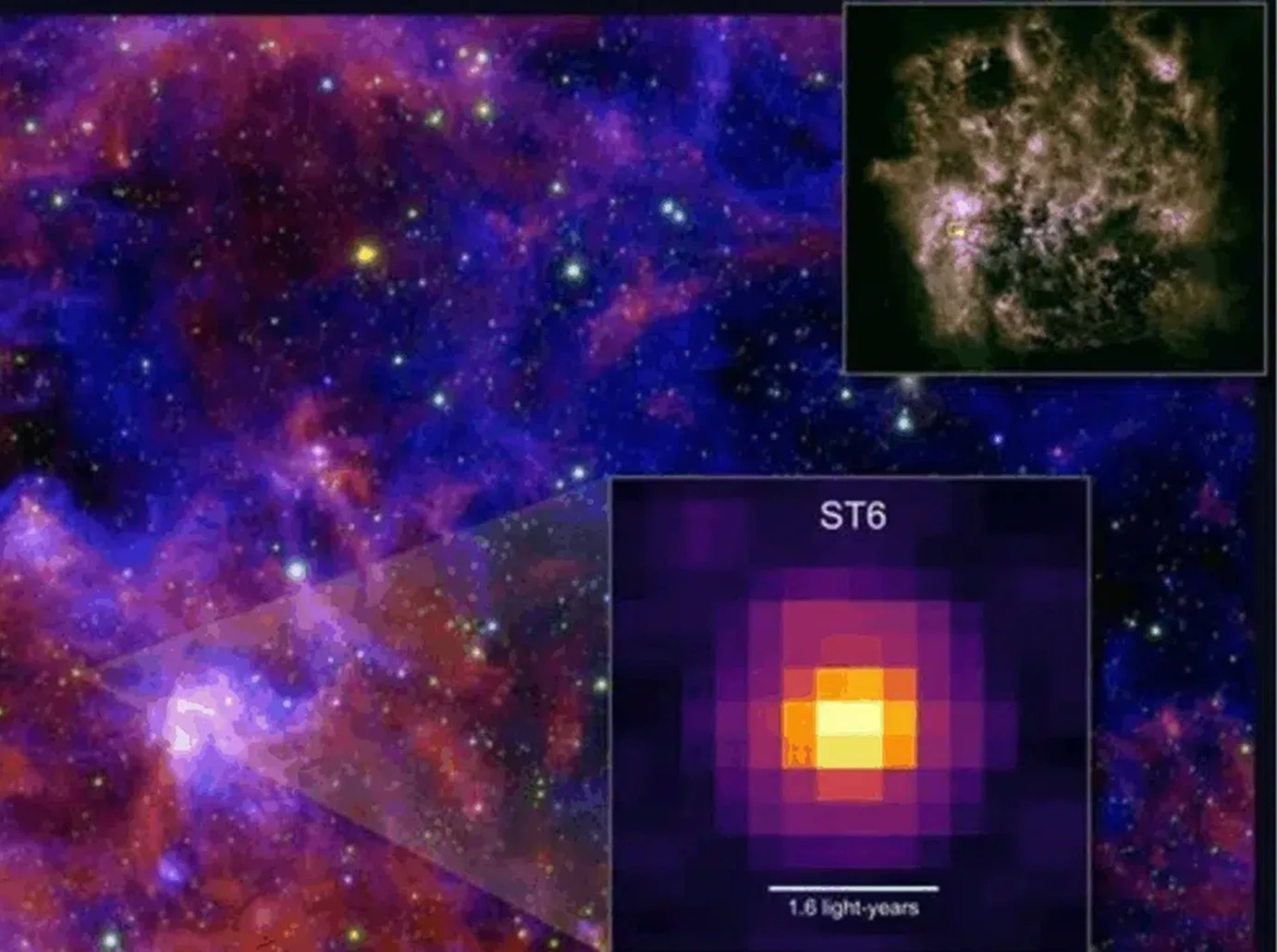
    2. The discovery was made while studying ST6, a protostar, using the JWST’s Mid-Infrared Instrument (MIRI).
    3. This marks the first time the JWST has identified essential life elements outside the Milky Way galaxy.
    4. The findings provide insights into the chemical complexities of star formation regions in different galaxies.
    5. Preliminary analyses suggest the presence of glycolaldehyde, a potential precursor to RNA-related sugars.


    A recent discovery in space has completely amazed astronomers. NASA’s James Webb Space Telescope (JWST) has detected frozen organic molecules in the most unexpected place: surrounding a young star in a far-off galaxy.

    Discovery of Organic Molecules

    The scientists were exploring ST6, a protostar (a star in its very early formation stage), when they stumbled upon these carbon-based compounds. This ‘young’ star is located in the Large Magellanic Cloud (LMC), a dwarf galaxy situated 163,000 light-years from our planet.

    Research and Techniques Used

    The study was led by Marta Sewilo from the University of Maryland. Using the JWST’s Mid-Infrared Instrument (MIRI), the team uncovered complex organic molecules (COMs, or carbon-bearing molecules containing more than six atoms) within interstellar ice. These findings were close to the Tarantula Nebula, which is known for being a prolific factory for star formation.

    Importance of the Findings

    The discovery of COMs marks a significant achievement for the JWST. This is the first occasion the space telescope has identified the essential elements for life outside our Milky Way galaxy, as previous findings were restricted to within our galaxy.

    The carbon-based compounds present an opportunity to expand our knowledge about the chemical intricacies of areas where stars are formed. Researchers can also examine how molecular chemistry evolves under varying conditions in different galaxies. Early analyses have even hinted at the existence of glycolaldehyde, which could be a precursor to ribose, a sugar that is vital for RNA.

    Source:
    Link