
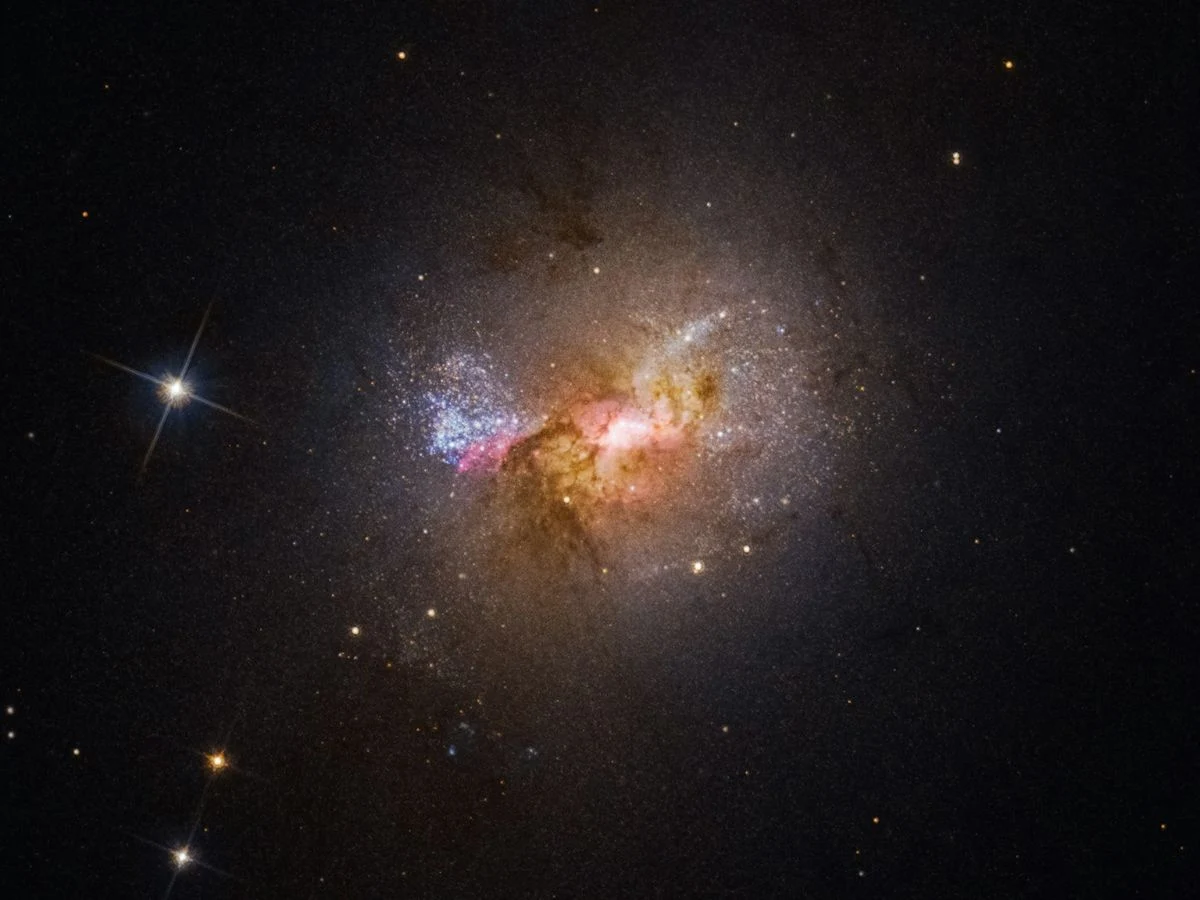
– The Large Magellanic Cloud distorts the Small Magellanic Cloud through gravitational pull.
– Infrared observation by the Vista telescope over 11 years enabled detailed study of stellar motions.
– Stars in the Small Magellanic Cloud’s center move away at 17 km/s due to this gravitational force.
– The Small Magellanic Cloud was likely more compact in the past than its current shape.
The Large Magellanic Cloud is a satellite galaxy of the Milky Way, located about 163,000 light-years away. Although it is frequently observed by astronomers, a new study has revealed its effect on the Small Magellanic Cloud.
Observations with the Vista Telescope
This dwarf galaxy, located 200,000 light-years from Earth, was observed during eleven years with the Vista telescope (Visible and Infrared Survey Telescope for Astronomy) in Chile. According to astronomers, this celestial object is distorted not only by the Milky Way but also by the Large Magellanic Cloud. The infared vision of this telescope was key for seeing through interstellar dust, allowing researchers to study the motion of stars within the Small Magellanic Cloud.
Researchers Reaction to the Results
Thus, it was thanks to the infrared vision of this telescope that this observation was possible. Researchers were able to see through interstellar dust and study the motion of stars within the Small Magellanic Cloud, providing interesting results, as Florian Niederhofer explains in a statement: “When I saw the results for the first time, I was amazed by the quality of the measured stellar motions. By combining observations that have been taken over a time baseline of more than a decade, we were able to map the internal kinematics of the Small Magellanic Cloud with a level of detail that is outstanding for observations from the ground.”
Key Phenomenon and Speed Data
While results had been revealed in previous years, this new study highlights a specific phenomenon. Indeed, the stars located at the heart of this dwarf galaxy are moving away from its center at a speed of 10.6 miles (17 kilometers) per second. This specific speed measurement is critical for understanding the gravitational dynamics between the two galaxies.
Gravitational Pull and Past Structure
Therefore, these results highlight the gravitational pull exerted by the Large Magellanic Cloud on its companion. And that’s not all, because according to astronomers, the Small Magellanic Cloud would have had a more compact structure in the past, very different from its current shape. The study provides evidence that the smaller galaxy once looked nothing like it does today.
Astronomy & Astrophysics
Leave a Reply