Tag: HW4

  • Tesla FSD Enables Phone Use While Driving and Gift Subscriptions

    Tesla FSD Enables Phone Use While Driving and Gift Subscriptions

    Key Takeaways

    1. Tesla is offering a free trial of the FSD 14 upgrade for newer vehicles with HW4/AI4 hardware until January 8, 2026.
    2. Owners of older HW3 vehicles will receive a Lite version of FSD 14, but they will miss the free trial unless gifted an FSD subscription.
    3. Tesla has introduced FSD gift subscriptions, priced at $113, allowing friends or family to buy the upgrade for HW3 owners.
    4. The latest updates allow drivers to use their phones under certain safe conditions, reflecting a shift towards less supervised driving.
    5. Tesla’s FSD is evolving towards unsupervised driving, with recent updates allowing for more relaxed driver engagement in low-risk scenarios.


    Tesla has recently embraced the festive season by offering the FSD 14 upgrade to owners of newer vehicles equipped with the latest HW4/AI4 hardware and cameras.

    Time-Sensitive Offer

    This special offer will end after the holidays on January 8, 2026. Owners who received the offer at the end of November have a window of 40 days to try FSD for free. However, this promotion is exclusive to those with newer Tesla models, leaving many owners of older HW3 vehicles without access since their cars can’t support the newest FSD update.

    Future Options for HW3 Owners

    Tesla has indicated that it will provide a version of FSD 14 Lite for HW3 vehicles, rather than upgrading them to HW4 computers as Elon Musk initially suggested. Unfortunately, by the time this lite version arrives, the free FSD trial offer is likely to be over.

    Nevertheless, HW3 vehicle owners will still have an opportunity to try FSD for free after January 8, but only if someone generously gifts them an FSD gift card. For the first time, Tesla is now providing FSD gift subscriptions, allowing friends or family members to purchase this upgrade for $113, which is higher than the regular $99 subscription price to cover future sales tax.

    A New Way To Experience FSD

    This initiative is a great way for someone to get introduced to FSD, as it allows a month of Full Self-Driving (Supervised) for the recipient to test and consider whether they want to keep using it.

    FSD is gradually becoming less “supervised” officially. Now, drivers can use their phones if the road conditions are suitable, similar to Mercedes’ L3 autonomy in specific areas. With the latest FSD 14.2.1 update, many users have noticed that their vehicle allows them to text for an extended period before prompting them to pay attention. Elon Musk confirmed this new feature, stating it depends “on context of surrounding traffic,” meaning it is permitted only in scenarios that the AI assesses as low risk. While people have been texting and doing other things while on FSD for some time now, Tesla is now formalizing this behavior as it moves closer to providing unsupervised FSD for newer cars.

    Source:
    Link


  • Tesla FSD 14 Launches for HW4: Sloth Mode & Parking Selection

    Tesla FSD 14 Launches for HW4: Sloth Mode & Parking Selection

    Key Takeaways

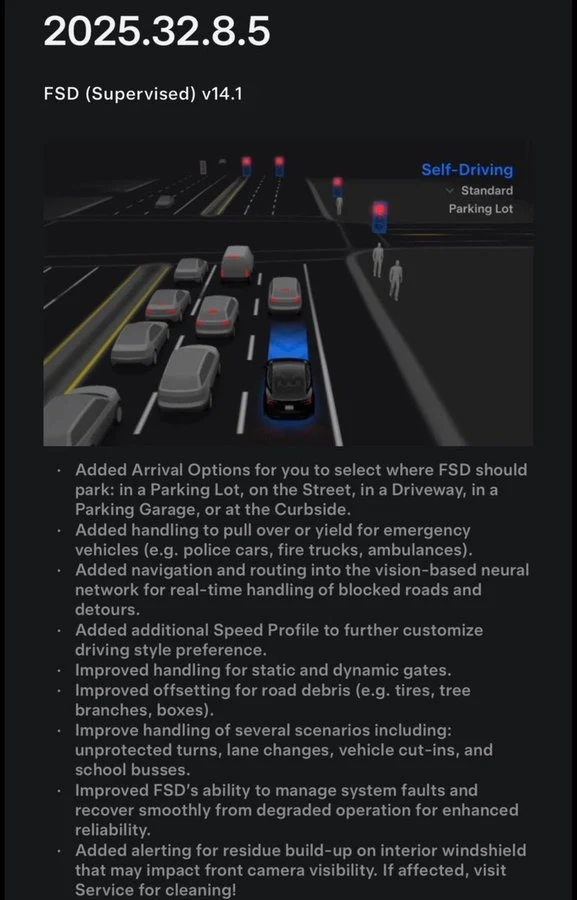
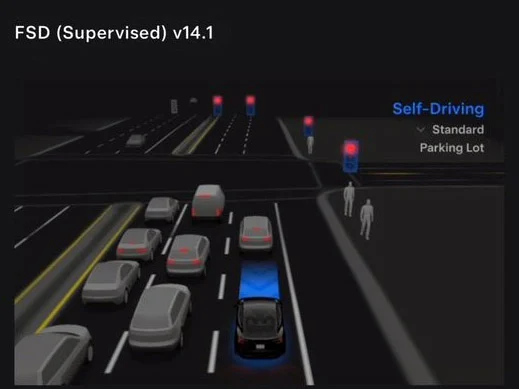
    1. Tesla has released Full Self-Driving (FSD) version 14.1 as part of the 2025.32.8.5 software update, available soon for early testers and select customers.

    2. FSD 14 is only compatible with newer Tesla models using the HW4 camera and computer system, facing challenges integrating FSD 13 into older HW3.0 vehicles.

    3. This update offers significant improvements, including six times the parameter count of FSD 13, resulting in smoother performance and a new safety-focused Sloth driving mode.

    4. New features include the ability to select parking spots at the end of a journey, with a “sentient” driving experience expected in the upcoming FSD 14.2 version.

    5. Many of the updates in FSD 14.1 are bug fixes and enhancements addressing past performance issues, alongside the eagerly awaited new functionalities.


    Tesla has begun releasing its next Full Self-Driving (Supervised) version 14.1, which is integrated into the new 2025.32.8.5 software update. Early access testers and certain customers are expected to receive it soon.

    Compatibility Issues

    Sadly, FSD 14 is designed exclusively for newer Tesla models equipped with the HW4 camera and computer system. Tesla is struggling to integrate even the previous FSD 13 into older Hardware 3.0 vehicles.

    Enhanced Driving Experience

    Nonetheless, FSD 14 represents a significant advancement in self-driving technology, boasting six times the parameter count compared to FSD 13, according to Elon Musk. In actual use, users can expect smoother performance and a new Sloth driving mode that prioritizes safety over speed, even more so than the Chill mode. The update also highlights the ability to select a parking spot at the end of a journey, while Musk’s anticipated “sentient” driving experience will reportedly be featured in the forthcoming FSD 14.2 version.

    Features to Anticipate

    The anticipated “sentience” of FSD is among the planned enhancements, alongside the new features for autonomous parking spot selection that are currently available only as options at the end of a trip. These are the functionalities that users are eagerly awaiting, while many of the other new features in FSD 14.1 appear to be primarily bug fixes and enhancements addressing situations where FSD has previously underperformed.

    Source:
    Link


  • Tesla Pushes Owners to Upgrade for Robotaxi as Uber Launches SUV

    Tesla Pushes Owners to Upgrade for Robotaxi as Uber Launches SUV

    Key Takeaways

    1. Tesla is encouraging individuals interested in its Robotaxi platform to upgrade to newer vehicles to access the service.
    2. The current pilot robotaxi service in Austin uses Tesla’s Model Y SUVs, but plans to allow vehicle owners to participate starting next year.
    3. Only vehicles with Full Self-Driving (FSD) feature and hardware version 4 or newer will be eligible for the Robotaxi platform.
    4. Uber is enhancing its robotaxi offerings by partnering with Lucid to acquire 20,000 Gravity SUVs equipped with Nuro’s autonomous driving technology.
    5. Tesla faces increasing competition in the robotaxi sector, with differing strategies on autonomous vehicle technology between Tesla and its rivals like Uber and Waymo.


    Tesla has begun sending out notifications to individuals who expressed interest in its Robotaxi ride-sharing platform, encouraging them to consider upgrading to a newer vehicle to benefit from the service.

    Current Operations

    At present, Tesla runs a pilot robotaxi service in Austin, Texas, using Model Y SUVs that are owned and operated by the company itself for this trial.

    Future Plans

    However, starting next year, Tesla plans to allow vehicle owners to use the Robotaxi platform. Based on the Austin pilot, it appears that only those with the Full Self-Driving (FSD) feature using hardware version 4 or newer will be eligible, which is the reason for the upgrade notifications.

    After Tesla’s announcement to broaden the robotaxi service area in Austin, Waymo responded similarly. Now, Uber, which operates a robotaxi service utilizing Waymo’s vehicles, has partnered with premium electric vehicle manufacturer Lucid to enhance its offerings.

    Major Developments

    Uber plans to acquire at least 20,000 Gravity SUVs from Lucid, which will come equipped with Nuro’s autonomous driving technology right from the factory. This represents a significant intensification in the competition for robotaxi services, and Tesla’s upgrade notifications could be a strategy to quickly expand its driverless vehicle fleet in response to rivals like Uber.

    One of Tesla’s advantages is its ability to utilize the standard HW4 computer and cameras that are included with its newer models, potentially allowing for a swift transition of many vehicles into the robotaxi fleet all at once. Conversely, Uber’s Lucid Gravity SUVs will feature Nuro’s autonomous driving tech, which is more streamlined than Waymo’s but still necessitates retrofitting.

    Industry Perspectives

    While competing autonomy companies acknowledge that Elon Musk’s camera-only approach may facilitate faster learning and scaling, they tend to favor a more cautious method that includes additional sensors and safety redundancies. The outcome of these differing strategies is yet to be determined, but Tesla is facing increasing competition in the robotaxi sector just as it plans to expand into more cities in the U.S. and incorporate owners’ cars into its fleet.

    Uber’s collaboration with Lucid and Nuro is set to launch on public roads by 2026, coinciding with Tesla’s anticipated introduction of the Cybercab two-seater into its robotaxi fleet. However, Tesla currently lacks a true three-row SUV in its lineup, meaning it won’t be fully equipped to compete with Uber’s driverless Lucid Gravity vehicles when they are deployed.

    Source:
    Link


  • Tesla HW4 Computer Failures as FSD 13 Launches for AI4 Vehicles

    Tesla HW4 Computer Failures as FSD 13 Launches for AI4 Vehicles

    While drivers of older Tesla vehicles equipped with HW3 computers are eagerly anticipating the much-anticipated FSD 12.6 update, those fortunate enough to own newer HW4 models are already enjoying the latest FSD 13.2.1.

    Issues with the New AI4.1 Upgrade

    However, there’s a significant problem for buyers of the latest Tesla models, which come with an unannounced upgrade to the HW4 computer, referred to as AI4.1. These new units are reportedly experiencing failures shortly after purchase, causing them to shut down unexpectedly.

    In some instances, the AI4 computer breaks down after just a few hundred miles, leading to the loss of not only the FSD feature but also the functionality of cameras and GPS navigation, making range estimates impossible to determine. Reports suggest that this issue is quite common, with Tesla’s service team receiving numerous alerts regarding it. The potential cause seems to be a low-voltage system that could be damaging the HW4 system boards during the calibration of the cameras.

    Uncertain Causes and Possible Recalls

    It remains unclear what exactly is causing the short-circuiting that leads to the failure of AI4.1 computers in Tesla vehicles manufactured in recent months; this could potentially be a production flaw. If that’s the case, it may lead to a recall for full unit replacement, even though Tesla is reportedly trying to postpone this outcome with a software solution.

    Despite providing quicker AI processing capabilities, Tesla’s HW4 computer doesn’t offer many other benefits compared to the HW3 unit. The primary aim appears to be reducing production costs, as HW4 has less RAM and storage in models like the Model Y and Model 3, along with increased power consumption when not in use.

    Cost-Cutting Consequences

    Tesla might have pushed the boundaries of cost-saving measures too far with the AI4.1 version of their computer, leading to potential weaknesses. Elon Musk had promised that all HW3 computers would be upgraded to AI4 units for free if FSD 13 couldn’t be made functional on them. Given the issues with the AI4 computer, this assurance doesn’t seem as promising now as it did at the time of the retrofit announcement.

    — Ashok Elluswamy (X), Electrek

    Source: Link

  • Tesla FSD V13.2 Launches: Full Parking Automation & 3-Point Turns

    Tesla FSD V13.2 Launches: Full Parking Automation & 3-Point Turns

    Tesla has unveiled its newest Full Self-Driving (Supervised) V13 edition, just a few months after the release of V12.5.

    Launch Timing and Features

    Previously, the AI team at Tesla had indicated that FSD 13 would be ready by October, likely coinciding with the Robotaxi demonstration. At the event, Cybercabs were indeed utilizing FSD 13. The public rollout has just occurred, and Tesla shared an extensive list of updates for FSD 13.2, highlighting improvements like a response speed that is twice as fast and enhanced collision avoidance, made possible by a three times larger AI model trained on computers that operate five times quicker.

    User Experience Enhancements

    While the statistics on processing capabilities, such as 5x-6x improvement in miles driven without needing intervention, are noteworthy, there are real benefits for users of FSD 13. For example, drivers can now engage FSD directly from Park with a simple button press. The new profiles for city and highway driving also contribute to a more pleasant driving experience.

    Development Insights

    Yun-Ta Tsai from Tesla mentioned the extraordinary effort to launch FSD 13:

    “We completely restructured the system to greatly simplify the flow—from direct photons to control—while adding much more functionality within the same unified framework. This is likely one of the most significant rewrites in years since we began our journey with ‘photon count’ four years ago.”

    New Functionalities

    Among the most noticeable features in FSD 13 are the capabilities for three-point turns and self-parking. The Tesla can now exit a parking spot, reverse, or park itself in locations like driveways or garages, with these features coming in a future update. FSD 13 also includes enhancements in camera visibility and cleaning, with plans for future updates to improve how the system handles camera view obstructions.

    Navigation Improvements

    FSD 13 can now identify road closures and suggest alternate routes, thanks to its ability to process mapping data more efficiently. Additionally, Tesla has tackled some common grievances of FSD users, such as unnecessary braking and overly cautious driving in parking areas.

    Hardware Limitations

    It’s unfortunate that all the new features in FSD 13.2 are only available for Tesla owners equipped with the latest HW4 or AI4 computer and camera systems. Most Teslas still operate on HW3, but Elon Musk hinted that the company might offer free upgrades to HW4 if it proves challenging to make the next unsupervised FSD update compatible with older hardware.

    With Elon Musk now leading the DOGE government efficiency department, the rollout of unsupervised FSD could happen more quickly, and it will soon be determined whether HW4 retrofits will be necessary.


    Image 1
  • Tesla Simplifies Identification of HW4 and HW3 Vehicles with License Plates

    Tesla Simplifies Identification of HW4 and HW3 Vehicles with License Plates

    Tesla has made it simpler for users to determine if their vehicles are equipped with HW3 or HW4 Full Self-Driving (FSD) cameras and processing power.

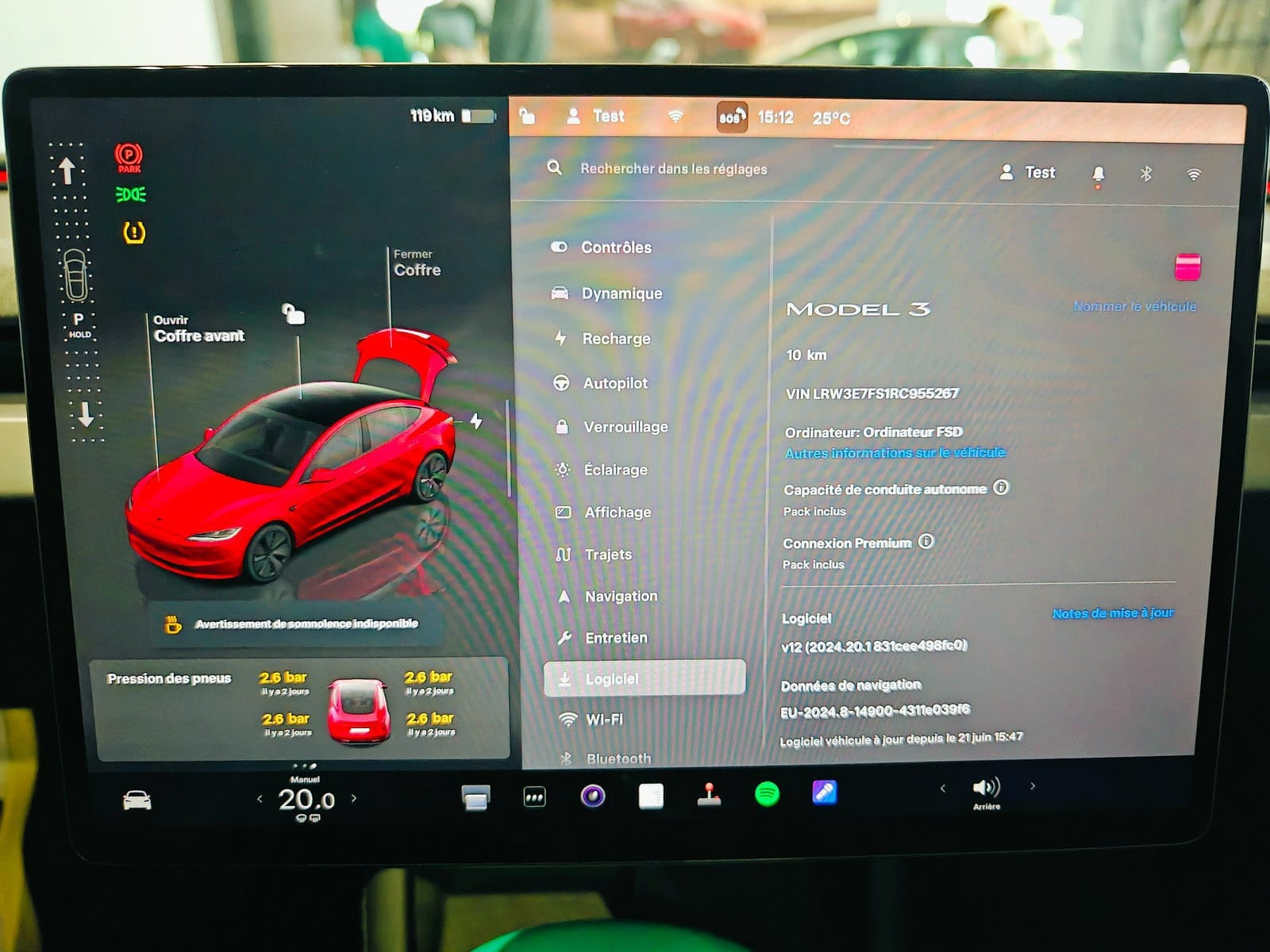
    With the most recent software update, version 2024.38, users can now view the FSD hardware version right in the additional vehicle info submenu. By selecting the Additional Vehicle Information option located under the FSD computer section in the Controls > Software menu, drivers can see if their Tesla features HW4, HW3, or the older HW2.5 setup.

    Understanding FSD Hardware Designations

    Tesla has rebranded Hardware 4.0 as the AI4 computer, which is how it appears in the fresh FSD hardware version display option. Previously, identifying whether a Tesla has a HW3 or HW4 kit has been quite complex, relying on physical traits such as the red tint associated with AI4 cameras or the vehicle’s delivery date.

    Although HW4 vehicles are still relatively rare, they were the first to receive the FSD 12.5 update. Tesla’s AI chief has indicated that these vehicles will also be prioritized for the forthcoming FSD 13 update, which includes new features.

    Free Upgrades for HW3 Vehicles

    Elon Musk has stated that if HW3 vehicles are unable to support the unsupervised FSD that comes with the v13 update, they will be upgraded to the AI4 computer at no cost. Initially, it was believed that retrofitting HW3 to HW4 was impractical due to differences in the system board size and connectors. However, visiting a Tesla service center will help navigate these constraints, as the company needs to collect miles driven on FSD to prove its safety to regulators overseeing the Robotaxi and Cybercab services.

    After introducing the FSD hardware version on the vehicle display, Tesla is also working on a feature to show the car’s license plate number. A hacker named Green has explored Tesla’s 2024.38 update code and discovered hints of a license plate number display on the central console screen. This feature appears to be rolling out first for Chinese models, as is common for the company, before becoming available worldwide.

    Personalization Options for Tesla Owners

    In addition to displaying the license plate number in the previously blank area, owners will have the ability to enter any text they wish. Parents whose kids enjoy customizing their virtual Teslas with unique colors will find this new feature to be another fun way to personalize their vehicle’s display, whether for a specific purpose or just for enjoyment.

    Green, NotATeslaApp