Tag: Huawei

  • Huawei Smartwatch Update Adds New Messaging Feature

    Huawei Smartwatch Update Adds New Messaging Feature

    Key Takeaways

    1. The Huawei Watch Fit 3 is receiving a new firmware update, version 5.0.0.17, which is 110.5 MB in size.
    2. Users can now directly respond to messages from their smartwatch using the new Celia keyboard feature, available for Android devices.
    3. The update allows users to reject calls from WhatsApp, Messenger, Instagram, and Telegram via notifications on the watch.
    4. The firmware aims to improve system stability in certain situations, though specific details are not provided.
    5. The update is being released in phases and can be downloaded through the Huawei Health app.


    The Huawei Watch Fit 3 smartwatch is getting a fresh global update. The new firmware, version 5.0.0.17(C00M03), is a 110.5 MB download that follows the HarmonyOS 5 release that happened at the end of 2024. This update introduces several enhancements related to messaging and calls.

    New Messaging Features

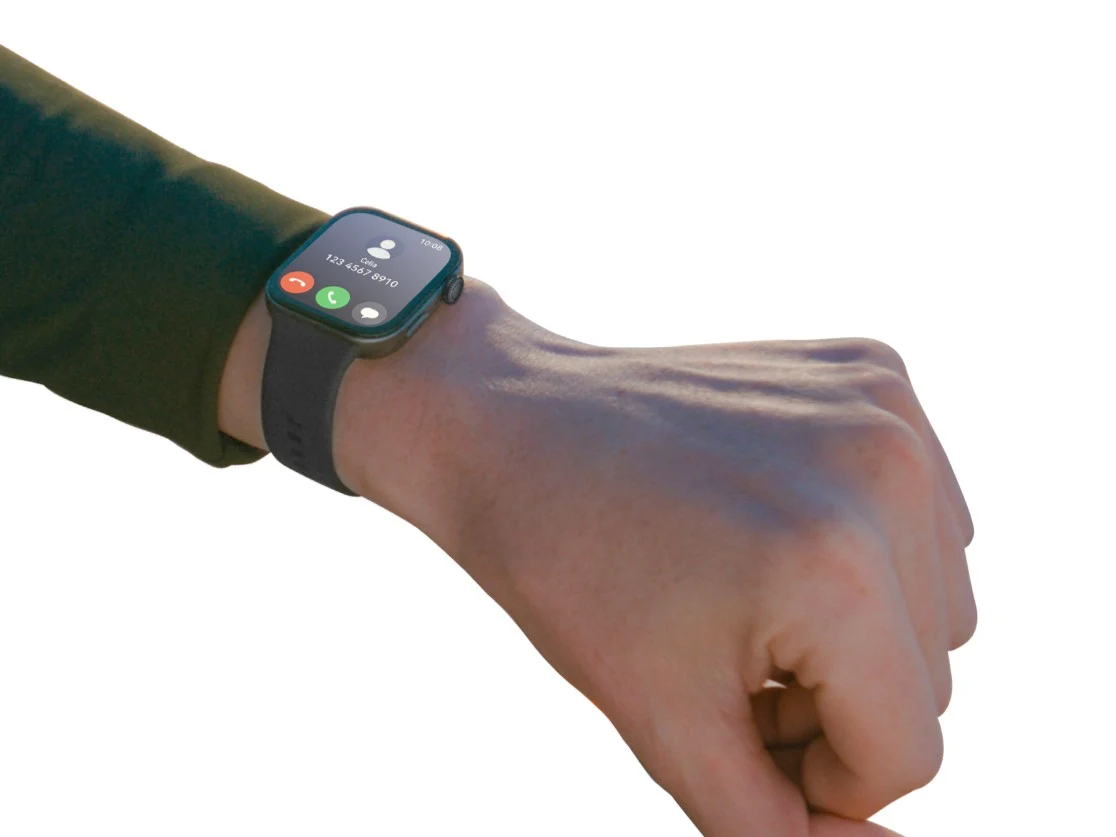
    According to the change log for firmware version 5.0.0.17, users can now directly respond to messages from their Watch Fit 3. This new capability comes from the integration of the Celia keyboard, which allows users to reply to messages across different platforms, including SMS, Whatsapp, and Messenger. However, it should be noted that this feature is only available for those using Android devices.

    Call Management Enhancements

    In addition, this update adds a feature that enables users to reject calls from WhatsApp, Messenger, Instagram, and Telegram. Now, users have the option to decline calls from their connected smartphone through notifications on their watch. Moreover, the firmware is reported to improve system stability in “certain situations,” although specifics are not provided.

    The firmware version 5.0.0.17(C00M03) can be downloaded via the Huawei Health app. It appears that the update is being rolled out in phases, and it is not yet clear when it will be available to all Huawei Watch Fit 3 users.

    Source:
    Link

  • Huawei Pura 80 Ultra Set to Launch with Enhanced OLED Display

    Huawei Pura 80 Ultra Set to Launch with Enhanced OLED Display

    Key Takeaways

    1. The Mate 70 RS Ultimate features a dual-layer OLED screen with a 120Hz refresh rate and a brightness of 3,500 nits, but the upcoming Pura 80 Ultra is expected to have even better display technology.
    2. The Pura 80 Ultra will likely use the same Kirin 9020 SoC as the Mate 70 RS Ultimate.
    3. Several models of the Pura 80 series are anticipated, including the 80 Ultra, 80 Pro+, 80 Pro, and standard 80, with staggered release dates.
    4. Each model in the Pura 80 series is expected to have a unique design, differing from the common practice of similar designs across variants.
    5. The Pura 80 Ultra will feature an advanced camera system with a large 1-inch main sensor and impressive zoom capabilities, paired with its high-quality display.


    The Mate 70 RS Ultimate Design stands out as a unique flagship smartphone, featuring a dual-layer OLED screen that boasts a 120Hz refresh rate and a maximum brightness of 3,500 nits. However, Huawei seems keen on outdoing itself with the anticipated Pura 80 Ultra, which is rumored to have even better display technology.

    Display Improvements Ahead

    This upcoming device is expected to offer the finest display seen in a Huawei phone so far, though it is likely to be powered by the same Kirin 9020 SoC found in the Mate 70 RS Ultimate.

    Multiple Models Expected

    Alongside the 80 Ultra, there are indications that models such as the 80 Pro+, 80 Pro, and base 80 may also be released. However, they might not all hit the market simultaneously, with speculations suggesting that the standard 80 could be the last to launch, as per the credible source Fixed Focus Digital.

    Unique Designs for Each Model

    This same source has also suggested that the four anticipated variants of the Pura 80 series could feature distinct designs, unlike other brands that often offer vanilla and Pro versions sharing the same basic chassis but with varying hardware specifications.

    The concept of each model in the 80 series having its unique look is fascinating, albeit potentially costly for Huawei, especially since each variant may necessitate a different screen.

    In the meantime, those purchasing the Pura 80 Ultra can expect to benefit from a cutting-edge camera system, which is said to include a large 1-inch main sensor along with impressive zoom capabilities, all displayed on what promises to be a top-notch screen.

    Source:
    Link

  • Pura 80 Ultra: Huawei’s Zoom Camera Teaser Inspired by P30 Pro

    Pura 80 Ultra: Huawei’s Zoom Camera Teaser Inspired by P30 Pro

    Key Takeaways

    1. Huawei’s smartphone camera technology gained prominence starting with the P9 in 2016, challenging major competitors like Samsung.
    2. The P30 Pro introduced key innovations, such as exceptional night mode, RYYB sensor technology, and a pioneering periscope telephoto camera.
    3. The upcoming Pura 80 launch promises advanced features, including a sneak peek at the new XImage camera system with a variable aperture.
    4. Enhanced zoom capabilities in the Pura 80 series aim to redefine standards, particularly in low-light conditions.
    5. The Pura 80 Ultra may include a switchable telephoto lens and a 24mm main camera with a variable aperture, while 3D facial recognition will not be included in 2025.


    Huawei’s journey to the forefront of smartphone camera technology started in 2016 with the launch of the Huawei P9. This marked the beginning of a competitive era, as the brand gained immense popularity and posed a real challenge to Samsung with the introduction of the P30 and P30 Pro. The P30 Pro, in particular, was notable for its exceptional night mode, Huawei’s signature RYYB sensor technology, and one of the first effective periscope telephoto cameras, which has since become the benchmark in high-end smartphones.

    Upcoming Launch of the Pura 80

    In anticipation of the Pura 80 launch event happening next week, Huawei is highlighting these achievements with a video on the Chinese social media platform Weibo. The video will conclude with a sneak peek of the new XImage camera system featured in the Pura 80 series. This system is expected to include a variable aperture and, although not yet confirmed, may showcase Huawei’s first 1-inch sensor alongside a dual-focus periscope telephoto lens.

    Enhanced Zoom Capabilities

    A major highlight of the Pura 80 series is the zoom camera, as evidenced in the second teaser video released from China. The ability to zoom in on distant subjects, particularly in low-light environments like concert halls, is a feature many brands boast about. Huawei is poised to potentially redefine standards in this area with the Pura 80 Ultra, as suggested by the promotional video. Digital Chat Station has also recently mentioned the “switchable telephoto lens” of the Pura 80 Ultra on Weibo. Another post indicates that the Pro model will feature a 24mm main camera with a variable aperture and an 89mm (or 3.7x) telephoto lens, though it appears that Huawei will skip 3D facial recognition in 2025.

    Source:
    Link

  • Huawei’s Upcoming Tri-Fold Phone to Launch This Year with Upgrades

    Huawei’s Upcoming Tri-Fold Phone to Launch This Year with Upgrades

    Key Takeaways

    1. The Huawei Mate XT debuted in September 2024 as the company’s first tri-fold smartphone.
    2. A successor to the Mate XT is rumored to be released later this year with expected upgrades.
    3. The new tri-fold smartphone may maintain the same display specifications as the Mate XT, with improved durability.
    4. The successor is anticipated to feature the Kirin 9020 processor, a significant upgrade from the Kirin 9010 in the original Mate XT.
    5. Camera improvements are expected, but specific details about the camera features have not been disclosed.


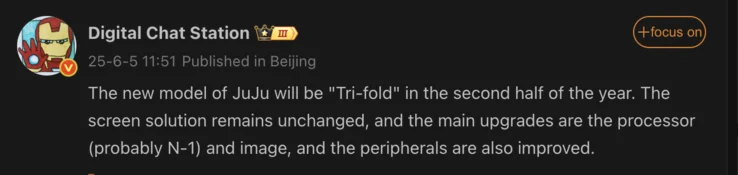
    The Huawei Mate XT made its debut in September 2024, marking the company’s first foray into tri-fold smartphones. Recently, a new rumor has emerged, suggesting that a successor to the Mate XT is set to be released later this year. This leak also sheds light on some of the significant upgrades expected in Huawei’s next tri-fold device.

    Screen Specifications

    The source of the leak, Digital Chat Station, indicates that the new tri-fold smartphone may retain the same display specifications as the Mate XT, implying that its size and resolution could stay the same, though enhancements in durability are likely.

    Processor Improvements

    An important enhancement for the next iteration of the phone will be its processor. The initial Mate XT was powered by the Kirin 9010 chip, whereas its successor is anticipated to feature the Kirin 9020 chipset. The Kirin 9020 is a 12-core processor manufactured on a 7nm process, which also drives Huawei’s top-of-the-line Mate 70 series.

    Camera Upgrades

    A further significant improvement expected in the upcoming tri-fold smartphone is its camera capabilities. Nevertheless, the source did not provide any specific details regarding the camera features. The original Mate XT came equipped with a triple rear camera system, which included a 50MP main sensor, a 12MP ultrawide lens, and a 12MP periscope telephoto lens.

    The leak suggests that the successor to the Mate XT is likely to be unveiled in the latter half of 2025. As of now, Huawei has not officially confirmed any details about a new tri-fold device, so it’s wise to approach this information with skepticism.

    Source:
    Link


  • Huawei Pura 80 Ultra Launch Date Revealed in Latest Leak

    Huawei Pura 80 Ultra Launch Date Revealed in Latest Leak

    Key Takeaways

    1. The Pura 80 Ultra is designed to compete strongly in the smartphone market, particularly with its standout camera design.
    2. The camera features a first-gen SmartSens SC5A0CS 1-inch sensor, promising significant improvements in videography and photography.
    3. Huawei is likely developing the camera technology in-house, with a potential upgrade of the color temperature sensor to 2MP.
    4. Pre-orders for the Pura 80 series are expected to start after the Dragon Boat Festival, which runs from May 31 to June 2, 2025.
    5. The official launch of the Pura 80 Ultra and its variants is anticipated to occur after the festival, possibly in July 2025.


    The Pura 80 Ultra is said to be ready to take over the smartphone market, especially with its camera design expected to stand out on its back panel, as reported by the usually trustworthy leaker, Fixed Focus Digital.

    Impressive Camera Features

    The capabilities of the Ultra’s camera are described as “intimidating” by the source, and this could be linked to its upgrade featuring the first-gen SmartSens SC5A0CS 1-inch sensor. This enhancement is anticipated to significantly improve both videography and photography.

    In-House Innovations

    It is believed that Huawei has developed the camera in-house, and there are hints about a possible upgrade for the color temperature sensor to 2MP, compared to 1.6MP in the previous Pura 70 Ultra version, despite earlier rumors suggesting a 5MP upgrade.

    Pre-Order and Release Timeline

    Fixed Focus Digital also claims that Huawei will likely start accepting pre-orders for the Pura 80 series after the upcoming public holiday in China, which is the Dragon Boat Festival. This festival begins today, May 31, 2025, and goes on until June 2.

    The Pura 80 Ultra and its variants are expected to be officially launched following this period, although the exact release date might not occur until July 2025.

    Source:
    Link


  • Huawei Pura 80 Pro Launching with New SmartSens 1-Inch Camera

    Huawei Pura 80 Pro Launching with New SmartSens 1-Inch Camera

    Key Takeaways

    1. The Pura 80 series will likely include vanilla, Pro, and Ultra models, similar to previous versions.
    2. The Pro model may feature a 1-inch main camera, which was previously thought to be exclusive to the Ultra version.
    3. The 1-inch camera is expected to have a 50MP resolution and be developed in-house by Huawei.
    4. Huawei plans to launch a new sensor brand called SmartSens for its self-made camera sensors.
    5. The anticipated main sensor model is “SC5A0CS,” with a smaller variant possibly featured in the Pura 80 Ultra or Pro.


    The upcoming Pura 80 series premium smartphones will probably include vanilla, Pro, and Ultra models, similar to what we saw with previous versions. However, it’s likely that only a few will come equipped with the most exciting new features that Huawei is expected to unveil.

    Pro Variant’s Exciting Feature

    Rumor has it that the Pro model might have a feature previously believed to be exclusive to the Ultra version: a 1-inch main camera.

    This camera, akin to the one found in the Xiaomi 15 Ultra, is speculated to have a 50MP resolution that matches its top-tier design. Interestingly, it’s thought that this sensor will be developed in-house by Huawei, rather than sourced from a third-party supplier like Sony or OmniVision.

    New Sensor Brand

    According to the well-informed leaker Digital Chat Station, Huawei plans to launch this self-made sensor under a new brand called SmartSens. The anticipated 1-inch flagship sensor, referred to as “SC5A0CS,” might be accompanied by a smaller variant measuring 1/1.3 inches. This smaller sensor could also appear in the Pura 80 Ultra, or maybe even the 80 Pro.

    Source:
    Link

  • Huawei’s Next Flagship Phone to Use Custom Camera Sensor Instead of Sony

    Huawei’s Next Flagship Phone to Use Custom Camera Sensor Instead of Sony

    Key Takeaways

    1. Huawei launched the Nova 14 series and their first foldable PC at a recent event in China.
    2. The upcoming Pura 80 series will likely include three models: Pura 80, Pura 80 Pro, and Pura 80 Ultra.
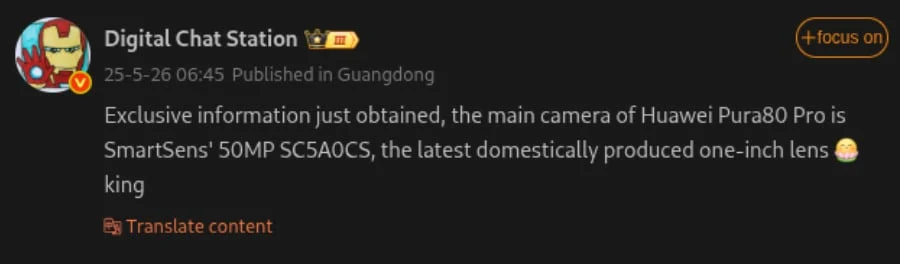
    3. The Pura 80 Pro will feature a custom 50-megapixel image sensor developed by Huawei, the SmartSens SC5A0CS.
    4. The rear camera setup for the Pura 80 Pro may include a 50-megapixel ultra-wide lens and a 50-megapixel telephoto macro camera, with a custom RYYB color filter for improved low-light performance.
    5. The Pura 80 Pro is expected to have a 6.78-inch OLED display with 1.5K resolution and LTPO variable refresh rate, launching in the second quarter of this year.


    Huawei recently held a significant launch event in China, where they introduced the Nova 14 series along with their first foldable PC. However, attention might soon turn to their upcoming release: the Pura 80 series.

    Upcoming Models in the Pura 80 Series

    There are strong indications that the lineup will consist of three models: the standard Pura 80, the Pura 80 Pro, and the high-end Pura 80 Ultra. Notably, the Pro version is now reported to utilize a custom image sensor created by Huawei itself.

    Custom Sensor for the Pura 80 Pro

    A new update from the well-known tipster Digital Chat Station suggests that the Pura 80 Pro will include a unique image sensor developed by Huawei. It is believed to incorporate the SmartSens SC5A0CS, a 50-megapixel, 1-inch RYYB sensor. This differs from prior claims made by the tipster, who had suggested that the Pura 80 Pro would feature a Sony IMX989 sensor. Indeed, it appears that Huawei was experimenting with the Sony sensor in an engineering prototype of the Pura 80 Pro a few months back. However, DCS notes that Huawei has altered its path during the hardware finalization.

    Camera Features and Display

    If Huawei has only made a change to the main sensor, the remainder of the rear camera configuration may stay consistent with earlier leaks. It is reported to include a 50-megapixel ultra-wide lens and a 50-megapixel periscope telephoto macro camera. Allegedly, all three sensors will employ a custom RYYB color filter that boosts low-light performance by allowing up to 40 percent more light intake. Furthermore, the Pura 80 Pro is said to come with a 6.78-inch OLED display that supports a 1.5K resolution and LTPO variable refresh rate.

    The Huawei Pura 80 series is anticipated to hit the market sometime during the second quarter of this year.


  • Huawei and Xiaomi Lead Smartphone Shipments in China Q1 2025

    Huawei and Xiaomi Lead Smartphone Shipments in China Q1 2025

    Key Takeaways

    1. Huawei leads the Chinese smartphone market with a 19% share in Q1 2025, surpassing competitors.
    2. China’s smartphone market grew by 5% year over year, driven by a government subsidy initiative, but growth slowed post-holiday.
    3. Xiaomi matched Huawei’s market share at 19%, with a 3% quarter-over-quarter increase.
    4. Apple fell to third place with a decline in market share from 17% to 15%, affected by the subsidy program’s price limitations.
    5. Oppo and Honor ranked fourth and sixth, with market shares of 15% and 13%, respectively; growth in the market is expected to continue but at a slower pace in 2025.


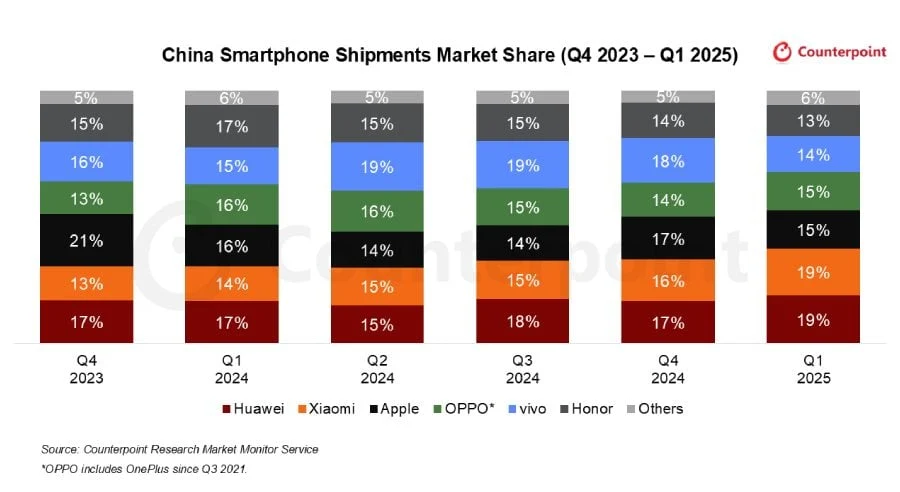
    Counterpoint has released its newest report on smartphone shipments in China, revealing that Huawei has secured the top position, surpassing all competitors to achieve the No. 1 rank in Q1 2025.

    Market Growth Insights

    China’s smartphone market experienced a 5 percent increase year over year, largely due to a government subsidy initiative that started in January. However, this initial surge in demand didn’t persist. Counterpoint notes that interest waned after the holiday period, leading to growth that still fell below what was anticipated.

    Huawei’s Performance

    Huawei managed to capture a 19 percent share of the market this quarter, marking a 2 percent rise from Q4 2024. Xiaomi matched Huawei’s share at 19 percent but recorded a slightly higher quarter-over-quarter increase of 3 percent.

    Apple dropped to third place, with its shipments declining by 2 percent, which reduced its share from 17 percent to 15 percent. Counterpoint suggests that this decrease is linked to the nature of the government subsidy program, which only applies to phones priced over CNY 6,000 (around $820). Many iPhones, especially the popular Pro models, are priced well above this limit, making them ineligible for discounts.

    Other Brands in the Market

    Oppo secured the fourth position with a 15 percent market share and a modest growth of 1 percent. Vivo experienced a notable decrease, dropping from 18 percent to 14 percent compared to the previous quarter. Honor followed closely behind in sixth place, holding a 13 percent share.

    Looking forward, Counterpoint anticipates that the Chinese smartphone market will keep growing year over year in 2025, albeit at a slower rate. The upcoming launches of new devices in Q2 and mid-year sales events are expected to provide a temporary uplift in shipments.

  • Huawei Kirin X90 Chip Built on New SMIC 5nm Technology

    Huawei Kirin X90 Chip Built on New SMIC 5nm Technology

    Key Takeaways

    1. Huawei has launched the MateBook Pro variant, powered by HarmonyOS and featuring the new X90 chip from HiSilicon.
    2. The X90 chip is rumored to be a modified version of the Kirin 9010, with details pending from upcoming reviews.
    3. The Kirin X90 is manufactured using SMIC’s 5 nm N+3 process, achieving a transistor density of around 125 million per mm².
    4. Production challenges exist, with SMIC producing only 3,000 wafers monthly and achieving a low yield of 20%.
    5. Caution is advised regarding Huawei’s claims about the chip’s capabilities, as independent analysis is needed to confirm its performance.


    Huawei has launched its much-anticipated MateBook Pro variant, often referred to as the ‘Mac Killer.’ This new device operates on HarmonyOS and features an enigmatic X90 chip from HiSilicon. A leaker has suggested that this chip is a modified version of the Kirin 9010, with some alterations in the CPU core structure. In-depth reviews of the chip are expected to clarify its details in the upcoming days. Meanwhile, a Chinese news outlet has shared some intriguing new insights about Huawei’s latest tech release.

    Chip Specifications

    The Kirin X90 is reportedly made using SMIC’s 5 nm N+3 process. This aligns with last year’s reports indicating that SMIC’s 5 nm technology was up and running. An X user has speculated that the chip’s density could be around 125 million transistors per mm², which is a bit lower than TSMC’s N5 at approximately 138 million transistors per mm². This is an impressive achievement, especially since SMIC managed to reach this level using DUV lithography, unlike TSMC, Intel, and others that utilize state-of-the-art ASMC EUV machines, which are currently inaccessible due to US sanctions.

    Production Challenges

    On the downside, the production yields are not very promising. An analyst found out that SMIC is producing about 3,000 wafers each month, but only achieving 20% yields. This situation doesn’t lend itself to large-scale production, but it might be more about setting a benchmark than creating a commercially viable product. It’s worth noting that Huawei has a history of trying to pass off TSMC chips as their own, so it might be prudent to wait until independent sources analyze the Kirin X90 in detail.

    Source:
    Link

  • Huawei, Honor, OPPO, and Vivo Join Forces for UFCS 2.0 Charging Standard

    Huawei, Honor, OPPO, and Vivo Join Forces for UFCS 2.0 Charging Standard

    Key Takeaways

    1. Huawei, Honor, Oppo, and Vivo have created a standardized charging protocol called UFCS 2.0 in China.
    2. UFCS 2.0 introduces 40W unauthenticated power delivery for faster charging without brand-specific adapters.
    3. The protocol includes reverse charging, allowing devices to charge others regardless of the brand.
    4. PowerChange feature adjusts charger output automatically based on the connected device, enhancing safety and efficiency.
    5. The collaboration aims to reduce confusion from incompatible charging standards, but global adoption remains uncertain.


    Huawei, Honor, Oppo, and Vivo have teamed up to create a standardized charging protocol in China. These four Chinese smartphone manufacturers gathered at the UFCS Industry Development Conference in Shenzhen on May 22 to sign a new agreement regarding the Universal Fast Charging Standard (UFCS) 2.0 protocol.

    Background on UFCS

    For those who don’t know, the UFCS charging was first launched by Huawei, Oppo, Vivo, and Xiaomi in 2021. It laid the groundwork for establishing centralized mobile fast charging standards among these brands.

    Enhancements in Version 2.0

    UFCS Version 2.0 brings significant technical improvements compared to its predecessor. The most important is the inclusion of 40W unauthenticated power delivery. This allows devices to charge at faster rates without the need for specific handshakes between brand-specific adapters and cables.

    The protocol also adds a reverse charging capability, enabling supported devices to charge others, no matter the brand.

    Features and Impacts

    The companies state that UFCS 2.0 requires a feature called PowerChange, which actively adjusts adapter power. This means that chargers will automatically recognize and modify their output based on the device they are connected to, irrespective of its manufacturer. This is intended to enhance both safety and efficiency, while minimizing the issues often associated with third-party charging accessories.

    The collaboration of these four brands for a unified charging standard is beneficial for users. Fast charging has become a standard expectation in modern smartphones, yet it is often inconsistent. Historically, each brand has promoted its own proprietary solutions, resulting in a confusing array of incompatible standards and surplus chargers for consumers. In theory, UFCS aims to alleviate that fragmentation, at least among this group.

    However, it remains uncertain whether this protocol will be adopted outside of China or embraced by global competitors such as Samsung or Apple. As long as companies continue to favor isolated standards, users will be reliant on the ecosystem they choose to invest in.

    Source:
    Link