Tag: Framework Desktop

  • Framework Desktop vs GMK EVO-X2: Ryzen AI Max+ 395 Efficiency

    Framework Desktop vs GMK EVO-X2: Ryzen AI Max+ 395 Efficiency

    Key Takeaways

    1. The Framework Desktop features a mobile Zen 5 Ryzen AI Max+ 395 CPU and integrated Radeon 8060S GPU, setting it apart from typical mini-ITX PCs that use desktop processors.
    2. It has lower power consumption, averaging about 144 W under load, compared to the GMK EVO-X2’s 186 W, while maintaining similar performance levels.
    3. The Framework Desktop operates in Balanced mode, showcasing efficient performance without high power usage.
    4. The larger size of the Framework results in quieter fans and lower core temperatures compared to the GMK model.
    5. The Framework Desktop is considered more adaptable and offers better value unless compact design is a top priority for the user.


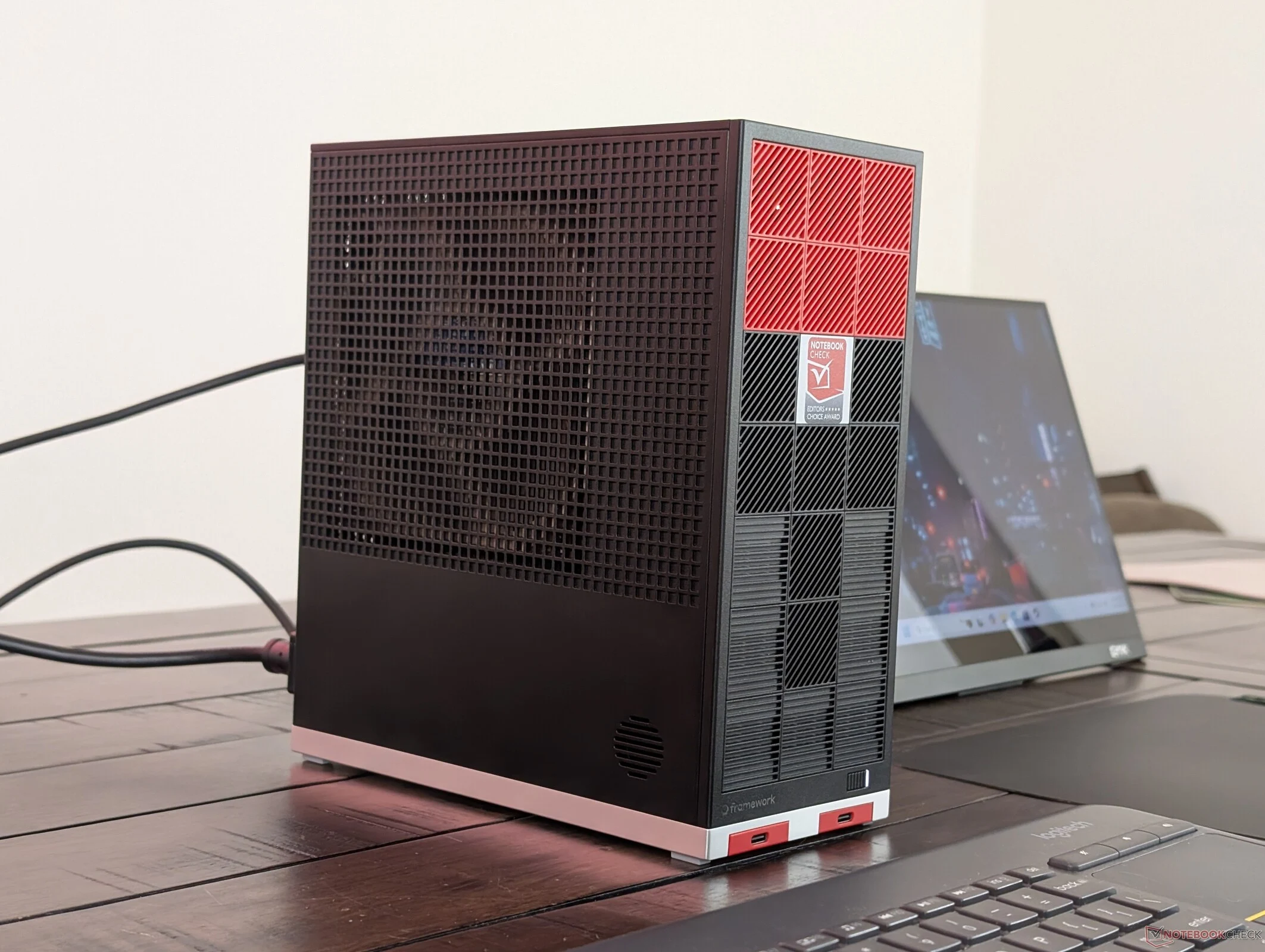
    Aside from emphasizing repairability and serviceability, the Framework Desktop stands out due to its mobile Zen 5 Ryzen AI Max+ 395 CPU and the integrated Radeon 8060S GPU. In contrast, many other mini-ITX PCs typically utilize “true” desktop processors instead. This same CPU is also present in smaller mini PCs such as the GMK EVO-X2, but the Framework Desktop operates with significantly lower power consumption than one might anticipate.

    Power Consumption Comparison

    Our comparison graphs indicate that the Framework system uses an average of about 144 W while running Prime95, whereas the GMK model consumes around 186 W, all while delivering nearly identical performance levels. Similar trends can be seen when testing GPU performance with Cyberpunk 2077. Notably, the Framework system is functioning in Balanced mode during these tests.

    Noise and Temperature Levels

    It’s not surprising that the greater size and more efficient power requirements of the Framework lead to noticeably quieter fans and lower core temperatures compared to the GMK. Unless you highly value the compact design of the GMK model, the Framework, which is similarly priced yet more adaptable, might be the superior choice.
     

  • AMD Ryzen AI Max+ 395 Powers Fastest Mini PCs Available

    AMD Ryzen AI Max+ 395 Powers Fastest Mini PCs Available

    Key Takeaways

    1. Most laptops with AMD Zen 5 CPUs target a TDP of 45 W to 65 W, except for the Ryzen AI Max+ 395, which targets 120 W for better performance.
    2. The Ryzen AI Max+ 395 outperforms many mini PCs, including the Core i9-14900HX, though it is limited in availability due to cooling requirements.
    3. The integrated Radeon 8060S GPU in the Ryzen AI Max+ 395 is 3 to 3.5 times faster than the Radeon 890M, rivaling mobile GeForce RTX 4060 and RTX 4070.
    4. Mini PCs with the Ryzen AI Max+ 395 can effectively run the latest games at 1080p or 1440p resolutions.
    5. While dedicated GPUs offer better graphics performance, they come with larger sizes and higher power consumption compared to the Ryzen AI Max+ 395.


    While the latest laptops often feature AMD Zen 5 CPUs, they usually aim for a TDP between 45 W and 65 W, even those designed for high performance. An interesting exception is the Ryzen AI Max+ 395, which has a target TDP of 120 W for enhanced performance. This CPU is not commonly found in most laptops due to its greater cooling demands, yet it has made its way into some of the fastest mini PCs of 2025.

    Benchmark Performance

    Our benchmarks, alongside the recent assessment of the Framework Desktop, demonstrate that the Ryzen AI Max+ 395 significantly outclasses many other mini PCs in the marketplace, including the Minisforum AtomMan G7 Ti with its Core i9-14900HX. The Minisforum MS-A2 stands out with its quicker Ryzen 9 9955HX; however, it is coupled with a rather sluggish Radeon 610M solution and lacks an integrated NPU.

    Graphic Capabilities

    The integrated Radeon 8060S GPU is where the Ryzen AI Max+ 395 really excels, being approximately 3 to 3.5 times faster than the Radeon 890M. This performance places it between the mobile GeForce RTX 4060 and the mobile RTX 4070. As a result, mini PCs like the Beelink SER9 Pro, Framework Desktop, and BOSGAME M5 are transformed into gaming machines that can handle the latest titles at 1080p or 1440p resolutions.

    Limitations of Dedicated GPUs

    Although mini PCs equipped with dedicated GPUs generally surpass the Ryzen AI Max+ 395 in graphics performance, they are usually larger and consume more power. We look forward to seeing the AMD CPU in a wider variety of mini PCs or high-performance laptops, as it remains quite rare in the current market.

  • Transform Your Framework PC into a Steam Console with Bazzite

    Transform Your Framework PC into a Steam Console with Bazzite

    Key Takeaways

    1. Valve may develop a Steam home console, but a DIY gaming console is possible now using AMD Ryzen AI Max series chips.
    2. The AMD Ryzen AI Max+ 395 APU shows significant performance improvements for laptops and mini-PCs.
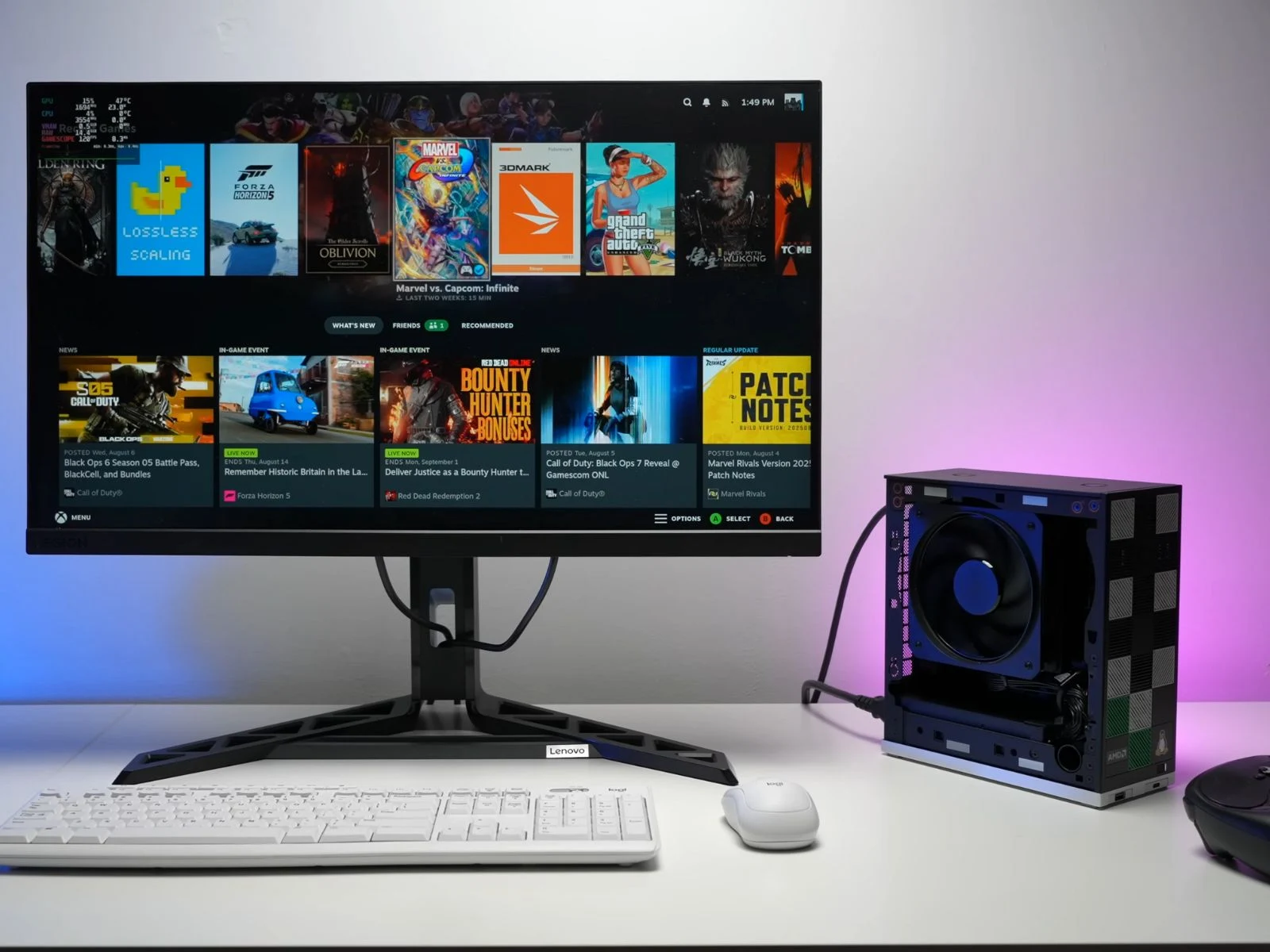
    3. The Framework Desktop mini-PC running the Bazzite OS is close to functioning as an official Steam console.
    4. Game performance tests showed Horizon Zero Dawn Remastered at 66 FPS and Cyberpunk 2077 at 75 FPS on the Framework Desktop.
    5. The Framework Desktop maintained low temperatures and minimal fan noise during gameplay, enhancing the user experience.


    I recently shared news about Valve possibly developing a Steam home console. Although the actual Steam console may not be available for several years, you can create your own DIY gaming console using modern chips from AMD and various OEMs, such as Framework.

    AMD Ryzen AI Max Series

    The AMD chip series I’m referring to is the AMD Ryzen AI Max series, especially the Max+ 395 APU. This chip is becoming a significant advancement for both laptops and mini-PCs. I reported on its performance when the YouTuber ETA PRIME tested it in the soon-to-be-released AIM MAX+ laptop, running both Windows 11 and Bazzite.

    Framework Desktop Testing

    We also observed the chip’s capabilities in the newly launched Framework Desktop with Windows 11. The YouTuber has now tested this mini-PC, installing the popular Linux gaming distribution, Bazzite, on it.

    ETA PRIME claims that the Framework Desktop is very close to functioning as an official Steam console because of its small size and the user-friendly nature of the Bazzite OS for controllers. If you want to try Bazzite on your main PC, don’t fret; it also includes a desktop mode for doing work in Linux.

    Game Performance

    In their testing, the YouTuber started with Horizon Zero Dawn Remastered, running it at a 1440p resolution on high settings with FSR set to Quality. The game averaged 66 FPS, slightly lower than the 72 FPS it achieved in Windows 11, based on ETA PRIME’s findings.

    The Framework Desktop maintained a TDP of 99–100W, with the processor temperature remaining under 65 degrees Celsius, which is impressive for thermal management.

    More Game Tests

    Next, ETA PRIME ran Cyberpunk 2077 at 1440p with high settings and FSR set to Balanced. The game performed at about 75 FPS. One notable aspect mentioned by the YouTuber was the absence of distracting fan noise: “It’s a pretty silent experience even with this boosting up to 100W,” they remarked.

    Source:
    Link


  • Framework Desktop with AMD Ryzen AI Max+ 395 Beats RTX 4060

    Framework Desktop with AMD Ryzen AI Max+ 395 Beats RTX 4060

    Key Takeaways

    1. Framework has launched a modular desktop PC that can be pre-ordered, featuring the AMD Ryzen Max+ 395 or Max 385 chips.
    2. The tested Framework Desktop model with the Max+ 395 chip showed impressive thermal performance, maintaining a TDP of 95 W and temperatures averaging around 69.5°C.
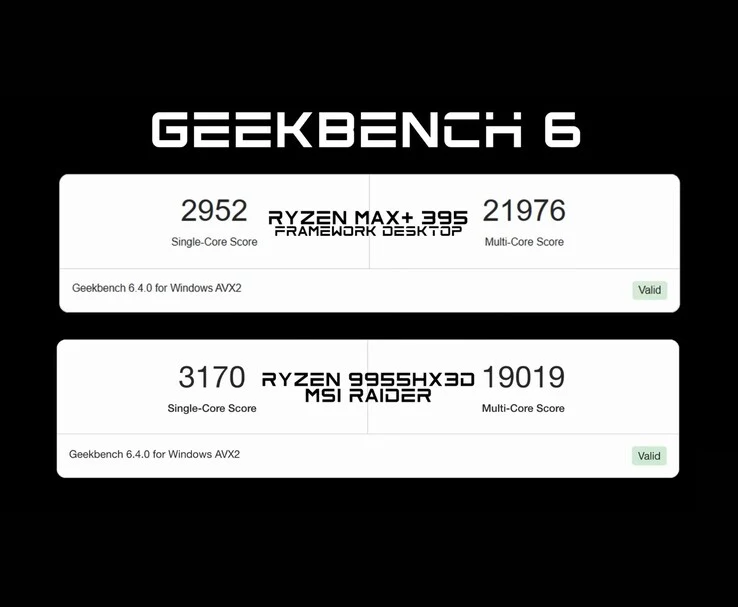
    3. In benchmark tests, the Framework Desktop scored 2,952 in single-core and 21,976 in multi-core performance, outperforming the AMD Ryzen 9 9955HX3D in multi-core tasks.
    4. The desktop achieved a score of 11,251 in 3DMark Time Spy, comparable to a laptop GPU setup with an RTX 4060.
    5. In gaming tests, the desktop managed 73 FPS in Cyberpunk 2077 and over 100 FPS in Forza Horizon 5 at high settings, showcasing strong gaming performance for integrated graphics.


    We’ve recently looked at the performance of the AMD Ryzen AI Max+ 395 chip in a forthcoming 16-inch gaming laptop. Now, we’re taking another look at the Max+ 395’s capabilities, but this time it’s in the Framework desktop PC.

    Framework’s New Desktop

    For those who might not know, Framework is known for its modular laptops that can be upgraded over time. A few months back, they introduced their first desktop, specifically a modular mini-PC. You can now pre-order the Framework Desktop, which comes with either a 16-core, 32-thread AMD Ryzen Max+ 395 or an 8-core, 16-thread Max 385.

    Performance Insights

    After the launch, we’ve got our first glimpse at the real-world performance of the Framework Desktop thanks to YouTuber ETA PRIME. The tested model was equipped with the Max+ 395 chip and 128GB of LPDDR5X RAM. Again, we have revisited the AMD Ryzen AI Max+ 395 chip’s performance in this desktop setup.

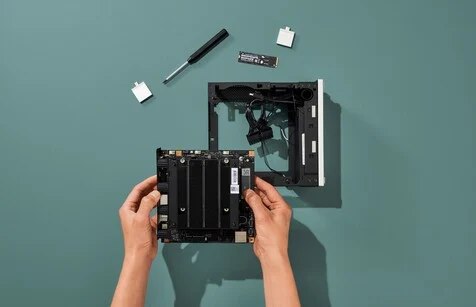
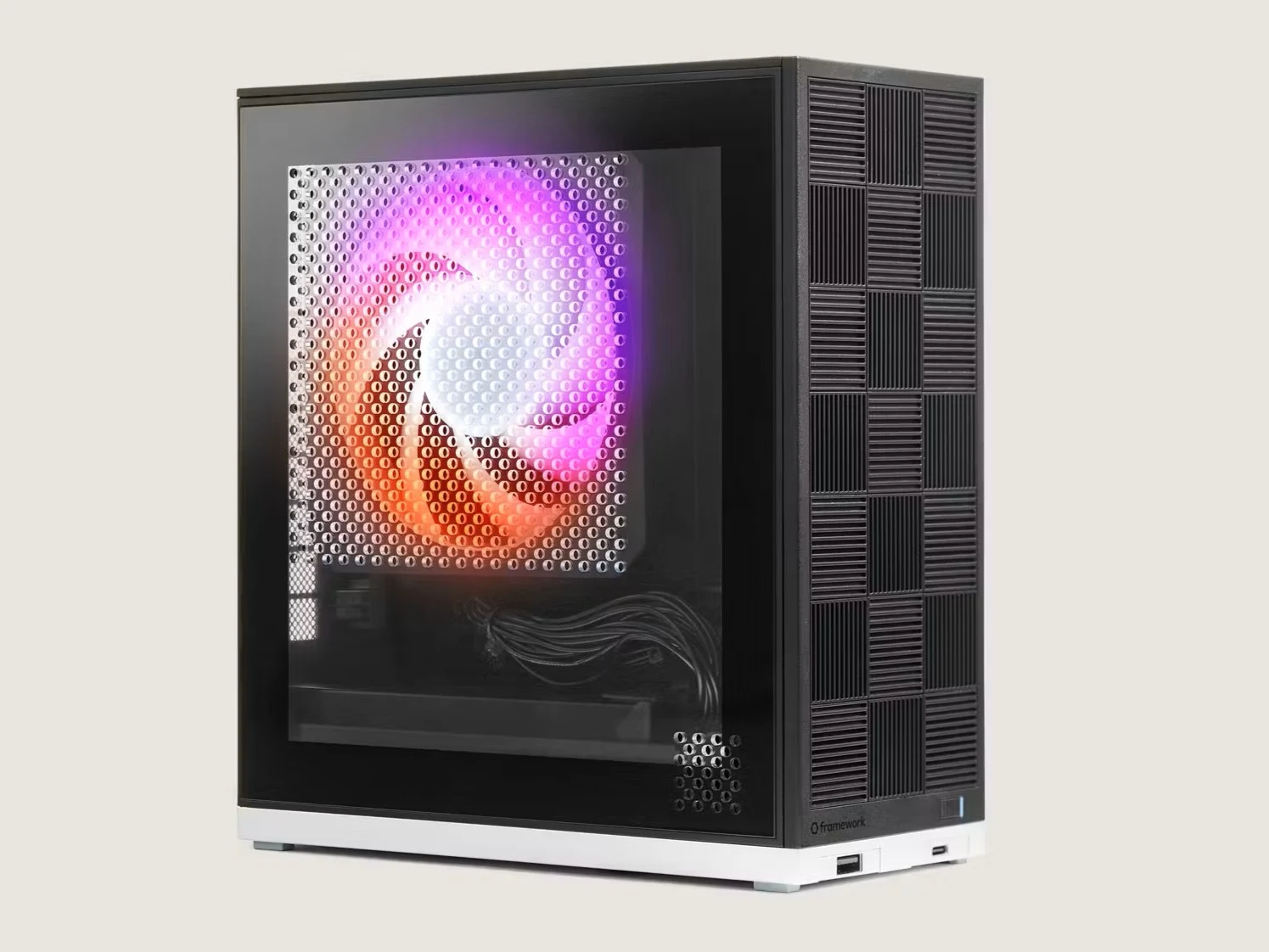
    The YouTuber built the unit using just the provided screwdriver, making it easy for beginners. He added a 2TB Western Digital Black SSD and chose the Noctua fan variant from the three cooling options offered by Framework. The fan was installed using a shroud supplied with the unit and connected to the APU-labelled 4-pin header inside.

    Impressive Thermal Performance

    Under maximum load, the chip maintained around 95 W TDP, reaching temperatures of 75.9°C at peak, while averaging around 69.5°C. ETA PRIME noted that this was impressive thermal performance for such a compact PC. In the Geekbench 6 benchmark, the Framework Desktop achieved a score of 2,952 in the single-core test and 21,976 in the multi-core test. It surpassed the AMD Ryzen 9 9955HX3D in multi-core performance, although it lagged a bit in single-core performance.

    The Framework Desktop also scored 11,251 in 3DMark Time Spy, which is comparable to an RTX 4060 laptop GPU paired with an AMD Ryzen 9 7940HS setup, even though it uses only integrated graphics.

    Gaming Performance

    In actual gaming scenarios, Cyberpunk 2077 ran at 73 FPS at 1440p High with FSR Balanced, while Spider-Man 2 reached 130 FPS with FSR Frame Generation enabled at 1440p High. Borderlands 3 averaged between 70 to 85 FPS at 1440p Ultra, and Forza Horizon 5 delivered over 100 FPS at 1440p Extreme and 78 FPS at 4K Ultra.

    Source:
    Link


  • AMD Strix Halo CPUs: Affordable Framework Desktop with Customization

    AMD Strix Halo CPUs: Affordable Framework Desktop with Customization

    Key Takeaways

    1. Integration of Strix Halo into Framework products includes a new mini-PC called the Framework Desktop.
    2. The top-tier model features an AMD Ryzen AI Max 395+ Strix Halo processor with 16 Zen 5 cores and 128 GB of LPDDR5x memory.
    3. The Framework Desktop has customizable front ports and supports additional storage via two NVMe slots, but RAM is not expandable.
    4. It includes a 120 mm cooler, a Noctua fan, and offers modular design options for appearance customization.
    5. Pricing starts at $1,099 for the entry-level model, with pre-orders available now and shipping expected in Q3 2025.


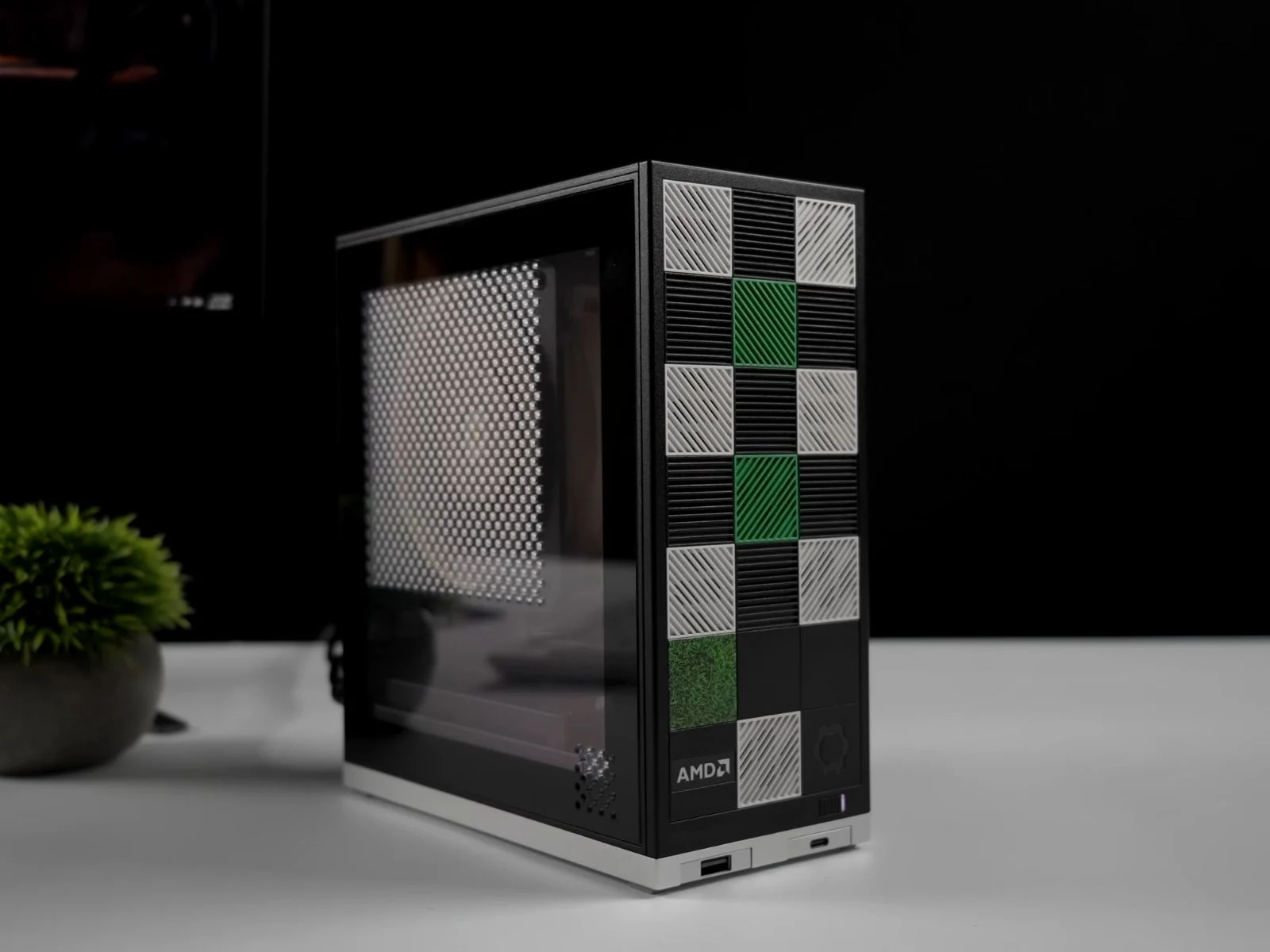
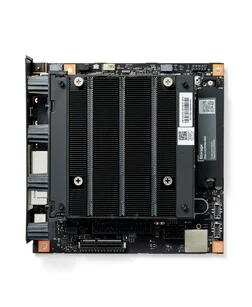
    AMD’s Frank Azor subtly hinted at the integration of Strix Halo into Framework’s products. The exciting news is that this has happened, and it comes in a new form factor: a desktop. The Framework Desktop is more of a mini-PC, but it features a PCIe Gen4 slot along with a variety of I/O options, including 2x USB 4.0 ports, 2x DisplayPort ports, 1x HDMI port, and 5 Gb/s Ethernet. True to Framework’s design philosophy, the front ports are customizable.

    Specifications Overview

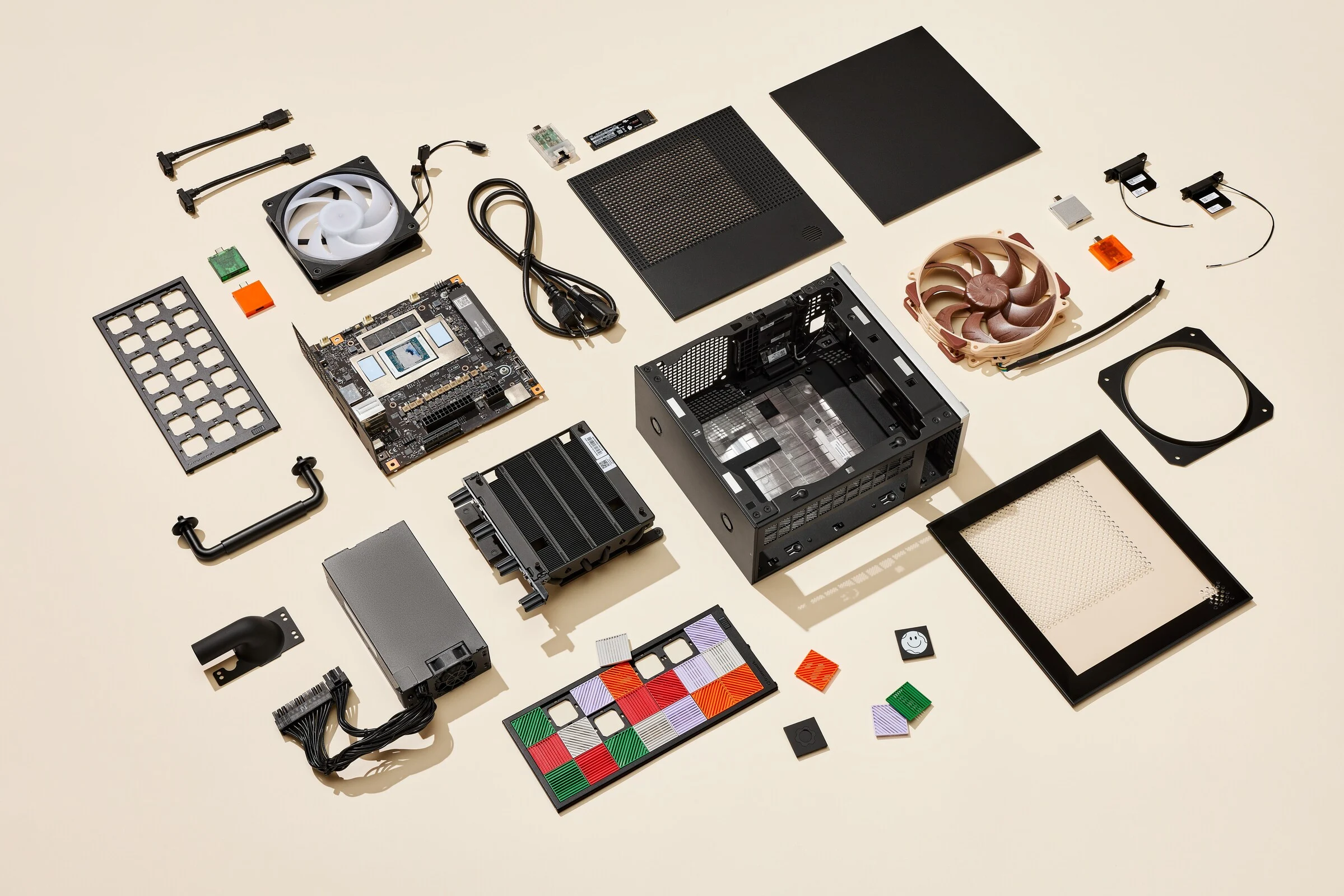
    The top-tier model is equipped with an AMD Ryzen AI Max 395+ Strix Halo processor, boasting 16 Zen 5 cores, 40 RDNA 3.5 compute units, and 128 GB of LPDDR5x memory on the package. There’s also a lower-end model with an 8-core Ryzen AI Max 385 available. However, RAM cannot be expanded, but you can increase storage by adding up to 16 GB through two NVMe slots. Additionally, the Framework Desktop comes with a built-in Wi-Fi 7 module. Powering this setup is a 400 Watt Flexi-ATX power supply unit.

    Performance and Cooling

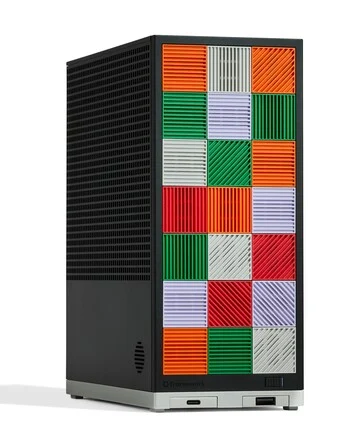
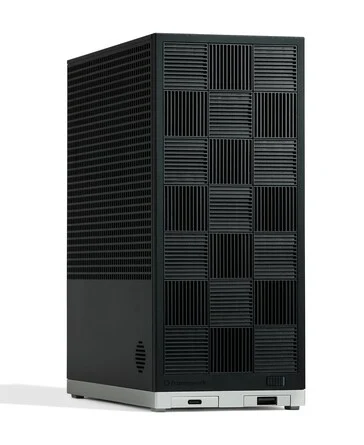
    Although Strix Halo is not extremely power-hungry compared to other desktop chips, it can consume as much as 86 Watts at full load. To manage this wattage, Framework has included a 120 mm cooler and a Noctua fan to maintain optimal temperatures for the mini-PC. If you prefer a different cooling solution, you’re welcome to use that. The Framework Desktop also features 21 modular tile-like blocks that allow for customization in appearance. Plus, you can attach a carrying handle for easier transport. Essentially, all you need to provide is a power supply and the motherboard from Framework; the rest is customizable, which is a common theme in the company’s products.

    Pricing and Availability

    The high-end Framework Desktop with the 16-core Strix Halo CPU and 128 GB of RAM will cost $1,999. This price is significantly lower than what Asus charges, although some might argue that the premium is warranted since Asus offers a fully functional laptop instead of just a mini-PC. The entry-level model with the 8-core CPU and 32 GB of RAM is priced at $1,099, which is also a reasonable price point. Pre-orders are available now, but shipping will only start in Q3 of 2025, so there’s plenty of time to save up some money.