Tag: Canis

  • Panther Lake Handheld vs PS6 Canis: Chip Efficiency Leak Comparison

    Panther Lake Handheld vs PS6 Canis: Chip Efficiency Leak Comparison

    Key Takeaways

    1. Intel is focusing on Panther Lake chips for new gaming handheld devices, aiming for improved performance and efficiency.
    2. AMD is partnering with Sony to develop a handheld for the PS6, utilizing a custom chip named ‘Canis.’
    3. Leaks suggest Panther Lake chips may offer similar performance to the Canis chip but consume twice the power.
    4. The PS6 handheld’s custom AMD APU is expected to be optimized for gaming, enhancing performance with less powerful hardware.
    5. Panther Lake devices are projected to launch by mid-2026, while the PS6 handheld is expected in late 2027 or early 2028.


    Intel is placing its bets on Panther Lake chips to start a new age of gaming handheld devices. Meanwhile, AMD is collaborating with Sony on a new PS6 generation handheld that will utilize a custom chip known as ‘Canis.’ Although not much is known about the performance of these devices, a notable leaker has shared a comparison between the two, albeit without precise details. Still, it provides a glimpse into potential efficiency and optimizations.

    Leaks and Expectations

    Kepler_L2 has been quite active in leaking information about the upcoming consoles, including the new Xbox and the PS6. For the PS6, there are expectations that a handheld will be announced, which will be able to run PS5 games natively, although with reduced fidelity. The recent leaks suggest that Panther Lake chips will deliver performance comparable to the Canis chip in the PS6 handheld, but at twice the power consumption.

    Performance Insights

    According to Kepler, while AMD’s Ryzen Z2 Extreme is deemed too slow and Strix Halo too fast, Panther Lake will find a balance in between. It is noted that the performance at 30W for Panther Lake will match what Canis offers at 15W. Even though these specs might not seem promising for Panther Lake handhelds, there’s more nuance to the situation. The custom AMD APU in the PS6 handheld will be optimized for gaming with a proprietary operating system, allowing it to extract greater performance from less powerful hardware.

    Gaming Approach

    In contrast, Panther Lake handhelds will approach gaming differently, being able to run a broader array of games and applications while also utilizing a more demanding OS. Thus, higher power consumption is anticipated. Additionally, recent leaks hint at dedicated gaming chips called the Intel Core G3 series, which are based on Panther Lake and tailored specifically for handhelds. These chips are expected to be better suited for gaming and should yield solid performance within the 15W to 30W range.

    Release Timeline

    In terms of when we might see these handhelds hit the market, predictions indicate that the first Panther Lake powered devices could launch by mid-2026. The PS6 handheld is projected to arrive around late 2027 or early 2028, considering that November 2027 will mark the seven-year console cycle that both Microsoft and Sony usually follow.

    Source:
    Link


  • PS5 Games May Drop Resolutions as Sony Prepares PS6 Handheld

    PS5 Games May Drop Resolutions as Sony Prepares PS6 Handheld

    Key Takeaways

    1. The new PS5 power-saving mode may be a strategy to prepare for the upcoming PS6 handheld, improving game performance through reduced resolutions.
    2. Sony is reportedly pushing developers to adopt lower-power strategies, showing frustration over the slow adoption rate.
    3. The company prefers reduced game resolutions over limiting frame rates, aiming for a better experience on portable devices like the PS6 handheld.
    4. Sony is requesting developers to optimize CPU usage, providing tools to identify bottlenecks and improve performance for the new handheld.
    5. The PS6 handheld is expected to be backward compatible with most PS5 games, but performance could suffer if developers do not update their titles.


    The new PS5 power-saving mode might be more than just an effort to save energy. Moore’s Law Is Dead has talked to some developers who believe it’s also a way to prepare games for the upcoming PS6 handheld. One method to ensure good performance on this device is by reducing game resolutions. However, not every developer sees this optimization as necessary.

    Sony’s Push for Optimization

    Moore’s Law Is Dead claims to have access to emails from Sony directed at various studios. Conversations with developers reveal that some feel the company is growing more frustrated. PlayStation seems to be in a hurry to persuade more game creators to adopt the lower-power strategy.

    Resolution and Frame Rate Preferences

    Instead of limiting frame rates to below 60 fps, the Japanese gaming company prefers that PS5 titles operate at reduced resolutions. The YouTuber believes this indicates a shift in focus toward the PS6 handheld, codenamed Canis. On a portable device, many consumers might be okay with native 1080p, similar to the Nintendo Switch 2. While upscaling can enhance image quality, poor 30 fps gameplay is generally less appealing.

    CPU Optimization Requests

    Sony is also asking developers to optimize CPU usage in their games. Leaks suggest that the Canis will feature four powerful Zen 6 cores along with two lower-power Zen 6 cores designated for its operating system. Although the chip should perform well compared to the PS5’s technology, the handheld’s power limitations present a challenge. To assist developers, PlayStation has recommended using the Razor utility, which helps identify CPU bottlenecks and supports optimization.

    The forthcoming PlayStation handheld is expected to be backward compatible with most PS5 games. However, if developers do not update their games, performance may decline. As MLID notes, some studios might not even be around by the time the PS6 handheld launches.

    Conclusion on Power Saver Mode

    The YouTuber firmly believes in the purpose behind the PS5 power-saving mode. He concludes that this feature serves as a “Trojan Horse for getting PS6 Handheld support ready before its launch.” Still, without an official announcement regarding Canis, fans are left hoping that the quality of games remains intact during this period.

    Source:
    Link


  • PlayStation Handheld Canis SoC Details Leaked: What We Know

    PlayStation Handheld Canis SoC Details Leaked: What We Know

    Key Takeaways

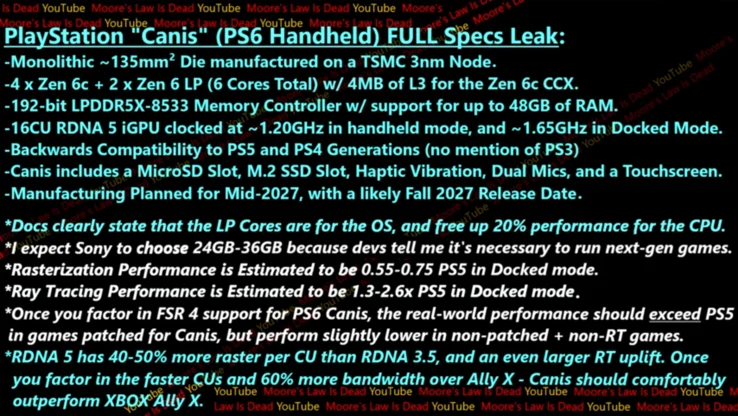
    1. The Sony Canis handheld gaming device features a six-core CPU with four Zen 6c cores and two Zen 6 Low Power cores, supporting up to 48 GB of LPDDR5X-8533 RAM.

    2. The estimated price for the Canis is projected to be between $549 and $699, potentially increasing by its market release in one to two years.

    3. Canis will include a 16 CU RDNA 5 integrated GPU, providing up to 75% of PS5’s rasterization performance when docked and impressive ray-tracing capabilities.

    4. Not all PS4 and PS5 games will work seamlessly on the Canis; some will require updates for optimal performance.

    5. A recent software update for PlayStation beta users introduced a ‘low power mode’ for the PS5, possibly to test game performance under limited power conditions.


    Moore’s Law is Dead recently shared detailed specifications for Sony’s new handheld gaming device, known as Canis. While some of the earlier information was somewhat speculative and included estimated ranges, the leaker has now provided clearer insights and updated some of the previous specs as well.

    CPU and RAM Details

    To kick things off, the Canis will come equipped with a six-core CPU, which includes four Zen 6c cores along with two Zen 6 Low Power cores. The device is designed to support up to 48 GB of LPDDR5X-8533 RAM, although the actual amount may be less. According to Tom’s analysis of the manufacturing expenses, Sony could comfortably fit in 40 GB without any problems. His projections suggest that the price could range from $549 to $699, but this price might rise by the time it hits the market in a year or two.

    GPU Performance

    On the graphics front, Canis is set to come with a 16 CU RDNA 5 integrated GPU, operating at a handheld clock speed of 1.2 GHz (and 1.65 GHz when docked). The device supports backward compatibility with both PS4 and PS5 games, delivering up to 75% of the PS5’s rasterization performance while docked. The ray-tracing capabilities are particularly noteworthy, boasting an impressive claimed 2.6x increase. However, not all games will function seamlessly on this handheld; several will need updates to ensure a smooth gaming experience on the device.

    Recent Software Updates

    In a recent update for PlayStation beta users, Sony introduced a ‘low power mode’ for the console that is meant to be used on a tabletop and does not operate on battery. While the official explanation pointed to energy efficiency, there’s a strong possibility that Sony is testing how PS5 games perform under limited power conditions, giving developers a chance to adjust their games accordingly.


  • PlayStation 6 Orion and Canis Handheld Codenames Leaked

    PlayStation 6 Orion and Canis Handheld Codenames Leaked

    Key Takeaways

    1. The PlayStation 6 will launch with two AMD-based APUs: the Orion chip for the main console and the Canis chip for a handheld device.
    2. The Canis handheld will support games from PS4, PS5, and PS6, offering both 1080p and 720p options for portable and home console play.
    3. A new power-saving mode for the PS5 is being introduced to support the upcoming PS6 ecosystem and enhance energy efficiency.
    4. Sony has changed its naming convention for the PS6 from Shakespearean themes to constellation names, with Orion and Canis representing the main console and handheld, respectively.
    5. More details about the PS6’s performance, pricing, and hardware are expected to be revealed in the coming months as Sony aims for a cohesive gaming ecosystem.


    Sony’s upcoming PlayStation 6 has been revealed in a recent leak, which indicates that the console will launch with two AMD-based APUs. As reported by Moore’s Law is Dead (MLID) through PlayStation Lifestyle, the Orion chip will be the primary processor for the PS6, while the Canis chip will operate a handheld device. Both chips utilize the same CPU and GPU architecture, enabling Sony to make development easier for both devices.

    Handheld Features

    The Canis handheld is not just a version of the PS5; it is an essential part of the PS6 lineup. According to MLID, it will support games from the PS4, PS5, and PS6, offering 1080p and 720p performance options, making it suitable for both portable play and as a small home console. This strategy aims to attract many late PS4 users into Sony’s new gaming ecosystem with a more affordable option.

    Power-Saving Mode

    The recent announcement of a power-saving mode for the PS5, which reduces performance to save energy, is in line with previous MLID statements that suggested this feature would help introduce Sony’s handheld devices. The implementation of this mode on the PS5 signifies the first step in shifting towards the PS6 ecosystem.

    New Naming Convention

    Sony has shifted from using Shakespearean-themed codenames for the PS5 (like Oberon) to constellation-inspired names for the PS6, with Orion as the main console and Canis for the handheld. Although Sony has yet to disclose specific hardware details or a release date, MLID claims that more information, including performance goals and pricing, will come in the upcoming months.

    The codenames Orion and Canis suggest that the PlayStation 6 will consist of more than just one console, as Sony aims to create a cohesive home and portable gaming ecosystem for the next generation. The introduction of a handheld PS6 might give Sony an edge in various price ranges and facilitate the transition from the PS4 as it approaches a launch window toward the end of the decade.

    Source:
    Link