

Key Takeaways
1. The Redmi Note 15 Pro Plus features Qualcomm’s Snapdragon 7s Gen 4 chipset, which shows only minor performance improvements over the Snapdragon 7s Gen 3 in benchmarks.
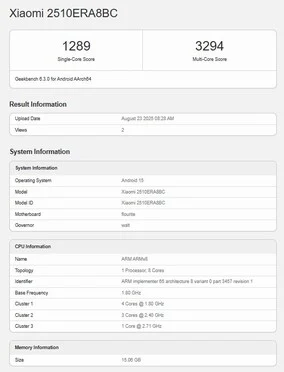
2. Initial benchmark scores indicate a single-core score of 1,289 and a multi-core score of 3,294 for the Snapdragon 7s Gen 4, surpassing the previous generation’s scores slightly.
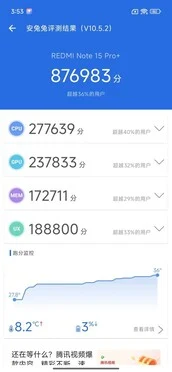
3. The Snapdragon 7s Gen 4 offers a 12% increase in CPU performance on AnTuTu, with a score of 277,639 compared to the 247,693 of the Snapdragon 7s Gen 3.
4. GPU performance also shows a 7% improvement, with the Redmi Note 15 Pro Plus achieving higher scores in various tests, including Geekbench’s Vulkan test.
5. Overall, the Snapdragon 7s Gen 4 is about 10% stronger than its predecessor, but the performance difference may not justify an upgrade for current Snapdragon 7s Gen 3 users.
Xiaomi recently introduced the Redmi Note 15 Pro Plus in China just last week. This mid-range smartphone is equipped with Qualcomm’s latest Snapdragon 7s Gen 4 chipset, but how does it stack up against the Snapdragon 7s Gen 3 found in last year’s Redmi Note 14 Pro Plus?
Benchmark Results Appear
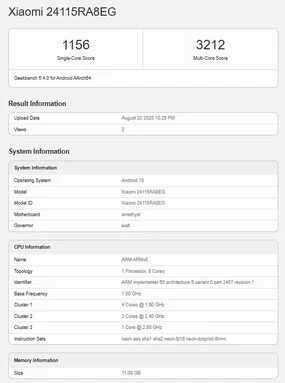
Although it’s still early to draw conclusions, initial benchmark results for the Redmi Note 15 Pro Plus have emerged, revealing that the Snapdragon 7s Gen 4’s performance is rather unimpressive. According to Geekbench, the phone achieved a single-core score of 1,289 and a multi-core score of 3,294. These figures are the same as those noted in Gizmochina’s review. In contrast, the Snapdragon 7s Gen 3 scored 1,156 and 3,212 on those tests.
Minor Improvements Noted
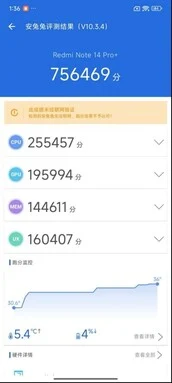
Clearly, the “new” Snapdragon 7s Gen 4 only surpasses the Snapdragon 7s Gen 3 in single-core performance. This can be attributed to the fact that the Snapdragon 7s Gen 4 is basically a rebranded version of the Snapdragon 7s Gen 3, with a minor increase in its prime core speed (2.71 GHz compared to 2.5 GHz). However, the improvement in peak performance is noticeable in AnTuTu scores. The Redmi Note 15 Pro Plus achieved a CPU score of 277,639, while the Redmi Note 14 Pro Plus scored 247,693, showing a nice 12% increase in performance.
GPU Performance Analysis
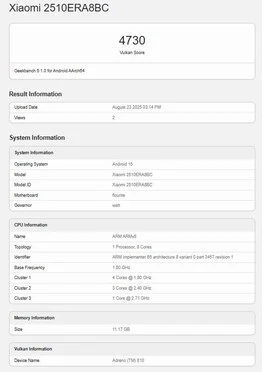
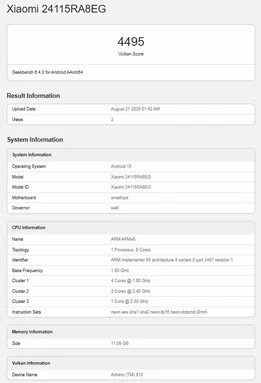
On the GPU front, the Snapdragon 7s Gen 4 continues to use the same Adreno 810 as its predecessor, the Snapdragon 7s Gen 3. Qualcomm hasn’t disclosed any specifics regarding clock speeds but asserts a 7% enhancement in graphical performance. This claim holds some weight; in Geekbench’s Vulkan test, the Redmi Note 15 Pro Plus scored 4,730, compared to 4,495 for the Redmi Note 14 Pro Plus. Furthermore, in AnTuTu, the combination of the new phone and SoC scored 237,833, a significant rise from the 195,994 achieved by their forerunners. In 3DMark’s WildLife extreme test, scores stand at 1,121 versus 1,054, favoring the Redmi Note 15 Pro Plus and its Snapdragon 7s Gen 4.
In summary, the Snapdragon 7s Gen 4 seems to be about 10% stronger than the Snapdragon 7s Gen 3 regarding CPU and GPU performance. Therefore, it is difficult to suggest this upgrade for users who already possess devices with the Snapdragon 7s Gen 3. The Snapdragon 7s Gen 4 is largely the same as the Snapdragon 7s Gen 3, and the performance difference isn’t substantial. A device like the Poco X7 Pro (available on Amazon) provides considerably better performance.
Source:
Link
Leave a Reply