
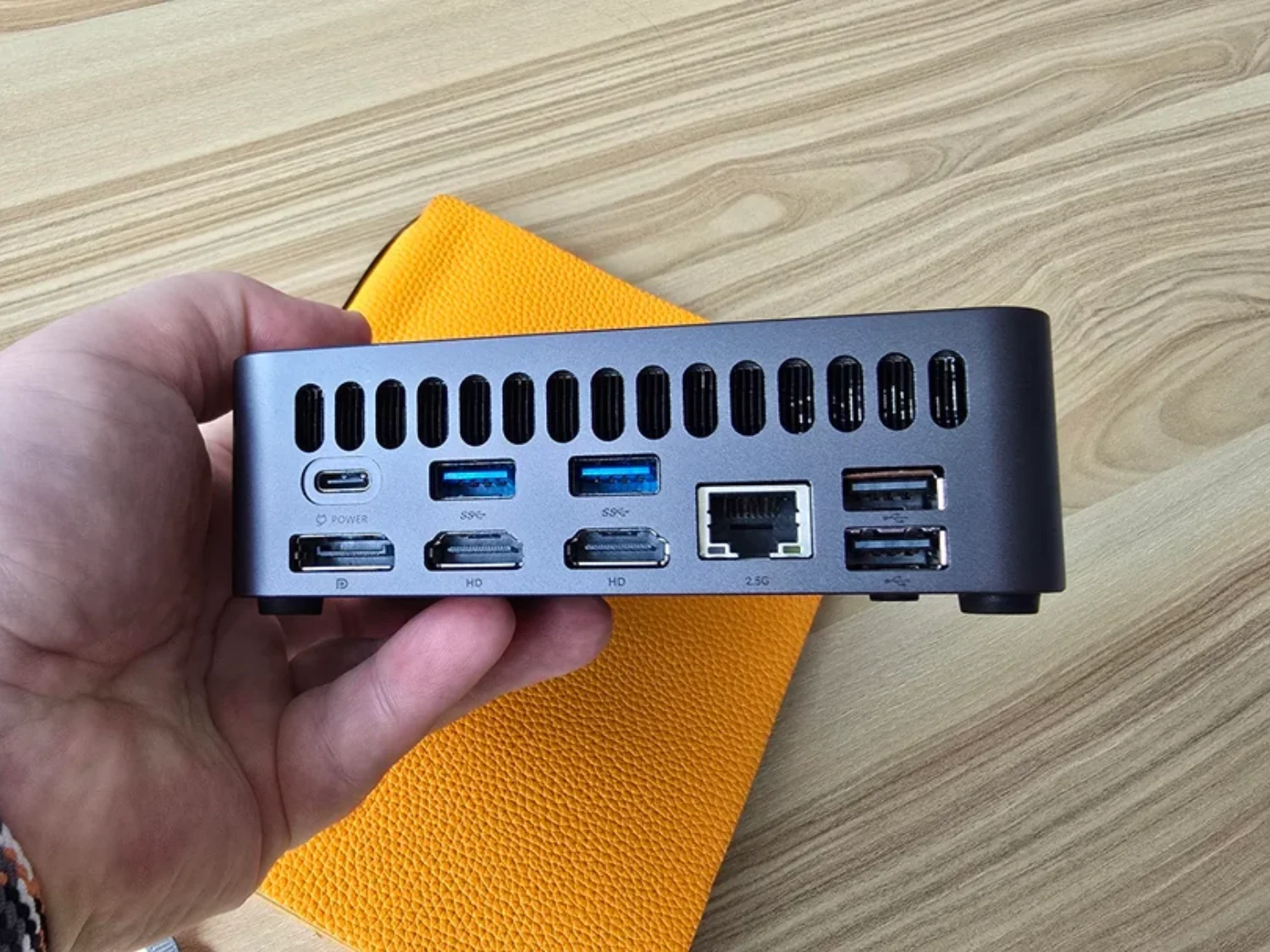
– OCuLink and USB4 are now included, addressing previous connectivity gaps.
– Powered by Intel Core Ultra 5 226V (Lunar Lake) with 16 GB non-upgradeable on-package RAM.
– Compact 128×128 mm chassis with front-mounted OCuPort for easier eGPU access.
– Rear panel features dual HDMI, DisplayPort, 2.5GbE, and additional USB-A ports.
– Still an engineering sample with no pricing or release date announced.
A pre-release engineering sample of the Ninkear M8_226V has surfaced on r/MiniPCs. The original poster gave us a detailed look at what looks like a Lunar Lake upgrade to the brands existing M8 platform — and with a connectivity loadout that is honestly quite impressive, especially for its size class. When we reviewed the Ninkear M8 earler this year, we flagged the absence of USB4 and OCuLink as big gaps. This Lunar Lake variant ships with both of them.
Core Specifications and Chipset Details
The M8_226V is powered by Intel’s Core Ultra 5 226V, a Lunar Lake chip that was built on TSMC’s 3 nm node. It packs 4 Lion Cove P-cores and 4 Skymont E-cores alongside Intel’s Arc 130V iGPU, a 40 TOPS NPU, and 16 GB of on-package LPDDR5x-8533 RAM — that last point being a key caveat, as Lunar Lake’s on-package memory is not upgradeable at all. The chip has a base TDP of 17 W with boost headroom up to 37 W, which would make it great for a compact, passively-manageable chassis without too much thermal stress.
Physical Dimensions and Port Configuration
At 128×128 mm and approximately 675 g, the M8_226V shares its footprint with the existing AMD-powered M8. What’s different is the port layout — and it’s the most interesting part of this particular design. The front panel has an OCuLink port alongside USB4. This combination allows eGPU connectivity with way more bandwidth then Thunderbolt alone could provide. Having OCuLink on the front rather than the rear is an unusual choice, but it should make enclosure attachment and removal considerably less awkward for users with big hands. The rear panel adds two HDMI outputs, a DisplayPort, 2.5GbE, and additional USB-A ports for legacy devices.
Hands-on photos also show the internals pretty clearly — a single M.2 slot is visible alongside the large SoC heat spreader, and the bottom label confirms 20V/5A power delivery which gives a maximum of 100 W. No pricing or release date has been announced yet. The poster has added that this is purely an engineering sample with full testing still pending, so we shouldnt expect retail units anytime soon.
Leave a Reply