
Key Takeaways
1. The Nancy Grace Roman Space Telescope aims to discover around 100,000 cosmic explosions and evidence of the earliest stars.
2. It has been equipped with two sunshields, called the Lower Instrument Sun Shade, to protect its instruments from solar heat and light.
3. The sunshields consist of two panels, the Solar Array Sun Shield and the Deployable Aperture Cover, each measuring 7 × 7 feet and 3 inches thick.
4. The lightweight design of the sunshields minimizes heat transfer, keeping the inner temperature extremely low while the outer side can reach high temperatures.
5. The telescope is set for a launch between fall 2026 and May 2027, with a 70-day thermal vacuum test planned to ensure functionality in space-like conditions.
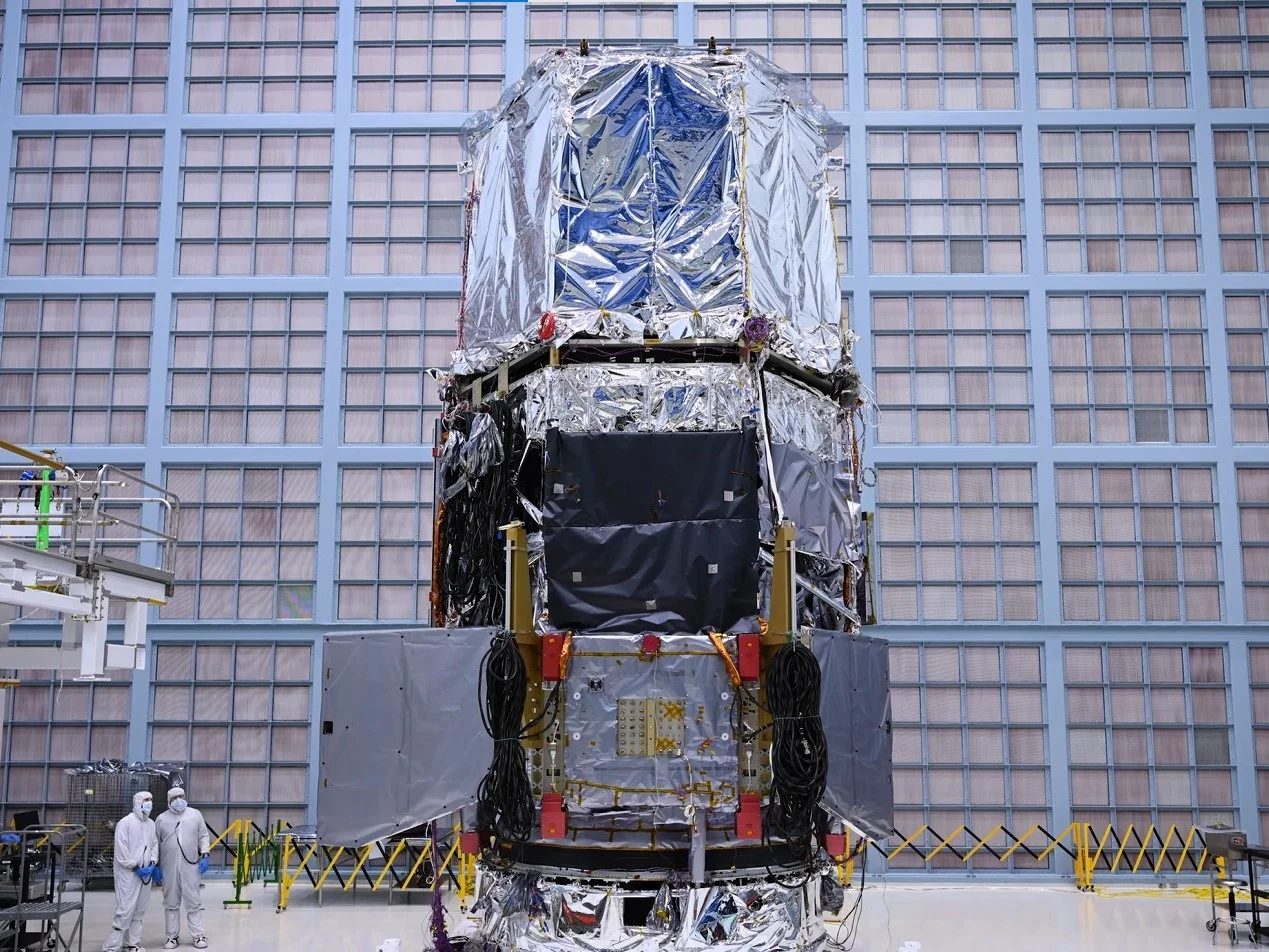
NASA has reached another significant point in putting together the Nancy Grace Roman Space Telescope. This telescope is anticipated to uncover about 100,000 cosmic explosions and proof of the earliest stars. Recently, it has been fitted with two sunshields. These sunshields, known collectively as the Lower Instrument Sun Shade, are designed to shield the telescope’s delicate instruments from the heat and light of the Sun. This protection is essential since strong solar radiation could interfere with the telescope’s capability to pick up faint infrared signals from the universe.
Details of the Sunshields
The two panels that form the sunshield are named the Solar Array Sun Shield and the Deployable Aperture Cover. Each panel measures roughly 7 × 7 feet (2.13 × 2.13 m) and has a thickness of 3 inches (7.62 cm). Conrad Mason, an aerospace engineer at NASA Goddard, likens them to “giant aluminum sandwiches,” as their design consists of metal sheets on the top and bottom, sandwiching a lightweight honeycomb core in the middle.
Lightweight Design and Thermal Protection
Thanks to its clever design, the sunshields are both light and strong. The materials used help to minimize heat transfer, keeping the inner side at temperatures as low as −211° F (−135 °C), even while the side facing the Sun can reach up to 216 °F (102.22 °C). Each panel is covered with a special polymer film, featuring 17 layers on the side exposed to the Sun and one layer on the other side.
Upcoming Tests and Launch Plans
The sunshade will be folded away for launch and will deploy about an hour post-launch. Roman’s inner segment is now prepared for a 70-day thermal vacuum test, during which engineers and scientists will evaluate the complete functionality of the spacecraft, telescope, and its instruments under conditions that mimic space. With everything proceeding smoothly, NASA aims to launch Roman as soon as the fall of 2026, but definitely no later than May 2027.
Source:
Link


Leave a Reply