
Key Takeaways
1. MIT researchers developed a self-assembling solid-state electrolyte that disintegrates in organic solvents, aiding battery recycling.
2. The new electrolyte forms ion-conducting nanoribbons when exposed to water, improving battery performance.
3. Batteries can be easily recycled by immersing them in solvents, allowing for quick disassembly of components.
4. The research emphasizes designing batteries with recyclability in mind, contrasting with traditional methods focused solely on performance.
5. The new technology aims to promote a circular economy for batteries, reducing the need for new material extraction.
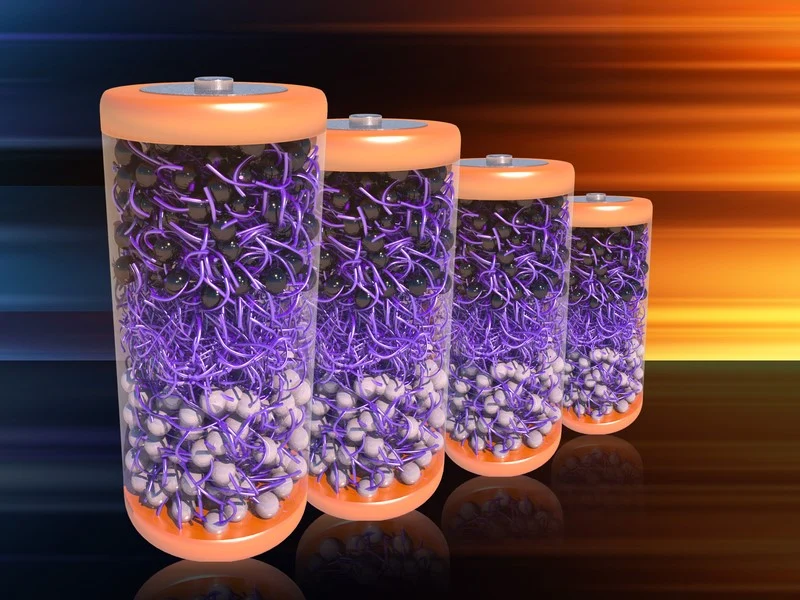
A group of researchers from MIT has come up with a groundbreaking self-assembling electrolyte for batteries, which could be a solution to the growing electronic waste issue caused by the rise of electric vehicles. They invented a unique type of solid-state electrolyte that rapidly disintegrates when placed in an “organic solvent.” This feature makes it easy to recycle valuable materials.
A New Era in Battery Design
This discovery, shared in the journal Nature Chemistry, might lead to significant changes in battery technology. The electrolyte is crafted from molecules that have a chemical structure akin to Kevlar. When these molecules come into contact with water, they spontaneously rearrange themselves, creating millions of robust, ion-conducting nanoribbons that can be hot-pressed into a solid form. This solid electrolyte acts as a bridge, connecting a battery’s positive and negative electrodes.
Simplifying Battery Recycling
When a battery reaches the end of its life, it can simply be immersed in an organic solvent. The electrolyte dissolves within minutes — a process likened by the lead author to cotton candy melting in water — leading to the disintegration of the battery and making it easy to recycle its parts.
A Fresh Perspective on Battery Materials
Historically, the battery industry has concentrated on creating high-performance materials and designs, often delaying considerations of how to recycle batteries built with intricate structures and difficult-to-recycle materials. Our strategy is to begin with materials that are easy to recycle and then determine how to make them suitable for batteries. This method of designing batteries with recyclability in mind from the start is a novel concept. — Yukio Cho, lead author of the study.
The team has successfully created a functioning solid-state battery utilizing their new electrolyte, although its performance is lower than that of “gold-standard commercial batteries.” The researchers believe this could encourage the creation of a circular economy for batteries, which would lessen the need for ongoing extraction of new materials.
Source:
Link
Leave a Reply