

Key Takeaways
1. MicroLEDs are being explored for data transmission beyond their traditional use in display screens, with potential profitability in this new area.
2. Research teams Aledia and Qubedot presented findings on MicroLED capabilities, highlighting their unique pixel technology and communication potential.
3. MicroLEDs can achieve data rates of 2 to 10 Gbit/s per channel, with a theoretical throughput of 500 GB/s under optimal conditions, despite lower bandwidth compared to lasers.
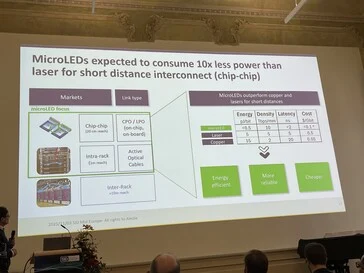
4. MicroLED technology offers significantly lower power consumption per transmitted bit, potentially reducing energy usage to one-tenth compared to current high-speed QSFP modules.
5. Future applications may include communication on motherboards, where MicroLEDs could improve chip interactions and reduce latency, although current use cases remain limited.
A new area might be emerging for the MicroLED sector beyond just display screens: data transmission. During the Society of Information Display’s Mid-Europe Chapter Conference (SID-MEC Conference) held in Göttingen, the concept of utilizing MicroLEDs for communication sparked lively discussions and is currently under investigation. Right now, though, this area is much smaller than the self-illuminating MicroLEDs used in various display formats. Yet, it has the potential to be a profitable field that many research teams are exploring.
Presentations from Key Players
At the SID-MEC Conference, two research teams showcased their findings. The possibilities are considerable, as highlighted by the talks from French firm Aledia and German company Qubedot. Both organizations mainly concentrate on microLED displays, with Qubedot focusing on distinctive pixels that can even imitate letters.
Unique Properties of MicroLEDs
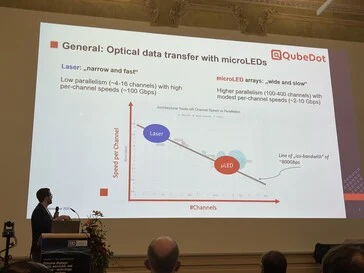
When it comes to data communication, these tiny LEDs have some distinct characteristics. Although their bandwidth isn’t as high as that of traditional lasers, like those in GBIC modules of switches within SFP slots, they are simpler to parallelize. Qubedot claims that achieving between two to ten Gbit/s per channel is feasible. The crucial detail is that the potential ranges from 100 to 400 channels. In ideal conditions, this could lead to a throughput of 500 GB/s. In contrast, typical laser communication provides around 100 Gbit/s and supports four to 16 parallel channels.
Power Consumption Concerns
QSFP modules offering 100 Gbps are indeed on the market, as are 400 Gbps modules. Nevertheless, the existing 100 Gbps QSFP modules face a significant issue: their power usage is extremely high, especially in comparison to alternatives. It’s common for them to consume between 2.5 to even 15 watts, depending on the module’s specifications. This is where MicroLED technology shines. According to Aledia, there exists an opportunity to decrease the power needed per transmitted bit to one-tenth.
Limitations of MicroLED Technology
Nonetheless, this reduced power consumption isn’t applicable everywhere. For instance, DAC connections between switches (within a single rack) are plausible. However, Aledia suggests that beyond this, MicroLED technology may not be adequate. With a practically achievable range of only one meter, linking two adjacent racks would be quite challenging.
Future Applications on Motherboards
Another possible use for microLEDs could be communication on motherboards (between chips). Since microLEDs function as semiconductors, they could potentially be incorporated into chips as a communication channel, enhancing interactions between chips in a cost-effective manner. They also offer benefits regarding interference reduction compared to electrical connections. Aledia notes that latency could drop from 5 ns with a laser to just 2 ns with microLEDs.
Ongoing Research and Future Prospects
However, the scope of applications remains very narrow. It’s worth mentioning that research into this technology has been ongoing for a considerable time, and Aledia and Qubedot are not the only companies active in this domain. Participants in discussions indicated that a significant breakthrough is still awaited, and it seems unlikely that this will evolve into a consumer technology in the near future.
Leave a Reply