Tag: MicroLED

  • MicroLED Technology: High Speed Data Transfer with Low Energy Use

    MicroLED Technology: High Speed Data Transfer with Low Energy Use

    Key Takeaways

    1. MicroLEDs are being explored for data transmission beyond their traditional use in display screens, with potential profitability in this new area.
    2. Research teams Aledia and Qubedot presented findings on MicroLED capabilities, highlighting their unique pixel technology and communication potential.
    3. MicroLEDs can achieve data rates of 2 to 10 Gbit/s per channel, with a theoretical throughput of 500 GB/s under optimal conditions, despite lower bandwidth compared to lasers.
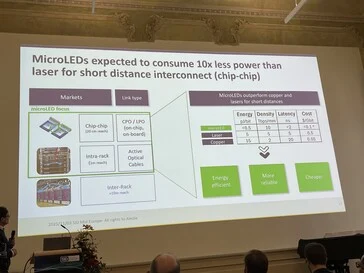
    4. MicroLED technology offers significantly lower power consumption per transmitted bit, potentially reducing energy usage to one-tenth compared to current high-speed QSFP modules.
    5. Future applications may include communication on motherboards, where MicroLEDs could improve chip interactions and reduce latency, although current use cases remain limited.


    A new area might be emerging for the MicroLED sector beyond just display screens: data transmission. During the Society of Information Display’s Mid-Europe Chapter Conference (SID-MEC Conference) held in Göttingen, the concept of utilizing MicroLEDs for communication sparked lively discussions and is currently under investigation. Right now, though, this area is much smaller than the self-illuminating MicroLEDs used in various display formats. Yet, it has the potential to be a profitable field that many research teams are exploring.

    Presentations from Key Players

    At the SID-MEC Conference, two research teams showcased their findings. The possibilities are considerable, as highlighted by the talks from French firm Aledia and German company Qubedot. Both organizations mainly concentrate on microLED displays, with Qubedot focusing on distinctive pixels that can even imitate letters.

    Unique Properties of MicroLEDs

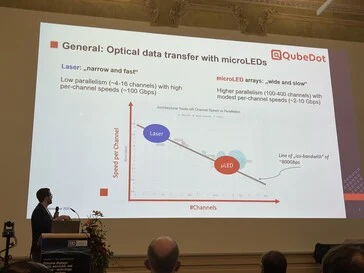
    When it comes to data communication, these tiny LEDs have some distinct characteristics. Although their bandwidth isn’t as high as that of traditional lasers, like those in GBIC modules of switches within SFP slots, they are simpler to parallelize. Qubedot claims that achieving between two to ten Gbit/s per channel is feasible. The crucial detail is that the potential ranges from 100 to 400 channels. In ideal conditions, this could lead to a throughput of 500 GB/s. In contrast, typical laser communication provides around 100 Gbit/s and supports four to 16 parallel channels.

    Power Consumption Concerns

    QSFP modules offering 100 Gbps are indeed on the market, as are 400 Gbps modules. Nevertheless, the existing 100 Gbps QSFP modules face a significant issue: their power usage is extremely high, especially in comparison to alternatives. It’s common for them to consume between 2.5 to even 15 watts, depending on the module’s specifications. This is where MicroLED technology shines. According to Aledia, there exists an opportunity to decrease the power needed per transmitted bit to one-tenth.

    Limitations of MicroLED Technology

    Nonetheless, this reduced power consumption isn’t applicable everywhere. For instance, DAC connections between switches (within a single rack) are plausible. However, Aledia suggests that beyond this, MicroLED technology may not be adequate. With a practically achievable range of only one meter, linking two adjacent racks would be quite challenging.

    Future Applications on Motherboards

    Another possible use for microLEDs could be communication on motherboards (between chips). Since microLEDs function as semiconductors, they could potentially be incorporated into chips as a communication channel, enhancing interactions between chips in a cost-effective manner. They also offer benefits regarding interference reduction compared to electrical connections. Aledia notes that latency could drop from 5 ns with a laser to just 2 ns with microLEDs.

    Ongoing Research and Future Prospects

    However, the scope of applications remains very narrow. It’s worth mentioning that research into this technology has been ongoing for a considerable time, and Aledia and Qubedot are not the only companies active in this domain. Participants in discussions indicated that a significant breakthrough is still awaited, and it seems unlikely that this will evolve into a consumer technology in the near future.
     

  • MicroLED Display Technology Approaches Commercialization

    MicroLED Display Technology Approaches Commercialization

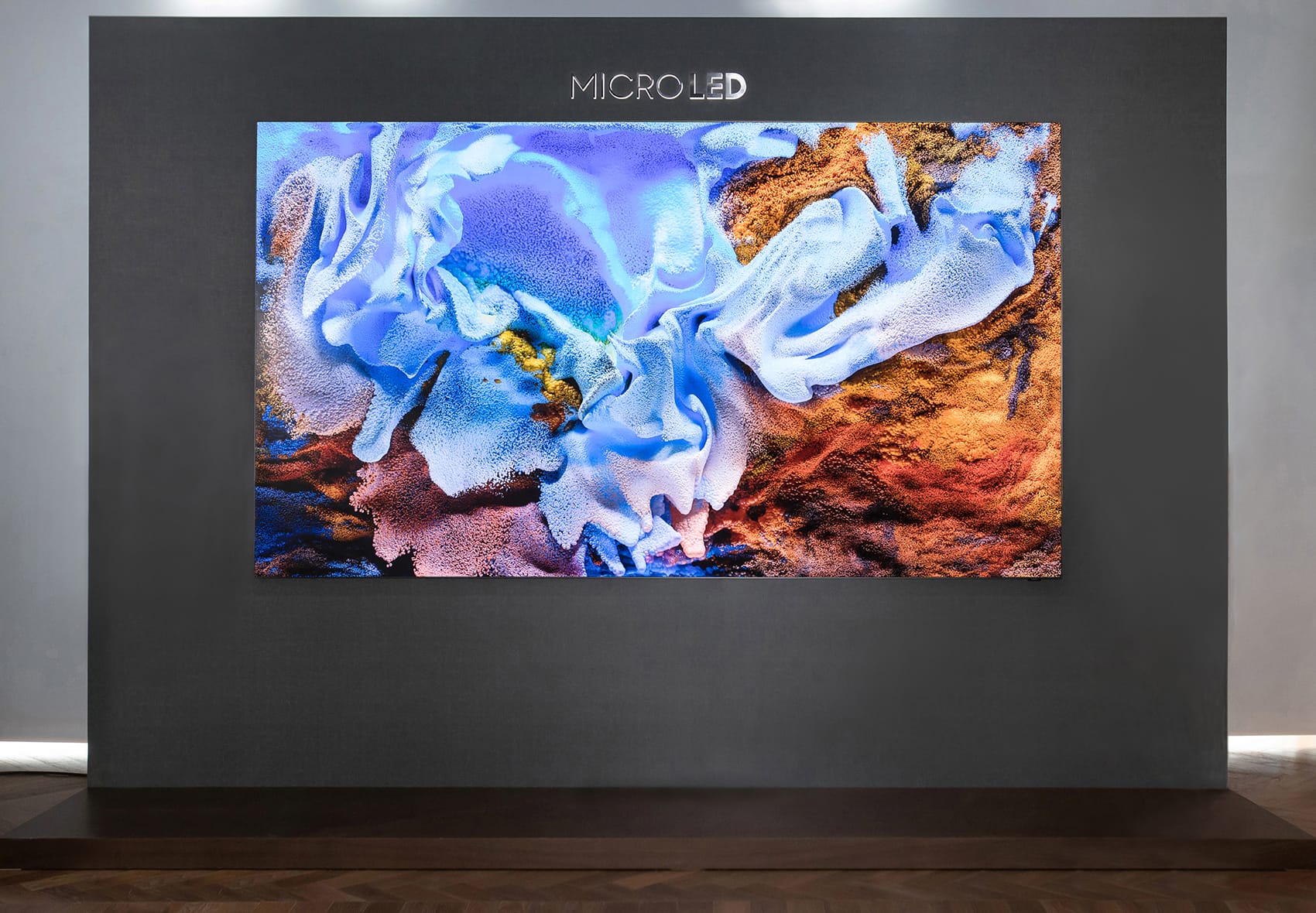
    MicroLED technology is widely recognized for its incredible brightness, vibrant colors, and dependability, positioning it as a leading candidate for the future of display technology. Although some concerns arose when Apple suspended its microLED development for the Apple Watch, many experts believe that the exceptional performance of this technology is too remarkable to overlook for certain applications.

    Potential in Automotive Displays

    One promising application for microLED is in the automotive sector. Its high brightness makes it ideal for dashboard displays and instrument panels, and it also offers the potential for striking, transparent head-up displays (HUDs). As noted by Qiu Yubin, a senior research VP at TrendForce, the disparity between luxury and more affordable vehicles could encourage car manufacturers to implement microLEDs in their premium models, even if the initial costs are elevated.

    MicroLED in AR Glasses

    Additionally, microLED technology utilizing silicon is gaining traction in augmented reality (AR) glasses, where being compact and bright is essential. TrendForce projects that the microLED chip market might soar to a staggering $5.8 billion by 2028, with an impressive annual growth rate of 84 percent from 2023 to 2028.

    Recent Developments

    There have been some recent significant advancements in this field. Tianma is aiming to finalize its production processes by the end of this year and plans to begin small-scale deliveries by late 2025. At the same time, BOE is collaborating with different companies to invest 1 billion yuan ($139 million) into establishing a new microLED production line in Zhuhai. This facility has claimed to be the first 6-inch microLED plant to achieve mass production, and it just commenced operations this month.

    Despite these advancements, microLED faces several obstacles. Geng Yi, the executive vice secretary-general of the China OLED Industry Alliance, highlights that major challenges persist, such as issues with large-scale production, high manufacturing expenses, a fragmented supply chain, and the absence of universal standards.

  • Apple Watch Ultra and AR Glasses to Embrace MicroLED Soon

    Apple Watch Ultra and AR Glasses to Embrace MicroLED Soon

    Apple is anticipated to broaden its Vision series of "spatial computing" wearables, introducing a new design that resembles AR glasses more closely than the current Pro headset. These upcoming glasses may provide a more comfortable fit for the face, though they could still be pricey. They are rumored to feature cutting-edge displays utilizing microLED technology instead of the traditional OLED, as shared by leaker Jukanlosreve. The first-generation Apple Glasses, possibly named iGlass, are expected to debut alongside the latest version of the Watch Ultra, which might also sport a similar type of display.

    New Launch Timeline

    Additionally, the release timeline for these devices has shifted to 2026. Previous reports about the initial Apple glasses and the future Watch Ultra hinted at delays that could push their launches to 2027. This new timeline suggests that Apple is making some progress on these projects, although fans may have to wait a bit longer than anticipated.

    Competing in the Market

    If Apple aims to compete with products like the ‘smart’ Ray-Bans, it would be ideal for the tech giant from Cupertino to focus on privacy more than Meta’s approach, which often raises concerns about intrusive data collection. The potential for a more privacy-conscious design and usage would certainly differentiate Apple’s offering in a crowded market, making it an appealing choice for consumers who value their personal information.

    Jukanlosreve shared this information via Twitter/X, keeping everyone updated on the latest developments in Apple’s wearable tech journey.

  • Garmin Signs Contract for MicroLED Displays Amid Fenix 8 Rumors

    Garmin Signs Contract for MicroLED Displays Amid Fenix 8 Rumors

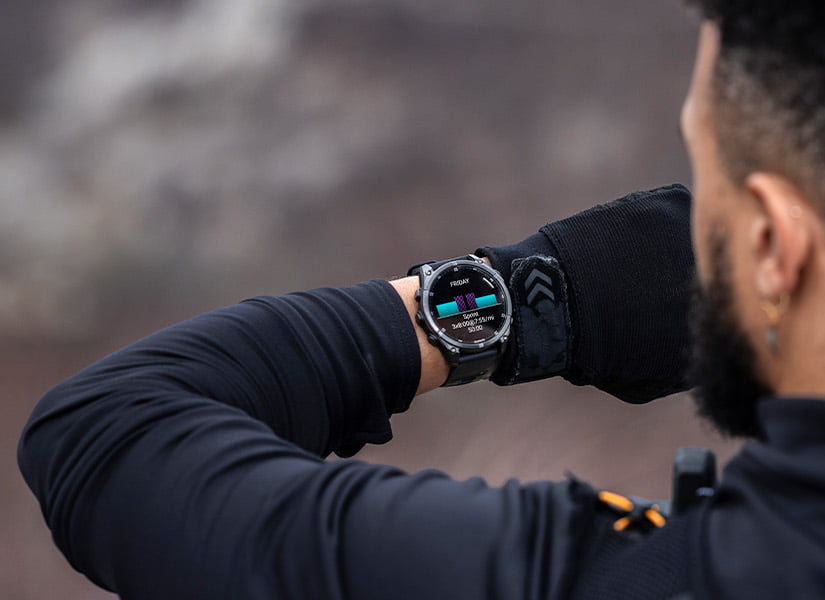
    Garmin has recently introduced new models in its Fenix smartwatch lineup, specifically the Fenix E and Fenix 8. However, new information suggests that the company might be looking to expand the Fenix 8 series with at least three additional variants. Notably, the Garmin Connect app briefly mentioned the Fenix 8 Pro, available in 47 mm and 51 mm sizes, alongside a third unreleased model dubbed the ‘Fenix 8 MicroLED’.

    Anticipated Pro Models

    The introduction of ‘Pro’ versions isn’t unexpected, especially considering earlier models like the Fenix 7 Pro Sapphire Solar, which is currently priced at $899.99 on Amazon. Nonetheless, Garmin has yet to explore MicroLED technology in its smartwatches. Instead, the company has shifted its focus from Memory in Pixel (MiP) displays to more colorful AMOLED screens in recent years.

    Collaboration for Innovation

    Speculation has been rife about tech giants like Apple and Samsung working to produce smartwatches featuring MicroLED displays. Recently, the5krunner reported that Garmin has partnered with Vuzix to create what Vuzix calls a ‘next generation nano-imprinted waveguide-based display system’ through a multi-phase development contract. This suggests that Garmin has plans to incorporate MicroLED technology at some point, although it is still unclear if this will be part of the Fenix 8 lineup.

    Vuzix’s Role in Development

    Vuzix elaborated on its partnership with Garmin, stating that the contract involves the development and sequential delivery of waveguide-based optical systems, complete with custom projection engines, eventually leading to production units. The expertise that Vuzix brings in designing and developing custom waveguide optics—combined with volume production through nano imprinting—aims to provide Garmin with significant advantages in cost, form factor, and space efficiency compared to existing technologies.