
Key Takeaways
1. The James Webb Telescope, launched on December 25, 2021, is revolutionizing our understanding of space by capturing images of previously unseen exoplanets.
2. Its location 1.5 million kilometers from Earth enhances its ability to observe distant and faint stars, aided by advanced tools like the coronagraph and MIRI spectrograph.
3. The telescope’s recent focus on the star TWA 7 has revealed a cold gas planet named TWA 7b, which is similar in mass to Saturn but uninhabitable.
4. TWA 7 is a young star, only 6.4 million years old, allowing for the development of planetary disks and surrounding rings, which were previously observed by other telescopes.
5. Future observations, including those with the Extremely Large Telescope in 2028, may lead to new discoveries and the potential for finding life on other rocky planets.
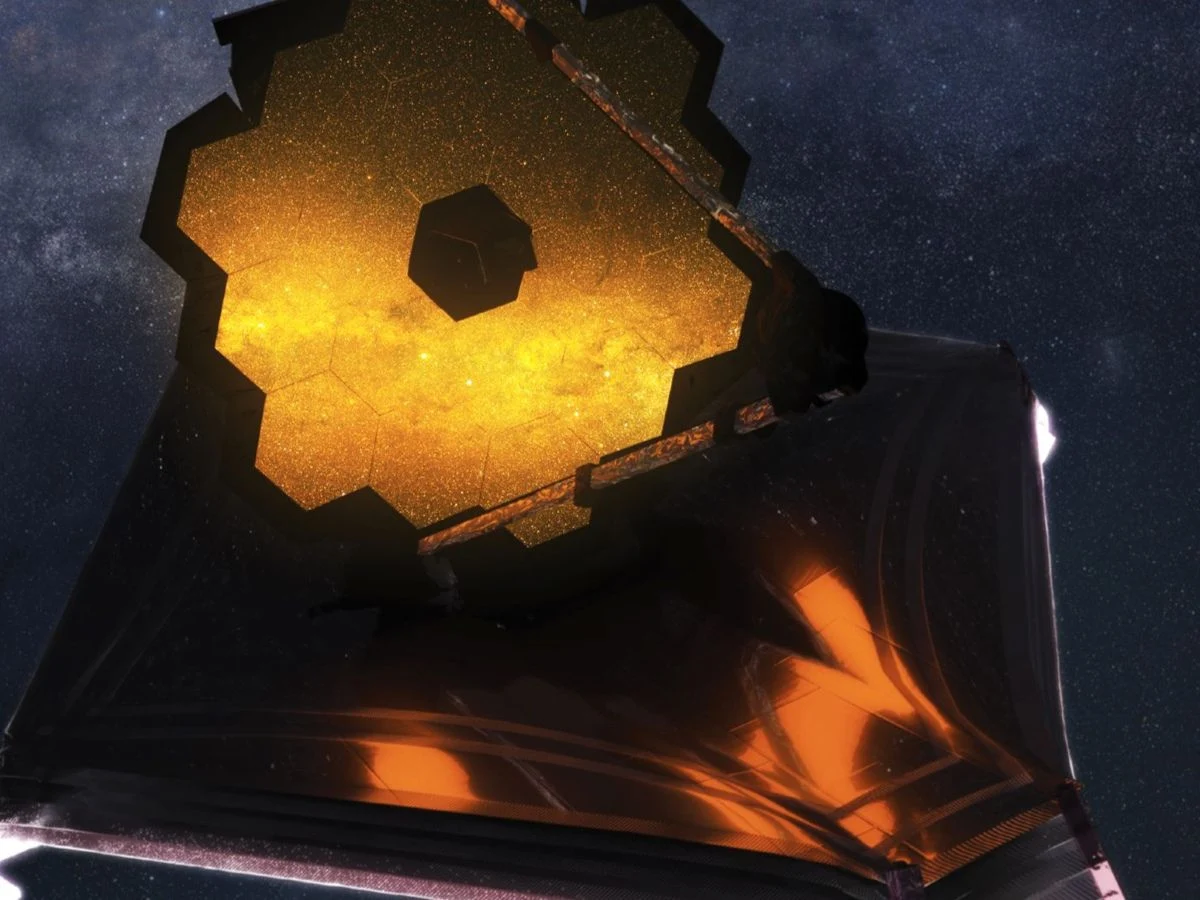
Launched on December 25, 2021, the James Webb Telescope is changing the way we look at space. It’s not just that; it has helped scientists uncover incredible findings, like an exoplanet close to our planet that seems to be in a difficult stage of its life.
Amazing Distance
Since it started its mission, sitting 1.5 million kilometers away from Earth, the telescope has successfully captured images of many exoplanets. Astrophysicist Anne-Marie Lagrange shared in the journal Nature, “It has spent a great deal of time observing planets that have never been imaged before.” This highlights the significance of its work.
Challenges of Observation
While this might not sound very impressive, it’s crucial to realize that watching such distant stars is a tough job. These stars are faint because they have low heat at their center. On top of that, they revolve around a bright star, which makes it hard for astronomers to spot them.
The James Webb Telescope has a strong edge: its coronagraph, which is designed based on the effects seen during a solar eclipse. This tool blocks the light from the star, allowing researchers to locate the stars that move around it. Additionally, its MIRI spectrograph can capture images of stars that are nearly invisible by using infrared technology.
A New Discovery
Researchers decided to focus this powerful device on TWA 7, a star in our galaxy that is “only” a hundred light-years away. This star is of particular interest because of its age, being 6.4 million years old, which has enabled planetary disks to develop in its vicinity. Moreover, observations from the Sphere instrument at the Very Large Telescope (VLT) in Chile uncovered three large rings surrounding it.
In the second ring, the James Webb Space Telescope detected a light source named TWA 7b. This celestial body has been classified as a cold planet, with a mass similar to Saturn’s. However, it appears that life could not exist there since it’s made entirely of gas. In other words, it’s composed of various gases.
Future Possibilities
Nonetheless, this planetary system holds promise, and upcoming observations, like those scheduled with the Extremely Large Telescope (ELT) in 2028, could yield more exciting discoveries. Who knows, we might even find signs of life on another rocky planet apart from Earth?
Source:
Link
Leave a Reply