
Key Takeaways
1. The James Webb Space Telescope (JWST) has made a groundbreaking discovery of the oldest supernova ever observed, known as GRB 250314A.
2. The discovery followed a timeline where the SVOM satellite detected a gamma-ray burst, and subsequent observations were made by the Neil Gehrels Swift Observatory and the Nordic Optical Telescope.
3. The Very Large Telescope estimated the supernova’s age to be 13 billion years, occurring just 730 million years after the universe’s formation.
4. JWST’s Near-Infrared Camera revealed that the supernova resembles those found in today’s universe, providing insights into the evolution of stars.
5. Observations of the galaxy containing the supernova suggest it is similar to other galaxies from the same early period, highlighting the scarcity of heavy elements at that time.
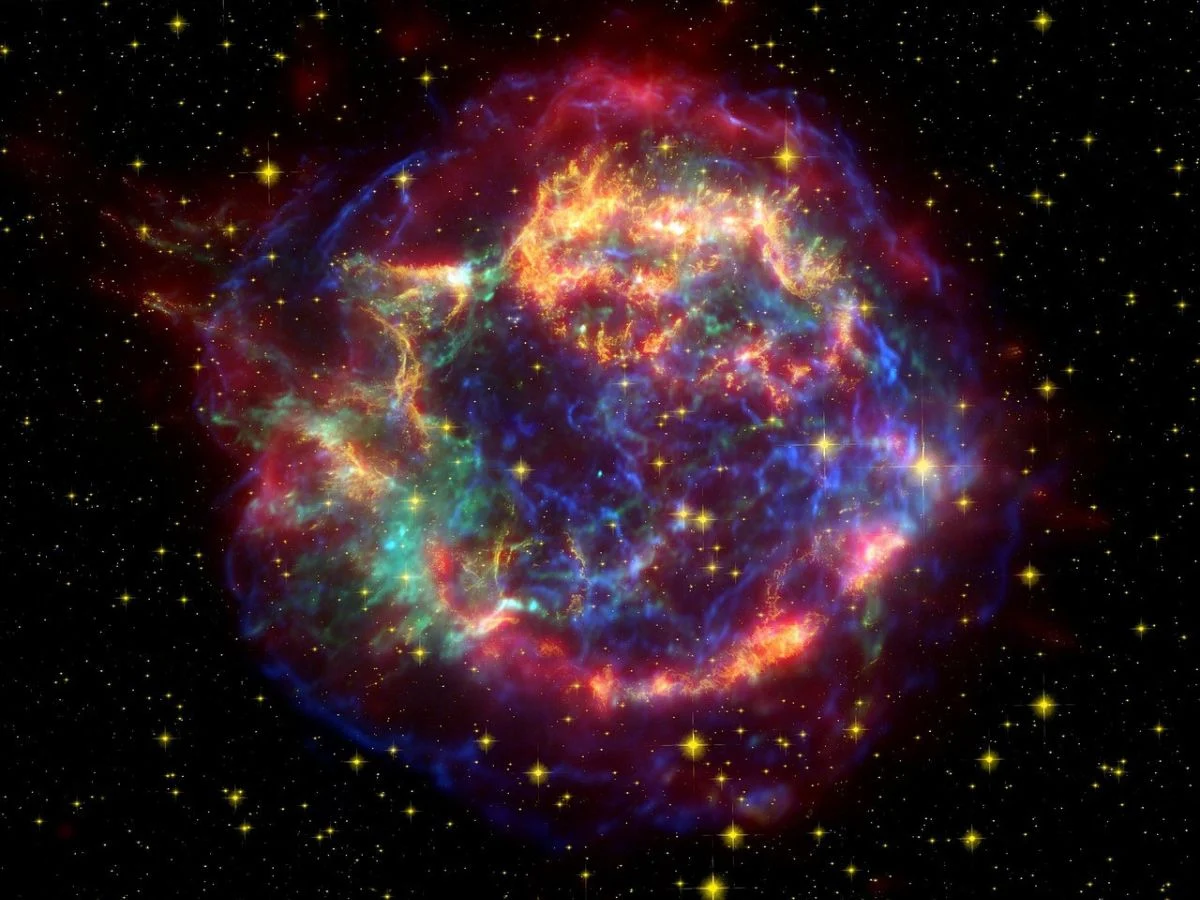
The James Webb Space Telescope is changing how we observe and understand the universe with its advanced tools. It has already revealed some amazing structures in space, but it has recently made an even bigger find: the oldest supernova ever observed.
Discovery Timeline
This remarkable discovery is part of a sequence of events. In March 2025, the SVOM satellite picked up a strong gamma-ray burst in space. An hour and a half later, the Neil Gehrels Swift Observatory also spotted this burst, enabling astronomers to pinpoint and analyze the event.
Observations from Other Telescopes
After that, the Nordic Optical Telescope situated in the Canary Islands recorded a weak light signal from the gamma-ray burst. This was before the Very Large Telescope could estimate the age of the supernova, which took place 13 billion years ago.
Then, the James Webb Space Telescope employed its Near-Infrared Camera to study this supernova, showcasing remarkable details. Thanks to this technology, astronomers learned that the supernova known as GRB 250314A resembled those seen in today’s universe, but from an earlier time.
Understanding the Context
Moreover, they could observe the galaxy that housed this star, giving them insights into the environment surrounding the supernova. Emeric Le Floc’h from CEA Paris-Saclay in France remarked:
“Webb’s observations indicate that this distant galaxy is similar to other galaxies that existed at the same time.”
This finding is a record for the James Webb Space Telescope, as the previous oldest supernova was found in a universe that was 1.8 billion years old. In contrast, this latest discovery happened merely 730 million years after the universe’s formation, during an era when heavy elements were still scarce.
Source:
Link
Leave a Reply