
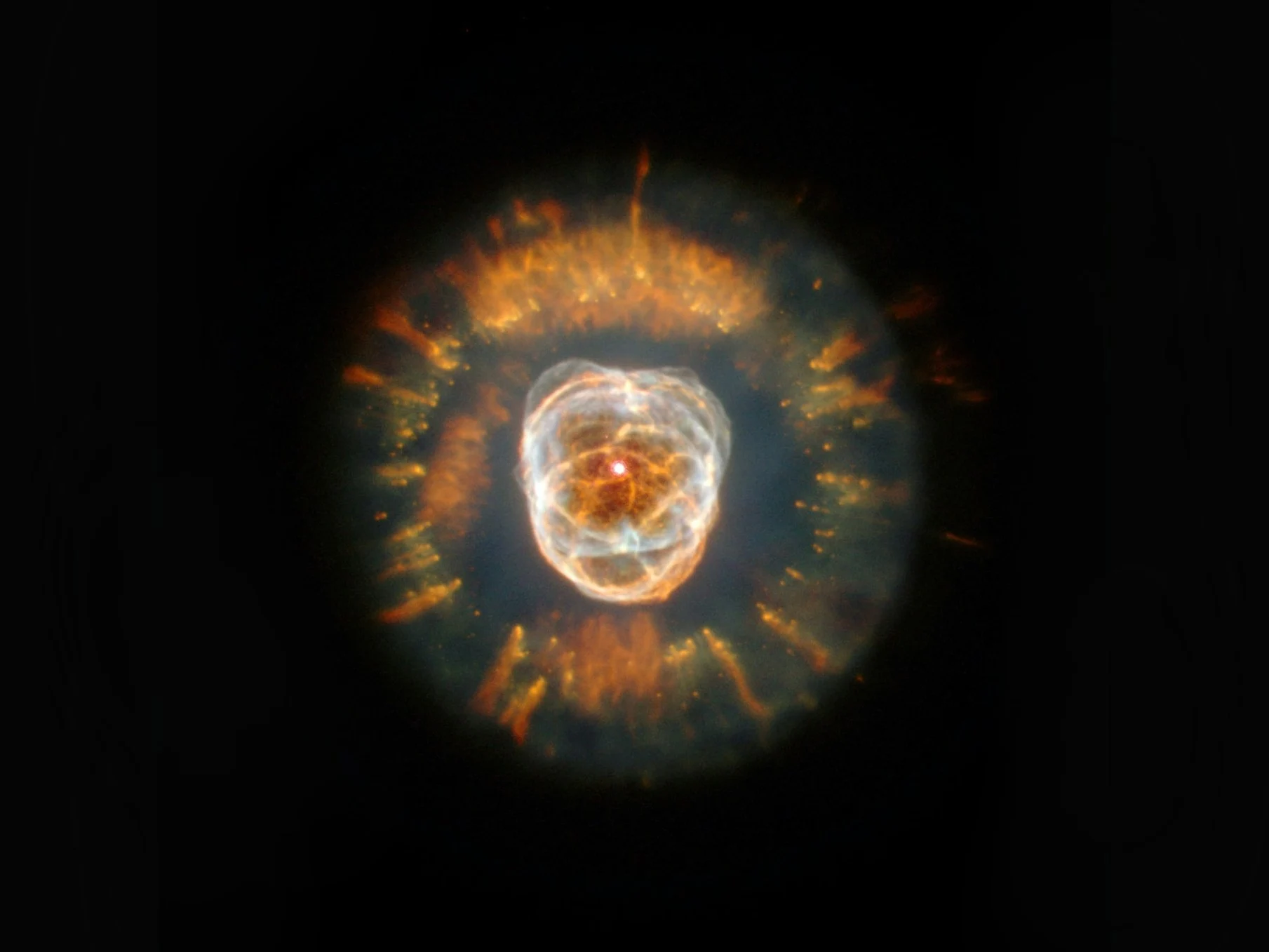
Tag: gamma-ray burst

  • Cosmic Collision Reveals How the Universe Creates Heavy Elements

    Cosmic Collision Reveals How the Universe Creates Heavy Elements

    Key Takeaways

    1. Gamma-ray bursts (GRBs) are among the most powerful explosions in the universe, with GRB 230906A identified in 2023 by the Fermi Gamma-ray Space Telescope.
    2. Short GRBs occur when two neutron stars collide after spiraling inward due to their gravitational attraction.
    3. The explosion of GRB 230906A was located in a dim galaxy about 8.5 billion light-years away, within a tidal tail formed from galaxy collisions.
    4. The merger of neutron stars produced a kilonova, creating heavy elements like gold and platinum through r-process nucleosynthesis.
    5. Future stellar formations may arise from the enriched material of these explosions, and similar events may occur when the Milky Way and Andromeda galaxies collide in 4 to 5 billion years.


    A gamma-ray burst (GRB) is considered one of the most powerful explosions in the universe. It was initially spotted by the Fermi Gamma-ray Space Telescope in 2023. These short GRBs happen when two neutron stars spiral inward due to their gravitational forces and eventually collide. A neutron star is the incredibly dense core of a gigantic star that remains after a supernova event.

    Tracing the Burst’s Origin

    Astronomers utilized the Chandra X-ray Observatory along with the Hubble Space Telescope to pinpoint the exact location of the burst, which was found in a very faint galaxy roughly 8.5 billion light-years away. This particular burst, referred to as GRB 230906A, took place within a stream of debris that results from galaxies colliding. This long stream of material, which is pulled from galaxies during their encounters, is termed a tidal tail – and it’s in this region that the burst occurred.

    The Aftermath of the Collision

    The merging of neutron stars also led to a kilonova, a bright explosion that arises during such collisions. This merger initiated nuclear reactions that created heavy metals via a process known as r-process nucleosynthesis. Elements like gold, platinum, uranium, and other heavy substances were produced and thrown into space. This enriched material could potentially give rise to new stars, and occurrences like this might help explain how gold came to be on Earth. In about 4 to 5 billion years, the Milky Way is expected to collide with the Andromeda Galaxy, which could lead to the formation of neutron stars that may merge and create similar explosive events.

    In conclusion, these findings not only deepen our understanding of the universe but also shed light on the cosmic processes that contribute to the creation of heavy elements. Events like GRB 230906A are essential for grasping how our universe evolves over billions of years. Such research continues to illustrate the intricate connections between stellar life cycles and cosmic phenomena.

    Source:
    Link
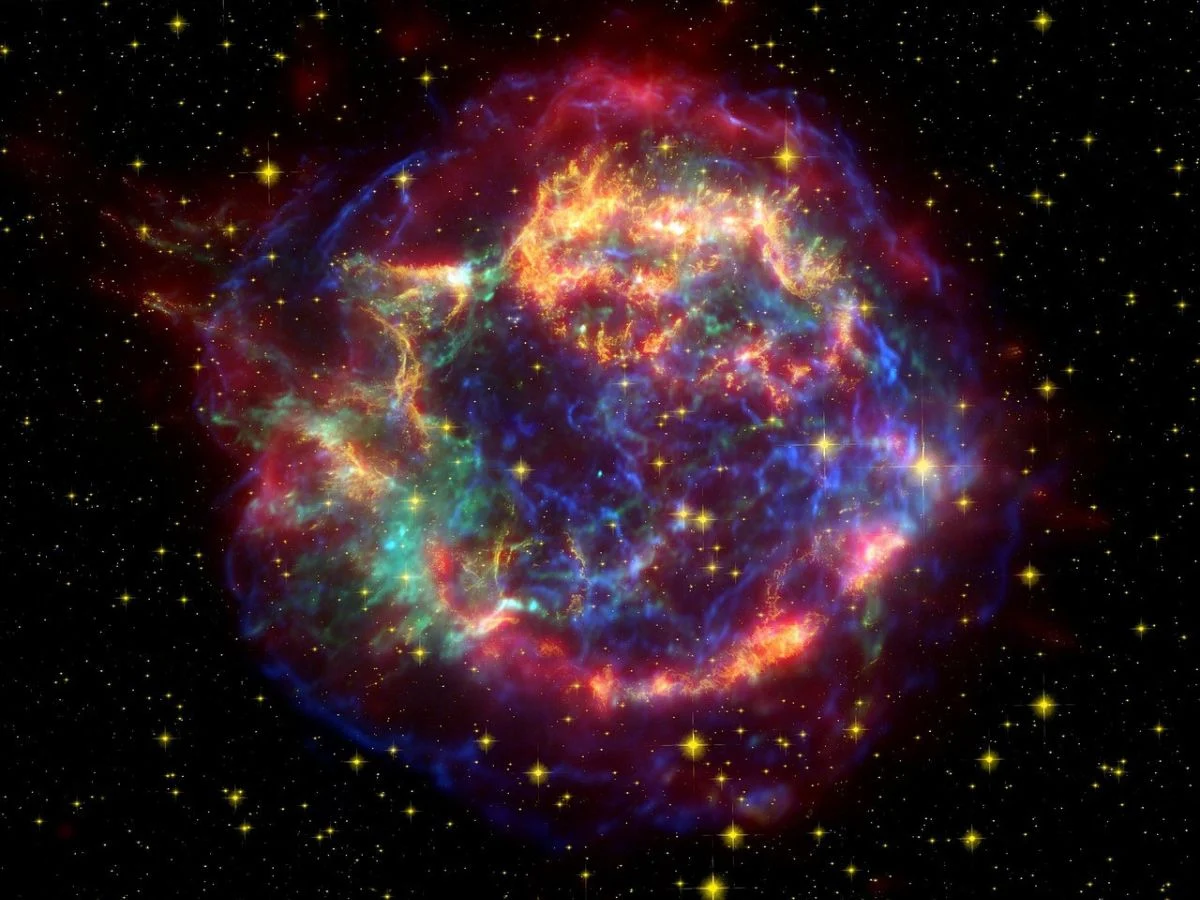


  • James Webb Space Telescope Discovers 13 Billion-Year-Old Supernova

    James Webb Space Telescope Discovers 13 Billion-Year-Old Supernova

    Key Takeaways

    1. The James Webb Space Telescope (JWST) has made a groundbreaking discovery of the oldest supernova ever observed, known as GRB 250314A.
    2. The discovery followed a timeline where the SVOM satellite detected a gamma-ray burst, and subsequent observations were made by the Neil Gehrels Swift Observatory and the Nordic Optical Telescope.
    3. The Very Large Telescope estimated the supernova’s age to be 13 billion years, occurring just 730 million years after the universe’s formation.
    4. JWST’s Near-Infrared Camera revealed that the supernova resembles those found in today’s universe, providing insights into the evolution of stars.
    5. Observations of the galaxy containing the supernova suggest it is similar to other galaxies from the same early period, highlighting the scarcity of heavy elements at that time.


    The James Webb Space Telescope is changing how we observe and understand the universe with its advanced tools. It has already revealed some amazing structures in space, but it has recently made an even bigger find: the oldest supernova ever observed.

    Discovery Timeline

    This remarkable discovery is part of a sequence of events. In March 2025, the SVOM satellite picked up a strong gamma-ray burst in space. An hour and a half later, the Neil Gehrels Swift Observatory also spotted this burst, enabling astronomers to pinpoint and analyze the event.

    Observations from Other Telescopes

    After that, the Nordic Optical Telescope situated in the Canary Islands recorded a weak light signal from the gamma-ray burst. This was before the Very Large Telescope could estimate the age of the supernova, which took place 13 billion years ago.

    Then, the James Webb Space Telescope employed its Near-Infrared Camera to study this supernova, showcasing remarkable details. Thanks to this technology, astronomers learned that the supernova known as GRB 250314A resembled those seen in today’s universe, but from an earlier time.

    Understanding the Context

    Moreover, they could observe the galaxy that housed this star, giving them insights into the environment surrounding the supernova. Emeric Le Floc’h from CEA Paris-Saclay in France remarked:

    “Webb’s observations indicate that this distant galaxy is similar to other galaxies that existed at the same time.”

    This finding is a record for the James Webb Space Telescope, as the previous oldest supernova was found in a universe that was 1.8 billion years old. In contrast, this latest discovery happened merely 730 million years after the universe’s formation, during an era when heavy elements were still scarce.

    Source:
    Link