
Key Takeaways
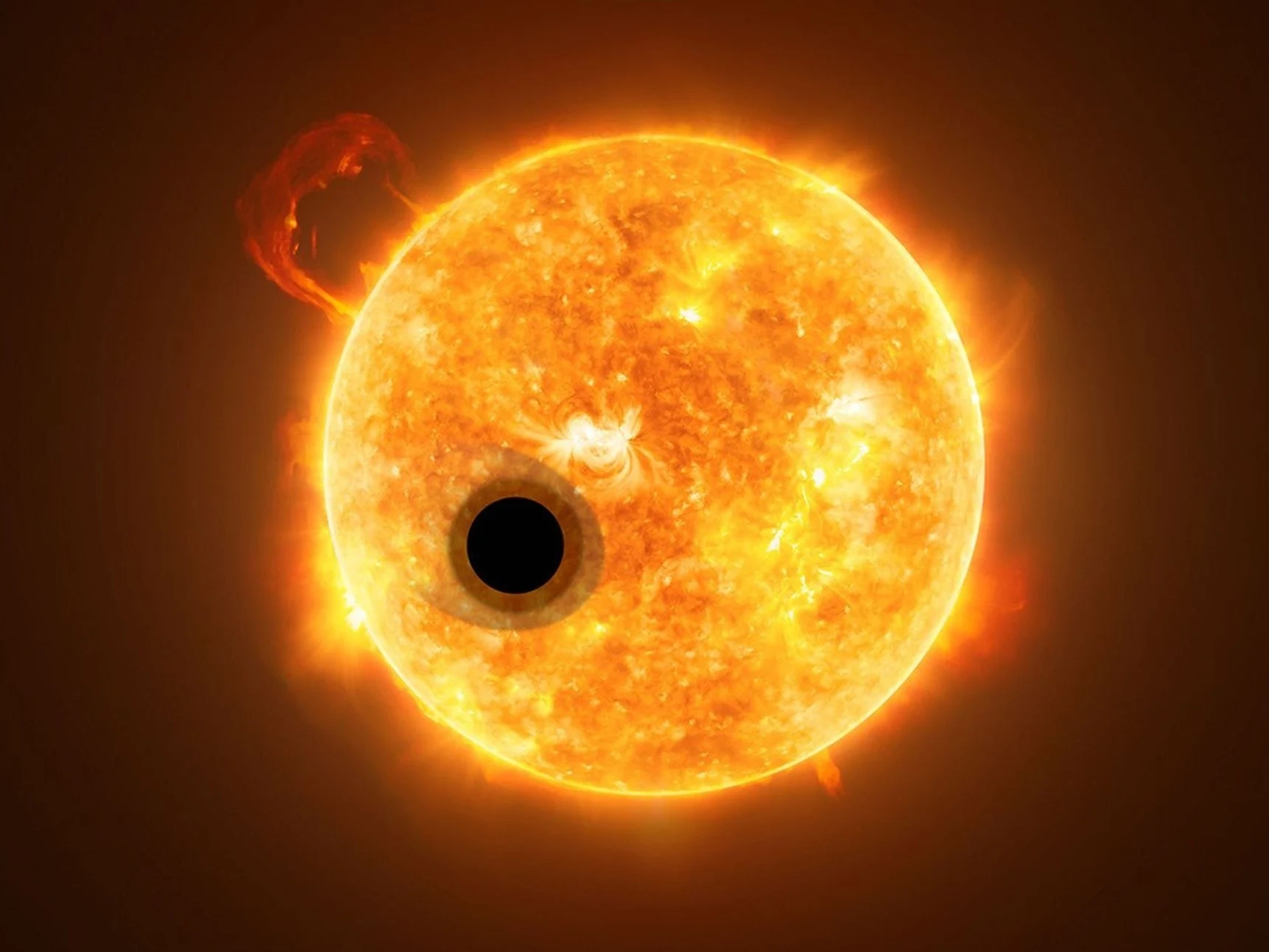
1. JWST observed helium escaping the atmosphere of WASP-107b, providing insights into how high temperatures can lead to atmospheric loss.
2. WASP-107b orbits a star 210 light-years away, with an orbit seven times smaller than Mercury, resulting in extreme heat exposure.
3. Discovered in 2017, WASP-107b is a “super-puff” planet, similar in size to Jupiter but with much lower mass.
4. The atmosphere of WASP-107b contains water, oxygen, carbon monoxide, carbon dioxide, and ammonia, but lacks methane, contrary to predictions.
5. Observations of WASP-107b help scientists understand atmospheric erosion, potentially offering insights into the evolution of planets like Venus.
According to a study released in Nature Astronomy, the JWST has observed that helium from WASP-107b is escaping its atmosphere. This gas is moving ahead of the planet, giving scientists a chance to explore in more depth how a planet can lose its outer layers because of very high temperatures.
A Unique Orbit
WASP-107b revolves around a star situated 210 light-years from our planet. The orbit of this exoplanet is about seven times smaller than that of Mercury, exposing it to an immense amount of heat, which seems to be fueling the fast outflow of its atmosphere into space.
Characteristics of WASP-107b
Discovered in 2017, WASP-107b is about the same size as Jupiter but has a mass that’s roughly 88 percent less, categorizing it as a “super-puff” low-density planet. Scientists think it originally formed farther from its star but was pulled into its current orbit, possibly influenced by another planet, WASP-107c.
Atmospheric Composition
The JWST has also verified the existence of water, oxygen, carbon monoxide, carbon dioxide, and ammonia in the atmosphere. However, unlike what chemical models predicted, methane was not found. The researchers theorize that the planet’s high temperatures are causing gases from deeper layers to rise to the upper atmosphere, which lack significant amounts of methane, leading to an atmosphere that differs from expectations.
The observations of WASP-107b are aiding astronomers in comprehending the erosion of planetary atmospheres. Even though the situation with this exoplanet is quite unique, the insights gathered by the JWST could shed light on the development of planets like Venus.
Source:
Link
Leave a Reply