
Key Takeaways
1. Smartphones have become powerful enough for demanding tasks like AAA gaming, video editing, and AI tasks.
2. The iPhone 17 shows a 588% improvement in single-core performance and 1,250% in graphics since the iPhone 6S.
3. Year-on-year performance gains for the iPhone 17 include an 8% increase in single-core and 34% in graphics compared to the iPhone 16.
4. Over the past decade, iPhones have improved by over 500% in single-core tasks and 1,200% in GPU capabilities.
5. Despite performance gains, the price increase from the iPhone 6S to the iPhone 17 is relatively modest, from $649 to $799.
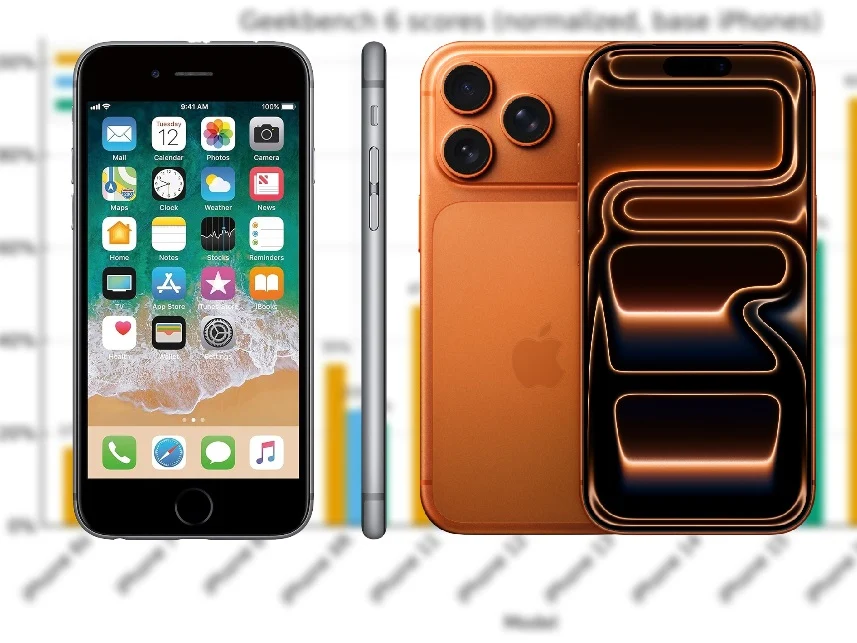
As smartphones have developed over the years, the improvements in performance from one generation to the next seems to have shrunk. Many users have forgotten that, when we look at the bigger picture, high-end smartphones are now powerful enough to tackle demanding tasks such as AAA gaming, video editing, and even AI tasks. This is particularly true for those who always want the most powerful device when they make a purchase.
Performance Evolution
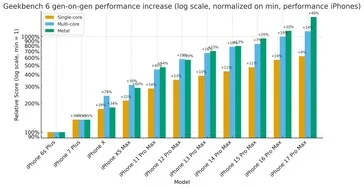
To really understand how much smartphones have advanced, especially from a performance viewpoint, it’s helpful to reflect on the power we carry with us daily. A user on r/iPhone has gathered various charts illustrating the performance enhancements from generation to generation for iPhone models, beginning with the iPhone 6S (2015) up to the recent iPhone 17 series.
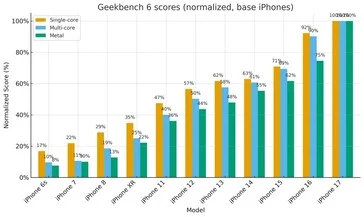
Since the debut of the iPhone 6S in 2015, which featured the Apple A9 SoC, the Geekbench 6 single-core score for the base iPhone 17 has shown a staggering improvement of 588%. The gains in multi-core and graphics performance are even more remarkable, sitting at 1,000% and 1,250%, respectively. These figures were derived from the Geekbench 6 database and adjusted against the A19 score, which was set at 100%.
Comparing Generations
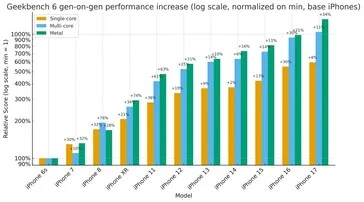
Examining the performance gains for each iPhone model compared to its direct predecessor, the iPhone 17 is said to be 8% quicker in single-core performance, 11% improved in multi-core, and 34% more efficient in graphics when compared to the iPhone 16. Notably, the iPhone 11 with the A13 Bionic holds the record for the largest single-core performance jump at 36%. The titles for the best multi-core and graphics performance go to the iPhone 8 (A11 Bionic) and the iPhone XR (A12 Bionic), respectively.
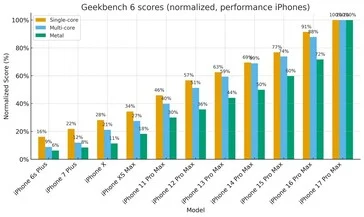
Now, let’s look at the “Pro” iPhones. The iPhone 17 Pro Max boasts improvements of about 625% in single-core, 1,111% in multi-core, and an impressive 1,667% in graphics when compared to the iPhone 6S. The year-on-year performance growth for the iPhone 17 Pro Max appears to be 9% for single-core, 14% for multi-core, and 40% for the GPU compared to the iPhone 16 Pro Max (Available “Renewed” on Amazon).
A Decade of Advancements
In other words, over the past decade since the iPhone 6S was released, the latest iPhones have become over 500% faster in single-core tasks, more than 1,000% faster in multi-core tasks, and an astonishing 1,200% better in GPU capabilities. This progress should make us value the technology that powers our smartphones. Of course, these performance advancements haven’t come without a cost, as the prices of iPhones have gradually increased. Nevertheless, considering that the iPhone 6S was launched at a starting price of $649 and the base iPhone 17 is priced at $799, the increase in cost over the years isn’t too bad.
Source:
Link
Leave a Reply