Tag: Performance Comparison

  • Choose the Dell XPS 16 with Core Ultra X7 Instead of New XPS 16 Core Ultra 7

    Choose the Dell XPS 16 with Core Ultra X7 Instead of New XPS 16 Core Ultra 7

    Key Takeaway

    1. The performance difference between the Core Ultra 5 and Core Ultra 7 is minimal, making the Ultra 7 a less cost-effective choice.
    2. Upgrading from the Core Ultra 5 or 7 to the Ultra X7 results in significant performance gains of up to 70% CPU and 150% GPU.
    3. It may be more beneficial to allocate budget towards storage or a higher-quality display instead of the more expensive, similar-performance Ultra 7 option.

    Introduction of the 2026 XPS 16 and Its Processors

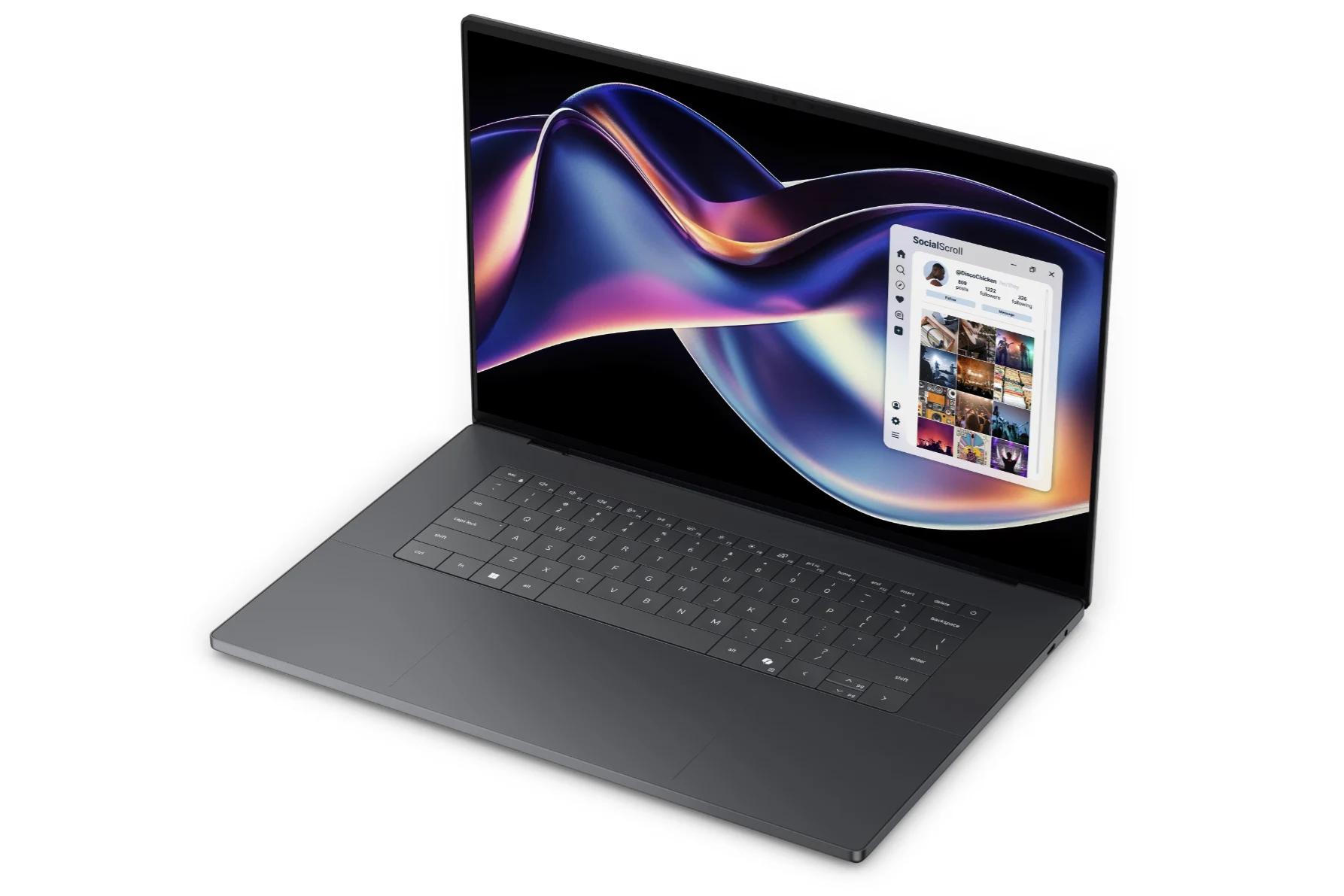
    The brand new 2026 XPS 16 comes with three different Panther Lake processors that its currently able to be configured with: the Core Ultra 5 325, the Core Ultra 7 355, and the more powerful Core Ultra X7 358H. Surprisingly enough, you might think that the performance gap between these CPUs would just grow in a straight line, but that’s not really the case at all.

    Performance Differences Between CPU Options

    When comparing how well each of these CPU options does, the charts below show a clear difference between the XPS 16 Core Ultra 5, the XPS 14 Core Ultra 7, and the XPS 16 Core Ultra X7 setups. We haven’t tested the XPS 16 Core Ultra 7 yet, but it’s expected that it performs pretty much the same as the XPS 14 Core Ultra 7. Moving from the Ultra 5 to the Ultra 7 doesn’t seem to give you much extra power, despite it costing more, so if your thinking about buying the new XPS 16, it might be wise to skip the Ultra 7 and spend that cash elsewhere, maybe more storage or a OLED screen.

    Why the Ultra X7 Is a Game Changer

    If you upgrade from the Core Ultra 5 or Ultra 7 to the Ultra X7, that’s where the XPS 16 truly stands out. The performance of both CPU and GPU can jump by up to 70% and 150% respectively. Interestingly, this significant boost comes with just around 35% more power usage. Some might say Dell should have just dropped the Ultra 7 entirely since customers end up paying more for very little extra, but the Ultra X7 really is where the power upgrades shine brightest.

    Additional Benchmarks and Performance Insights

    Furthermore, if you want to dive deeper into the performance metrics, plenty more benchmark comparisons are available on our detailed review of the XPS 16 with the Ultra X7 setup, giving you all the granular details you might need.
    Sources
    • iPhone 2025 vs 2015: 10 Years of 1000%+ Performance Boost

      iPhone 2025 vs 2015: 10 Years of 1000%+ Performance Boost

      Key Takeaways

      1. Smartphones have become powerful enough for demanding tasks like AAA gaming, video editing, and AI tasks.
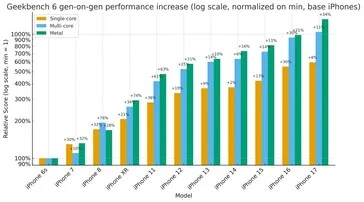
      2. The iPhone 17 shows a 588% improvement in single-core performance and 1,250% in graphics since the iPhone 6S.
      3. Year-on-year performance gains for the iPhone 17 include an 8% increase in single-core and 34% in graphics compared to the iPhone 16.
      4. Over the past decade, iPhones have improved by over 500% in single-core tasks and 1,200% in GPU capabilities.
      5. Despite performance gains, the price increase from the iPhone 6S to the iPhone 17 is relatively modest, from $649 to $799.


      As smartphones have developed over the years, the improvements in performance from one generation to the next seems to have shrunk. Many users have forgotten that, when we look at the bigger picture, high-end smartphones are now powerful enough to tackle demanding tasks such as AAA gaming, video editing, and even AI tasks. This is particularly true for those who always want the most powerful device when they make a purchase.

      Performance Evolution

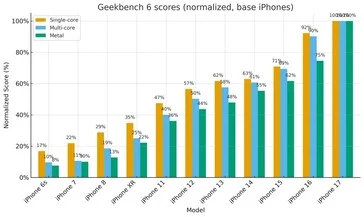
      To really understand how much smartphones have advanced, especially from a performance viewpoint, it’s helpful to reflect on the power we carry with us daily. A user on r/iPhone has gathered various charts illustrating the performance enhancements from generation to generation for iPhone models, beginning with the iPhone 6S (2015) up to the recent iPhone 17 series.

      Since the debut of the iPhone 6S in 2015, which featured the Apple A9 SoC, the Geekbench 6 single-core score for the base iPhone 17 has shown a staggering improvement of 588%. The gains in multi-core and graphics performance are even more remarkable, sitting at 1,000% and 1,250%, respectively. These figures were derived from the Geekbench 6 database and adjusted against the A19 score, which was set at 100%.

      Comparing Generations

      Examining the performance gains for each iPhone model compared to its direct predecessor, the iPhone 17 is said to be 8% quicker in single-core performance, 11% improved in multi-core, and 34% more efficient in graphics when compared to the iPhone 16. Notably, the iPhone 11 with the A13 Bionic holds the record for the largest single-core performance jump at 36%. The titles for the best multi-core and graphics performance go to the iPhone 8 (A11 Bionic) and the iPhone XR (A12 Bionic), respectively.

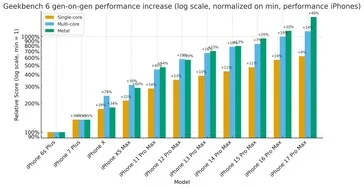
      Now, let’s look at the “Pro” iPhones. The iPhone 17 Pro Max boasts improvements of about 625% in single-core, 1,111% in multi-core, and an impressive 1,667% in graphics when compared to the iPhone 6S. The year-on-year performance growth for the iPhone 17 Pro Max appears to be 9% for single-core, 14% for multi-core, and 40% for the GPU compared to the iPhone 16 Pro Max (Available “Renewed” on Amazon).

      A Decade of Advancements

      In other words, over the past decade since the iPhone 6S was released, the latest iPhones have become over 500% faster in single-core tasks, more than 1,000% faster in multi-core tasks, and an astonishing 1,200% better in GPU capabilities. This progress should make us value the technology that powers our smartphones. Of course, these performance advancements haven’t come without a cost, as the prices of iPhones have gradually increased. Nevertheless, considering that the iPhone 6S was launched at a starting price of $649 and the base iPhone 17 is priced at $799, the increase in cost over the years isn’t too bad.

      Source:
      Link


    • Google Pixel 9a vs. Samsung Galaxy A56: Which is the Better Choice?

      Google Pixel 9a vs. Samsung Galaxy A56: Which is the Better Choice?

      Key Takeaways

      1. The Pixel 9a with Tensor G4 shows throttling during heavy use, while the Galaxy A56 achieves better frames per second despite a slower SoC.
      2. The Pixel 9a has slightly better battery life due to a larger capacity, but the A56 charges faster and lacks wireless charging.
      3. The Pixel 9a supports one nano SIM and one eSIM, while the Galaxy A56 offers more flexibility with two nano SIMs and two eSIMs options.
      4. Samsung provides clear transparency about its AI features, allowing users to disable cloud features on the Galaxy A56.
      5. The Galaxy A56 is more budget-friendly, priced €190 less than the Pixel 9a for the 256GB variant.


      When you think about performance, you might assume that the Pixel 9a with its Tensor G4 has a clear advantage. However, when pushed to its limits during heavy use and gaming, it experiences noticeable throttling. This results in the Galaxy A56, despite having a generally slower SoC, achieving a better frames per second rate.

      Battery Comparison

      In terms of battery life, the Pixel does have a slight edge, but this is likely due to its larger battery capacity. Conversely, the A56 charges more quickly, but it does not support wireless charging. Regarding the camera quality, the Google device is undoubtedly superior.

      SIM Card Capabilities

      The differences in SIM card options are also important to consider. Google provides one nano SIM and one eSIM, while the European version of the Samsung Galaxy A56 offers support for two Nano SIMs, two eSIMs, or even a mix of both. This flexibility can be very beneficial, especially for those who travel frequently. Moreover, One UI includes a dual messenger feature, allowing users to have a second version of apps, such as WhatsApp.

      Transparency and Pricing

      Furthermore, Samsung’s phone excels in transparency. This is particularly clear in how it communicates its AI features, clearly outlining which ones operate in the cloud and which are processed locally on the device. Additionally, users have the option to completely disable cloud features on the Galaxy A56.

      Finally, Samsung’s pricing is also more appealing, with the 256GB variant of the Galaxy A56 priced at €190 less than the Google Pixel 9a (starting at $488 on Amazon) at the time of this writing, especially in Germany.

      Source:
      Link

    • AnTuTu Top 10 Flagships March 2024: ROG Phone 8 Pro Leads

      AnTuTu Top 10 Flagships March 2024: ROG Phone 8 Pro Leads

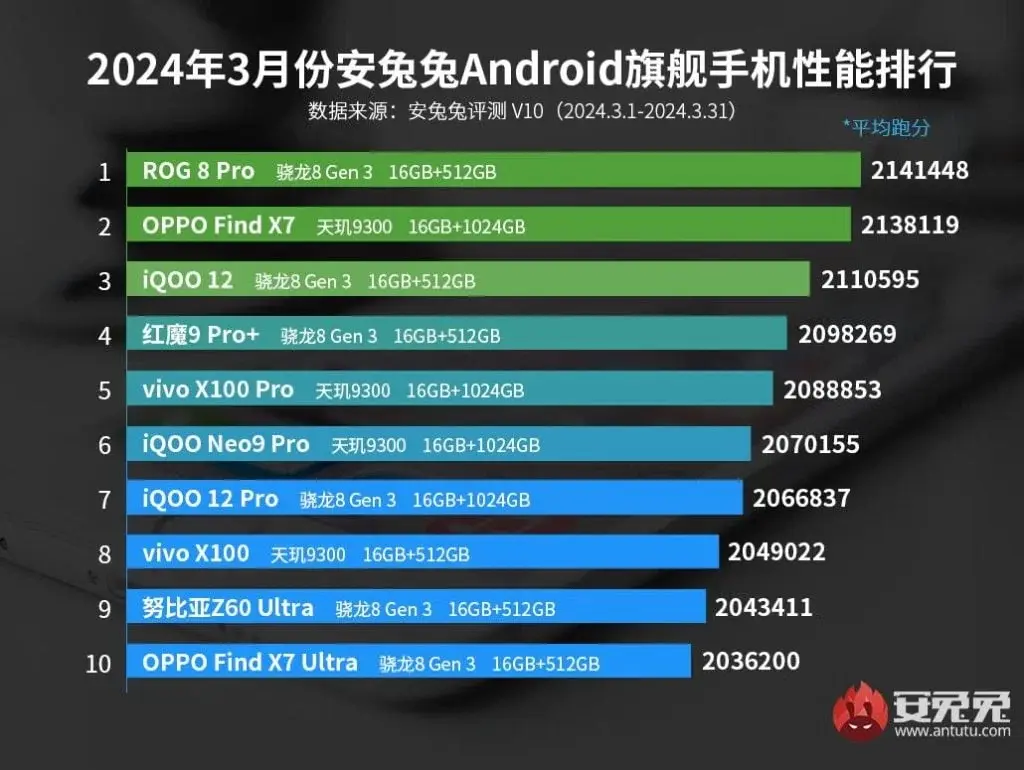
      AnTuTu recently unveiled its rankings for the best-performing flagship smartphones in March 2024, focusing on CPU, GPU, Memory (RAM), and UX performance. These metrics offer insights into how well these devices handle tasks like gaming. Below is the list of the top 10 smartphones according to AnTuTu:

      AnTuTu Top 10 Smartphones in March 2024:

      • Asus ROG Phone 8 Pro (Snapdragon 8 Gen 3, 16GB+512GB) – 2,141,448
      • OPPO Find X7 (Dimensity 9300, 16GB+1TB) – 2,138,119
      • iQOO 12 (Snapdragon 8 Gen 3, 16GB+512GB) – 2,110,595
      • Red Magic 9 Pro+ (Snapdragon 8 Gen 3, 16GB+512GB) – 2,098,269
      • Vivo X100 Pro (Dimensity 9300, 16GB+1TB) – 2,088,853
      • iQOO Neo 9 Pro (Dimensity 9300, 16GB+1TB) – 2,070,155
      • iQOO 12 Pro (Snapdragon 8 Gen 3, 16GB+1TB) – 2,066,837
      • Vivo X100 (Dimensity 9300, 16GB+512GB) – 2,049,022
      • Nubia Z60 Ultra (Snapdragon 8 Gen 3, 16GB+512GB) – 2,043,411
      • OPPO Find X7 Ultra (Snapdragon 8 Gen 3, 16GB+512GB) – 2,036,200

      Oppo Find X7


      AnTuTu Top 10 Flagships March 2024: ROG Phone 8 Pro Leads

      In February, OPPO’s Find X7, powered by Dimensity 9300, surpassed the Asus ROG Phone 8 Pro in performance. However, the ROG Phone 8 Pro has made a comeback in March 2024, claiming the top spot with a benchmark score of 2,141,448, thanks to recent optimizations.


      AnTuTu Top 10 Flagships March 2024: ROG Phone 8 Pro Leads

      Asus ROG Phone 8 Pro: Phantom Black

      Despite this, the OPPO Find X7 is a close second with 2,138,119 points, trailing by only 3,329 points. This indicates a neck-and-neck competition between Dimensity 9300 and Snapdragon 8 Gen 3 chips, showcasing strong performance levels. The industry anticipates MediaTek and Qualcomm’s upcoming chips, including the Snapdragon 8 Gen 4 and Dimensity 9400, which are rumored to outperform Apple’s A18 Pro in multi-core tests.

      The iQOO 12 secures the third spot, followed by Nubia’s Red Magic 9 Pro+ with a Snapdragon 8 Gen 3 SoC in fourth place. The Vivo X100 Pro, featuring Dimensity 9300, completes the top 5. Positions six to ten are occupied by iQOO Neo 9 Pro, iQOO 12 Pro, Vivo X100, Nubia Z60 Ultra, and OPPO Find X7 Ultra. Additionally, this month’s top-performing Flagship killers include the newly launched OnePlus Ace 3V, surpassing the Redmi K70E for the top position.

      For more insights and details, you can refer to the official AnTuTu rankings for March 2024.