

Key Takeaways
1. NGC 45 is a low surface brightness galaxy, making it faint and difficult to see against the night sky.
2. The galaxy has fewer stars compared to the amount of gas and dark matter it contains.
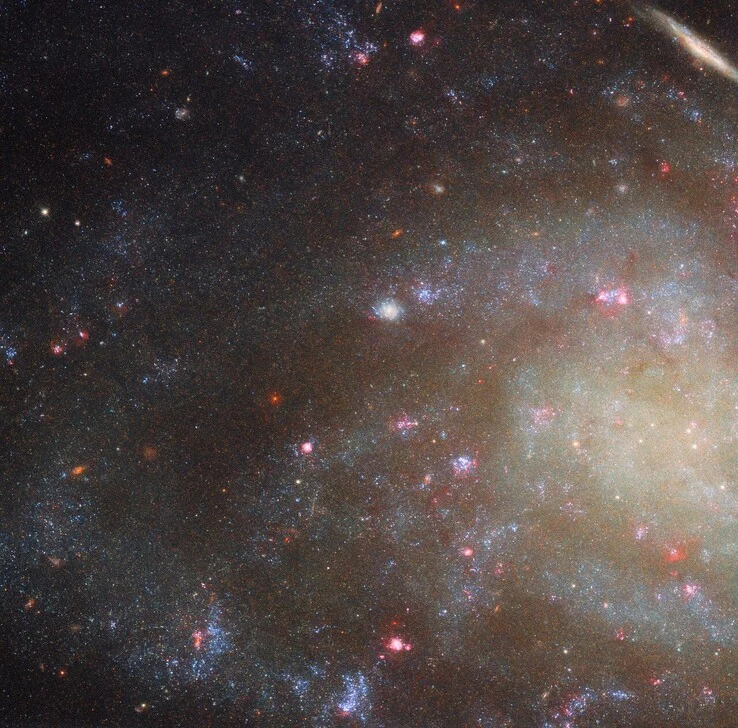
3. A recent image from the Hubble Space Telescope reveals its spiral arms, star formation areas (nebulae), and data from two observation projects.
4. NGC 45 was discovered by John Herschel in 1835, and low surface brightness galaxies may make up 30 to 60% of all galaxies in the universe.
5. NGC 45 can be observed with a mid-sized telescope in the Whale constellation under the right conditions.
NGC 45 is a galaxy with low surface brightness, which makes it hard to see since it is fainter than the surrounding night sky. The number of stars in these kinds of galaxies is quite limited when compared to the amount of gas and dark matter they contain. This is the reason they don’t shine very brightly, leading to their specific name. Thus, the recent close-up image of NGC 45 taken by the Hubble Space Telescope is quite fascinating.
Stunning Imagery
The photograph reveals the spiral arms of NGC 45, which are dotted with stars (seen as small blue points) along with glowing pink clouds, which are areas where stars are being born, referred to as nebulae. The picture is a mix of data from two different observation projects; the first one looked at 50 galaxies nearby, utilizing ultraviolet and near-infrared wavelengths. The second focused specifically on H-alpha light, which is a particular red light emitted from hydrogen.
Historical Context
Though NGC 45 was originally discovered by the English astronomer John Herschel back in 1835, the first large low surface brightness galaxy recognized was Malin 1, found in 1986. Studies indicate that these hard-to-find galaxies might constitute about 30 to 60% of all galaxies found throughout the universe.
Observing NGC 45
If you have a mid-sized telescope, you can point it towards the Whale constellation, and with the right conditions, you may be able to see NGC 45.
Source:
Link
Leave a Reply