
Key Takeaways
1. The Milky Way’s supermassive black hole is about 4 million times the mass of the Sun, yet some celestial bodies can survive its influence.
2. Astronomers used the ERIS instrument at the Very Large Telescope in Chile to challenge previous beliefs about the fate of certain celestial entities near the black hole.
3. The gas and dust cloud G2 was observed to safely pass the black hole without being destroyed, suggesting a star within it helps maintain its stability.
4. Other celestial objects, like the binary star system D9 and the moving formations X7 and X3, are also showing unexpected behaviors in their interactions with the black hole.
5. These findings indicate a surprisingly peaceful environment around the supermassive black hole, contrasting with its known destructive power.
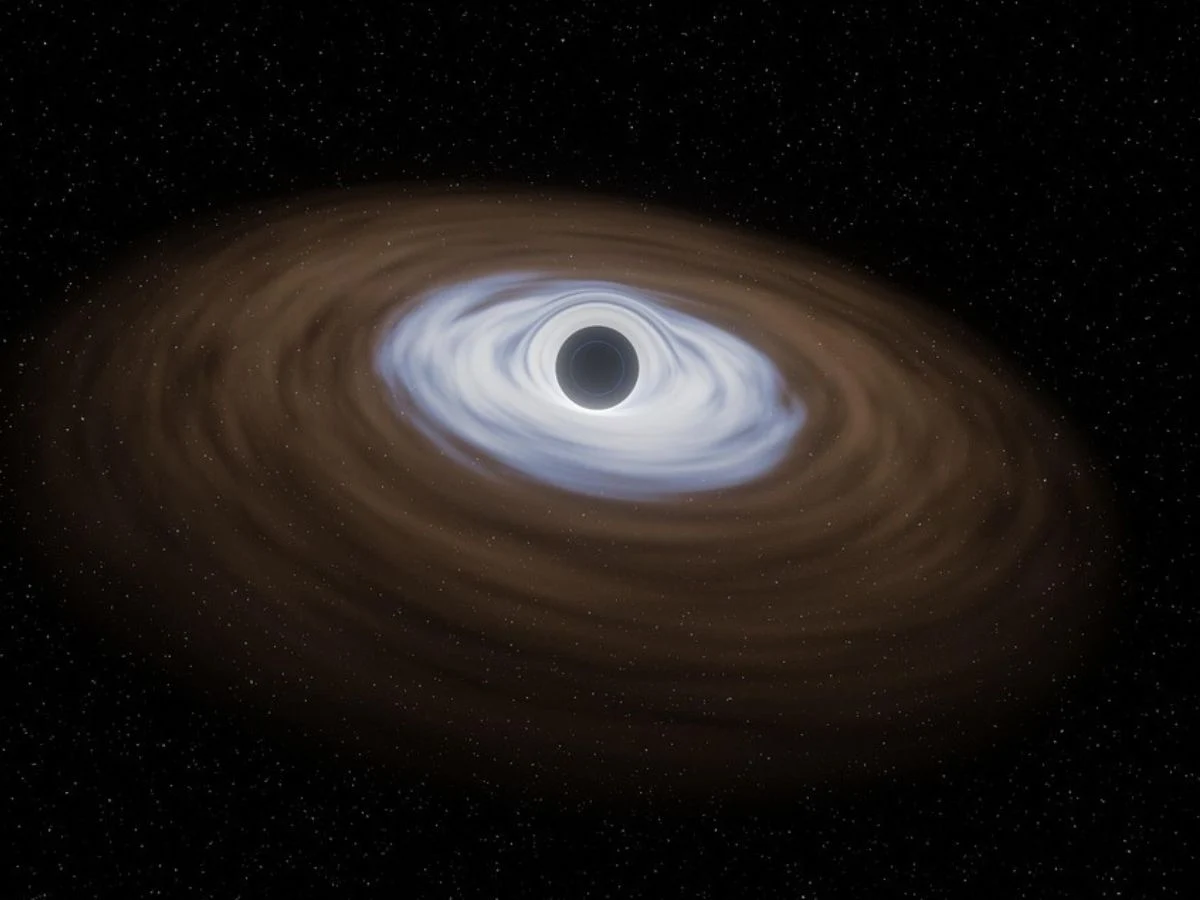
At the core of our Milky Way galaxy, there lies a supermassive black hole that is roughly 4 million times heavier than our Sun. Despite its incredible strength, scientists have found that some celestial bodies can endure its influence. This is quite unexpected, as the force from such a structure can rip apart numerous stars, planets, and clouds in space.
Discovering the Unexpected
Using the ERIS instrument from the Very Large Telescope located in Chile, astronomers were able to make this fascinating discovery. They also found that previous research, which suggested these celestial entities would vanish into the black hole, was incorrect.
The Case of G2
Years back, researchers looked at G2, a cloud comprising gas and dust, which was situated in a dangerous area that could lead to its destruction. However, the outcome was quite the opposite; astronomers observed that this formation simply moved past the black hole, steering clear of the event horizon without any alterations. Dr. Florian Peißker proposed a theory to account for this phenomenon, suggesting that a star exists within the gas and dust cloud, enabling it to keep a stable orbit.
Observations of Other Objects
Other celestial phenomena have also been examined, like D9, a binary star system that has yet to merge. Moreover, X7 seems to be continuing its path northward, while X3 has sped up by approximately 100 km/s. This indicates that the environment surrounding this cosmic giant is relatively peaceful, which is quite a contrast to its formidable destructive capability.
In summary, the findings from Astronomy & Astrophysics reveal a complex relationship between these celestial entities and the supermassive black hole at the heart of our galaxy.
Source:
Link


Leave a Reply