
Category: TV / Monitor

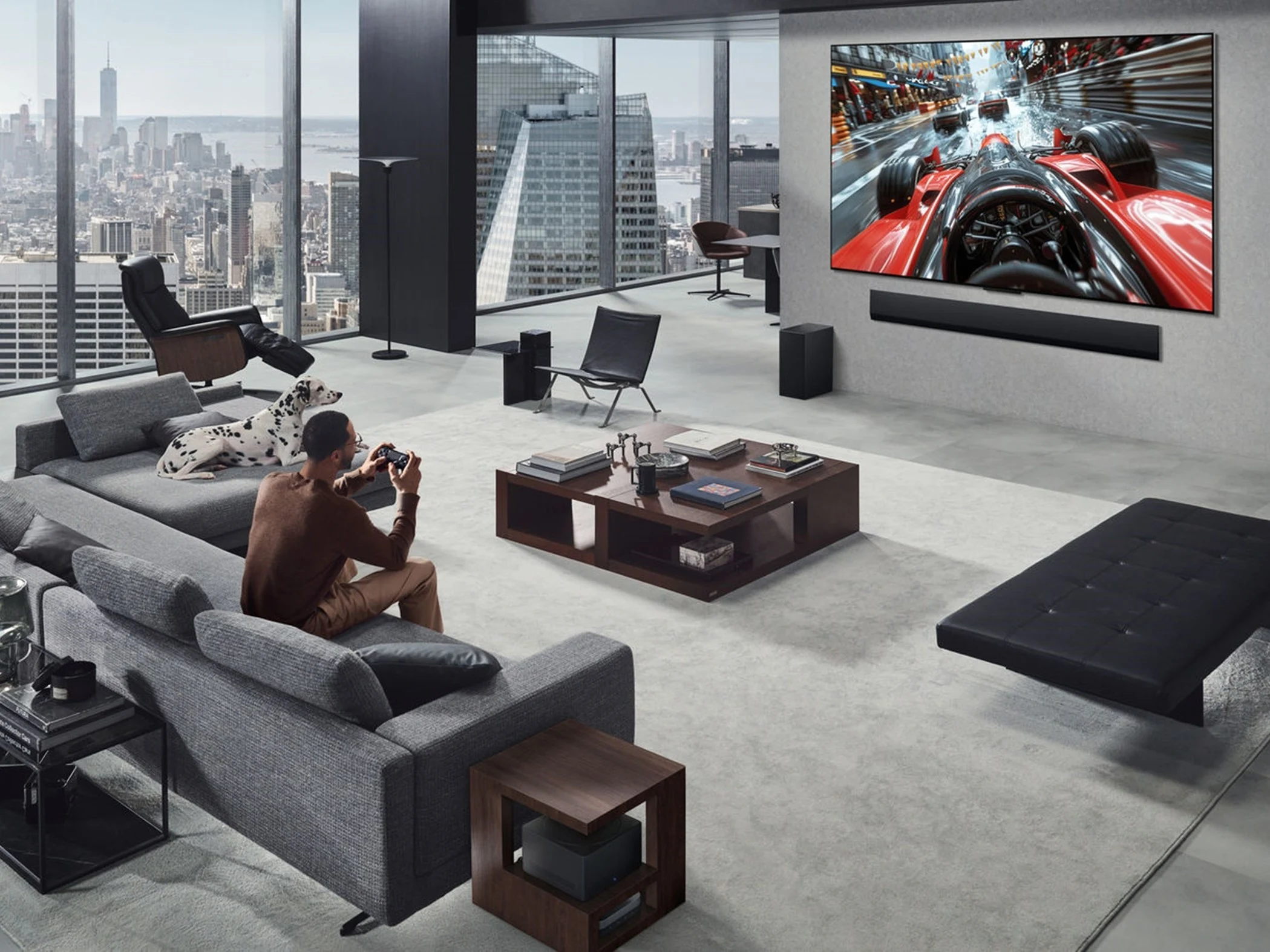
  • LG OLED evo M5 TV with Wireless Box Launches Worldwide

    LG OLED evo M5 TV with Wireless Box Launches Worldwide

    Key Takeaways

    1. Clutter-Free Setup: The LG M5 features True Wireless technology with the LG Zero Connect Box for a cable-free setup, allowing easy connection of devices.

    2. Impressive Specifications: This 4K TV offers a native 120 Hz refresh rate, up to 2,500 nits peak brightness, and supports Dolby Vision, HDR10, and Filmmaker Mode.

    3. Gaming Features: The M5 is gamer-friendly with 144 Hz VRR, ALLM, and compatibility with AMD FreeSync Premium and Nvidia G-Sync.

    4. Smart TV Capabilities: It runs on LG’s Smart TV platform, supporting various streaming apps and voice assistants like Google Assistant and Amazon Alexa.

    5. Pricing Information: The starting price in the UK is £3,799 for the M5, with specific prices in Austria and Germany, but US pricing is not yet available.


    LG has begun the global launch of its OLED evo AI M5 4K Smart TV 2025. This television was first presented at CES earlier this year, alongside the G5 model. LG claims this TV is tailored for both gamers and for those who enjoy watching films and shows.

    Clutter-Free Setup

    The M5 model features the company’s True Wireless technology, allowing for a setup without messy cables. This is made possible by the LG Zero Connect Box, which promises lossless transmission of video and audio wirelessly. Any gaming consoles or speakers that you have can be connected to the box using ports like three HDMI 2.1, Toslink, and Ethernet. You can easily hide the box and the devices in a cabinet or place them near your couch.

    Impressive Specifications

    The LG M5 is a 4K TV with a native refresh rate of 120 Hz, and it comes in four different sizes: 65-inch, 77-inch, 83-inch, and 97-inch. It is reported to be 45% brighter than the previous model; a test from Rtings indicated a typical brightness of 471 nits, with peak brightness reaching nearly 2,500 nits. The TV also supports Dolby Vision, HDR10, and Filmmaker Mode. For gamers, it boasts 144 Hz VRR, ALLM, and is compatible with AMD FreeSync Premium and Nvidia G-Sync. Moreover, it operates on LG’s Smart TV platform, offering a variety of streaming applications, and it is compatible with Google Assistant, Amazon Alexa, Matter, and Apple HomeKit. Integrated 4.2 channel speakers provide support for Dolby Atmos.

    Pricing Details

    In the UK, the LG OLED evo AI M5 4K Smart TV can be found at retailers such as SmithsTV, with starting prices of £3,799. Shoppers in Austria and Germany can buy this model from stores like Elektro Köck, where the 65-inch version costs €3,899. A complete pricing list for all four sizes is below. However, pricing for these new models in other regions, particularly the US, has not yet been disclosed.

    Source:
    Link

  • ViewSonic Launches 138-Inch Foldable LED Monitor with Android

    ViewSonic Launches 138-Inch Foldable LED Monitor with Android

    Key Takeaways

    1. The ViewSonic LDS138-151 LED monitor has a massive 138-inch display, designed to fold for easy transport.
    2. It features a resolution of 1920 x 1080 pixels, a contrast ratio of 6500:1, and a brightness of 600 nits.
    3. The monitor has an IP54 rating, making it resistant to dust and minor water splashes.
    4. It includes Android 9, 32GB of internal storage, and two 30-watt stereo speakers, allowing for direct content playback.
    5. The cost of the monitor is available only upon request, and it is designed for easy part replacement due to front access.


    The ViewSonic LDS138-151 LED monitor is a massive display with a screen that measures 138 inches, making it over 10 feet wide. To facilitate transport through doorways and elevators, ViewSonic designs the monitor with hinges on the left and right sections, allowing them to fold inwards. When the stand is collapsed, its dimensions reduce to 6.8 by 6.5 by 2.8 feet, but the monitor still carries a hefty weight of 551 pounds.

    Display Specifications

    This “Direct View” LED screen boasts a resolution of 1920 x 1080 pixels, yielding a pixel density of 16 PPI, which is on the lower side. The monitor features a contrast ratio of 6500:1 and can achieve a full-screen brightness of 600 nits. ViewSonic claims that the screen has a lifespan of 100,000 hours. If any defects arise, the panel can be accessed from the front for easy replacement of parts.

    Durability and Features

    With an IP54 rating, the monitor is safeguarded against dust and minor water splashes. The height is adjustable thanks to a motorized stand, and the wheels enable simple repositioning. ViewSonic promotes the LDS138-151 as an all-in-one device, incorporating Android 9 and 32GB of internal storage. This allows users to play content directly on the monitor without needing an additional media player. Additionally, the monitor comes with two 30-watt stereo speakers, four HDMI ports, Wi-Fi capability, and two 3.5mm headphone jacks.

    The cost of the ViewSonic LDS138-151 is available only upon request. For further information about this enormous foldable monitor, you can check the official product page.

    Source:
    Link


  • New TCL Q8C QD-MiniLED TV Launch with Discounts Available Now

    New TCL Q8C QD-MiniLED TV Launch with Discounts Available Now

    Key Takeaways

    1. The TCL Q8C Premium QD MiniLED TV is now available in various European countries and is similar to previous models like the C8K, C89K, and C81K.
    2. It comes in four sizes: 65-inch, 75-inch, 85-inch, and 98-inch, featuring a WHVA CrystGlow Panel with a native contrast ratio of 7,000:1 and up to 5,000 nits brightness.
    3. The TV supports 4K resolution with a native refresh rate of 144Hz and includes gaming features such as Game Accelerator, Game Bar, and AMD FreeSync Premium Pro.
    4. It offers various HDR formats, built-in Bang & Olufsen speakers, and connectivity options like HDMI 2.1, USB 3.0, Bluetooth 5.4, and Wi-Fi 6.
    5. Pricing starts at €1,499 in France, with discounts available in multiple countries, including Italy (€1,699) and Germany (€1,599 for the 65-inch model).


    The TCL Q8C Premium QD MiniLED TV has hit the market in various European nations. This model is basically the same as the C8K, C89K, and C81K TVs, which were introduced in multiple regions back in June 2025. It shares similarities with the QM8K, which was launched in the US earlier this year, starting at $1,798 on Amazon.

    Available Sizes

    The Q8C is offered in four distinct sizes: 65-inch, 75-inch, 85-inch, and 98-inch. Each TV features a WHVA CrystGlow Panel utilizing QLED technology, boasting a native contrast ratio of 7,000:1. These models cover 97% of the DCI-P3 color spectrum and can reach brightness levels up to 5,000 nits, along with 3,840 local dimming zones.

    Gaming Features

    With a 4K resolution and a native refresh rate of 144Hz, the Q8C also includes Game Accelerator, which goes up to 288Hz. Additional gaming features consist of Game Bar and AMD FreeSync Premium Pro. The TV supports Dolby Vision IQ, HDR10+, HLG formats, IMAX Enhanced, and Filmmaker Mode. Thanks to the Google TV platform, users can easily access various streaming services and can wirelessly share their screens using Google Cast or Apple AirPlay 2. It also comes with Bluetooth 5.4, Wi-Fi 6, and ports such as HDMI 2.1 (eARC), USB 3.0, and Ethernet. Plus, it includes built-in Bang & Olufsen speakers that are compatible with both Dolby Atmos and DTS Virtual:X.

    Pricing and Discounts

    LDLC, which services France, Belgium, and Switzerland, has the TCL Q8C Premium QD MiniLED TV starting at €1,499. The 75-inch, 85-inch, and 98-inch versions are currently being offered at discounted prices. In Italy, you can find prices beginning at €1,699 on Amazon. For Germany, the recommended retail price for the 65-inch model is €1,599, with discounts available on all sizes at the retailer Otto. A complete list of suggested retail prices for each size in these countries can be seen in the table below.

    Source:
    Link


  • Xiaomi TV Stick 4K (2nd Gen) Review and Hands-On Images

    Xiaomi TV Stick 4K (2nd Gen) Review and Hands-On Images

    Key Takeaways

    1. The Xiaomi TV Stick 4K (2nd Gen) has appeared for sale on AliExpress despite no official announcement from Xiaomi.
    2. Over 500 units have already been sold, with positive early reviews and customer feedback.
    3. The design features a more rounded shape and a new remote similar to other Xiaomi TV products.
    4. It is a certified Google TV device with Google Assistant support, Wi-Fi 6, and a quad-core processor.
    5. The package includes a remote, power adapter, power cable, and HDMI extender, priced at around $45.


    The Xiaomi TV Stick 4K (2nd Gen) has recently surfaced online, with a well-known store on AliExpress offering the streaming gadget for purchase. While Xiaomi has not yet made an official announcement regarding the release of the streaming stick, some concerns about the product’s validity have emerged. However, initial hands-on reviews seem to ease those worries.

    Sales and Reviews

    Currently, the 70-mai Goldway Store on AliExpress has sold over 500 units of the Xiaomi TV Stick 4K (2nd Gen), and reviews are starting to flow in. Many of these reviews indicate that customers have received the streaming device and even include some hands-on pictures of it.

    Design and Features

    The Xiaomi TV Stick 4K (2nd Gen) aligns with the images shown in the listing. This updated streaming stick showcases a more rounded look compared to its predecessor, the first-gen Xiaomi TV Stick 4K. Additionally, it comes with a new remote, which is the same as that found in the Xiaomi TV Box S (2nd Gen) and Box S (3rd Gen). The packaging also reveals that the TV Stick 4K (2nd Gen) is a certified Google TV device, complete with Google Assistant support. Moreover, it supports Wi-Fi 6 and is powered by a quad-core processor.

    What’s in the Box

    Included with the new Xiaomi TV Stick 4K (2nd Gen) are the remote, a power adapter, a power cable, and an HDMI extender cable. It is currently priced at approximately $45 and is anticipated to be officially launched in the next few months.

    Source:
    Link


  • Loewe Unveils 97-Inch OLED Flagship Smart TV

    Loewe Unveils 97-Inch OLED Flagship Smart TV

    Key Takeaways

    1. Loewe has launched its largest smart TV yet, the stellar 97, featuring a 97-inch OLED screen.
    2. The TV utilizes advanced W-OLED technology from LG Display, offering exceptional contrast, brightness, and accurate color reproduction with Dolby Vision IQ.
    3. It runs on the latest Loewe os9 platform, which includes smart features like Miracast, Apple AirPlay, and a dedicated gaming zone with cloud gaming support.
    4. The stellar 97 showcases elegant craftsmanship with a brushed aluminum frame and options for flush wall installation.
    5. The TV is priced at €29,999 (approximately US$35,333) and will be available from select retailers, with US pricing still to be announced.


    German luxury brand Loewe, known for its home entertainment products, has recently added a new model to its smart TV collection—its biggest one yet. The Loewe stellar 97, featuring a massive 97-inch OLED screen, is now ready for purchase after being announced last year.

    Stunning Display Technology

    At the core of the stellar 97 is a cutting-edge W-OLED panel made by LG Display. This panel, like other OLED technologies, offers exceptional contrast and rich blacks, along with remarkable brightness for this type of display. Loewe claims that with Dolby Vision IQ Precision Detail and factory calibration, the TV provides color reproduction that accurately represents the director’s intent. The company also states that the smart TV adheres to all relevant color and visual standards.

    Smart Features and Gaming

    The stellar 97 operates on the latest Loewe os9, which is built on the Vidaa U9 platform. This operating system enables features like Miracast and Apple AirPlay, as well as access to various apps, some of which are preinstalled. For gamers, the new Vidaa Cloud Gaming Zone is a highlight, along with support for services like Blacknut and Boosteroid.

    Elegant Craftsmanship

    Produced at Loewe’s facilities in Kronach, Germany, the stellar 97 is marketed as a “craft design” television, merging high-end aesthetics with top-notch materials. It comes with a brushed aluminum frame and an aluminum back cover. The TV’s integrated wall mount allows for a nearly flush installation against a wall, while VESA screw holes are also an option for mounting.

    Nonetheless, all these high-end features come with a hefty price tag. The Loewe stellar 97 dr+ has a suggested retail price of €29,999 (approximately US$35,333) and will be available from select specialist retailers starting this month. Pricing details for the US market still remain undisclosed.


  • LG Display Tests JDI eLEAP OLED Tech for Brighter, Efficient Panels

    LG Display Tests JDI eLEAP OLED Tech for Brighter, Efficient Panels

    Key Takeaways

    1. LG Display is testing Japan Display’s eLEAP OLED technology, which uses lithography instead of FMM, leading to finer pixel structures and higher aperture ratios.
    2. The evaluation is happening at LG Display’s Paju facility, utilizing existing equipment for quick assessment and low investment.
    3. eLEAP technology shows potential for niche markets, especially in 20~30-inch automotive displays and monitors, with advantages like enhanced brightness and lower power consumption.
    4. Samsung Display is rumored to explore eLEAP technology, indicating increased industry interest in maskless OLED production methods.
    5. Successful tests of eLEAP could revolutionize the OLED industry by improving yields and performance, enabling more energy-efficient and high-resolution displays.


    LG Display has started to work on and test Japan Display’s (JDI) eLEAP OLED technology, which doesn’t use FMM. Instead, eLEAP employs lithography for arranging red, green, and blue OLED materials, which allows for a finer pixel structure and higher aperture ratios. JDI asserts that this innovative method produces an aperture ratio that is twice that of standard FMM OLED, thus enhancing light-emitting efficiency from 28% to 60%.

    Testing at Paju Facility

    The evaluation is taking place on LG Display’s E4 production line in Paju, South Korea, which typically manufactures large OLED panels for televisions. The company already has all the required CVD and thin-film encapsulation equipment, compatible with eLEAP, allowing for a swift assessment and minimal investment in new capital.

    Potential Market Applications

    While LG Display has yet to make a decision regarding mass production of eLEAP, the company acknowledges the technology’s potential for niche OLED markets, particularly in the 20~30-inch range for automotive displays and monitors. The Paju facility is suitable for initial operations due to its current lower utilization, since most TV OLED panels are produced in Guangzhou, China.

    eLEAP panels come with several advantages, like enhanced brightness, lower power consumption, and the potential for flexible and shapeable displays. The company claims its technology significantly prolongs the lifespan of OLED panels by more than three times when compared to those using FMM, and offers over double the brightness of existing FMM-based OLEDs. These benefits match the market demands for energy-efficient, high-performance displays in VR headsets, wearables, and the automotive sector.

    Industry Interest in eLEAP

    There are also rumors that Samsung Display is looking into eLEAP, with research and development expected to begin in late 2024, which shows a growing interest in maskless OLED production techniques within the broader industry. Additionally, the Chinese OLED manufacturer Vixionox is advancing towards non-FMM OLED production using the ViP branding for its next-generation OLED lines.

    Although the timeline for commercial launch is still uncertain, these tests might signify a turning point for the OLED industry. Traditional FMMs restrict design possibilities and increase costs. If these efforts prove successful, LG Display and others may enhance yields and performance, paving the way for a new era of energy-efficient, high-resolution displays across various devices.

    Source:
    Link


  • Netflix Launches Exclusive NASA+ Space Content This Summer

    Netflix Launches Exclusive NASA+ Space Content This Summer

    Key Takeaways

    1. NASA is collaborating with Netflix to share content from its free NASA+ service, aiming to reach a global audience.
    2. The NASA+ service remains free and ad-free on NASA’s official app and website, with no additional charges for Netflix users.
    3. This partnership enhances audience engagement and inspiration in the current media landscape, according to NASA’s general manager of NASA+.
    4. NASA previously partnered with Amazon’s Prime Video to launch a Free Ad-Supported Television (FAST) channel, showcasing its work in space exploration.
    5. The collaboration allows Netflix to live-stream rocket launches, conduct exclusive interviews, provide mission updates, and offer real-time views from the International Space Station (ISS).


    NASA is taking exciting steps to collaborate with Netflix by sharing content from its free NASA+ service. The space agency aims to utilize the popular streaming platform to reach viewers all over the world.

    Details on NASA+ Service

    The NASA+ service will continue to be available for free without any advertisements on NASA’s official app and website. There won’t be any extra charges for Netflix users either.

    Rebecca Sirmons, who is the general manager of NASA+, mentioned that this collaboration helps the agency to boost interaction and inspire a worldwide audience in today’s media environment.

    Recent Partnerships

    Earlier in May, NASA made a similar agreement with Amazon’s Prime Video, launching a Free Ad-Supported Television (FAST) channel. This channel enables audiences to easily explore the agency’s work in space exploration, science, and technology.

    Netflix has also been focusing on diversifying its offerings with live content. They are gradually adding more live sports, partnering with WWE, and hosting unique live events, like a celebrity golf tournament that features athletes from the Formula 1: Drive to Survive and Full Swing documentary series.

    Additional Streaming Deals

    Moreover, Netflix recently struck a deal with the French media company TF1, which permits them to stream widely popular scripted dramas and unscripted shows like The Voice, alongside major live sports events, specifically for their French subscribers.

    With the new NASA collaboration, Netflix will gain the capability to live-stream rocket launches, conduct exclusive interviews with key personnel, provide live mission updates, and offer real-time views of Earth from the International Space Station (ISS).

    NASA emphasized that audiences can still enjoy all this content totally ad-free on their official website and app.

    Source:
    Link

  • Android 14 Update Now Available for Onn 4K and Onn 4K Pro

    Android 14 Update Now Available for Onn 4K and Onn 4K Pro

    Key Takeaways

    1. The initial rollout of Android 14 for Walmart’s Onn 4K and Onn 4K Pro resulted in many devices becoming unusable.
    2. A new update for Android 14 is now being distributed to the Onn 4K, Onn 4K Pro, and Onn Stick.
    3. The new update for Onn 4K Pro has a build number of “URO1.250103.029.C1” and is about 0.91 GB in size.
    4. The update is available to all users, including those who did not experience issues with the first Android 14 update.
    5. Initial feedback on the new update is positive, with no new reports of bricked devices.


    As mentioned last week, the launch of Android 14 for Walmart’s Onn 4K and Onn 4K Pro boxes didn’t go well, leading to many users ending up with unusable devices after applying the update. The rollout was paused for a while, but now, a new update is finally being distributed to these devices.

    Update Rolling Out

    According to reports on Reddit, Walmart’s Onn boxes are now receiving an updated version of Android 14. Besides the previously mentioned Onn 4K and Onn 4K Pro, the Onn Stick is also included in this over-the-air update. For the Onn 4K Pro, the new update has the build number “URO1.250103.029.C1” and is approximately 0.91 GB in size.

    Positive Feedback

    Interestingly, this new build is accessible to all users of these devices, even those who installed the first Android 14 update without any problems. It remains unclear if this version fixes the issues that were caused by the previous release, but initial feedback has been encouraging, with no additional reports of bricked devices. Therefore, owners of the Onn 4K Pro, Onn 4K, and Onn Stick can confidently install this update without worrying about major problems.

    Source:
    Link


  • Xiaomi TV Stick 4K (2nd Gen) Now Available for Global Purchase at $45

    Xiaomi TV Stick 4K (2nd Gen) Now Available for Global Purchase at $45

    Key Takeaways

    1. Xiaomi has launched the TV Box S (3rd Gen), which outperforms many competitors but has some flaws.
    2. The Xiaomi TV Stick 4K (2nd Gen) is not officially announced but is available for purchase on Aliexpress.
    3. Both the TV Stick 4K (2nd Gen) and Box S (3rd Gen) share hardware similarities, including a 6nm quad-core CPU and the ARM G310 V2 GPU.
    4. The TV Stick 4K (2nd Gen) features 2 GB of RAM and 8 GB of storage, while the Box S (3rd Gen) offers 32 GB of storage and better connectivity.
    5. The TV Stick 4K (2nd Gen) is priced at $45.64 and lacks a Type-C port, while the Box S (3rd Gen) is priced at $52.99 and comes with enhanced features.


    Xiaomi has recently introduced its TV Box S (3rd Gen), which has shown to outperform many competitors, despite having a few flaws. The brand also seems to have quietly launched a new version of the well-received Xiaomi TV Stick 4K, according to new listings.

    New Generation of TV Stick

    Specifically, the Xiaomi TV Stick 4K (2nd Gen) has not been officially announced yet. It is absent from Xiaomi’s official websites, but we have contacted the company for confirmation and will share any updates we receive. However, it is available for purchase on Aliexpress from the 70mai-Goldway Store, which has a stellar reputation and has been operating for seven years, boasting over 180,000 followers.

    Hardware Similarities

    Regarding the TV Stick 4K (2nd Gen), it seems to have quite a few similarities with the Box S (3rd Gen) in terms of hardware. The listing indicates it contains a 6nm quad-core CPU, and the GPU is reported to be the same ARM G310 V2 found in the Box S (3rd Gen). This suggests that both devices may be run by the Amlogic S905X5M chipset, which has shown impressive performance, outpacing competitors like the Onn 4K Pro and Fire TV Stick 4K Max 2.

    Memory and Features

    The TV Stick 4K (2nd Gen) comes with 2 GB of RAM, identical to the Box S (3rd Gen), but it is limited in storage with just 8 GB compared to the 32 GB offered by the larger device. Other features include Wi-Fi 6, Bluetooth 5.2, support for Dolby Vision, HDR 10+, Dolby Atmos, and DTS-X. A downside is that Xiaomi still hasn’t included a Type-C port, as the TV Stick 4K (2nd Gen) appears to have a Micro USB port instead.

    The TV Stick 4K (2nd Gen) is currently listed on Aliexpress for a price of $45.64. In contrast, the Box S (3rd Gen) is available on the same platform for $52.99, offering a much better value due to its enhanced storage and connectivity options. Unlike the TV Stick 4K (2nd Gen), the Box S (3rd Gen) has been officially launched, making it less likely to have any malware issues.

    Source:
    Link


  • “Polarizing ‘Lord of Mysteries’ Anime Sparks Popularity Concerns”

    “Polarizing ‘Lord of Mysteries’ Anime Sparks Popularity Concerns”

    Key Takeaways

    1. Pacing Issues: The adaptation struggles with pacing, cramming too much content, which leaves viewers confused and detracts from the story’s suspenseful buildup.

    2. Unique Genre Blend: While categorized as isekai, it diverges from typical conventions with its dark Victorian setting and Lovecraftian/steampunk influences, making it less mainstream.

    3. Clarification of Format: “Lord of Mysteries” is a donghua (Chinese animation), not a traditional anime, which differentiates it from similar series like “Solo Leveling.”

    4. Viewer Engagement Disparity: The series has garnered significantly fewer likes compared to “Solo Leveling,” indicating a gap in viewer engagement and popularity.

    5. Potential Disappointment for Fans: Fans of the original web novel may find the adaptation lacking, given the high quality and acclaim of the source material.


    Lord of Mysteries made its debut yesterday, June 28, as the newest animated series in the recent wave of manhwa and web novel adaptations. Two episodes, each lasting 35 minutes, were released to attract viewers’ attention. While the animation has received generally favorable reviews for its artistic style and direction, the initial episodes have attracted notable criticism for their pacing, managing to adapt over 40 chapters from the original material.

    Pacing Problems

    These two episodes face challenges because of their pacing. It’s important to mention that the novel begins at a very slow pace—almost like a slice-of-life story—but the anime tries to fix this by cramming in lots of content into the first episodes. The absence of slower scenes and the careful buildup of suspense leaves viewers confused about what’s actually happening. This could be a critical mistake, especially for a series that explores several unconventional themes and features a distinct magic system.

    Unique Genre Approach

    In technical terms, Lord of Mysteries falls into the isekai category. However, it quickly breaks away from common genre conventions due to its dark Victorian atmosphere and the blending of Lovecraftian and steampunk influences. These elements make it stand out but also make it less likely to achieve the widespread popularity of other isekai titles or more accessible power fantasies like Solo Leveling.

    Clarifying the Format

    Though referred to as an anime in this discussion, Lord of Mysteries is actually a donghua—a Chinese animated series produced by the Chinese studio B.C May Pictures and inspired by the Chinese web novel of the same title. In contrast, Solo Leveling is based on a Korean novel but is created by a Japanese studio, thus qualifying as anime. The dubbing situation is also noteworthy; Lord of Mysteries is in Chinese, and a Japanese dub has not yet been released more than 24 hours after the premiere. Casual viewers typically prefer the latter option.

    Viewer Engagement

    These differences are evident in the numbers. Within 48 hours of Solo Leveling’s first episode being released, it received over 110,000 likes on Crunchyroll. In comparison, Lord of Mysteries’ first episode has garnered only 14,000 likes over 30 hours post-release. Clearly, a significant gap in popularity exists. Whether this gap narrows will depend on how the series addresses its pacing and dubbing issues in the weeks ahead.

    In any case, it’s unlikely that it will ever reach the soaring popularity of Solo Leveling. There’s no shame in that—after all, only a select few shows achieve such heights. Unfortunately, fans of the original novel might find the adaptation disappointing, and rightly so, given the quality and acclaim of the source material.