Tag: 4K gaming

  • Hisense U7SG Mini LED TVs: 330Hz Gaming, 3000 Nits Brightness

    Hisense U7SG Mini LED TVs: 330Hz Gaming, 3000 Nits Brightness

    Key Takeaways

    1. Hisense launched the U7SG series of ULED Mini LED TVs in various sizes (55, 65, 75, 85, 100, and 116 inches) with 4K resolution.
    2. Each model features a VA panel with a peak brightness of 3000 nits and refresh rates from 48 Hz to 165 Hz for smooth visuals.
    3. The TVs include gaming-focused features such as a native game mode of 165 Hz, “Game Booster” for up to 330 Hz, and support for AMD FreeSync Premium Pro.
    4. Audio capabilities vary by size, with larger models offering enhanced speaker configurations and support for Dolby Atmos and DTS Virtual:X.
    5. The U7SG TVs run on Google TV and come with multiple HDMI 2.1 ports and a sleek unibody design.


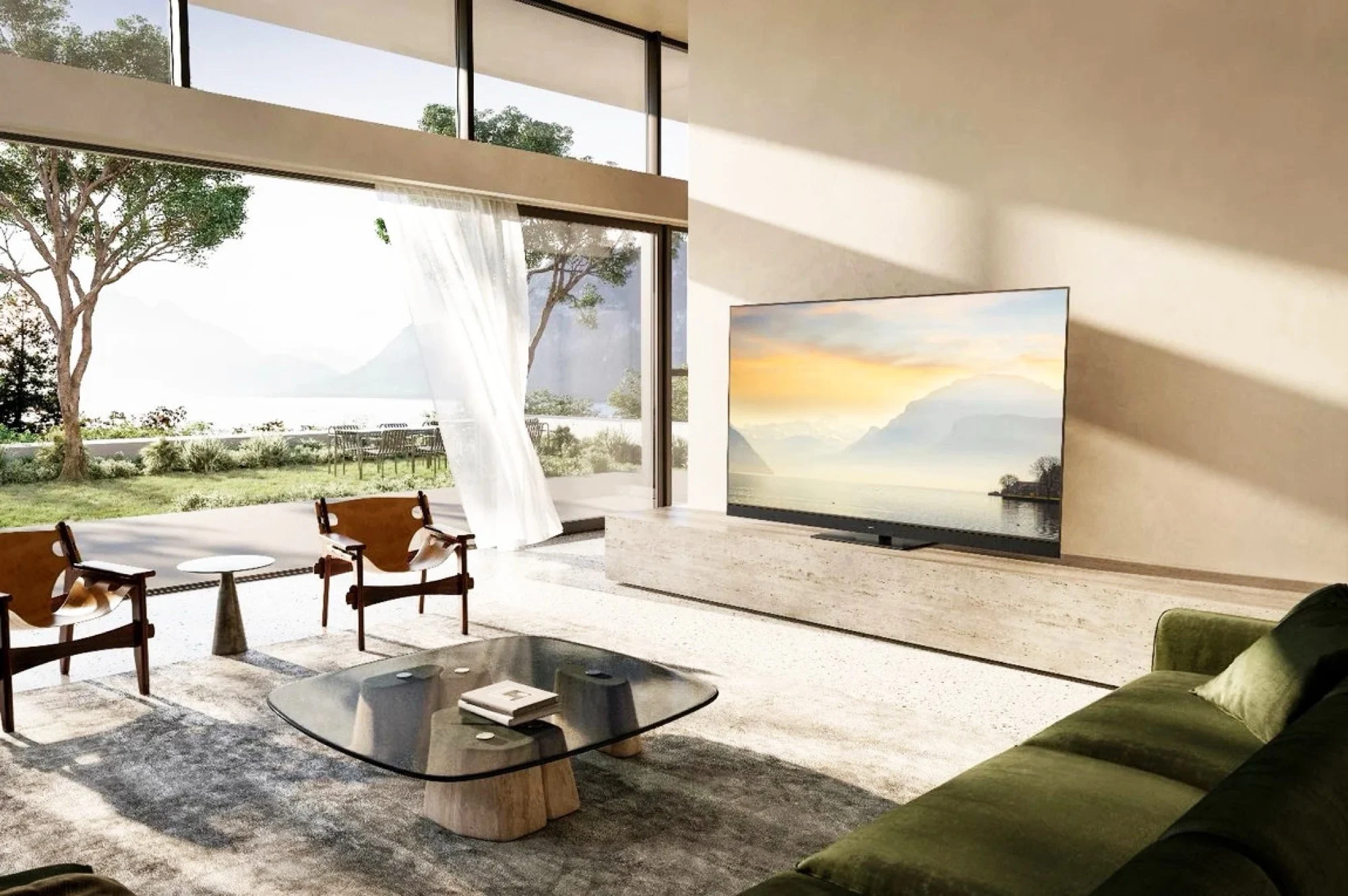
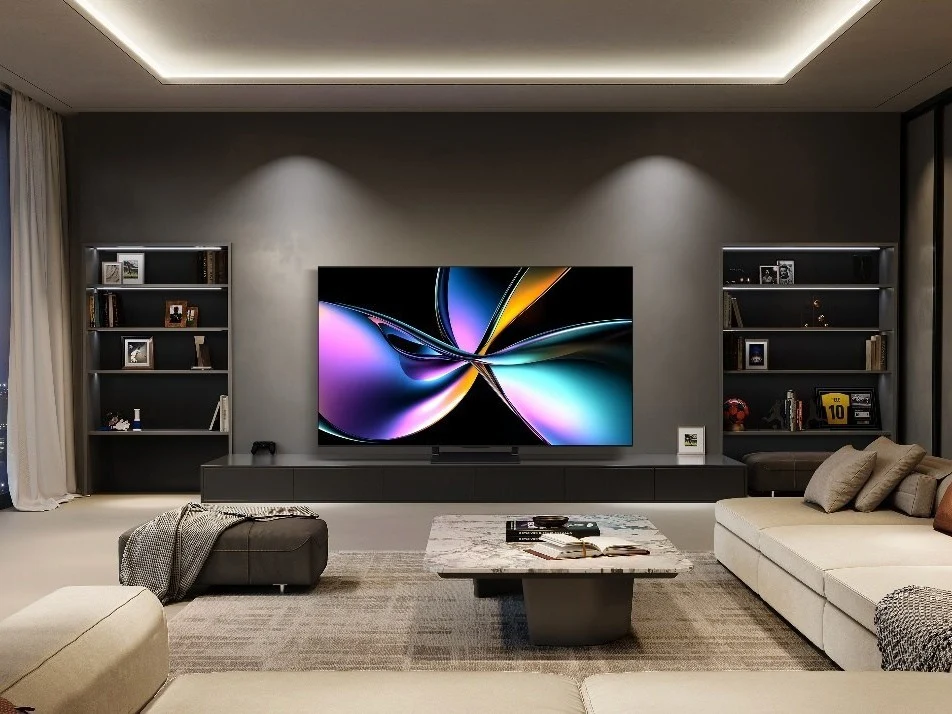
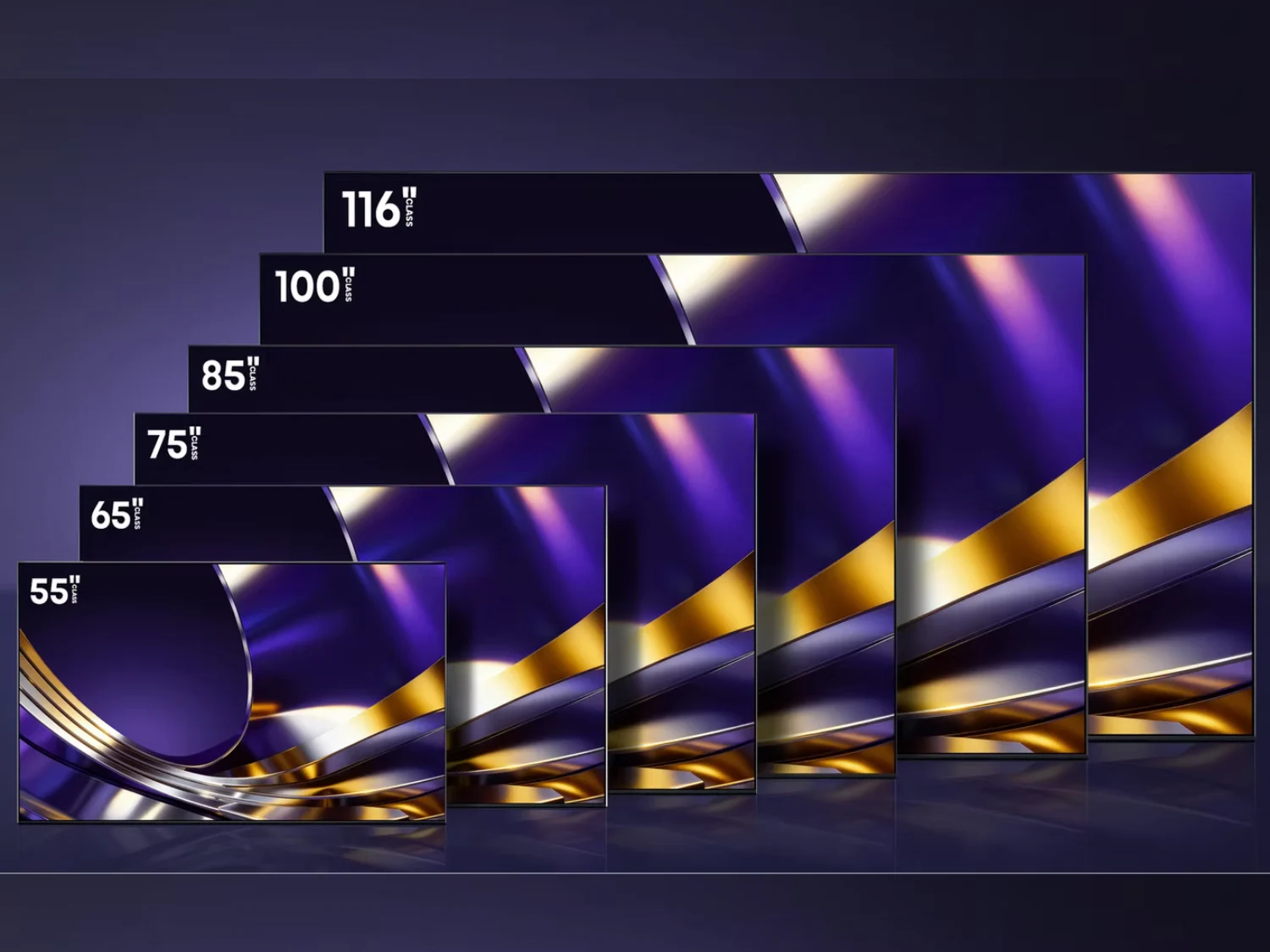
    Hisense has launched a fresh range of ULED Mini LED TVs for the American audience, called the U7SG series. This new collection boasts six different sizes: 55, 65, 75, 85, 100, and 116 inches, all featuring 4K Mini LED screens.

    Specifications and Features

    Every model is equipped with a VA panel delivering a resolution of 3840 × 2160 and offers wide viewing angles of 178 degrees. The TVs are capable of refresh rates that range from 48 Hz to 165 Hz, ensuring smoother visuals during rapid action scenes or gaming sessions. Hisense highlights a peak brightness that can reach up to 3000 nits, thanks to the Hi-QLED Mini LED Pro backlighting technology, which utilizes numerous tiny LEDs for accurate local dimming and enhanced contrast.

    Gaming Capabilities

    Gaming is a significant focus of the U7SG series. Each TV comes with a native game mode of 165 Hz and features a “Game Booster” option that can elevate refresh rates to as high as 330 Hz at reduced resolutions. The lineup includes support for AMD FreeSync Premium Pro to minimize screen tearing and lower input lag. Furthermore, Hisense has added an anti-reflection screen coating for better visibility in well-lit environments.

    Audio and Connectivity

    Color performance is managed by Hisense’s Hi-QLED Color+ system and is certified by Pantone. The TVs operate on the company’s Hi-View AI Engine Pro, which is designed to evaluate scenes and adjust contrast, color, and sharpness automatically during playback.

    The audio capabilities vary with the screen size. The models from 55 to 85 inches come with a 2.1.2-channel speaker configuration, providing up to 50 W of output, while the 100-inch model boosts that to 60 W. The largest 116-inch model upgrades to a 6.2.2-channel audio system with an even higher output. The entire range supports Dolby Atmos and DTS Virtual:X for immersive sound.

    These TVs run on Google TV and are equipped with four HDMI 2.1 ports, one LAN port, two USB-A ports, and an optical audio output. In terms of design, the U7SG models feature a sleek unibody frame, with various stand choices available depending on the size.

    Source:
    Link


  • AOC Unveils 27-Inch Dual-Mode Monitor with 288Hz Refresh Rate

    AOC Unveils 27-Inch Dual-Mode Monitor with 288Hz Refresh Rate

    Key Takeaways

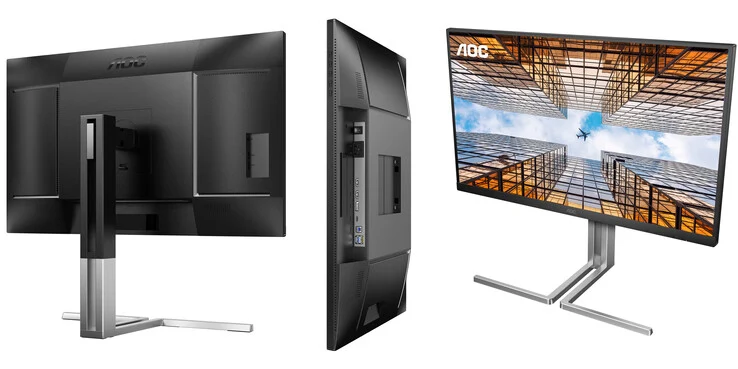
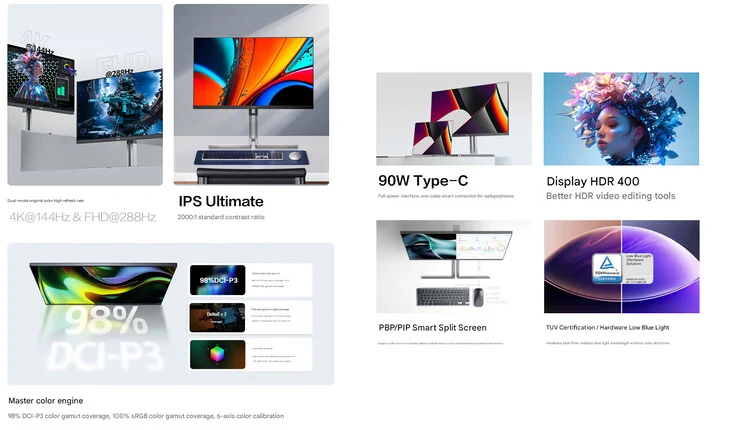
    1. The AOC U27U3XD is a 27-inch display with two modes: FHD at 288 Hz for gaming and 4K at 144 Hz for professional use.
    2. The monitor features a 27-inch IPS panel with full 100% sRGB and 98% DCI-P3 color coverage.
    3. It supports Adaptive-Sync and Nvidia G-Sync but does not support AMD FreeSync.
    4. Connectivity includes a USB-C port with DisplayPort Alt and 90 W PD for single cable connection to devices.
    5. The monitor includes a built-in KVM module, VESA wall mounting support, a brightness level of 450 nits, and various eye protection technologies.


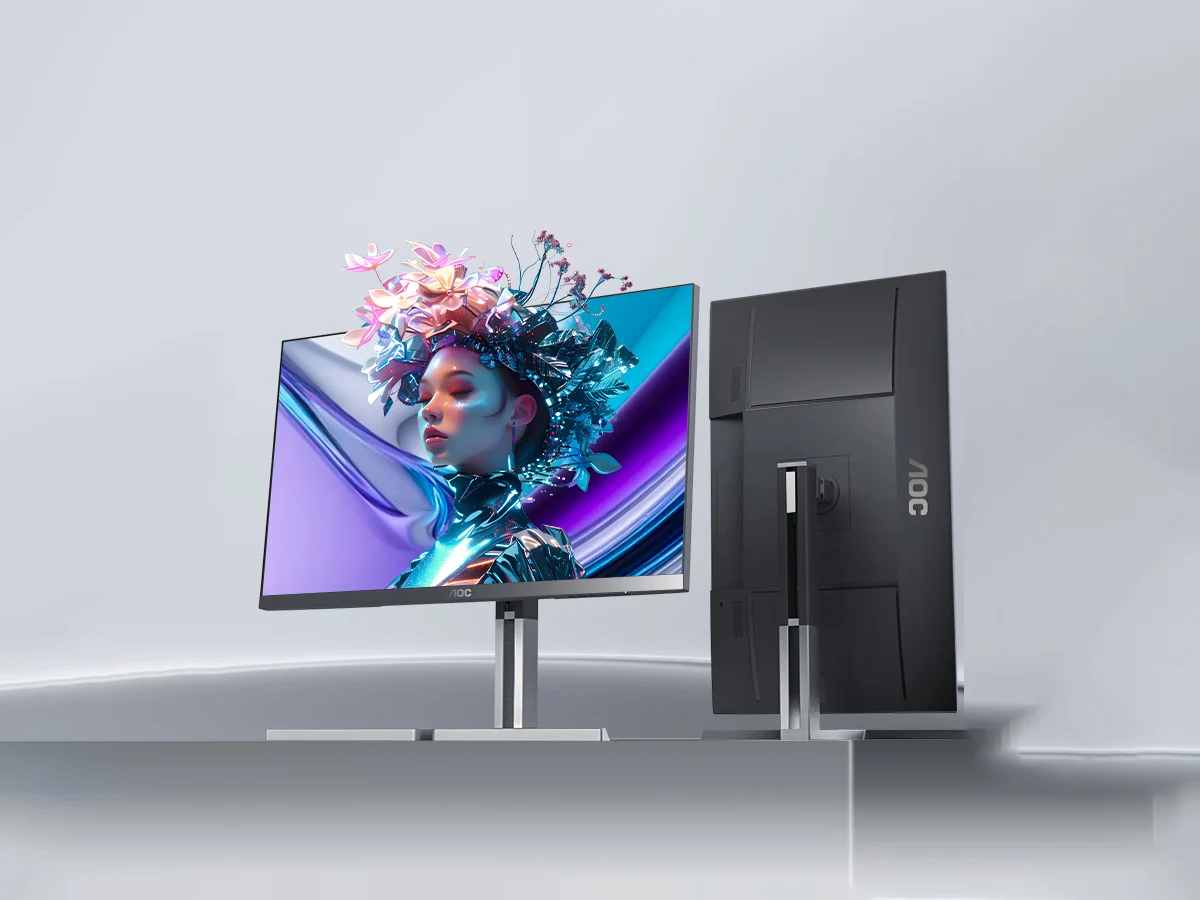
    AOC has unveiled the U27U3XD, a fresh 27-inch display that was first presented in June 2025. As mentioned before, this monitor offers two unique modes, giving users the choice between high refresh rates and high definition while using it. The monitor debuted in China with a price of CNY 1,796, which is approximately $252.

    Modes and Performance

    For those who didn’t catch our earlier updates, the AOC U27U3XD can run at both FHD and 4K resolutions. However, the refresh rate varies between these two modes. In the FHD setting, it serves as a competitive gaming monitor with a refresh rate of 288 Hz.

    When switched to 4K resolution, the refresh rate decreases to 144 Hz. This mode prioritizes clarity, making it better suited for professional tasks. Additionally, the AOC U27U3XD features a 27-inch IPS panel with full 100% sRGB and 98% DCI-P3 color coverage.

    Gaming Features and Connectivity

    For gaming enthusiasts, the monitor supports Adaptive-Sync and is compatible with Nvidia G-Sync. It’s important to note that unlike its predecessor, the U27U3X, the U27U3XD does not support AMD FreeSync. The monitor also comes with a variety of connectivity options, including:

    Notably, the USB-C port on this gaming display supports DisplayPort Alt and provides 90 W PD, allowing a single cable connection to compatible laptops and PCs (20 Gbps 3.3-feet Silkland 240 W USB-C cable currently priced at $12.59 on Amazon). Among other features, it boasts a built-in KVM module, support for VESA wall mounting, a brightness level of 450 nits, and various eye protection technologies. AOC is anticipated to expand the availability of the U27U3XD to the global market soon.

    Source:
    Link


  • Panasonic Z8BA: Affordable 77-Inch OLED TV with 144Hz and HDR

    Panasonic Z8BA: Affordable 77-Inch OLED TV with 144Hz and HDR

    Key Takeaways

    1. The Panasonic Z8BA OLED TV sits between the Z80B and Z95B models, priced at $2,198 on Amazon.
    2. It features a 4K resolution, 144Hz refresh rate, and supports Dolby Vision HDR content at 144 fps, making it ideal for gamers.
    3. The TV includes HDMI 2.1, VRR, and AMD FreeSync Premium, along with a True Game Mode for enhanced color accuracy.
    4. Users can customize HDR output and access streaming services via an Amazon Fire TV interface, with smart home control through Alexa.
    5. The 77-inch model is priced at $2,499, significantly lower than the Z95B’s $4,699 retail price, with no international launch details yet.


    The Panasonic Z8BA is positioned between the Z80B and Z95B (priced at $2,198 on Amazon) in the company’s current OLED series, but it apparently does not skimp on specifications. One of the most notable distinctions from the top-tier model is likely the brightness, although Panasonic has not shared a specific measurement nor indicated which panel is utilized in this model.

    Impressive Display Features

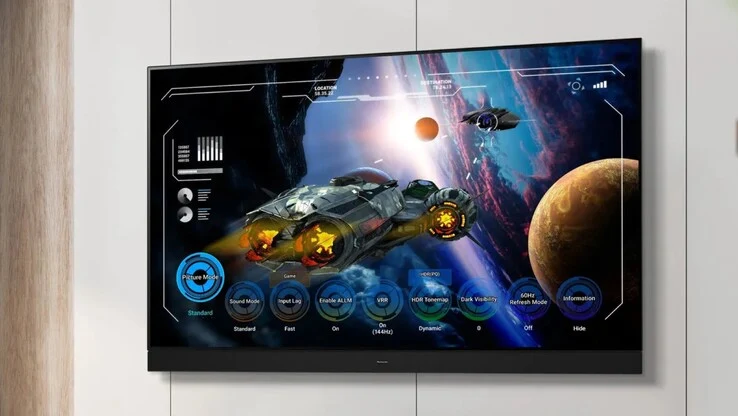
    Regardless, this OLED display offers a 4K resolution with a refresh rate of 144Hz and is capable of showcasing Dolby Vision HDR content at 144 fps. With features like HDMI 2.1, VRR, and AMD FreeSync Premium, this television appears to cater perfectly to gaming fans. Panasonic states that the True Game Mode enhances color accuracy in games, and unique audio settings amplify sounds critical to RPGs and shooters, like dialogues and gunfire.

    Customization and Smart Features

    Panasonic mentions that users have the option to turn off tone mapping, allowing the source device to manage it. This is particularly crucial for achieving the best HDR output on the Nintendo Switch 2. Moreover, the set includes the company’s specialized HCX Pro AI Processor MK II. An Amazon Fire TV interface facilitates access to all significant streaming platforms, and users can manage smart home gadgets seamlessly through Alexa voice commands. The speaker system has been fine-tuned by audio specialists at Technics.

    Pricing and Availability

    The Panasonic Z8BA OLED TV is set to debut in the U.S., with the large 77-inch variant retailing for $2,499. In comparison, the 77-inch Z95B has a suggested retail price of $4,699. Panasonic has yet to release information about a possible international launch.


  • New TCL Q8C QD-MiniLED TV Launch with Discounts Available Now

    New TCL Q8C QD-MiniLED TV Launch with Discounts Available Now

    Key Takeaways

    1. The TCL Q8C Premium QD MiniLED TV is now available in various European countries and is similar to previous models like the C8K, C89K, and C81K.
    2. It comes in four sizes: 65-inch, 75-inch, 85-inch, and 98-inch, featuring a WHVA CrystGlow Panel with a native contrast ratio of 7,000:1 and up to 5,000 nits brightness.
    3. The TV supports 4K resolution with a native refresh rate of 144Hz and includes gaming features such as Game Accelerator, Game Bar, and AMD FreeSync Premium Pro.
    4. It offers various HDR formats, built-in Bang & Olufsen speakers, and connectivity options like HDMI 2.1, USB 3.0, Bluetooth 5.4, and Wi-Fi 6.
    5. Pricing starts at €1,499 in France, with discounts available in multiple countries, including Italy (€1,699) and Germany (€1,599 for the 65-inch model).


    The TCL Q8C Premium QD MiniLED TV has hit the market in various European nations. This model is basically the same as the C8K, C89K, and C81K TVs, which were introduced in multiple regions back in June 2025. It shares similarities with the QM8K, which was launched in the US earlier this year, starting at $1,798 on Amazon.

    Available Sizes

    The Q8C is offered in four distinct sizes: 65-inch, 75-inch, 85-inch, and 98-inch. Each TV features a WHVA CrystGlow Panel utilizing QLED technology, boasting a native contrast ratio of 7,000:1. These models cover 97% of the DCI-P3 color spectrum and can reach brightness levels up to 5,000 nits, along with 3,840 local dimming zones.

    Gaming Features

    With a 4K resolution and a native refresh rate of 144Hz, the Q8C also includes Game Accelerator, which goes up to 288Hz. Additional gaming features consist of Game Bar and AMD FreeSync Premium Pro. The TV supports Dolby Vision IQ, HDR10+, HLG formats, IMAX Enhanced, and Filmmaker Mode. Thanks to the Google TV platform, users can easily access various streaming services and can wirelessly share their screens using Google Cast or Apple AirPlay 2. It also comes with Bluetooth 5.4, Wi-Fi 6, and ports such as HDMI 2.1 (eARC), USB 3.0, and Ethernet. Plus, it includes built-in Bang & Olufsen speakers that are compatible with both Dolby Atmos and DTS Virtual:X.

    Pricing and Discounts

    LDLC, which services France, Belgium, and Switzerland, has the TCL Q8C Premium QD MiniLED TV starting at €1,499. The 75-inch, 85-inch, and 98-inch versions are currently being offered at discounted prices. In Italy, you can find prices beginning at €1,699 on Amazon. For Germany, the recommended retail price for the 65-inch model is €1,599, with discounts available on all sizes at the retailer Otto. A complete list of suggested retail prices for each size in these countries can be seen in the table below.

    Source:
    Link


  • TCL C9K Premium QD-MiniLED TV Launches in Europe

    TCL C9K Premium QD-MiniLED TV Launches in Europe

    Key Takeaways

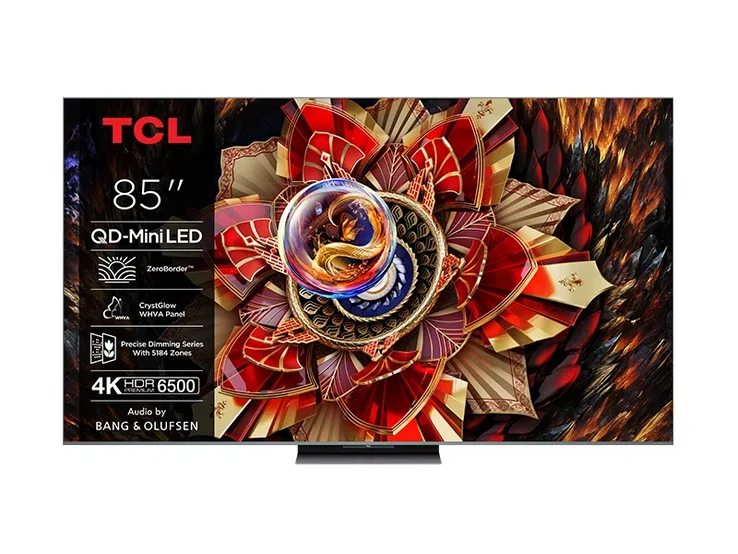
    1. The TCL C9K Premium QD-MiniLED TV, also known as the C91K, has launched in Europe with various size options and pricing starting at €1,999 for the 65-inch model.
    2. It features up to 5,184 local dimming zones and can achieve a peak HDR brightness of 6,500 nits, along with a high contrast ratio of 7,000:1.
    3. The TV supports advanced technologies like Dolby Vision IQ, HDR10+, IMAX Enhanced, and Filmmaker Mode, enhancing the viewing experience.
    4. Designed for gamers, it has a native refresh rate of 144Hz, a 288Hz VRR Game Accelerator, and includes four HDMI 2.1 ports for connectivity.
    5. The C9K operates on the Google TV interface and has a sleek design with a slim bezel of 3-4 mm, marketed as a ZeroBorder TV.


    The TCL C9K Premium QD-MiniLED TV has officially launched in Europe. This television, referred to as the C91K, was unveiled in April 2025, along with the newly released C8K, the C7K (which is currently priced at €799 for the 55-inch model on Amazon.de), and the C6K.

    Availability in Europe

    You can now purchase the TCL C9K in France through Boulanger and in Belgium via Coolblue. The pricing for the different sizes is as follows: the 65-inch model is available for €1,999, the 75-inch version is priced at €2,999, and the 85-inch variant retails at €3,999. Additionally, Belgium offers a larger 98-inch version for €4,999.

    Specifications and Features

    The official TCL product page for the C9K, which does not include details about the 98-inch model, states that this QLED TV provides up to 5,184 local dimming zones and can reach a peak HDR brightness of up to 6,500 nits. Similar to other TVs in this series, it features the CrystGlow WHVA Panel with a contrast ratio of 7,000:1, “ultra-low” reflectivity, and improved color viewing angles. Furthermore, it supports advanced technologies like Dolby Vision IQ, HDR10+, IMAX Enhanced, and Filmmaker Mode.

    Gaming and Connectivity

    This 4K television boasts a native refresh rate of 144Hz, along with a 288Hz VRR Game Accelerator. It also features a Game Bar for easy access to gaming settings, plus four HDMI 2.1 ports for connectivity. The TCL C9K operates on the Google TV interface and comes equipped with speakers crafted by Bang and Olufsen. Marketed as a ZeroBorder TV, it has a slim bezel of just 3-4 mm and an almost invisible black border.

    The timeline for the TCL C9K Premium QD-MiniLED TV’s release in other European countries is still unclear. A version of this model intended for the US market, known as the QM9K, is anticipated to launch later this month.

    Source:
    Link


  • Sony PS5 Pro to Support More 8K and 4K/120 FPS Games

    Sony PS5 Pro to Support More 8K and 4K/120 FPS Games

    Key Takeaways

    1. The PlayStation 5 Pro aims to run more games at 4K/120 fps and possibly 8K/60 fps in the future.
    2. Sony is developing a new version of PlayStation Spectral Super Resolution (PSSR) to enhance visual quality while reducing performance loss through AI.
    3. The current minimum render resolution for the PS5 Pro is 1,536 x 864, with potential plans to lower it to improve performance, similar to Nvidia’s DLSS 4.
    4. Sony may introduce a 1440p mode to maintain 120 fps if the console struggles at 4K.
    5. There is no confirmed release date for games supporting PSSR2, and it’s uncertain how Sony will promote this technology.


    The Sony PlayStation 5 Pro (around $699 on Amazon) is probably going to be able to run more games at 4K/120 fps or even 8K/60 fps in the future. Recent updates from the YouTube channel Moore’s Law is Dead suggest that Sony is working on a new version of PlayStation Spectral Super Resolution (PSSR), which aims to enhance visual quality while reducing performance loss through a new AI model.

    New Tech Developments

    In addition to the updated machine learning model, it’s expected that Sony will lower the render resolution to meet its ambitious goals. Right now, the PlayStation 5 Pro has a minimum render resolution of 1,536 x 864 when it upscales games to the 4K resolution that’s common on many smart TVs. For comparison, Nvidia’s DLSS 4 uses a lower render resolution of 1,280 x 720. If the console has trouble keeping a steady 120 fps at 4K, even with PSSR2, Sony is said to be considering a 1440p mode that would maintain 120 fps.

    Uncertain Future

    As of now, there is no set release date for the first game that will support PSSR2. It’s also unclear if Sony will promote this improved upscaling technology or just roll out games that provide higher resolution outputs and frame rates. Regardless, Sony’s intention to provide a 120 fps mode might be in response to the Nintendo Switch 2, which is expected to run some games at 120 fps – but at a much lower resolution.

    Source:
    Link

  • Nvidia Reveals Nintendo Switch 2 TFLOPs and Tech Specs

    Nvidia Reveals Nintendo Switch 2 TFLOPs and Tech Specs

    Key Takeaways

    1. The Nintendo Switch 2 supports 4K at 60 fps when docked and 1080p at 120 fps in handheld mode.
    2. Speculations suggest it uses the Nvidia Tegra T239 chipset with 12GB of RAM and an Ampere GPU.
    3. The console’s performance is comparable to the Xbox Series S, with around 3.9 TFLOPs in docked mode.
    4. The Switch 2 features hardware-accelerated ray tracing and AI-driven upscaling through dedicated RT and Tensor processing units.
    5. It supports Variable Refresh Rate (VRR) in handheld mode to reduce screen tearing during gameplay.


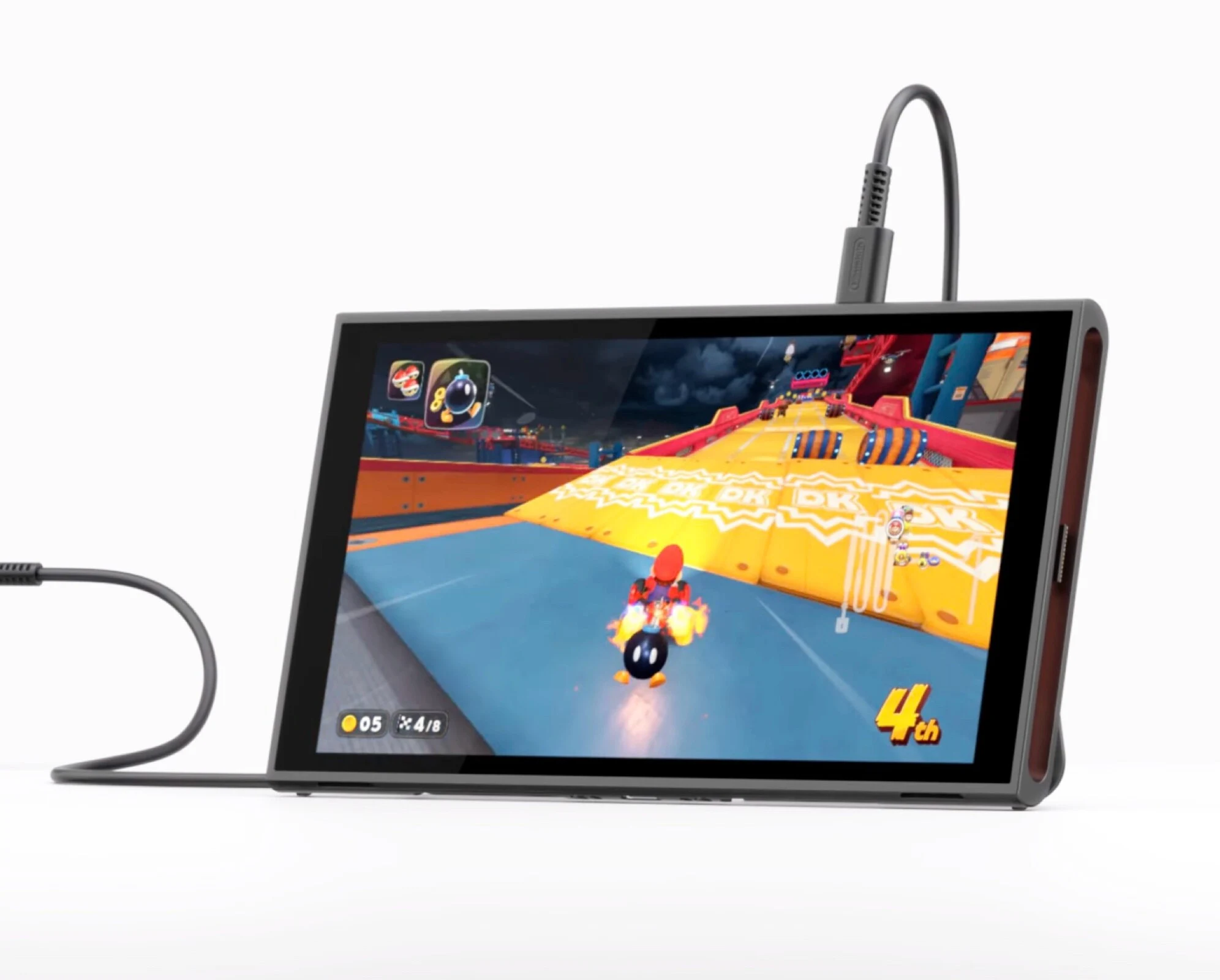
    The Nintendo Switch 2 was revealed on Wednesday, and many hands-on videos have already appeared online. While it’s known that games can operate at 4K with 60 frames per second when docked or 1080p at 120 fps in handheld mode, Nintendo hasn’t shared any specifics about the built-in processor or how the console performs overall.

    Potential Specifications Leaked

    There are speculations that the Switch 2 utilizes the Nvidia Tegra T239, which boasts eight ARM Cortex-A78E performance cores, 12GB of RAM, and an Ampere GPU with 1,536 CUDA cores. Just for context, this GPU architecture was rolled out with the GeForce RTX 3000 series. Nvidia has released some technical information about the Nintendo Switch 2 on their blog. Although Nvidia doesn’t specifically name the Tegra T239 chipset, they assert that the chip delivers ten times the GPU performance of the original Nintendo Switch.

    Performance Insights

    In docked mode, this equates to around 3.9 TFLOPs, meaning that the hybrid console will be as fast as the Xbox Series S. Nvidia points out that the chip has dedicated RT and Tensor processing units for hardware-accelerated ray tracing and DLSS, which provides AI-driven upscaling to higher resolutions. Additionally, the Tensor cores enable the Nintendo Switch 2’s camera to follow the user’s face and isolate it via AI technology. Another noteworthy detail is that the Switch 2 supports VRR in handheld mode, allowing the display’s refresh rate to adjust according to the games’ frame rates, thus minimizing screen tearing.

    Nvidia’s recent insights have sparked excitement in the gaming community, with many eager to see how these advancements will influence gameplay.

    Source:
    Link

  • Nintendo Switch 2 Leak: 4K Dock Confuses Console Specs

    Nintendo Switch 2 Leak: 4K Dock Confuses Console Specs

    Key Takeaways

    1. Some Switch 2 development kits may not support 4K output, despite earlier mixed reports.
    2. The Switch 2 dock features a DisplayPort 1.4 to HDMI 2.1 converter and may support 4K gaming at 60Hz using DSC technology.
    3. The Realtek RTD2175N-CG chip in the dock could potentially enable 4K/120Hz output, but only when the console is docked.
    4. Software and games for the Switch 2 will need to support 4K resolutions, and upscaling may be necessary unless the console has more power than expected.
    5. Anticipation builds for the upcoming Nintendo Direct, where the hybrid nature and advancements of the console might be showcased, including a possible upgraded dock.


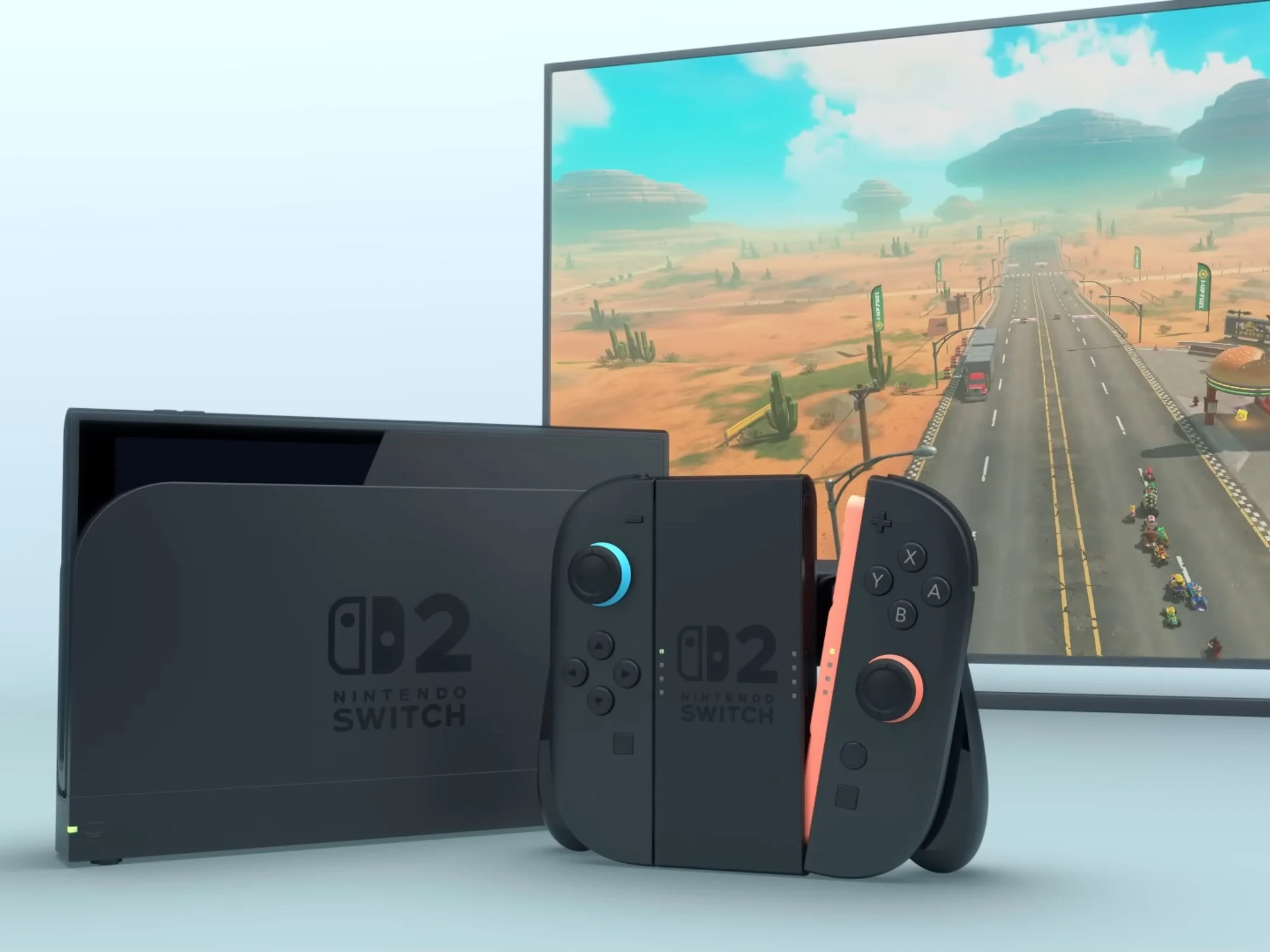
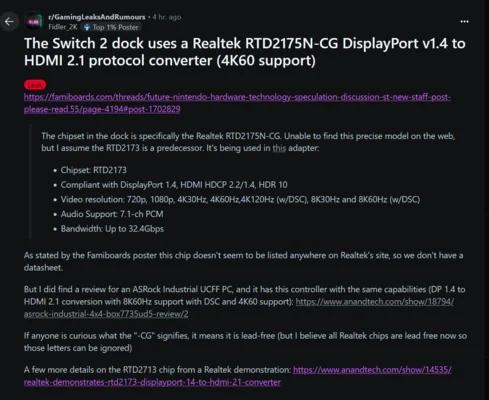
    Insider Gaming’s Tom Henderson has recently disclosed that some Switch 2 development kits do not feature a 4K output. This revelation has caught the attention of gamers, especially since earlier leaks contained mixed specifications. While the upcoming Nintendo Direct on April 2nd may clarify these issues, there is already some encouraging information for fans. A user on Famiboards has pointed out that the Switch 2 dock incorporates a DisplayPort 1.4 to HDMI 2.1 converter. The Realtek chip used supports 4K gaming at 60Hz, along with enhanced settings using DSC (Display Stream Compression).

    Realtek Chip Details

    The Realtek chip in question is known as RTD2175N-CG. Although specific details about this chip are not widely available, there is a similar model called RTD2173. If the newer version can at least equal its features, the Switch 2 dock could potentially support 4K/120 Hz output with DSC. This capability would only apply when the console is docked, but earlier speculations mentioned a handheld mode running at 120Hz with VRR, probably at lower resolutions. While the information regarding the Realtek chip does not confirm VRR support, it does indicate compatibility with HDR.

    Gaming Requirements

    It’s important for gamers to understand that software and games for the Switch 2 would need to offer support for 4K resolutions. Additionally, unless the console boasts more power than anticipated, upscaling would be essential to achieve this resolution. Still, the latest leak regarding the Switch 2 eases some of the concerns raised by Henderson’s insights about dev kits. If the dock is indeed utilizing the RTD2175N chip, it could mean that the development kits do not fully represent the final specifications of the Switch 2.

    Anticipation for the Future

    Considering previous reports, a dock capable of 4K output shouldn’t come as a shock. At the 2023 Gamescom, there were whispers that the Switch 2 was able to run The Legend of Zelda: Breath of the Wild at 4K and 60 fps. Now, it seems Nintendo is gearing up to demonstrate the advancements the console has made. If the upcoming Nintendo Direct highlights the hybrid nature of the console, an upgraded dock might well take center stage.

    Source:
    Link


  • Hisense U7 Mid-Premium Mini LED TV Launching Soon

    Hisense U7 Mid-Premium Mini LED TV Launching Soon

    Key Takeaways

    1. The Hisense U7QG Mini LED TV is part of a larger lineup of ULED TVs, including the U9QG, U8QG, and U6QF.
    2. It features 4K resolution, 165Hz native refresh rate, QLED technology, and an AGLR-Antiglare screen.
    3. The TV supports advanced features like IMAX Enhanced, Dolby Vision, Filmmaker Mode, and is gamer-friendly with a 165Hz Game Mode.
    4. It will be available in six sizes ranging from 55-inch to 116-inch, launching in the US on April 15th and in Europe by May 15th.
    5. Some sizes of the U7QG may be priced under $1,000, with additional models like the QM6K QD-Mini LED TV also available.


    The Hisense U7QG Mini LED TV has recently been announced. This model is part of a bigger lineup of ULED TVs, which includes the U9QG, U8QG, and U6QF. The company markets the U7 as a “mid-premium TV” that features MiniLED Pro technology.

    Specs and Features

    Similar to the top-end U9, the U7 boasts a 4K resolution along with a native refresh rate of 165Hz. Thanks to QLED technology, viewers can expect deep blacks and vibrant colors, while the AGLR-Antiglare screen minimizes reflections. Additional features include IMAX Enhanced, Dolby Vision, and Filmmaker Mode. For gamers, the TV offers a 165Hz Game Mode Ultra, Game Booster 288Hz, VRR, ALLM, and compatibility with AMD FreeSync Premium Pro. Furthermore, it supports Wi-Fi 6E and includes various ports, such as four HDMI 2.1 inputs, and comes with built-in 60W 2.1.2 channel speakers that support Dolby Atmos and are Tuned by Devialet.

    Availability and Pricing

    The Hisense ULED MiniLED U7 Series will come in six different sizes: 55-inch, 65-inch, 75-inch, 85-inch, 100-inch, and 116-inch. It is set to launch in the US on April 15th and will be available in Europe by May 15th. Though the company hasn’t released a complete price list yet, they indicate that some sizes might be priced under $1,000. Other models in Hisense’s 2025 TV lineup include the QM6K QD-Mini LED TV, with the 55-inch currently retailing for $598 on Amazon.

    Source:
    Link

  • AMD RX 9070 XT Price Lower than RTX 5070 Ti, Reports Say

    AMD RX 9070 XT Price Lower than RTX 5070 Ti, Reports Say

    Key Takeaways

    1. Launch Date and Pricing: AMD Radeon RX 9070 and RX 9070 XT are set to launch on March 6th, with expected prices between $549 and $749.

    2. Market Focus: AMD is targeting the mid-range market, not planning a high-end GPU to compete with Nvidia’s RTX 5090, while the RX 9070 XT may offer good value for 4K gaming.

    3. Competitive Pricing Insights: The RX 9070 XT could potentially retail for $699, which would make it a more attractive option compared to the RTX 5070 Ti priced at $749 or more.

    4. Upcoming Announcement: AMD is holding a YouTube event on February 28 to likely confirm pricing for the RX 9000 series, which could impact market availability.

    5. Gamer Concerns and Market Share: Gamers have raised concerns about performance without multi-frame generation, and AMD could gain more market share by ensuring sufficient RX 9000 series card distribution.


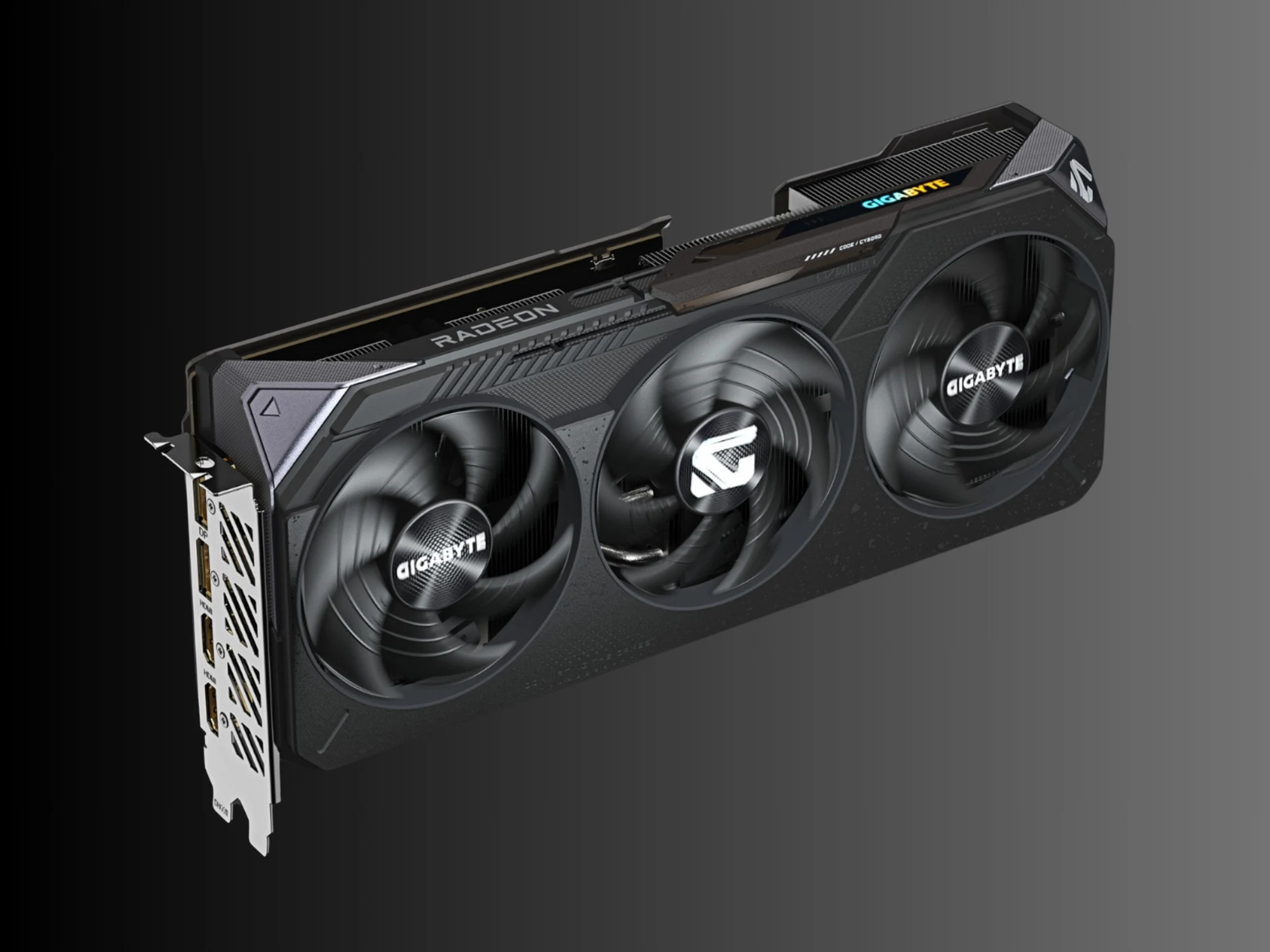
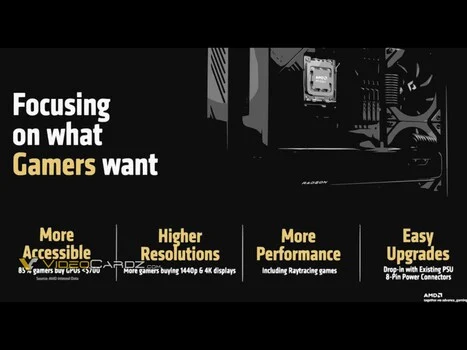
    With the expected launch date of the AMD Radeon RX 9070 and RX 9070 XT set for March 6th, the precise pricing is still unclear. Retailer leaks suggest that the manufacturer’s suggested retail prices (MSRPs) might fall between $549 and $749, aligning closely with the Nvidia RTX 5070 and RTX 5070 Ti. Nevertheless, AMD has recently released a slide indicating potentially more competitive pricing, especially for the RX 9070 XT. VideoCardz has shared some press materials which imply that the RDNA 4 GPU could be priced below $700.

    Key Insights from Media Slide

    The main point from the media slide is that 85% of gamers tend to buy video cards costing less than $700. At the moment, AMD does not plan to introduce a high-end GPU that would compete with the RTX 5090. Instead, the focus is on the mid-range segment, although the RX 9070 XT could provide excellent value for those interested in 4K gaming. Initial benchmarks have indicated significantly better ray-tracing performance with AMD’s latest GPUs.

    Price Expectations and Comparisons

    The promotional image supports the idea that the RX 9070 XT could retail for $699. Renowned tech leaker David Huang has also concurred with this estimate in a recent post on X. However, additional taxes may push the GPU’s price well above that figure. Plus, overclocked models might see increased prices. A $649 RX 9070 XT would also make it a more appealing choice compared to the RTX 5070 Ti, which starts at $749 or more.

    AMD has planned a YouTube event on February 28 to likely confirm the pricing for the RX 9000 series. This announcement may still come too late for customers eager to see better stock availability than what the RTX 5000 series offers.

    Gamer Opinions and Market Competition

    Gamers have also voiced their concerns about the performance enhancements of Blackwell GPUs, especially without multi-frame generation enabled. AMD has the potential to capture more of Nvidia’s market share by distributing a sufficient number of RX 9000 series cards while delivering more power for the cost.

    Source:
    Link