Category: Phones

Stay updated with the latest phone news, reviews, and trends. Discover cutting-edge smartphones, features, and innovations in our Phones category at GizNewsDaily

  • iPhone 16 Battery: Metal Casing, Higher Capacity, New Tech

    iPhone 16 Battery: Metal Casing, Higher Capacity, New Tech

    Tipster Majin Bu on X has shared some images of the iPhone 16’s battery pack. Surprisingly, the battery now has a metal casing instead of the usual soft foil packaging. Although it initially looks like dummy units, a closer inspection shows it to be an actual battery, with an additional metal casing on top of the plastic foil packaging.

    The metal casing will reportedly improve the heat dissipation

    The battery pack retains its familiar shape but now boasts a higher 3,597mAh capacity compared to the iPhone 15’s 3349 mAh. The battery capacity is engraved on the metal surface.

    While the exact reason behind Apple’s shift back to a hard casing design is unclear, reports suggest it could be aimed at improving heat dissipation. The iPhone 15 series did suffer from overheating issues post-launch. Though subsequent software updates have largely resolved this for most users, this change in the battery could further enhance heat management.

    Inside the metal casing could be a different battery tech

    The iPhone 13 Pro Max and 14 Pro Max weigh a hefty 240 grams, which is heavier than the book-style foldable Honor Magic V2 (231g). Last year, Apple replaced the stainless steel middle frame with titanium, making the iPhone 15 Pro Max 19 grams lighter than its predecessor.

    The extra metal casing for the battery will make the iPhone 16 heavier than the 171-gram iPhone 15. The higher battery capacity is also expected to contribute to the device’s weight.

    Additionally, the use of a metal casing occupies significant internal space, which was one of the major reasons smartphone makers switched to thinner plastic foil packaging. The soft packaging is also safer as it allows gas to expand and exit the battery pack easily in case of an accident, minimizing risk to the user.

    That said, there might be new battery technology inside that necessitates a hard casing but doesn’t carry the same explosion risk. It might also offer a higher energy density; otherwise, the phone would have to become thicker to accommodate the 3597mAh metal-encased battery. For example, the vivo X Fold3 Pro houses a 5700mAh battery (the largest battery in a foldable) using relatively new Silicon carbide (Si/C) composite material.


  • Google Updates Controversial Repair Policy to Work with Customers

    Google Updates Controversial Repair Policy to Work with Customers

    The earlier repair policy for Pixel devices indicated that devices with non-authorized parts should not be sent to Google for repair. If someone ignored this policy, they risked not getting their device back. This policy had been effective since mid-2023.

    Unauthorized Parts Clause

    The previous policy explicitly stated:

    Unauthorized Parts: You will not send in a Device containing non-Google-authorized parts – if You do, Your Device will not be returned to you.

    This policy recently gained attention thanks to right-to-repair advocate Louis Rossman. In response, Google informed Android Authority that they would be updating the policy.

    Google’s Response and Policy Update

    Google has now revised its repair policy. The new policy states that if Google decides not to return a device with unauthorized parts due to health and safety concerns, they will at least contact the user and work towards a solution.

    The updated clause reads:

    Unauthorized Parts: If You send a Device containing non-Google-authorized parts for repair, in certain situations (e.g., safety), the Service Provider may not be able to repair Your Device. Service Provider will return Your Device except when health or safety requirements prevent us from doing so. If the Service Provider can’t return Your Device, Google will work with You on the next steps.

    Implications of the Updated Policy

    The revised policy now leaves room for the service provider to decide whether to repair the device. This means Google could potentially repair and return devices if they consider the unauthorized parts safe. If the device is deemed unsafe, they will collaborate with the user on the next steps.

    As illustrated, the new policy remains somewhat open-ended. It may still take some time for Google to coordinate with users to return devices without compromising health and safety. Your device will either be returned fixed, as is, or through further steps worked out with Google.

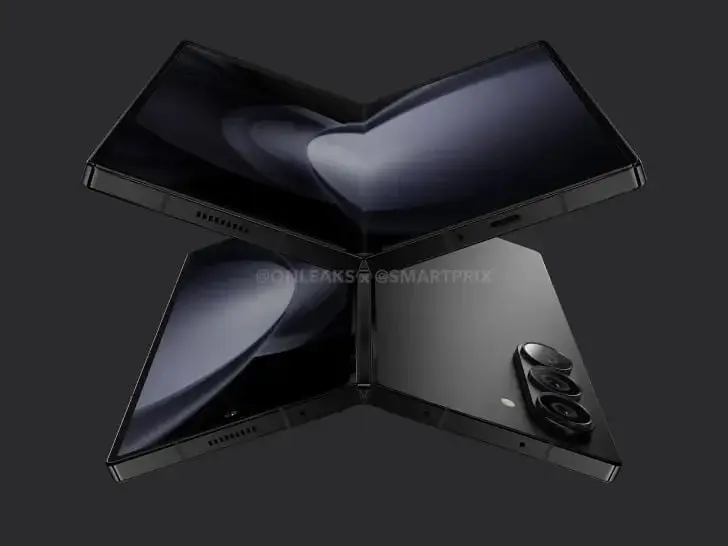
  • Galaxy Z Fold 6 Camera: No Upgrades, Reportedly Unchanged

    Galaxy Z Fold 6 Camera: No Upgrades, Reportedly Unchanged

    Samsung fans anticipating a camera upgrade with the upcoming Galaxy Z Fold 6 might face disappointment. A leak from a typically reliable source, Ice Universe, indicates the Fold 6’s cameras will be identical to the Fold 5, which were, in turn, identical to the Fold 4.

    The leak specifies that “all camera specifications, including front camera, rear camera, UPC [Under Panel Camera], and aperture value, are exactly the same, and there is no change.”

    Camera Specifications

    This suggests the Fold 6 will sport the same 50MP main sensor with an f/1.8 aperture, a 10MP telephoto lens with an f/2.4 aperture and 3x optical zoom, and a 12MP ultrawide lens with an f/2.2 aperture and a 123-degree field of view. Both the main and telephoto lenses are expected to continue featuring optical image stabilization (OIS).

    Competition from Chinese Brands

    Samsung’s pace of innovation in its foldable phones has been slow in recent years. Meanwhile, Chinese brands like Vivo and Oppo have been consistently pushing the boundaries. For example, Vivo’s latest X Fold 3 Pro foldable claims the title of the world’s lightest foldable phone, weighing just 236 grams, despite housing a substantial 5700mAh battery — larger than some well-known bar phones like the iPhone 15 Pro Max. Additionally, the X Fold 3 Pro has an impressive camera setup, possibly making it the best foldable camera phone.

    Minimal Upgrades

    In contrast, Samsung has been keeping the upgrade list minimal, only introducing expected generational updates like a new processor. However, this year, there might be a notable change in the Fold 6’s design. Samsung is reportedly planning to provide a wider cover screen, making it feel more like a conventional phone when closed. Apart from this, leaks so far suggest no major changes or upgrades in the forthcoming foldable.

  • Qualcomm Unveils Snapdragon 6s Gen 3: New Chip or Rebranded 695?

    Qualcomm Unveils Snapdragon 6s Gen 3: New Chip or Rebranded 695?

    Qualcomm has discreetly introduced the Snapdragon 6s Gen 3 5G chipset designed for mid-range smartphones. This chipset is fabricated using a 6nm process node.

    Snapdragon 6s Gen 3 Specs and Features

    The Snapdragon 6s Gen 3 is an octa-core chipset featuring a (2+6) core configuration, reaching a peak clock speed of 2.3GHz. It incorporates unspecified Qualcomm Kryo CPU cores. The GPU, also undisclosed, supports H.264 (AVC), H.265 (HEVC), VP8, and VP9 playback. A benchmark listing suggests it might be the Adreno 619, the same GPU found in the Snapdragon 695.

    This chipset supports FHD+ (1080 x 2520) display output at a 120Hz refresh rate.

    Camera Capabilities

    For the camera system, manufacturers can implement up to 108MP photo capture, a 32MP single camera, a 25MP + 13MP dual-camera setup, or a 13MP triple camera setup. It supports 1080p video recording at 60 fps and 720p slow-motion video capture at 120 fps. The actual implementation of these features depends on the smartphone manufacturer.

    The chipset includes the Qualcomm Spectra triple ISP for image processing, similar to the Snapdragon 6 Gen 1.

    Audio and Connectivity

    The chipset supports high-fidelity audio up to 384 kHz/32-bit, and features AI-based echo cancellation and noise reduction.

    For cellular connectivity, it uses the Snapdragon X51 5G Modem-RF System, offering a maximum download speed of 2.5Gbps. It supports a range of technologies including mmWave, 5G NR, LTE, HSPA, sub-6 GHz, TDD, WCDMA, FDD, SA, NSA, TD-SCDMA, CDMA 1x, EV-DO, and GSM/EDGE.

    WiFi and Bluetooth

    The chipset supports WiFi 4, WiFi 5, and Bluetooth 5.2 through the Qualcomm FastConnect 6200 System. It also includes Qualcomm’s proprietary TrueWireless technology for enhanced performance with compatible Bluetooth devices.

    The Snapdragon 6s Gen 3 supports LPDDR4x memory (up to 2133 MHz), UFS 2.2 storage, and Quick Charge 4+ technology for fast charging.

    A Rebranded Snapdragon 695?

    According to Android Authority, this new chipset might be a rebranded version of the Snapdragon 695 5G. The chipset has two part numbers: SM6375-AC and SM6370. Documentation indicates that the latter is not 5G capable, although it still includes the same 5G Snapdragon X51 modem.

    Android Authority speculates that the Snapdragon 6s Gen 3 could merely be a rebranding of the Snapdragon 695, with the 4G version having its 5G modem disabled. For reference, the Snapdragon 695 was launched in 2021.


    Qualcomm Unveils Snapdragon 6s Gen 3: New Chip or Rebranded 695?
  • Poco M6 Plus 5G: Budget Smartphone Features and Expectations

    Poco M6 Plus 5G: Budget Smartphone Features and Expectations

    Poco, a sub-brand of Xiaomi, is preparing to unveil the Poco M6 Plus 5G in India. This smartphone is anticipated to be a cost-effective option, powered by the new Qualcomm Snapdragon 4 Gen 2 processor. Rumors suggest it will be a rebranded version of the Redmi Note 13R, recently introduced in China. Here’s a detailed look at what to expect from the Poco M6 Plus 5G.

    Display

    The phone is expected to feature a 6.79-inch Full HD+ (1080 x 2460 pixels) LCD display with a 120Hz refresh rate, ensuring a smoother user experience. The display will likely have a center punch-hole design for the front-facing camera.

    Performance

    Rumors indicate that the Poco M6 Plus 5G will be powered by the Qualcomm Snapdragon 4 Gen 2 processor, designed to offer balanced performance for everyday tasks and light gaming. It will probably come with 6GB or 8GB of RAM and provide up to 512GB of storage, ensuring smooth multitasking and ample space for your files.

    Camera

    In terms of the camera, the Poco M6 Plus 5G is expected to significantly deviate from the Redmi Note 13R. While the Redmi Note 13R features a 50MP primary camera, the Poco M6 Plus 5G is rumored to boast a 108MP main sensor. This high-resolution sensor is expected to be accompanied by a 13MP secondary ultra-wide sensor. For selfies and video calls, an 8MP lens is anticipated.

    If these leaks hold true, the Poco M6 Plus 5G could be an excellent option for budget-conscious users prioritizing camera quality. A 108MP sensor promises high-resolution photos with greater detail, especially in well-lit conditions.

    Software

    The Poco M6 Plus 5G is expected to run on Android 14 with Xiaomi’s custom skin, HyperOS. This UI offers various features and customization options for a personalized user experience. Regular updates from Xiaomi can be anticipated to keep the phone secure and up-to-date.

    Battery and Charging

    The device is likely to house a 5030mAh battery, similar to the Redmi Note 13R. This capacity should provide a full day’s worth of usage on a single charge for most users. Additionally, the phone is expected to support 33W fast charging.

    Design and Build

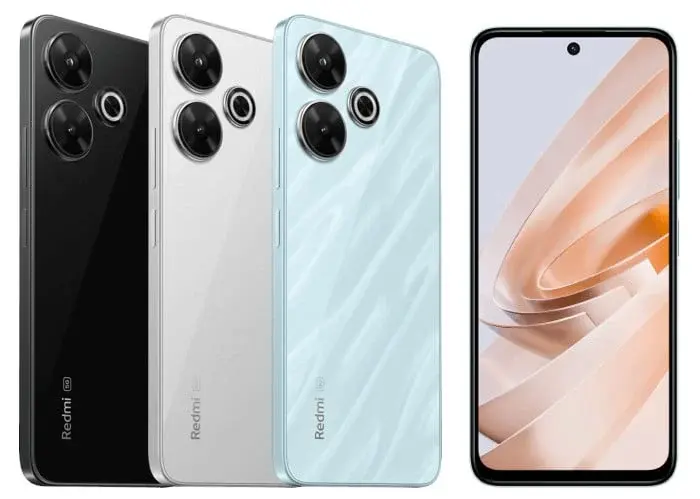
    According to a leak from the Google Play Console, the device appears to closely resemble the Redmi Note 13R, particularly from the front. Although there are no official details regarding the back panel’s design, it is likely to mirror the Redmi Note 13R, assuming it’s a rebrand. The Redmi Note 13R features a glass back with a wave-textured finish and includes a side-mounted fingerprint scanner for security.

    Price and Availability

    The Poco M6 Plus 5G is expected to launch in India soon. While the exact launch date remains unconfirmed, leaks suggest it could arrive sometime this month. Pricing details are also unknown, but considering the Redmi Note 13R’s pricing in China (starting around $193), we can expect the Poco M6 Plus 5G to be a budget-friendly smartphone.

    Conclusion

    The Poco M6 Plus 5G appears to be a promising option for budget-conscious smartphone users in India. The phone offers a good processor, a smooth display, and a long-lasting battery. The surprise camera upgrade with a rumored 108MP sensor makes it even more appealing.

    However, it’s important to note that these details are based on leaks and rumors. We’ll have to wait for the official launch to confirm the exact specifications, pricing, and availability of the Poco M6 Plus 5G.

  • Infinix Note 40S Key Specs Revealed on Google Play Console

    Infinix Note 40S Key Specs Revealed on Google Play Console

    Infinix has recently introduced the Note 40 Series Racing Edition. The company is also reportedly working on adding a new model to this lineup, which includes the standard version, 4G and 5G versions of the Pro, and a Pro+ 5G variant. The upcoming device is likely to be the Infinix Note 40S, which has been spotted on the Google Play Console certification website, revealing essential specifications.

    Infinix Note 40S Google Play Console Listing

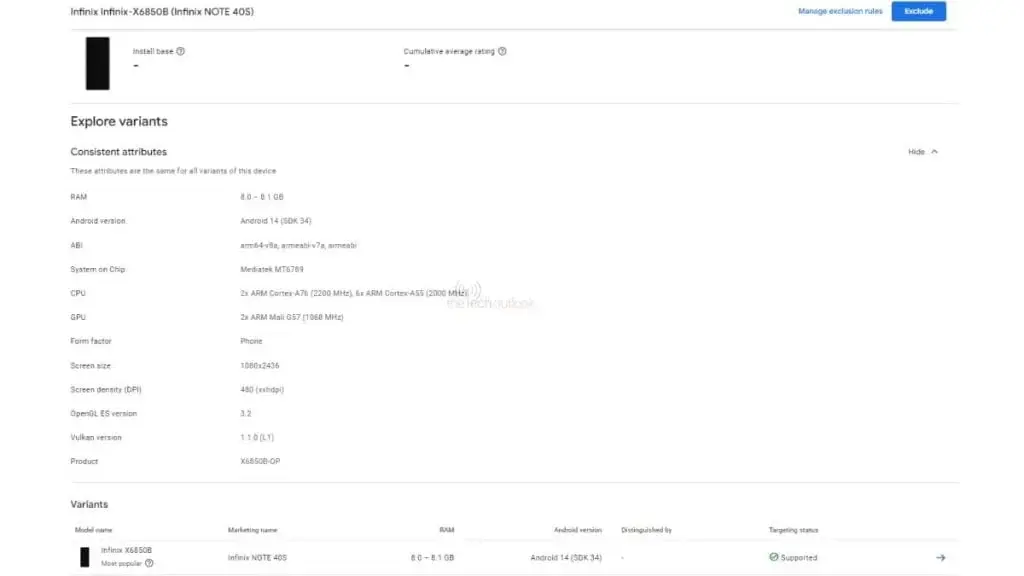
    The Infinix Note 40S appears on the Google Play Console website with the model number X6850B. The smartphone render shows a curved display with a centrally aligned punch-hole cutout. It boasts a display resolution of 1080 x 2436 pixels and a screen density of 480 dpi.

    According to the Google Play Console, the device will feature a MediaTek MT6789 system on a chip, which includes two Cortex-A76 cores and six A55 cores, along with a Mali G57 GPU. This indicates that the Infinix Note 40S will be powered by a Helio G99 processor. The device will come with 8GB RAM, and additional options may be available at launch. It will also run on Android 14 OS out of the box.

    This is all the information currently available from the certification website about the Infinix Note 40S. More details are expected to emerge in the coming weeks.

    Infinix Note 40 5G Launch in the Philippines

    Recently, Infinix launched the Note 40 5G in the Philippines. This model features a 6.78-inch FHD+ AMOLED display with a 120Hz refresh rate and an integrated fingerprint scanner. It is powered by a Dimensity 7020 processor, paired with 12GB RAM and 512GB storage. The smartphone is supported by a 5,000mAh battery with 33W wired and 15W wireless charging capabilities. The Infinix Note 40 5G also includes a rectangular camera module with a 108MP main sensor, two 2MP lenses, and an 'Active Halo' LED light.

  • Snapdragon 8 Gen 4: New GPU, Improved Cache & Memory Compression

    Snapdragon 8 Gen 4: New GPU, Improved Cache & Memory Compression

    Qualcomm’s upcoming flagship mobile processor, the Snapdragon 8 Gen 4, is anticipated to debut later this year, with increasing rumors about its advanced features. A fresh leak by Weibo user Digital Chat Station has unveiled enhancements for the forthcoming SoC’s graphics processing unit (GPU).

    New GPU Architecture

    According to the tipster, the 8 Gen 4 will feature an improved GPU architecture with enhanced cache and memory compression technology. The architecture, referred to as “Slice GPU architecture” by a source on X (formerly Twitter) with the handle sun.dtsi, is noteworthy.

    The source elaborates that in Slice architecture, the GPU is segmented into multiple independent physical units known as “slices,” each with its own pipeline, cache, and memory.

    Enhanced GPU Utilization

    Digital Chat Station also disclosed that Qualcomm has created a “new technology” to boost “GPU utilization,” ultimately enhancing performance. The X source identifies this technology as “Dynamic Wave Pairing,” for which Qualcomm filed a patent in 2022.

    According to the patent’s abstract, Dynamic Wave Pairing enables the GPU to distribute tasks more efficiently by assigning workloads to different sections within itself and selecting the most appropriate one for each task. This ensures the GPU operates at optimal capacity, resulting in smoother performance.

    Performance Gains from Custom Oryon CPU Cores

    Qualcomm’s custom Oryon CPU cores are also projected to deliver substantial performance improvements. Earlier reports this month indicated that the 8 Gen 4’s high-performance core achieves a clock speed of 4.2GHz, with benchmark scores of 3,000 points in single-core and 10,000 points in multi-core on Geekbench.

    All the leaks thus far imply that the Qualcomm Snapdragon 8 Gen 4 will be a formidable SoC, posing stiff competition to MediaTek’s Dimensity 9400 and Samsung’s Exynos 2500.

  • Xiaomi Mix Fold 4 to Support eMBB Tech, MIIT Certification

    Xiaomi Mix Fold 4 to Support eMBB Tech, MIIT Certification

    Xiaomi is gearing up to release its next-generation book-style foldable phone, the Xiaomi Mix Fold 4, which might become the thinnest foldable phone available.

    Alleged Xiaomi Mix Fold 4 Bags MIIT Certification

    Recently, a device with the model number 24072PX77C received network access certification from the Ministry of Industry and Information Technology (MIIT). This phone supports various standards, including NR SA/NR NSA/TD-LTE/LTE FDD/WCDMA/CDMA 1X/GSM.

    Besides, it features Tiantong satellite connectivity and Enhanced Mobile Broadband (eMBB) technology. eMBB, a 5G service category, offers higher bandwidth and lower latency compared to 4G services, enabling applications like 8K video streaming and immersive virtual reality (VR) and augmented reality (AR).

    According to Weibo tipster Digital Chat Station, the model number corresponds to the Mix Fold 4. The phone might also support 5.5G or 5G-Advanced, which is an evolution of 5G technology enhancing speed, latency, and efficiency.

    The phone will be equipped with the Snapdragon 8 Gen 3 chipset, the same one found in many flagship devices like the Xiaomi 14 series. It will feature a 5000mAh battery (2390mAh + 2485mAh) and support both wired and wireless fast charging. Although the exact charging speed isn’t confirmed, a previous leak suggested it might offer upgraded 100W wired fast charging. For context, the Mix Fold 3 had 67W wired and 50W wireless fast charging.

    The Mix Fold 4 is expected to sport a 50MP quad camera setup, including a 5X periscope telephoto lens, similar to its predecessor. The main and ultrawide sensors could be the OV50E and OV13B respectively. The Mix Fold 3 had a 3.2x telephoto and a 5x periscope telephoto. According to ITHome, the 3.2x telephoto might be replaced by a 2x one, with the 2x and 5x telephoto modules featuring OV60A and S5K3K1 sensors respectively.

  • TSMC Faces No Immediate Competition from Huawei in Chipmaking

    TSMC Faces No Immediate Competition from Huawei in Chipmaking

    TSMC, the world’s leading chip manufacturer, minimized concerns about Huawei’s recent progress in chip development during its shareholder meeting. Highlighting a technological disparity and US export limitations, TSMC executives expressed confidence in retaining their market leadership.

    Chairman Mark Liu responded to a shareholder’s question about Huawei and other rivals, stating, “TSMC considers every competitor very carefully. We will always have competitors. But it has nothing to do with Huawei or not.” He downplayed the threat from Huawei, implying that both Huawei and China are significantly behind.

    TSMC's Confidence

    TSMC President Wei Zhejia also asserted that “it’s impossible” for Huawei to match their chip fabrication technology. This confidence stems from TSMC’s entrenched position at the cutting edge of the semiconductor industry.

    Huawei faces significant hurdles due to US government restrictions that limit its access to advanced chipmaking equipment, impeding its ability to compete at the highest level. Consequently, while TSMC plans to initiate 2nm chip production by next year, Huawei is still dealing with 7nm processors, with speculations that their 5nm SoC might launch soon.

    Huawei's Struggles

    Blacklisted by the US in 2019, Huawei has attempted a resurgence with the Mate 60 Pro and its new Kirin 5G processors. However, their 7nm technology places them at a disadvantage in terms of performance and efficiency compared to the latest chips from other manufacturers.

    While Huawei’s strides towards self-reliance are commendable, the technological gap and the constraints imposed by US sanctions remain significant obstacles. The question is whether any competitor, including Huawei, can bridge the gap and challenge TSMC’s dominance and strict export controls. Only time will reveal if a new contender can unseat the current leader in the chipmaking arena.

  • Motorola Edge 50 Ultra India Launch Teased: Wooden Back Design

    Motorola Edge 50 Ultra India Launch Teased: Wooden Back Design

    In April, Motorola introduced the Edge 50 Pro smartphone to the Indian market. Now, the brand has hinted at the release of the Edge 50 Ultra smartphone in India. This model was initially unveiled globally back in April.

    Teaser Details

    In a recent teaser, Motorola disclosed that the Indian variant of the Edge 50 Ultra will come with a wooden back finish. For those unaware, Motorola has brought back its well-liked wooden backs with the Edge 50 series. These backs are made from genuine wood and come with a faint wood scent. The specifications of the Indian version of the Motorola Edge 50 Ultra are anticipated to match the global version.

    Motorola Edge 50 Ultra Specifications

    Motorola has rolled out the Edge 50 Ultra in Europe, which boasts a 6.67-inch curved pOLED display with a resolution of 2,712 x 1,220 pixels, a 144 Hz refresh rate, and a peak brightness of 2,500 nits. The display supports HDR10+ and is safeguarded by Corning Gorilla Glass Victus. Additionally, it features an in-built fingerprint sensor.

    The Edge 50 Ultra is powered by the Snapdragon 8s Gen 3 processor, coupled with 16GB LPDDR5X RAM and up to 1TB of UFS 4.0 storage. It operates on the Android 14-based Hello UI.

    Camera and Battery

    The smartphone’s camera setup includes a 50MP primary sensor with Optical Image Stabilization (OIS), a 50MP ultra-wide sensor, and a 64MP telephoto camera with 3x zoom. It houses a 4500mAh battery, supporting 125W wired charging and 50W wireless charging.


    Motorola Edge 50 Ultra India Launch Teased: Wooden Back Design