Stay updated with the latest phone news, reviews, and trends. Discover cutting-edge smartphones, features, and innovations in our Phones category at GizNewsDaily
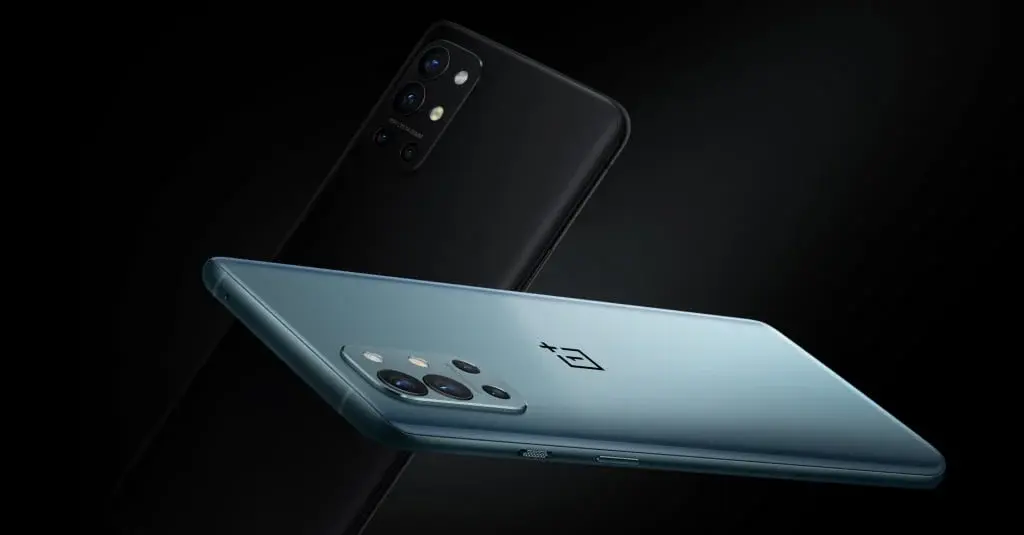
The new OxygenOS 14.0.0.601 update for the OnePlus 9R is being gradually rolled out. If you haven't received it yet, be patient—it’s released in phases and might take some time to reach your device.
The version released in India comes with the build number LE2101_14.0.0.601(EX01) and includes the June security patch, along with several major bug fixes in the user interface.
OnePlus 9R OxygenOS 14.0.0.601 Update Changelog
Adds a horizontal layout for the Lock screen clock.
Volume adjustment is now possible in Quick Settings.
Option to hide the track when drawing the Lock screen pattern to unlock your device.
Improves system stability.
Floating window size can now be adjusted by dragging its bottom; swipe up to close a mini window.
Integrates the June 2024 Android security patch to enhance system security.
This update for the OnePlus 9R introduces UI features that are already present on some other OnePlus devices. Essentially, this update brings new UI changes and the June security patch. For more details, visit the OnePlus Community.
The Moto G85 was recently seen on the TENAA certification site and is set to launch as the Motorola S50 Neo in China on June 25. Now, its global version has surfaced on China’s 3C certification site and a European retailer listing, revealing several key details. The Moto G85 is expected to be the successor to the Moto G84 5G.
Moto G85 Spotted on 3C and European Retailer
On the 3C certification site, the Moto G85 is identified by the model number XT2427-4 for the China variant of the S50 Neo. The global variant carries model numbers XT2427-2 and XT2427-3. According to the certification listing, the Moto G85 will support 33W fast charging, an upgrade from the 30W support on its predecessor. The charger is listed with model number MC-338, capable of speeds at 15W, 27W, 30W, and 33W during testing.
Meanwhile, the Moto G85 also appeared on a European retailer site. The device will be available in Gray, Olive, and Surf colors. It will be priced at EUR 349 for the 12GB + 256GB RAM and storage configuration.
Key Features and Specifications
The Moto G85 is anticipated to launch soon in global markets. Leaked renders of the smartphone show a curved display and a raised camera island on the back panel. The latter is expected to house 50MP and 8MP camera sensors, while a 32MP selfie camera will be featured up front. According to TENAA, the device will be powered by a 5,000mAh battery unit and is rumored to run on a Snapdragon 4 Gen 3 SoC. It will have a 6.6-inch FHD+ OLED display integrated with a fingerprint scanner.
OnePlus Nord 2T has received a new update today, integrating the June security patch. The Nord 2T was introduced by OnePlus in May 2021, originally launching with Android 12. As a result, the major Android updates for this model have now concluded.
Update Details
OnePlus had committed to providing 2 years of significant Android updates and 3 years of security patches for the Nord 2T. While the Nord 2T won’t receive further Android version updates, it will continue to get security patches for another year, given that it’s now June 2024. This latest update is primarily focused on security enhancements. According to a post on the OnePlus Community, the OxygenOS 14.0.0.605 update is currently being rolled out for Indian devices (Update version: CPH2401_14.0.0.605(EX01)).
Availability
The update is initially available in India and is expected to reach more regions shortly. If users encounter any issues following the update, OnePlus recommends reporting them by dialing *#800#.
Huawei’s homegrown operating system, HarmonyOS, is seeing swift growth in China. Launched in 2019 as an alternative to Android following U.S. sanctions that limited access to Google’s mobile OS, HarmonyOS now boasts the second-largest market share in China at 17%.
This surpasses Apple’s iOS, which holds a 16% share, while Google’s Android remains the leader with a 68% share. Huawei’s rapid rise in its home market seems to be prompting a shift in its strategy toward app developers.
Potential Commission Fee
Currently, Huawei does not charge developers for using its HarmonyOS platform. However, a new Bloomberg report suggests that the company is contemplating a 20% commission fee on app revenue.
Charging developers a commission is a common industry practice. Companies like Apple and Google charge between 15% and 30%. Huawei has not yet made an official statement regarding this potential change.
Hardware-Driven Success
Huawei’s recent achievements have been more hardware-focused than software-centric. The company’s smartphone business has seen significant growth since the launch of the Mate 60 series last year, which featured in-house Kirin chips with 5G capabilities despite ongoing U.S. sanctions.
Their latest flagship, the Pura 70 series, also quickly sold out upon its April release. This resurgence appears to be impacting Apple’s market share in China, according to market research data. Looking ahead, Huawei is anticipated to unveil the Mate 70 between September and October.
HarmonyOS NEXT
The Mate 70 is expected to be the first Huawei phone to feature the stable version of HarmonyOS NEXT, which will completely drop support for Android apps. HarmonyOS NEXT is currently in the testing phase, with recent reports indicating that the Developer Preview 2 offers better animation effects than Android.
It remains to be seen whether Huawei will officially implement the rumored commission fee and how developers will react to this shift in the HarmonyOS ecosystem.
Motorola is gearing up to unveil its latest foldable phones, the Razr 50 and Razr 50 Ultra, on June 25th. However, European retail listings have already disclosed the pricing details for these upcoming devices.
The Razr 50 will be offered in Orange, Grey, and Sand color variants. The entry-level version, which comes with 8GB of RAM and 256GB of storage, will be priced at €899.
Premium Model Details
For those in search of a higher-end foldable, the Razr 50 Ultra will be available at €1,199. This premium model will be available in Green, Blue, and Peach and will feature 12GB of RAM along with 512GB of internal storage.
Motorola Razr 50 and Razr 50 Ultra Specifications
The Razr 50 Ultra is anticipated to come with a 4-inch wide cover display and a 6.9-inch inner OLED display, replacing the LTPO AMOLED screens from previous versions. The primary display will boast a resolution of 1272×1080 pixels.
Under the hood, the Ultra model will be powered by the Snapdragon 8s Gen 3 processor, offering RAM options ranging from 8GB to 18GB and storage choices from 128GB to 1TB. It will also sport a 3800mAh battery. In terms of cameras, the Razr 50 Ultra will feature two 50MP sensors on the back and a 32MP front-facing camera.
The standard Motorola Razr 50 will also have a 6.9-inch inner display but will come with a smaller 3.6-inch outer screen. It will be powered by the MediaTek Dimensity 7300X chipset.
This model will include a dual-camera setup with a 50MP and a 13MP sensor on the rear, along with a 32MP front camera. It will be equipped with a 4200mAh battery supporting 33W fast charging.
Since the last few days, CMF has been hinting at the release of its next set of devices. Now, the Nothing sub-brand has officially announced the launch date. Additionally, CMF has confirmed that the Buds Pro 2 and Watch Pro 2 will debut alongside the Phone 1. The Buds Pro 2 and Watch Pro 2 are set to succeed their predecessors from last year. Meanwhile, the CMF Phone 1 will be the brand’s inaugural smartphone. Continue reading for the launch details.
CMF Phone 1, Buds 2, Watch Pro 2 Launch Date Announced
The upcoming CMF devices will be unveiled at the next Nothing Community Update event. The event is scheduled for July 8, at 10 am (2:30 pm IST). All three devices, including the Phone 1, Buds Pro 2, and Watch Pro 2, will be available on Flipkart in India.
The latest teasers continue to emphasize the sub-brand’s distinctive rotating dial on the new products. However, we speculate that the CMF Watch Pro 2 might feature a circular dial as opposed to the square one on its predecessor. Further details about the wearables remain undisclosed.
CMF Phone 1 Specifications and Pricing
Key details about the CMF Phone 1 have already leaked. It is rumored to be more affordable than the Nothing Phone (2a), with a box price of Rs 19,999. The phone will feature the sub-brand’s signature Orange color with a leather texture back panel and a Matte Black variant. It is expected to sport a 6.7-inch 120Hz display. Internally, it is tipped to be powered by a Dimensity 7200 SoC, coupled with 8GB RAM and up to 256GB storage. The device may come with a 5,000mAh battery unit supporting 33W fast charging.
Motorola has introduced its latest flagship smartphone, the Edge 50 Ultra, to the Indian market following its global unveiling. This new device is now the most premium model in the Edge 50 series, which also includes the Edge 50 and Edge 50 Pro. Here’s a detailed look at the specifications and pricing of the Motorola Edge 50 Ultra in India.
Motorola Edge 50 Ultra Specifications
One of the standout features of the Edge 50 Ultra is its unique rear panel option made of real wood, which also emits a pleasant fragrance. Additionally, it comes in vegan leather finishes available in Peach Fuzz and Forest Grey colors.
The phone sports a 6.7-inch Super 1.5K (1440p) pOLED display with HDR10+ certification. This screen supports a billion shades of color with 100% DCI-P3 color space and offers a smooth 144Hz refresh rate. Gamers will benefit from the 360Hz touch rate in gaming mode. The display can reach up to 2500 nits in brightness and is also certified for HDR 10+.
The device boasts robust build quality, featuring a front made of 3D Corning Gorilla Glass Victus and frames crafted from sandblasted aluminum. It is also IP68 water-resistant, providing protection against dust and water ingress.
Performance and Camera
Powered by the latest Snapdragon 8s Gen 3 processor, the Edge 50 Ultra runs on Android 14. It is equipped with 12GB of LPDDR5X RAM, which can be expanded virtually, and 512GB of UFS 4.0 storage.
The camera setup includes four sensors on the back: a 50MP main sensor, a 50MP ultrawide with macro vision, a 64MP telephoto with 3x optical zoom, and a laser autofocus sensor. For selfies, there’s a 50MP front camera with AI features. Audio is managed by dual stereo speakers with Dolby Atmos tuning and three microphones.
Battery and Connectivity
The phone’s 4500mAh battery is rated for over a day’s use (up to 40 hours) and can be rapidly charged with a 125W TurboPower adapter, which claims to deliver a full day’s charge in under 7 minutes. It also supports up to 50W wireless charging and 10W wireless power sharing.
Security features include an in-display fingerprint reader, face unlock, ThinkShield for business-grade security, and Moto Secure for extra protection. Connectivity options include a USB Type-C port, Bluetooth 5.4, Wi-Fi 7, and NFC.
Price and Availability
The Motorola Edge 50 Ultra is priced at Rs 59,999 in India for the sole variant with 12GB RAM and 512GB storage. With launch discounts and bank offers, the price can be reduced to Rs 49,999. The first sale is scheduled to begin on June 24th, 2024.
Qualcomm is gearing up for its annual Snapdragon Summit, slated for late October 2024. As always, the event will highlight the next-generation flagship processor – the Snapdragon 8 Gen 4.
The 8 Gen 4 represents more than just a typical incremental upgrade for Qualcomm’s flagship SoCs. The company is completely redesigning this chip, including its fundamental architecture. So, what can we expect from the upcoming Snapdragon 8 Gen 4? Here’s a summary of the details we’ve gathered so far on what Qualcomm has in store for its next-gen mobile SoC.
Oryon Cores for Mobile SoC
One of the major changes in the Snapdragon 8 Gen 4 is the shift from Cortex to Qualcomm’s self-developed Oryon CPU cores. These Oryon cores are the same ones used in the company’s latest Snapdragon X Elite and X Plus PC chips. However, it’s unlikely the current computing-focused Oryon cores will be used in mobile devices. Instead, a scaled-down version of these Oryon cores will likely be featured, though it’s unclear how much Qualcomm will cut down the design.
Core Architecture
The Snapdragon 8 Gen 4 is expected to be built on a 3nm process using TSMC’s N3E node. Compared to the 4nm process of the Snapdragon 8 Gen 3, the 3nm node allows for more transistors in the same chip area, resulting in better performance and efficiency. The smaller transistors should, in theory, consume less power when performing the same tasks compared to the 4nm process. However, these advancements will likely come at a cost. Analyst Ming-Chi Kuo predicts a 25-30% price increase for the 8 Gen 4 compared to its predecessor, which means phones powered by the new SoCs will also be more expensive.
Beyond the changes in architecture and node, the core structure of the Snapdragon 8 Gen 4 is also expected to change. The Snapdragon 8 Gen 3 used a 1+3+4 cluster design, featuring one high-performance core, three mid-range cores, and four efficiency cores. The Snapdragon 8 Gen 4 is expected to switch to a 2+6 design, eliminating the efficiency cores altogether. It will reportedly feature two high-performance Oryon cores clocked at 4.26 GHz, along with six Cortex-A725 cores at 2.8 GHz. MediaTek first adopted this approach of not including efficiency cores with its Dimensity 9300 last year, and Qualcomm appears to be following suit.
GPU
The Snapdragon 8 Gen 4 is expected to feature a new Adreno GPU, possibly the Adreno 830. While details about this graphical unit are scarce, it is expected to use a new Slice GPU architecture and new technology to improve “GPU utilization,” which will deliver overall better performance.
Early Benchmarks
What do these changes bring in terms of actual performance? The Snapdragon 8 Gen 4’s primary competitor will likely be Apple’s A-series chip, expected to power the iPhone 16. Early leaks suggest the 8 Gen 4 might match the A18 in single-core performance and potentially surpass it in multi-core tasks. It reportedly achieved around 3000 for single-core and 10,000 for multi-core performance, easily surpassing the iPhone 15 Pro and Galaxy S24 Ultra scores. The Snapdragon 8 Gen 4 has also been reported running AnTuTu, where it scored 1,769,083 points. This score is lower than expected for the Snapdragon 8 Gen 4 but that could possibly be due to optimization issues.
Snapdragon 8 Gen 4 Phones
Early reports suggest that the Xiaomi 15 series will likely be the first smartphone to feature the Snapdragon 8 Gen 4 processor. This comes as no surprise, given Xiaomi’s track record of adopting Qualcomm’s latest flagship SoCs. Following Xiaomi, the OnePlus 13 and iQOO 13 series are expected to follow suit. Xiaomi’s sub-brand Redmi is also reportedly working on a Snapdragon 8 Gen 4 phone, likely from the Redmi K80 series. Moreover, it’s likely that the Samsung Galaxy S25 series, Samsung Galaxy Z Fold 7, Samsung Galaxy Z Flip 7, and Sony Xperia 1 VII will also adopt the new Snapdragon 8 Gen 4 chip, following in the footsteps of their predecessors which use the current-gen Snapdragon 8 Gen 4.
Conclusion
Qualcomm is introducing several new features with the 8 Gen 4, including completely new Oryon CPU cores, an architecture without efficiency cores, and TSMC’s advanced 3nm node process. These advancements are expected to improve the performance of flagship phones in 2025. However, consumers will have to wait for independent reviews and real-world testing before making a final judgment on the Snapdragon 8 Gen 4. Whether it delivers a true leap forward or becomes a power-hungry powerhouse disguised in a bulky chassis remains to be seen.
Vivo officially announced the Vivo T3 5G model in India earlier this year. Now, the brand is apparently expanding the T3 series in the region with a new smartphone. This upcoming device is the Vivo T3 Lite, which is an upcoming budget phone with 5G support. So let’s have a look.
Vivo T3 Lite: What do we know so far
According to a 91Mobiles report, the Chinese brand is gearing up to launch the Vivo T3 Lite in India soon. As the name suggests, the ‘Lite’ hints that it is a budget phone. Industry sources close to the matter also added that the launch date should be revealed soon. Reportedly, this new device will be the brand’s most affordable 5G smartphone and will have a price tag under 12,000 INR (roughly 144 US Dollars).
Vivo T3 5G first launched in India back in March 2024
In other words, it will likely cost around 11,999 INR. The report also confirmed some of the key specifications of the Vivo T3 Lite. The phone will be equipped with the MediaTek Dimensity 6300 SoC. This is the same chipset that powers the Realme N65, which is another budget grade handset. For optics, the Vivo T3 Lite is expected to feature a 50-megapixel Sony AI primary camera that will likely be paired with a secondary sensor.
Expected Launch and Design
Unfortunately, this was all the information that was shared regarding this device. Although we can expect more details to surface soon. Based on the new leak, the Vivo T3 Lite is set to launch in the region around the end of this month. The device would sit right below the base Vivo T3 and may feature some similarities in terms of design. So stick around for more as we will be providing updates when more information is available regarding this matter.
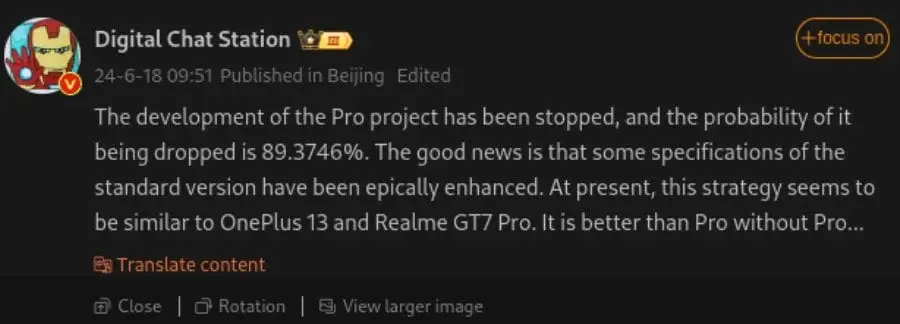
iQOO’s next flagship series may undergo a notable strategic change. Renowned tech insider Digital Chat Station on Weibo has indicated that the development of the iQOO 13 Pro variant seems to have been terminated.
Digital Chat Station mentioned, "The development of the Pro project has been stopped, and the probability of it being dropped is 89.3746%." This translates to a high chance that the iQOO 13 Pro will not launch alongside the regular iQOO 13.
Enhanced Standard Version
However, there is good news for iQOO enthusiasts. The tipster also shared, "The good news is that some specifications of the standard version have been epically enhanced." This implies that the focus might now be entirely on the iQOO 13, with its features receiving significant upgrades.
This isn’t the first instance of rumors regarding the cancellation of the Pro model in the iQOO 13 series. The same source has mentioned this in previous reports (1, 2), reiterating that the Pro variant may not debut this year. We’ve also explored potential reasons for discontinuing the Pro model in another report, which you can read here.
Expected Specifications
It remains to be seen how much of a performance boost the standard model will get, but the absence of a Pro variant suggests iQOO is confident that the base model can hold its own against competitors.
Rumors suggest that the device will feature a flat OLED display with 2K resolution. The screen is also expected to include an ultrasonic fingerprint scanner for biometrics. Furthermore, the device might offer up to 16 GB of RAM and up to 1 TB of storage. It could come equipped with a 6,000mAh battery supporting 120W fast charging. There is a possibility that the iQOO 13 will launch in November of this year.